

China Resources Pharmaceutical Exits Tianmai Biotech After Decade-Long Investment, Offloading Stake for RMB 1.93 Billion
CR PHARMA COMM
Pharmaceutical Circulation Service Provider
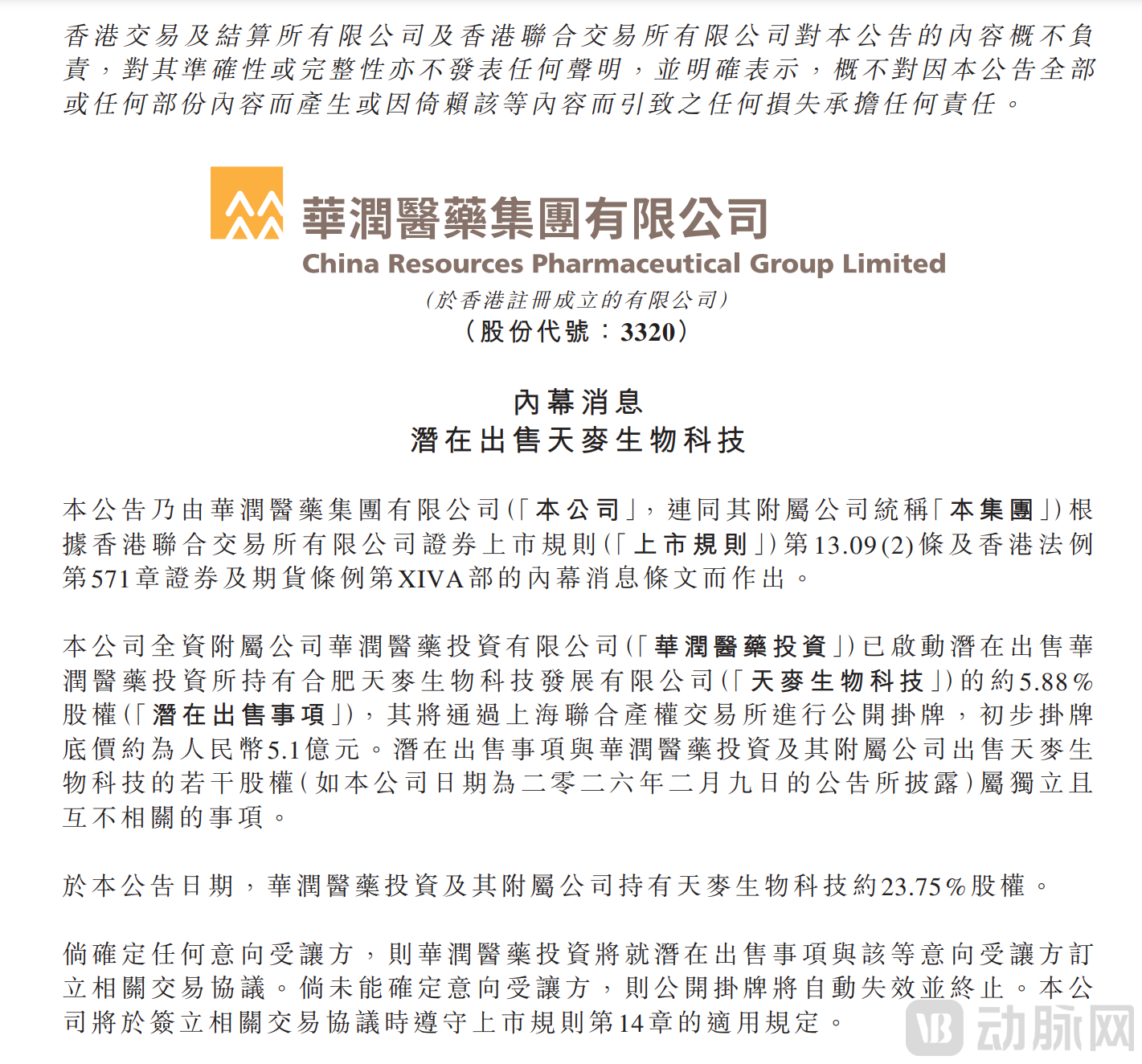
Recently, CR PHARMA COMM (03320.HK) announced that its wholly-owned subsidiary, China Resources Pharmaceutical Investment, intends to list for transfer approximately 5.88% equity interest in Hefei Tianmai Biotechnology Development Co., Ltd. at a reserve price of about RMB 510 million. This marks the second time within just over a month that CR PHARMA COMM has disposed of its stake in Tianmai Biotechnology. In February 2026, CR PHARMA COMM listed a 17.87% equity interest for transfer at RMB 1.42 billion. These two transactions are independent, with the combined reserve prices totaling RMB 1.93 billion.
Should both transactions be successfully completed, the China Resources (CR) group will completely exit Tianmai Bio, bringing an end to a strategic investment that has lasted nearly a decade. From its high-profile equity stake in 2016 and joint efforts to expand the insulin market, to its current departure, CR PHARMA COMM’s withdrawal reflects not only the failure of Tianmai Bio’s core innovative pipeline but also the broader strategic reshaping within the CR group—and state-owned pharmaceutical platforms at large—from “adding assets” to “divesting non-core holdings.”
1Ten-Year Oral Insulin Strategy Hits the Pause Button
As the domestic insulin market entered its golden period of development, CR PHARMA COMM and Tianmai Bio formed a strategic alliance.
In 2016, the number of diabetic patients in China continued to rise, driving strong demand for insulin as a core therapeutic agent. At that time, the potential for domestic companies to capture market share through import substitution was widely viewed favorably. Against this backdrop, CR PHARMA COMM strategically invested in Tianmai Biologics in December of the same year, becoming its largest shareholder. The two parties signed an agreement to jointly develop recombinant human insulin and related technology platforms.
At that time, Tianmai Biologics was already a key player in China’s insulin sector. In its early stages, the company invested in building a high-standard insulin production base, positioning itself for the research and development and manufacturing of recombinant human insulin products. In 2013, it completed the construction of large-scale production workshops, and in 2018, its recombinant human insulin injection was officially launched nationwide. The equity investment by CR PHARMA COMM not only provided capital support to Tianmai Biologics but also leveraged its advantages in pharmaceutical distribution and channel layout to boost the market promotion of the latter’s products.
However, when CR PHARMA COMM chose to partner with Tianmai Biologics that year, its primary interest lay not in the already-listed insulin biosimilars, but in the oral insulin drug developed by Tianmai Biologics using technology licensed from the Israeli company Oramed Pharmaceuticals (hereinafter referred to as “Oramed”)—namely, Recombinant Human Insulin Enteric-Coated Capsules (ORMD-0801). Compared with traditional injectable insulin, the non-invasive nature of oral insulin can significantly lower the barrier to treatment and improve patient adherence, giving it strong competitiveness in the multi-billion-dollar market for insulin and its analogs. This was once regarded by the market as Tianmai Biologics’ core “innovation story” and the fundamental basis supporting its high valuation.
In December 2025, a notice issued by the National Medical Products Administration (NMPA) revealed that ORMD-0801, submitted for marketing approval by Tianhui Bio, an affiliate of Tianmai Bio, had not been approved for launch. This means that the commercialization process in the Chinese market for this highly anticipated oral insulin formulation—the first of its kind to seek marketing approval globally—has been put on hold.
In fact, the failure of ORMD-0801 was not without warning. As early as January 2023, Oramed announced that its Phase III clinical trial of an oral insulin capsule for the treatment of type 2 diabetes failed to meet both primary and secondary endpoints. Specifically, the ORA-D-013-1 study enrolled a total of 710 patients to evaluate the efficacy of ORMD-0801 (8 mg once or twice daily) versus placebo. However, the results showed that the drug did not significantly reduce patients’ glycated hemoglobin (HbA1c) or fasting blood glucose levels.
Subsequently, Oramed decided to terminate the global clinical development program for this drug in the field of type 2 diabetes. Although Tianmai Biotech continued to advance its marketing authorization application based on independently completed clinical trial data in China, differences between domestic and international trial protocols in aspects such as patient disease status and dosage regimens ultimately led to failure in passing the review by the National Medical Products Administration.
The demand for oral insulin is substantial, primarily because it promises to eliminate the pain and discomfort associated with traditional injectable insulin, thereby improving patient adherence. It enables physiological drug delivery (directly to the liver), which aligns more closely with the body’s natural metabolism than injections do. This approach not only holds the potential to reduce the risks of hypoglycemia and weight gain but also allows for earlier therapeutic intervention to preserve pancreatic islet function.
However, for oral insulin to become a clinical reality, it must overcome the barriers posed by its unique physicochemical properties and the human digestive system. As a protein hormone, insulin is rapidly digested and degraded by gastric acid and pepsin. Furthermore, its large molecular weight makes it difficult to penetrate the intestinal wall and enter the bloodstream. In addition, precise control of the oral dosage is challenging, which can easily lead to unstable absorption and even an increased risk of hypoglycemia.
Although research efforts such as the use of enteric-coated capsules and nanotechnology have attempted to overcome these barriers, subcutaneous injection or pump infusion via specialized devices remains the mainstream clinical approach at present, and the large-scale clinical application of oral insulin still faces significant challenges.
Globally, Novo Nordisk invested $3.6 billion in the development of oral insulin before ultimately announcing its termination in 2016; Pfizer’s inhaled insulin, Exubera, was withdrawn from the market just one year after launch, resulting in a $2.7 billion loss. It is therefore no small feat for Tianmai Biotech to have advanced ORMD-0801 to the pre-launch stage.
2Why Did China Resources Choose to Exit at This Time?
No decade-long partnership ends for a single reason. CR PHARMA COMM’s withdrawal appeared to be triggered by the sudden setback in the launch of oral insulin, but the underlying logic is far more complex—driven jointly by technical risks, shifts in market dynamics, and a reset of strategic priorities.
When CR PHARMA COMM took a stake in Tianmai Biologics in 2016, the company’s oral insulin was still in the early stages of clinical development. Its technological prospects offered significant potential but were accompanied by extremely high uncertainty. For large state-owned pharmaceutical enterprises, such high-risk innovative investments are inherently exploratory in nature—betting on the future and playing the odds.
Now that ORMD-0801 has encountered clinical setbacks, the value of its core assets has diminished, necessitating a reshaping of the company’s overall valuation logic. CR PHARMA COMM’s decision to exit at this juncture is, to some extent, a rational response to the “realization” of technological risks.
Nevertheless, even without the breakthrough of oral insulin, Tianmai Bio’s position in the traditional insulin market warrants reevaluation. Over the past decade, China’s insulin sector has undergone a dramatic shift from a blue ocean to a red ocean.
On the one hand, with the rise of domestic companies such as Gan & Lee Pharmaceuticals and Tonghua Dongbao, the pricing structure of insulin products has been reshaped. The continuous advancement of national centralized volume-based procurement (VBP) for insulin has led to a significant decline in product prices, ushering the industry into an era of thin margins. On the other hand, the market landscape has become entrenched. Multinational giants such as Novo Nordisk and Sanofi firmly dominate the high-end market segment, leveraging their first-mover brand advantages and physicians’ prescribing inertia. For late entrants lacking brand premium and unable to compete on economies of scale, the challenges of competition have increased substantially.
For CR PHARMA COMM, the strategic returns from continuing to provide financial support to companies operating in red ocean markets have become increasingly limited.
From the perspective of CR PHARMA COMM, the listing reserve price of RMB 1.93 billion, if successfully transacted, will generate a substantial inflow of cash. The allocation of these funds also offers significant strategic possibilities.
The strategic priorities of the China Resources (CR) group are now clear: first, to focus on core businesses and strengthen the foundation of its key listed platforms; second, to plan for the future by securing positions in frontier sectors through industrial funds. CR Sanjiu’s continued deepening presence in the Consumer Healthcare (CHC) sector, and CR PHARMA COMM’s Chengdu Industrial Fund’s investments in innovative drugs and medical devices, both point in the same direction—concentrating resources in areas with greater certainty and growth potential. From this perspective, the exit from Tianmai Biologics represents a strategic reallocation of resources, proactively freeing up capital and management attention to invest in sectors that offer stronger synergy with core businesses and clearer growth trajectories.
3Leading Pharmaceutical Companies Accelerate Streamlining Efforts
Another background that cannot be overlooked is that 2025 marks the concluding year of the action plan for deepening and enhancing state-owned enterprise (SOE) reforms. The State-owned Assets Supervision and Administration Commission’s (SASAC) performance assessment of central SOEs based on the “one profit, five ratios” framework, along with its mandate to divest from “non-core and non-competitive businesses,” has created clear policy-driven pressure.
Against this backdrop, within the China Resources (CR) conglomerate, CR PHARMA COMM’s exit from Tianmai Biologics is merely one instance among multiple divestitures. Over the past year, the group has intensively streamlined its pharmaceutical assets: Dong-E-E-Jiao listed its equity stake in Sinopharm Holding Jinan Co., Ltd. for transfer; CR Sanjiu consecutively transferred shares in several subsidiaries; and CR Boya Bio sold Jiangxi Boya Xinhe Pharmaceutical... Behind these moves lies the rigid constraint on asset efficiency imposed by state-owned enterprise (SOE) reforms. Consequently, minority investments with weak synergy to core businesses, ongoing losses, or uncertain prospects have naturally become subjects of scrutiny. As 2025 marks the concluding year of the Action Plan for Deepening and Enhancing SOE Reforms, accelerating the divestment of non-core and non-competitive businesses has become an irreversible trend.
For CR PHARMA COMM, a company born and raised through mergers and acquisitions (M&A), the past strategy primarily involved acquiring promising pharmaceutical projects to rapidly fill sectoral gaps and expand its industrial chain footprint. However, it is now shifting from “addition” to “subtraction,” beginning to divest non-core assets and exit inefficient businesses.
For CR PHARMA COMM, the better option is to invest capital and energy in areas with stronger synergy with its core business and higher certainty of growth. For Tianmai Biologics, as the major shareholder exits and the development of its core products changes, the urgent issues to be addressed are the advancement of its subsequent pipeline and commercialization implementation—and this will mark the beginning of another story.