

Jilin University to Transfer Postoperative Urination Assistance Device Patent for RMB 560,000
Recently, Jilin University issued a public notice on technology transfer, proposing to transfer the patent“A Postoperative Urination Assistance Device for Patients Using Nursing Beds”The patent rights are transferred to Hefei Zhichan Technology R&D Co., Ltd. through negotiated pricing, with a contract transaction amount ofRMB 560,000。
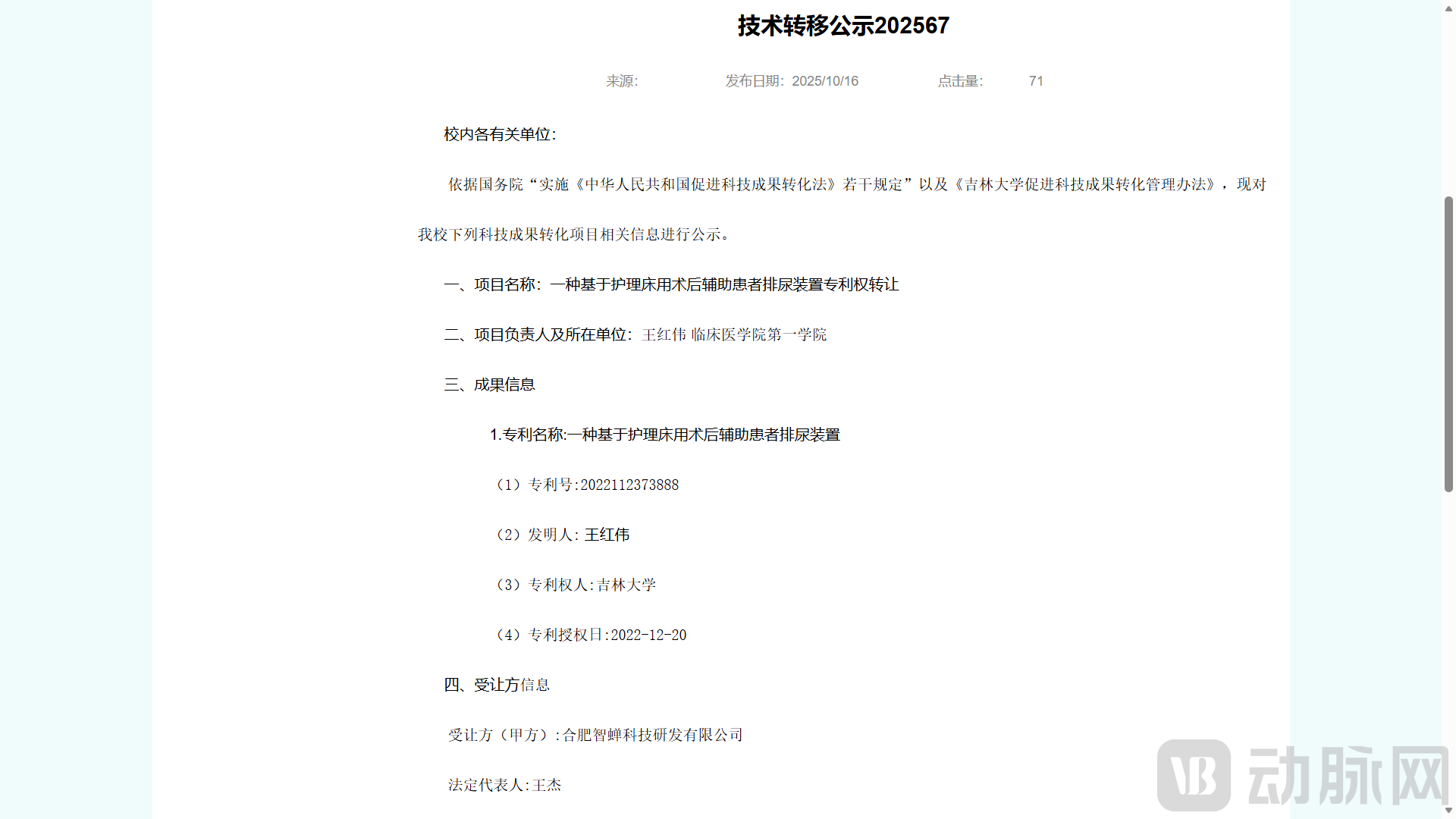
Image from the official website of Jilin University
This patent is held by the First Clinical Medical College of Jilin UniversityWang HongweiR&D isA Postoperative Urination Assistance Device Designed for Nursing Beds, the core innovation lies inFolding, Pulleys, Transmission, and FixationFour Integrated Linkage Components Address Industry Pain Points in Traditional Nursing Beds, Such as the Inability of a Single Caregiver to Lift Patients During Assisted Voiding, Impaired Supine Defecation and Urination, and Inadequate Privacy Protection. This Innovation Enables an All-in-One Operation: Stepping on the Pedal Automatically Adjusts the Patient to a Sitting Position, Allows a Single Caregiver to Easily Lift the Patient’s Hips, and Deploys a Privacy Screen to Secure the Patient’s Posture. It Significantly Reduces Labor Costs While Markedly Improving the Smoothness and Comfort of Postoperative Urination and Defecation.
Postoperative Bed Rest-Associated Urinary DysfunctionIt is one of the common complications in postoperative surgical patients. Due to factors such as surgical trauma, anesthetic effects, and limited limb mobility, patients are unable to independently change positions or void urine and defecate in the short term after surgery. This loss of autonomous bladder and bowel function has become a routine challenge in postoperative clinical care, requiring full assistance from nursing staff for urination and defecation management, thus constituting one of the core components of postoperative basic nursing care.
Currently, the conventional clinical solution to this issue still relies on standard hospital beds, where caregivers manually place absorbent pads and bedpans for patients to assist with urination. The lack of dedicated assistive devices means this traditional nursing approach has numerous significant drawbacks:
First,Standard Nursing Bed Without Patient Lifting Mechanism, a single caregiver cannot independently place the underpad and bedpan beneath the patient’s buttocks; this task requires multi-person collaboration, which significantly increases labor costs in clinical care and reduces the efficiency of nursing operations.
Secondly,The patient remained in a supine position throughout, with the buttocks naturally closed and tightly sealed., which not only leads to difficulty in urination and defecation but also frequently results in urine adhering to the skin and excreta missing the bedpan. This increases the risk of pressure ulcers and skin infections while reducing patient comfort during care.
Third,Privacy protection measures are extremely rudimentary., merely using fabrics such as towels and bedding to simply cover the patient's private areas results in poor coverage, making privacy breaches highly likely. This causes psychological embarrassment and discomfort for the patient. Meanwhile, the covering materials are easily contaminated by excreta, thereby increasing the workload for nursing care and cleaning.
Based on this, there is an urgent clinical need for a specialized postoperative voiding assistance device compatible with nursing beds, which canEnables single-operator independent use, facilitates smooth patient voiding and defecation, while ensuring both privacy protection and nursing convenience., thereby addressing the numerous drawbacks of traditional nursing protocols and enhancing the professionalism and humanization of urinary care for postoperative bedridden patients.
This postoperative urinary assistance device for nursing beds addresses critical clinical pain points in postoperative care. Through a mechanically linked design featuring multi-component synergy, it achieves dual innovation in both technology and functionality. Compared to traditional postoperative urinary assistance solutions, it demonstrates disruptive advantages in operational convenience, nursing efficiency, patient experience, and safety. Its innovations are reflected in the deep integration of structural design, functional implementation, and clinical adaptability, with each technical design precisely aligned with the actual needs of clinical nursing.
This device features innovative R&DFoldable Component, relying onFirst Pusher Frame, Second Pusher Frame, and Connecting RodThrough coordinated linkage, the mechanism drives the headboard of the nursing bed to fold upward and the footboard to tilt downward via mechanical transmission, smoothly adjusting postoperative bedridden patients from a supine position to a sitting posture. This design aligns with the physiological anatomical features of human urination and defecation, fundamentally resolving issues such as impaired excretion due to tight gluteal closure in the supine position and the inability to accurately deposit waste into the bedpan, thereby significantly enhancing the fluency and comfort of patient elimination.
Meanwhile, Device InnovationEquipped with a pulley assemblyBy ingeniously applying the mechanical principles of pulley systems and integrating steel wire ropes with multiple sets of pulleys, caregivers need only exert a force equivalent to one-third of the patient’s body weight on the foot pedal. This action drives the steel wire rope via a pull rod, easily lifting the patient’s buttocks to a certain height. This innovation completely overcomes the traditional limitation in nursing care where a single caregiver cannot independently place underpads or bedpans, eliminating the need for multi-person assistance and significantly reducing clinical labor costs. Furthermore, the elevated position of the buttocks helps prevent urine from adhering to the patient’s skin, thereby reducing the risk of postoperative complications such as pressure ulcers and skin infections, and enhancing the professionalism of postoperative care.
Privacy Protection: Innovative Device DesignLinkage Mechanism Between the Transmission Assembly and the Privacy Shielding Structure, which links the flipping motion of the tailboard with the deployment of the shielding rod and shielding cloth. While the tailboard flips down to adjust the patient's position, the second transmission roller, transmission belt, and gears work in coordination to automatically lift the shielding rod and extend the shielding cloth, forming a closed shield over the patient's private areas. This replaces the rudimentary method of using towels or bedding for simple coverage in traditional nursing care, fundamentally preventing exposure of the patient's private parts, alleviating psychological embarrassment and discomfort during excretion, and effectively preventing the shielding material from being contaminated by excreta, thereby reducing the cleaning workload for nursing staff.
Furthermore, the device’s innovative design featuresThe fixation component features a flexible metal structure with fixation bumps and a multi-position slot design., under the action of the second spring, the locking rod can precisely engage with limit slots at different heights within the locking groove, thereby securely fixing the folding and lifting structures of the device. This prevents device loosening or patient tipping during seated excretion, significantly enhancing the stability and safety of the device during use and providing reliable protection for postoperative patients with debility.
Notably, the core innovation of this device lies in achieving“One single action triggers end-to-end workflow integration”By simply stepping on the pedal, caregivers can simultaneously accomplish four core functions: patient posture adjustment, hip elevation, privacy shielding, and structural stabilization. This design eliminates complex operational steps, resulting in an extremely low learning curve for caregivers. It is well-suited to the fast-paced and high-intensity nature of clinical nursing, truly achieving operational convenience and functional integration, thereby demonstrating strong market prospects.
Against the current market backdrop, the accelerating pace of population aging is driving a continuous expansion in care needs for individuals with disabilities and partial disabilities. Meanwhile, there is a growing demand in postoperative hospital care for efficient and user-friendly assistive devices. Concurrently, strong national support for the research and development of age-appropriate products and the upgrading of the elderly care service industry has created a favorable policy environment for the commercialization and promotion of nursing assistive devices.
Coloplast Two-Piece Urinary Ostomy Pouchis its core ostomy care product,Flagship Shengshu and Teshu Series, it is the mainstream nursing consumable for post-urostomy care, suitable for patients requiring long-term stoma care after procedures such as radical cystectomy, as well as some patients with severe urinary incontinence. This product features a two-piece design with separate baseplate and pouch. The baseplate utilizes hypoallergenic, high-adhesion adhesive to prevent leakage and reduce skin complications. The transparent pouch allows for easy observation of urine status, while its anti-reflux and anti-siphon structure helps prevent urinary tract infections. The pouch can be replaced independently, and the baseplate is reusable. Available in multiple specifications to meet individualized needs, the product is easy to use and can be self-replaced at home.
At the market level, Coloplast has secured a dominant position in the high-end segment of China’s urostomy care market, leveraging its technological expertise and strong brand reputation. It is the preferred choice for premium healthcare institutions and is widely utilized in relevant departments of Grade 3A hospitals, high-end elderly care facilities, and home care settings.
Pukang Nursing BedIt is Pukang Medical’s iterative masterpiece, deeply cultivated in the field of nursing beds, focusing onCare for Urination and Defecation in Bedridden Patients and Prevention of Pressure UlcersCore Requirements: This nursing bed is designed to address the key care challenges faced by postoperative patients and individuals with disabilities or partial disabilities who are bedridden. It comes standard with an opening for urinary and fecal elimination, and integrates relevant technologies to assist with turning and getting out of bed. The bed can be used in conjunction with a bedpan to facilitate elimination, thereby reducing the risk of pressure ulcers. The bed frame design balances practicality and safety, featuring guardrails, silent universal wheels, and one-touch braking. Both the bed surface height and support for various body parts are adjustable.
From a market perspective, leveraging Pukang Medical’s brand heritage and production capacity advantages, this nursing bed holds a significant position in the domestic nursing bed market. It is a standard procurement item for medical institutions and elderly care facilities at all levels, as well as a key choice for government medical equipment procurement and age-friendly renovation projects. Positioned as a mid-to-high-end nursing device, it is suitable for use in hospitals, elderly care institutions, and home-based care settings.