

Cofoe Medical Seeks 'A+H' Listing with HK IPO Filing: Annual Revenue Hits RMB 3.387 Billion, Babaka Emerges as Cash Cow

Cofoe
Intelligent Medical Device R&D, Production, and Sales Company
Five years after its listing on the A-share market, Cofoe Medical, a leading domestic player in home medical devices, has once again knocked on the door of the capital markets. On March 16, Cofoe Medical resubmitted its listing application to the Hong Kong Stock Exchange (HKEX), planning to issue H-shares and list on the Main Board. Previously, Cofoe Medical had made its initial filing with the HKEX on August 29, 2025.
Cofoe’s planned IPO in Hong Kong marks another significant capital move following its 2021 listing on the ChiNext Board of the Shenzhen Stock Exchange. If successful, the company will achieve a dual “A+H” listing, further enhancing its international brand influence and diversifying its financing channels. However, the A-share market reacted lukewarmly to the news, with shares rising by only 0.23% at the opening on the following day.
Amid intensifying competition and accelerating market consolidation in the medical device industry, does Cofoe’s second IPO filing represent a proactive strategic shift to solidify its market position, or is it an effort to accumulate resources for future global expansion?
1“BeiBeijia” Generates Annual Revenue of 500 Million Yuan
Back in 2007, Cofoe was merely a small medical device trading company in Hunan Province; today, it has grown into an “invisible champion” in China’s home-use medical device sector. Cofoe’s growth story serves as a microcosm of the development of China’s consumer healthcare industry. Unlike many medical device companies that rely on a single blockbuster product, Cofoe has pursued a differentiated strategy characterized by “comprehensive category coverage and integrated synergy.”
Over the past two decades, Cofoe has gradually built an advanced product matrix comprising more than 200 product categories and tens of thousands of product specifications. Its product portfolio focuses on five core segments:Rehabilitation aids, medical nursing, health monitoring, respiratory support, and traditional Chinese medicine physiotherapy—these categories cover nearly all scenarios of home-based medical and health management.
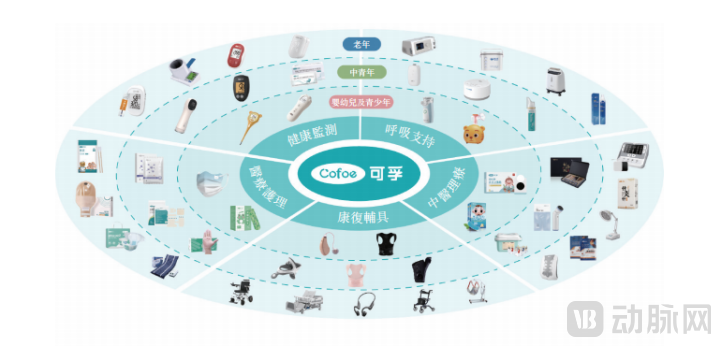
Cofoe Medical’s Product Line Coverage (Source: Cofoe Medical IPO Prospectus)
According to the Frost & Sullivan industry report, in terms of 2024 domestic revenue,Cofoe is the second-largest home medical device company in China., with a market share of 2.1%. Its position is even more prominent in niche markets: Cofoe ranks first in the home rehabilitation aids market, with a market share of 2.4%; in the posture correction belt market, Cofoe’s “Beibeijia” brand also ranks first, with a market share of 27.2%.
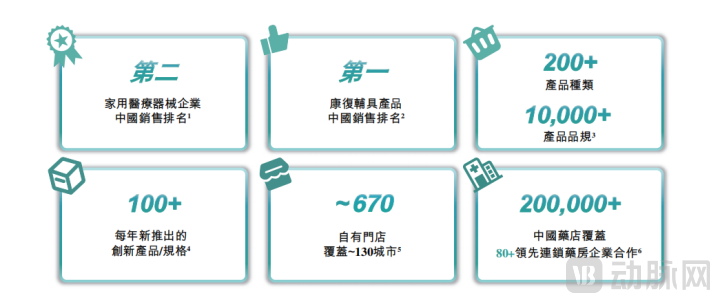
Image source: Cofoe Medical's prospectus
As a flagship product line under its portfolio, Cofoe Medical acquired “Beibeijia” in April 2022, operating it as an independent brand and expanding its target audience from adolescents to adults. In 2024, “Beibeijia” experienced a resurgence through live-streaming rooms on e-commerce platforms, becoming a “cash cow” for Cofoe Medical. Data from the Chanmama platform shows that on May 8, 2024, Beibeijia’s products ranked first in the live-streamed healthcare products category, with cumulative sales exceeding RMB 100 million over the preceding 90 days (the platform’s algorithm caps the displayed amount at RMB 100 million). According to the prospectus,In 2024, Cofoe’s posture correction products, including Beibeijia, generated annual revenue of RMB 500 million, capturing a market share of 27.2%, significantly higher than the second-place competitor’s 8.5% share.
Centered on a comprehensive product portfolio and leveraging both offline stores and online shops as its two major sales channels, Cofoe has become the preferred destination for consumers seeking one-stop solutions for home medical devices. On one hand, its proprietary brands, including “Cofoe,” “Jianer Hearing,” and “Beibeijia,” continue to deepen their market presence, supported by nearly 670 self-operated stores and partnerships with over 80 enterprises among the “Top 100 Chain Pharmacies.” On the other hand, its distributor network incorporates well-known third-party brands such as Philips, collaboratively building an offline network that covers all 31 provinces in China and reaches more than 200,000 retail pharmacies.
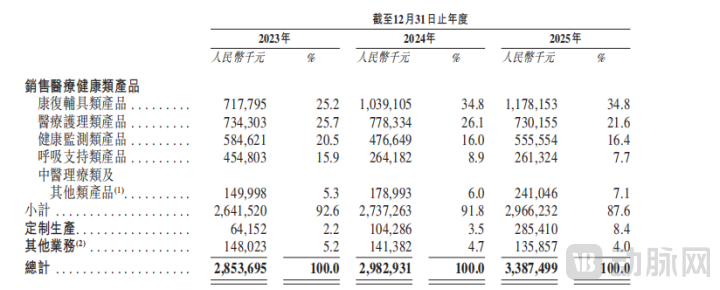
Cofoe’s Product Revenue Composition from 2023 to 2025 (Source: Cofoe Medical Prospectus)
From the perspective of product revenue structure, rehabilitation aids constitute Cofoe's largest revenue segment, achieving a 64.14% growth compared to 2023. This was primarily driven by its leading position in the market for high-value-added products such as hearing aids and electric wheelchairs.In 2025, rehabilitation assistive devices generated RMB 1.178 billion in revenue, accounting for 34.8% of the total.Meanwhile, the revenue share of respiratory support products (such as oxygen concentrators and ventilators), which made significant contributions during the pandemic, has declined as demand has normalized.
2Annual Revenue of RMB 3.387 Billion
As a home medical device company with stronger consumer attributes, Cofoe has established stable profitability.
During the reporting period from 2023 to 2025, the Company’s annual revenue grew steadily from RMB 2.854 billion to RMB 3.387 billion, representing a growth rate of 18.68%. Notably, operating revenue in the fourth quarter of 2025 reached RMB 990 million, a year-on-year increase of 34.79%. Over the same period, net profit rose from RMB 253 million to RMB 370 million, demonstrating a healthy growth trajectory.
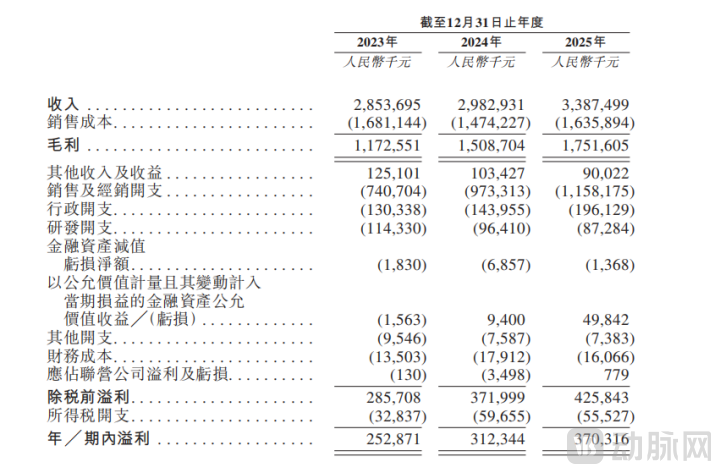
Cofoe Medical: Core Financial Summary (2023–2025) (Source: Cofoe Medical Prospectus)
In terms of profitability, the gross profit margin increased significantly from 41.1% in 2023 to 51.7% in 2025, primarily driven by product portfolio optimization and an increased proportion of high-margin rehabilitation assistive devices.
From a product segment perspective, the gross profit margin of rehabilitation assistive devices increased from 48.4% to 63.2%, that of medical nursing products rose from 47.6% to 52.6%, and that of health monitoring products climbed from 37.8% to 49.9%.
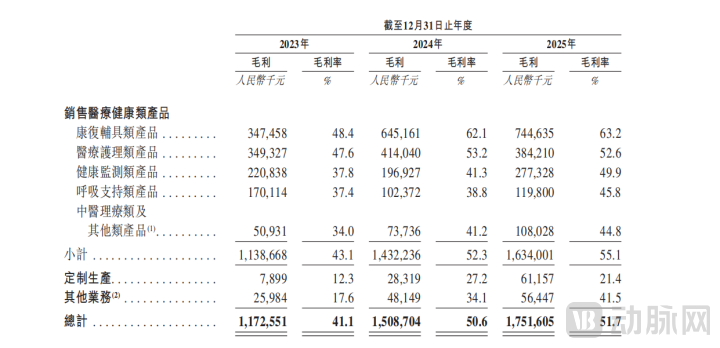
Source: Cofoe's prospectus
Data shows that Cofoe’s operating cash flow has remained consistently positive, reaching RMB 394 million, RMB 663 million, and RMB 696 million in 2023, 2024, and 2025, respectively, demonstrating the sustainable “cash-generating” capability of its core business.
3"Medical Technology" and "Consumer Market": A Dual-Pronged Approach
Although often categorized as a “non-pharmaceutical medical device” company, an analysis of Cofoe’s product strategy reveals that it has not slackened its efforts in technological innovation. This is particularly evident in the home medical device market, which places equal emphasis on both “medical technology” and “consumer market” attributes.
Cofoe has assembled an in-house R&D team of over 350 members and established three specialized research institutes focused on Medical Electronics and Rehabilitation Medicine, Biosensing and Innovative Materials, and Respiratory Support. As of the end of 2025, the company held 699 patents and launched multiple blockbuster products, including an AI-enabled IoT non-invasive ventilator capable of real-time pressure monitoring and automatic adjustment to correct sleep-disordered breathing events; dual-parameter test strips for precise blood glucose and uric acid detection within 10 seconds; and a new generation of bone-conduction hearing aids equipped with 12-nanometer chips and AI-driven scenario recognition algorithms.
On the supply side, Cofoe operates four major production bases in Changsha, Yueyang, Nantong, and other locations, adopting a hybrid “in-house manufacturing + OEM/ODM” model. This approach allows the company to focus its proprietary capacity on high-value-added products while expanding standard product capacity through more flexible means. Furthermore, its open smart logistics system not only serves internal needs but also provides third-party warehousing and distribution services to external clients, creating an additional revenue stream.
4Overseas Revenue Share Rises to 8.8%
Cofoe was listed on the ChiNext Board of the Shenzhen Stock Exchange in October 2021, with an initial public offering price of RMB 93.09 per share and net proceeds of approximately RMB 3.5 billion, once becoming a highly anticipated medical device IPO that year.
Compared with its “sprint” in the A-share market, Cofoe’s engagement with the Hong Kong stock market has not been smooth. On August 29, 2025, Cofoe Medical submitted an application for a main board listing to the Hong Kong Stock Exchange, but the process subsequently lapsed due to lack of further updates.
Following its listing on the A-share market, Cofoe Medical Technology Co., Ltd. increased investments in R&D, distribution channels, and production capacity using the funds raised, and implemented multiple strategic initiatives in the Hong Kong and Macao markets, including the acquisition of Ximanna Medical Systems (Hong Kong). By the end of 2025, Cofoe had more than 30 medical equipment retail centers, seven specialized podiatry clinics, and one external counterpulsation therapy center in operation in Hong Kong, laying a solid foundation for its entry into the Hong Kong market.
Compared with previous efforts, Cofoe Medical is better prepared this time. The prospectus shows that the company plans to use the funds raised from its Hong Kong listing for global expansion, continuous R&D, domestic sales channel expansion, brand promotion, and general working capital. According to the prospectus,Its global business footprint now spans more than 60 countries and regions across Asia, Africa, Europe, and the Americas. In 2025, its overseas revenue share rose to 8.8%, up from 1.7% in 2023.
It can be said that the push towards the more internationalized Hong Kong stock market serves as a signal of its intention to enhance overseas business expansion capabilities and optimize the efficiency of cross-border M&A capital operations. After stabilizing its domestic foundation, Cofoe Medical has clearly directed its next-stage core strategy towards international resource integration, leveraging the Hong Kong stock market as a "springboard."
5High Traffic Costs for Businesses Heavily Reliant on E-commerce
As China’s aging process accelerates, the vast elderly population is driving the emergence of a massive and promising silver economy. In this wave of development, elderly nutrition and chronic disease management have evolved from ancillary services into key breakthroughs for the entire sector.
Frost & Sullivan predicts that China’s home medical device market will grow from RMB 198.2 billion in 2024 to approximately RMB 300 billion by 2030, at a compound annual growth rate (CAGR) of 7.9%. As an industry leader, Cofoe is expected to capture a significant share of this market.
Nevertheless, there is no shortage of competitors vying for a share of the “cake.”
In China, although Cofoe currently ranks second in the industry, its market share stands at only 2.1%, reflecting the highly fragmented nature of the sector. A multi-dimensional competitive landscape has emerged, driven by diverse participants including domestic giants, multinational brands, and emerging technology companies. Furthermore, Cofoe’s market ranking remains relatively low in niche segments such as respiratory support and health monitoring.
Approximately one-third of Cofoe Medical’s revenue is derived from e-commerce platforms such as Tmall, JD.com, and Douyin. Persistently high marketing expenses are eroding the health of its business model. According to the company’s 2025 financial report, sales and marketing expenses reached RMB 1.158 billion, surpassing its total annual revenue in 2019. Of this amount, online promotion and service fees exceeded RMB 550 million. How long the company can sustain the trade-off between traffic acquisition and rising costs remains uncertain.
Currently, the domestic market for home-use medical devices has increasingly become a contest of “intelligence” and “personalization.” Keeping pace with technological iterations and shifting consumer preferences undoubtedly requires greater capital investment. Due to the strong consumer-goods nature of these products, their efficacy has instead become a limiting factor for repeat purchases. National-level brands represented by “Bei Bei Jia” have long remained at the center of discussions regarding the actual effectiveness of physical correction products.
Looking at the global market, Cofoe has listed overseas expansion as the primary use of its fundraising proceeds, with its overseas revenue share rising to 8.8% in 2025. However, challenges on its path to internationalization include the international trade environment, regulatory differences, localized competition, and the establishment of brand awareness and product distribution networks.
Precisely targeting the “home scenario + medical devices” sector, Cofoe has continued to exert efforts around its product portfolio strategy, focusing on the commercialization of technologically advanced products that can raise the standard of home care. Cofoe Medical has completed a full-category product ecosystem layout. This second listing in Hong Kong is a key step in building its “A+H” dual financing platform. If it can successfully open up domestic and international capital channels and effectively address the many challenges in the globalization process, Cofoe Medical may truly transform from a local leader into a home medical device brand with international influence.