

Tongji Hospital of Huazhong University of Science and Technology to Transfer Intra-spinal Ultrasound Probe for Spinal Endoscopy at RMB 202,000
Recently, Tongji Hospital affiliated with Tongji Medical College of Huazhong University of Science and Technology released a public notice on the transformation of scientific and technological achievements, proposing to transfer its “An Intraspinal Ultrasound Probe for Use in Endoscopic Spine Surgery”Patent assigned to Hunan Quanwei Medical Technology Co., Ltd. The assignment fee isRMB 202,000. The inventor of this patent isYang Shuguang, Tao Hong, Tian Xuebi, Mei Wei.
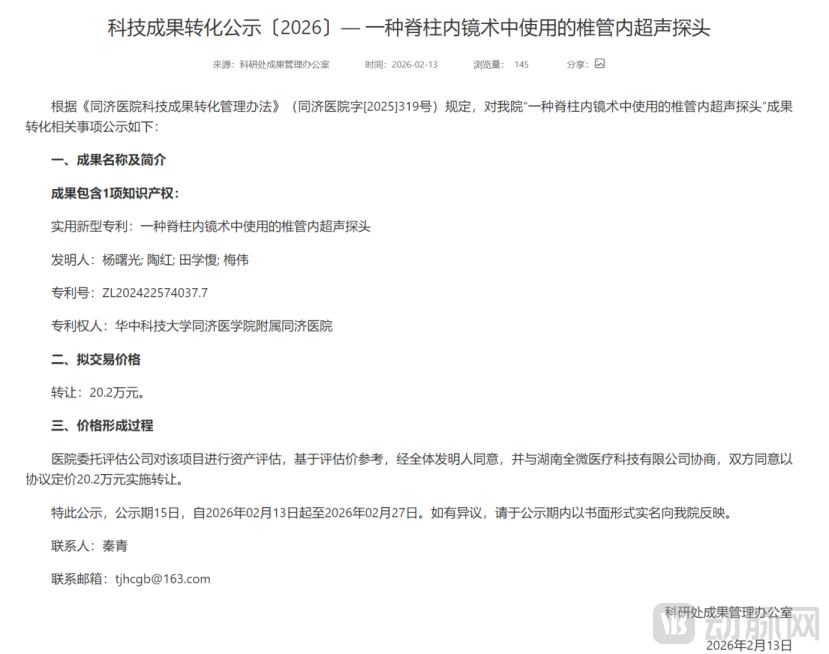
Image source: Official website of Tongji Hospital, Tongji Medical College, Huazhong University of Science and Technology
Endoscopic Spine Surgery isA Minimally Invasive Surgical Technique, a working channel is inserted into the spinal canal through a tiny skin incision, followed by the insertion of a spinal endoscope equipped with a light source and imaging system; corresponding surgical instruments are then introduced through the instrument channel of the endoscope,Indicated for the treatment of conditions such as herniated discs and spinal stenosis that are refractory to conservative therapy., alleviating limb pain and sensorimotor dysfunction in patients.
As a core technology for minimally invasive treatment of spinal disorders, endoscopic spine surgery is widely used in the clinical management of conditions such as herniated discs and spinal stenosis; however, in traditional endoscopic spine surgery,Lack of Dedicated Instruments for Intraspinal Structure Exploration: Clinical Practice Relies on Traditional Assessment Methods and General-Purpose Instruments, facing multiple pain points and dilemmas.
First,The identification of intraspinal canal structures lacks intuitive, real-time exploration methods, placing extremely high demands on the surgeon’s professional expertise and resulting in a steep learning curve.The anatomical structures within the spinal canal are complex, with nerve roots, the dural sac, and intervertebral disc tissues in close proximity. Furthermore, individual variations in anatomical structures exist among different patients, and some patients present with additional complications such as tissue adhesions, all of which increase the difficulty of structural identification. In traditional surgery, surgeons must rely on their solid foundational knowledge of anatomy, static preoperative CT/MRI imaging results, and clinical experience accumulated over many years to perform three-dimensional mental reconstruction and subjective judgment. This approach is used to identify target structures within the spinal canal and differentiate between normal and pathological tissues. However, this method lacks real-time intraoperative visual support. For novice physicians, it is difficult to rapidly establish spatial awareness within the spinal canal, making them highly prone to errors in identifying tissue structures. Consequently, this significantly increases the risk of severe intraoperative complications, such as nerve injury and dural sac rupture.
Second,Intraoperative localization lacks precise reference standards, leading to overreliance on radiological imaging, which not only prolongs surgical duration but also introduces additional risks of radiation exposure.. When surgeons are uncertain about the anatomical course or the location of pathological tissue during a procedure, or need to confirm the placement of surgical instruments, they often require repeated X-ray imaging for localization and verification. This iterative process of image acquisition and analysis complicates the surgical workflow, prolongs operative time, and increases the burden on patients due to prolonged intraoperative immobilization. Furthermore, repeated X-ray exposures elevate the radiation dose received by both the surgical team and the patient.
Third,Lack of Quantitative Basis for Surgical Procedure Assessment, during the removal of herniated disc material and nucleus pulposus, the extent of resection can only be determined based on experience and preoperative assessment,Difficult to Achieve Precise Control, excessive resection can accelerate lumbar degeneration, while insufficient resection fails to achieve effective decompression. Furthermore, conventional general-purpose ultrasound probes, due to issues with size and structural design, are incompatible with the working channels of endoscopic spinal instruments and cannot perform effective exploration within the aqueous environment of the spinal canal.
The patented intraoperative intraspinal ultrasound probe for spinal endoscopy, successfully commercialized in this initiative, precisely targets the clinical pain points of traditional spinal endoscopic surgery through targeted innovative design. It demonstrates prominent advantages in both technical architecture and clinical application, offering multifaceted technical benefits and significant clinical value.
In terms of structural design,The probe consists of the ultrasound probe body, connecting tube, ultrasound probe head, integrated connecting cable, and information transmission device., the connecting tube is a 10°-40° curved tube, the probe body has a diameter of ≤4mm and is compatible with 3.5mm-4.0mm endoscopic instrument channels, allowing smooth insertion into the spinal canal through the spinal endoscope operating port; the connecting tube and the ultrasound probe body are made of biocompatible materials such as carbon fiber and alloy metals, and the integrated connection cable is made of soft and tough materials such as silicone,Balancing operational adaptability and biosafety.
In terms of functional implementation, the ultrasound probe head can emit 10–14 MHz ultrasound waves in a 180° circular pattern, clearly displaying the tissue structures within the spinal canal at a depth of up to 4 cm.It can accurately identify and localize structures such as intraspinal nerve roots, the dural sac, and herniated disc material, enabling non-invasive, radiation-free intraoperative real-time exploration.
In terms of operational design, the integrated connection cable has a length of 0.5 m to 5 m and is available in multiple specifications. The cable is equipped with an anti-slip grip handle and features length markings with the probe body as the zero reference point.Facilitates the operator in adjusting the probe position through maneuvers such as advancement, retraction, and rotation, thereby ensuring precise control over the insertion depth., significantly enhancing operational convenience.
In clinical applications, after the probe is inserted into the aqueous environment of the spinal canal, it can rapidly localize tissue structures,Accelerate surgical procedures and effectively avoid complications such as nerve and dural injuries,It also provides an intuitive basis for evaluating the volume of nucleus pulposus resection,Precise Determination of Surgical Endpoints, thereby enhancing the safety and efficacy of spinal endoscopic surgery.
There are many competing products in the current market for spinal endoscopy accessory exploration and operating instruments adapted to clinical minimally invasive diagnosis and treatment scenarios, such asGerman SPINENDOS Full-Spine Endoscopy System,As the core product of a global professional supplier of minimally invasive endoscopic spinal surgery systems, it features a comprehensive portfolio covering lumbar, cervical, and thoracic endoscopes. The system offers diverse surgical approaches, including a proprietary interlaminar approach technique, with indications spanning various spinal disorders such as herniated discs, spinal stenosis, and spinal tuberculosis.
“An Intraspinal Ultrasound Probe for Use in Endoscopic Spinal Surgery“Utility model patent technology demonstrates significant market advantages in the niche scenario of endoscopic spine surgery, serving as a dedicated instrument for intraspinal canal exploration during endoscopic spine procedures,”Fills the market gap caused by the lack of real-time intracavitary ultrasound detection capabilities in existing spinal endoscopy systems., with strong compatibility and high adaptability. Meanwhile, compared to imported supporting instruments for spinal endoscopy, this patented product relies on a localized R&D and production model,Possesses a Significant Cost Advantage, better aligning with the procurement and clinical needs of primary healthcare institutions in China, thereby offering greater potential for market penetration. Furthermore, the product’s design balances ease of use with precision, effectively reducing the complexity of surgical procedures and shortening the learning curve for operators.Better aligned with the clinical practice realities of hospitals at all levels in China。
At present, the incidence of spinal diseases in China is showing a gradual upward trend, with a continuous increase in the number of patients suffering from degenerative spinal conditions such as intervertebral disc herniation and spinal stenosis.Clinical Demand for Minimally Invasive Spine Surgery Continues to Rise; Meanwhile, with the continuous advancement of healthcare resource decentralization, primary healthcare institutions have become important application scenarios for minimally invasive spinal treatments.Grassroots Hospitals Have an Urgent Need for Minimally Invasive, Safe, and Cost-Effective Surgical Instruments, thereby providing significant application space for the market adoption of specialized instrumentation for spinal endoscopy.