

Johnson & Johnson's C2 Aero IVL Catheter Achieves 98.6% Procedural Success Rate and 24% Reduction in Treatment Time in Pivotal Clinical Trial
Recently, at the “Latest Breakthrough Clinical Trials (LBCT)” session of the Cardiovascular Research Technologies Conference (CRT 2026) in the United States, Professor Matthew J. Price’s team announcedEarly Clinical Data on Shockwave Medical’s Next-Generation Coronary Intravascular Lithotripsy (IVL) Catheter, C2 Aero, the corresponding results were also published simultaneously in the leading cardiovascular journal JACC: Cardiovascular Interventions.
Data shows that this product not only doubles the therapeutic pulse frequency, but also achieves a 98.6% surgical success rate in 145 patients.
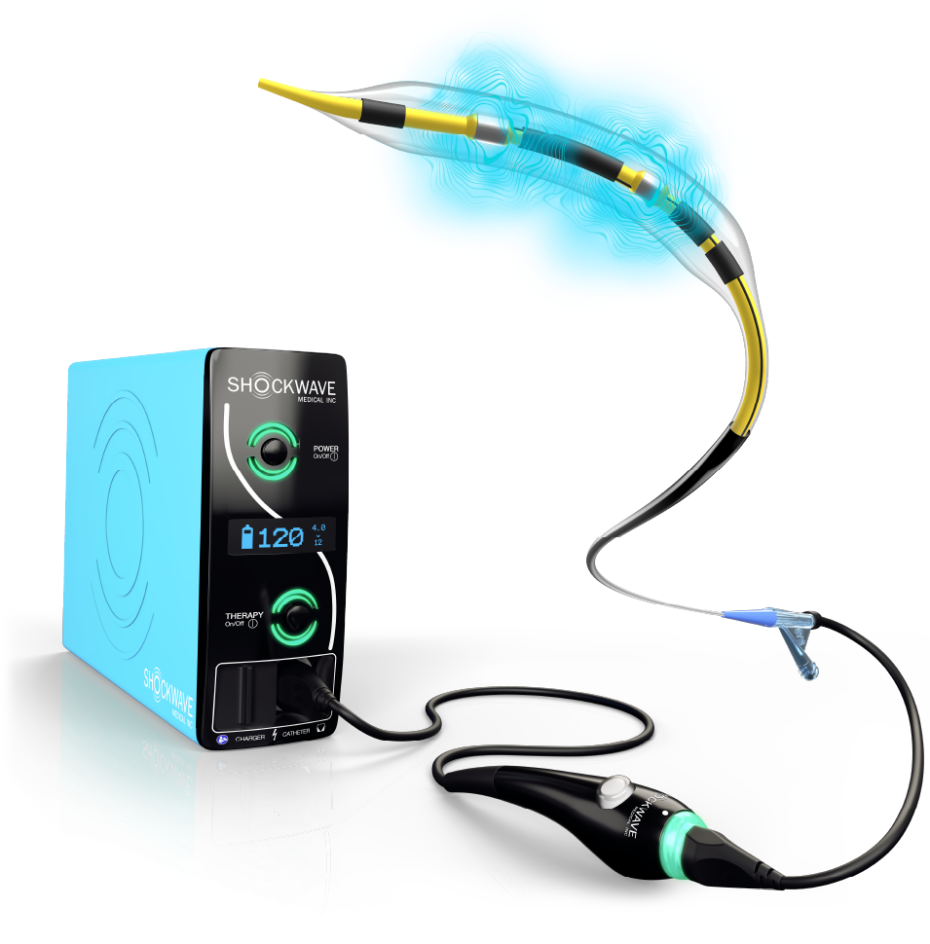
Shockwave C2 Aero Model Schematic
1From 1Hz to 2Hz, IVL Truly “Accelerates” for the First Time
As a breakthrough technology for the treatment of vascular calcification, Intravascular Lithotripsy (IVL) selectively fractures calcified plaques using acoustic pressure waves emitted from a balloon catheter. It has previously become a clinical “game-changer” by virtue of its advantages of “precise targeting without damaging soft tissue.”
The new-generation Shockwave C2 Aero catheter has undergone systematic optimization to address pain points in clinical practice. According to the official website, the design objectives of the C2 Aero directly target“Easier to deliver, easier to navigate, easier to reposition, more efficient”。
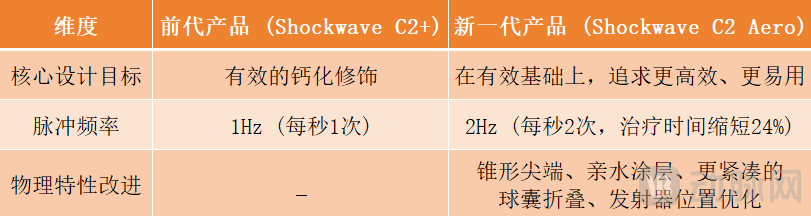
C2+ vs. C2 Aero: A Comparison Across Three Key Dimensions
Core Highlight: Doubled Pulse Efficiency
Traditional coronary IVL catheters operate at a pulse frequency of 1 Hz (one pulse per second). In contrast, the C2 Aero, through technological iteration,First increase in pulse frequency to 2 Hz, achieving the delivery of 10 pulses within 5 seconds, thereby doubling treatment efficiency.
Higher pulse frequencies enable adequate modification of calcified plaques in a shorter time, leading to two key breakthroughs:Balloon repressurization time reduced by 50%, and overall treatment time shortened by 24%.
For hemodynamically unstable patients, shorter balloon inflation times result in less myocardial ischemia, providing operators with a critical window for rescue interventions; for routine procedures, they translate to improved catheterization laboratory turnover efficiency and potentially reduced radiation exposure for both patients and medical staff.
Notably, the “speed” of the C2 Aero is not achieved at the expense of precision. According to official information, the emitter position has been shifted 1 mm forward compared to the previous generation, ensuring equal distances from each emitter to its respective radiopaque marker ring, thereby optimizing the uniformity of energy distribution. Meanwhile, the balloon can refold more compactly after inflation, facilitating precise adjustments by the operator as needed.
These improvements point to the same goal: further enhancing the “controllability” of IVL in complex lesions.
2Validation in 145 High-Risk Patients: Not Only Fast, but Also “Stable”
In the interventional field, where speed is paramount, safety remains an inviolable red line. To validate the efficacy and safety of its new platform, Shockwave conductedMulticenter Clinical Trial: Disrupt CAD DUO IDE Study。
The study enrolled a total of 145 patients, with a mean age of 70.5 years; 30% had comorbid diabetes mellitus, the mean lesion length was 27.7 mm, and the mean calcification length was 39.6 mm, characterizing a typical high-risk population with complex anatomy. To assess whether increased procedural speed affects efficacy, the study specifically incorporated a propensity-matched cohort from the Disrupt CAD III trial (which evaluated the previous-generation 1-Hz catheter) for a non-inferiority comparison.
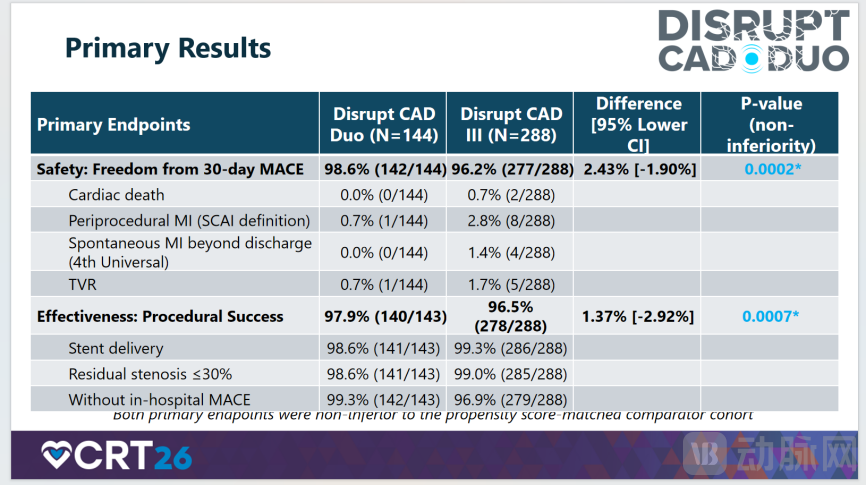
Primary Results of the Disrupt CAD DUO IDE Trial
Against the backdrop of such complex lesions, the new-generation 2-Hz IVL catheter has delivered an impressive performance:
● Validity Verification: Up to 98.6% of patients underwent successful surgery and experienced no adverse cardiovascular events during hospitalization. This indicates that the vast majority of patients navigated the perioperative period smoothly, while treatment efficiency doubled.
● Safety Verification: The rate of patients free from major adverse cardiovascular events and without the need for target vessel revascularization within 30 days postoperatively was 97.9%.
●Non-inferiority Verification: Compared with a matched cohort treated with the earlier 1-Hz IVL system, the next-generation 2-Hz platform met the non-inferiority criteria for the primary endpoint, confirming that the increased pulse rate did not compromise efficacy.
The research team specifically noted that although the incidence of IVL-induced ventricular capture increased slightly after the frequency was raised (occurring in approximately 66% of procedures in the study), no clinically significant hypotension or malignant arrhythmia events were observed in this study.
Furthermore, there was no significant difference in the total number of pulses delivered by the operator between procedures with and without ventricular capture, indicating that this phenomenon did not hinder the normal implementation of IVL therapy. This confirms that the new-generation high-frequency technology maintains a favorable safety profile while accelerating treatment.
Furthermore, Professor Price presented 6-month follow-up results at CRT 2026, providing further evidence of the mid-term safety of the new technology. The data showed a cumulative MACE rate of 3.6% (driven primarily by one additional myocardial infarction and two target vessel revascularizations), with no cardiac deaths reported.
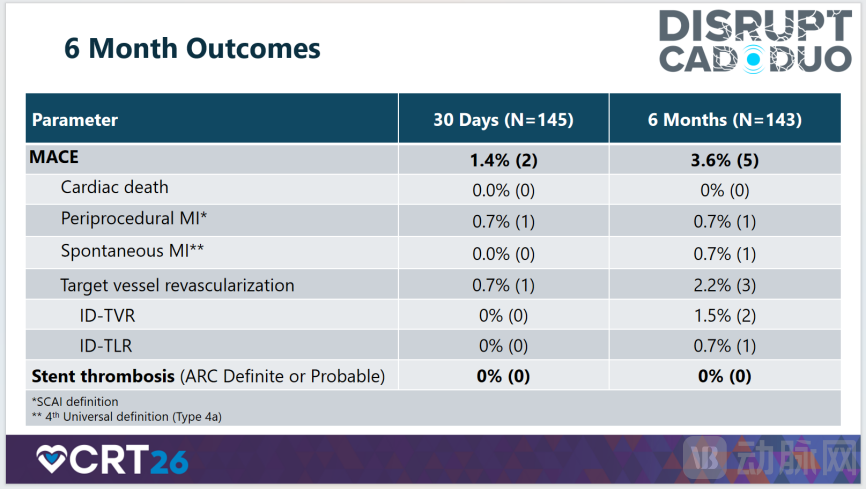
6-Month Results of the Disrupt CAD DUO IDE Trial
3Providing a Superior Solution for Complex Calcified Lesions
Coronary calcification is regarded as a “tough nut to crack” in interventional therapy. Although traditional techniques such as rotational atherectomy can recanalize the vessel, they require a high level of technical expertise and carry a risk of distal embolization.
Since being hailed as the “terminator” of calcified lesions in the 2021 Chinese Expert Consensus on the Diagnosis and Treatment of Coronary Artery Calcified Lesions, intravascular lithotripsy (IVL) technology has become a powerful tool for managing complex lesions such as deep calcification and calcified nodules. This is attributed to its unique mechanism—“rigid against hardness, compliant against softness”—which selectively fractures calcified plaques via sonic pressure waves without damaging soft tissue.
The advent of the 2-Hz catheter enables operators to achieve results as reliable as those with the 1-Hz catheter at a faster pace, which holds potential value for improving procedural turnover and reducing patients’ radiation exposure time.
With Shockwave Medical now part of Johnson & Johnson, its pace of innovation in the cardiovascular intervention field is accelerating further. From the initial C2 to the widely adopted C2+, and now to the C2 Aero with doubled efficiency, Shockwave has continuously consolidated its leading position in the treatment of calcified lesions through iterative advancements in materials science and engineering design.
In the future, as long-term follow-up data from the Disrupt CAD DUO study are gradually released, this technology-driven “acceleration” of IVL catheters may redefine the standard workflow for treating complex calcified lesions.