

Chengdu University of Traditional Chinese Medicine to Transfer Patented Shoulder Rehabilitation Device for CNY 900,000
Recently, Chengdu University of Traditional Chinese Medicine released a public notice on patent transfer, proposing to transfer its“A Rehabilitation Exercise Disc for Frozen Shoulder”The patent rights were transferred to Chengzhong Yunkang (Chengdu) Health Technology Co., Ltd. through negotiated pricing, with a transaction amount of900,000 yuan。
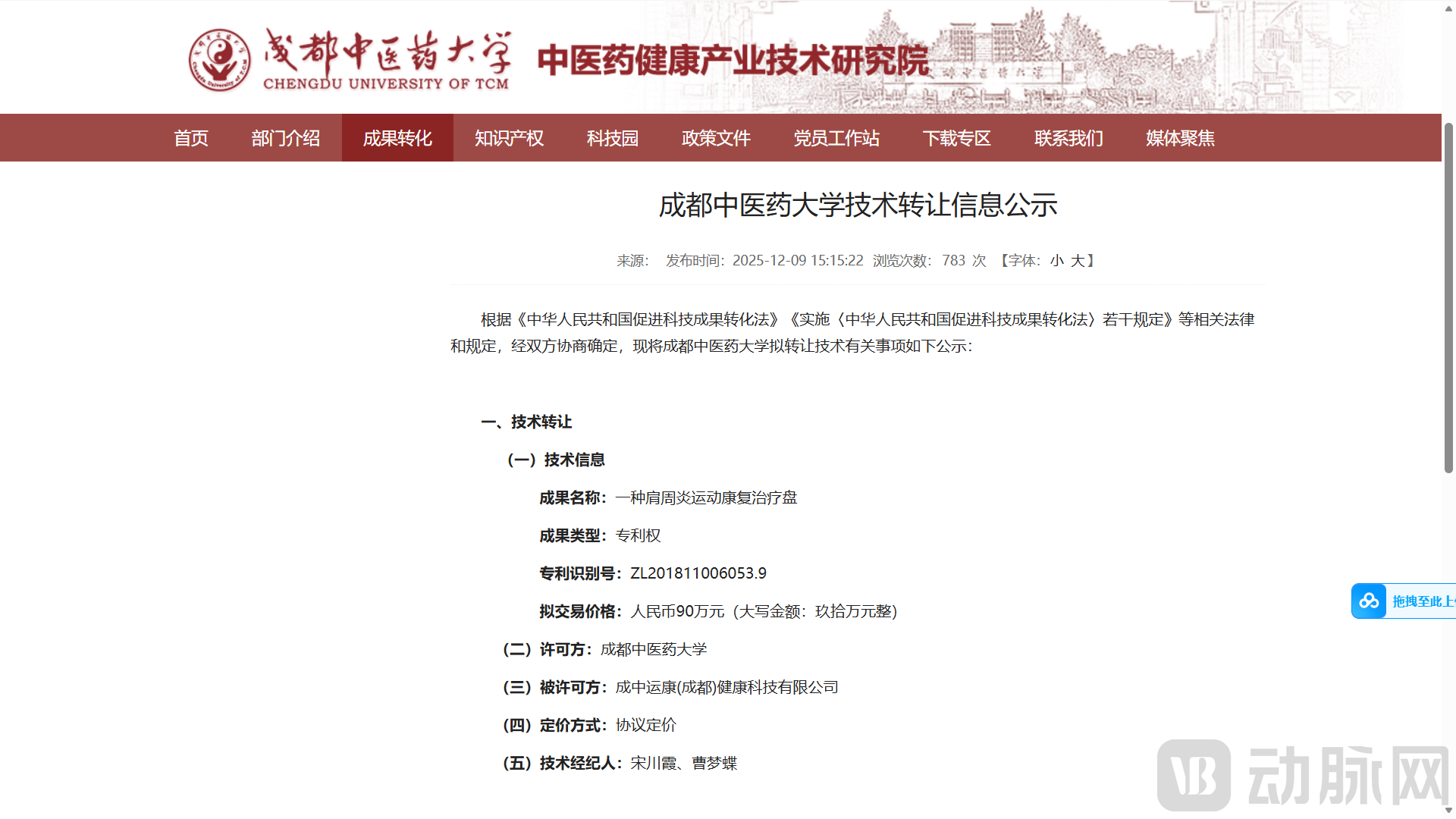
Image from the official website of Chengdu University of Traditional Chinese Medicine
This patent isSpecialized Rehabilitation Medical Devices for Frozen Shoulder, it can meet the rehabilitation training needs throughout the entire course of frozen shoulder, including the acute, freezing, and thawing phases. It enables a variety of targeted rehabilitation exercises, such as multi-directional shoulder joint movements and specific rotator cuff muscle training. Additionally, resistance can be flexibly adjusted according to patients' training requirements, providing an adaptable tool for physical rehabilitation in individuals with frozen shoulder.
Periarthritis of the ShoulderIt is a prevalent condition among the elderly, also known as "adhesive capsulitis," "frozen shoulder," or "condensing shoulder." Its core pathological feature involves adhesions and other lesions in the tissues surrounding the shoulder joint, leading to shoulder pain and limited range of motion, with most patients experiencing widespread tenderness in the shoulder region. As a chronic osteoarticular disorder, periarthritis of the shoulder is not merely a single joint injury but a comprehensive pathology affecting the soft tissues around the shoulder joint, including muscles, ligaments, and bursae. Consequently, its rehabilitation requires targeted functional exercises to gradually release adhesions and restore joint mobility.
Rehabilitation training for frozen shoulder still faces multiple challenges in clinical practice; on the one hand, due to the influence of the condition itself,The patient has a significantly limited range of motion in the shoulder joint, accompanied by persistent pain and widespread tenderness., most patients are unable to independently and effectively perform standardized rehabilitation exercises; even with the willingness to undergo physical therapy, they struggle to complete basic training movements on their own; on the other hand,Patients with frozen shoulder are particularly sensitive to gravity.The core principle of rehabilitation training is to strictly control external pressure on the shoulder joint, with exercises progressing gradually from light to heavy intensity. However, the lack of simple practical standards and adaptive tools for this professional requirement makes it difficult for patients to precisely control the intensity and range of motion during self-directed training. This often leads to aggravated joint injury due to improper technique, while also hindering the effective implementation of clinical rehabilitation guidance in home-based settings.
Currently, clinical treatment for frozen shoulder mainly adoptsPharmacological and Physical TherapyTwo methods. Among them,Pharmacological treatment involves the administration of analgesics.as the main focus, this approach can only temporarily alleviate shoulder joint pain through pharmacological effects, without fundamentally releasing joint adhesions or restoring joint function, thus constituting a symptomatic rather than curative measure. Moreover, the likelihood of disease recurrence is high after discontinuation of medication, long-term use may lead to drug dependence, and it can also cause various adverse effects, including gastrointestinal discomfort and increased metabolic burden on the liver and kidneys.
Physical Therapy Combined with Functional ExercisesIt is another clinically proven effective approach for the rehabilitation of frozen shoulder; however, its implementation lacks adequate equipment support. The rotary wheel-type shoulder rehabilitation devices commonly used in current clinical practice have inherent design flaws. First, these devices cannot overcome the gravitational force of their own connecting rods and rotating wheels, thereby imposing an additional load on the patient’s already vulnerable shoulder joint during training, which may easily cause secondary injury. Second, the devices lack resistance adjustment functionality, making it impossible to modulate training resistance according to the patient’s rehabilitation stage and physical tolerance. With frozen shoulder“From mild to severe, step by step”contradicts the core principles of rehabilitation, making it difficult for this protocol to meet the personalized rehabilitation needs of patients at different stages of disease.
This exercise-based rehabilitation therapy device for frozen shoulder is designed around the professional requirements of frozen shoulder rehabilitation training. It achieves multiple targeted innovations in structural and functional design, creating a specialized apparatus tailored to the rehabilitation needs of patients with frozen shoulder. First,Innovatively adopts a layout featuring a disc-shaped main body paired with multi-ring concentric circular slide rails, adaptable to varying ranges of motion and exercise requirements; fixed mounting holes are provided on the back of the disc body, supporting multiple installation methods such as wall mounting, ceiling suspension, and floor placement, thereby meeting positioning needs for diverse training scenarios. Secondly,Design of a Detachable Multi-Weight Handle Structure, allowing for flexible replacement of handles with different weights based on rehabilitation progress to achieve precise adjustment of training resistance. Thirdly,Optimize the Fit Between the Slider and the Guide Rail, the slide rail adopts an inverted “T”-shaped structure; hemispherical grooves are machined into the bottom surface and side walls of the slider to accommodate matching balls, thereby replacing direct friction with rolling contact and significantly reducing resistance during slider movement. Fourthly,Add a combination structure of fixed pulleys and adjustable straps at the center of the disc body, expanding the implementation pathways for various training exercises such as passive shoulder elevation. Fifth,Innovative Ergonomic Handle Design, further enhancing flexibility and adaptability in use.
Meanwhile, this patent also demonstrates multiple advantages in practical applications, precisely addressing the pain points associated with traditional rehabilitation equipment. First,High Adaptability Across the Entire Disease Course, through the combined design of sliding rails and fixed pulleys, it can cover the training needs across all stages of frozen shoulder—acute phase, frozen phase, and thawing phase—meeting the full-spectrum rehabilitation requirements from non-resisted passive training to full range-of-motion (ROM) resisted training. Second,Eliminates additional instrument load, during training, the patient only needs to overcome the weight of the slider and handle, without having to counteract the gravity of the connecting rods and pulleys inherent in traditional equipment. This design aligns with the heightened sensitivity to gravity observed in patients with frozen shoulder, effectively preventing secondary injury to the shoulder joint during exercise. Third,Controllable training resistance with easy adjustment, training resistance can be precisely controlled by replacing handles of different weights, strictly adhering to the core principle of rehabilitation training that progresses gradually from light to heavy. Fourth,Easy to Operate and Assemble, patients can independently replace accessories and adjust the length based on training exercises. It is suitable for clinical rehabilitation guidance in medical institutions and also meets the needs of patients conducting autonomous rehabilitation training at home, offering wide applicability across various scenarios.
As a common clinical osteoarticular disorder, frozen shoulder is primarily characterized by shoulder pain and limited range of motion. Its rehabilitation treatment must address multiple dimensions, including exercise therapy, symptom relief, and traction, while being tailored to the individual patient’s physical condition and stage of disease. In response to clinical pain points, several domestic research and development institutions have developed specialized rehabilitation devices for frozen shoulder, ranging fromIntelligent Training, Pain Relief, Sports Rehabilitation, Traction Assistanceand other areas to provide solutions for patients.
These rehabilitation devices for frozen shoulder are designed around the actual recovery needs of patients, covering key aspects of the rehabilitation process such as training, relief, and traction. With distinct yet complementary functionalities, they provide diverse rehabilitation options for patients at different stages of the disease and with varying physical conditions. Furthermore, they offer clinically relevant practical insights for the research and development of rehabilitation medical equipment, promoting the evolution of frozen shoulder treatment devices toward greater precision and human-centric design.