

Henan Cancer Hospital Licenses Innovative Laparoscopic Trocar with Sealing and Antibacterial Functions to Tuoren Holding Group for RMB 500,000 Plus Sales Royalties
Recently, Henan Cancer Hospital released a public notice on the transformation of scientific and technological achievements, indicating that the hospital intends to transfer, through an exclusive license,"Laparoscopic Surgery-Specific Trocar"The relevant patents have been assigned to Tuoren Holding Group Co., Ltd., with a transfer fee of RMBRMB 500,000 Milestone Payment + Sales Royalties. The inventor of this patented technology isZhang Bin and His Team。
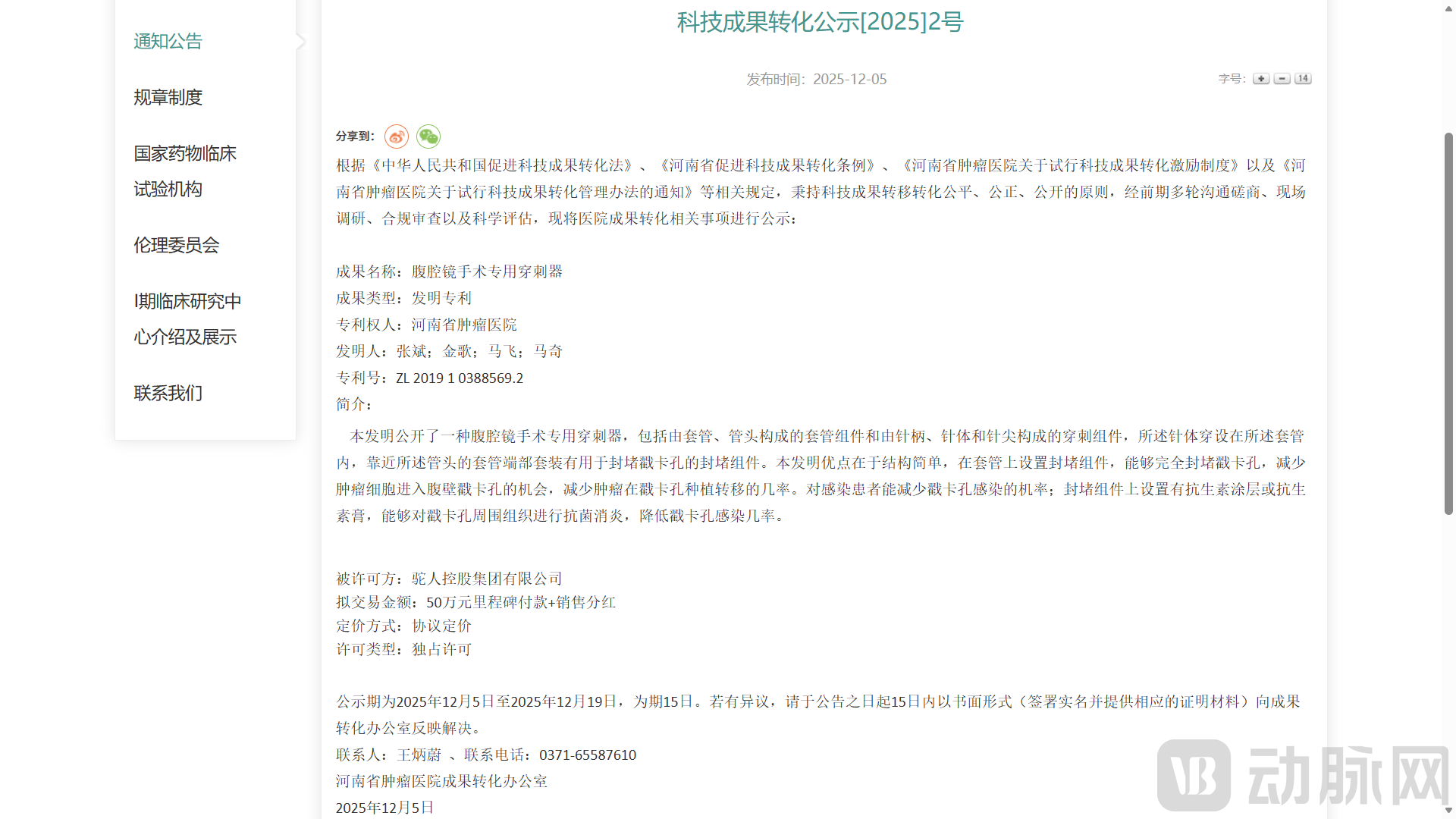
Image from the official website of Henan Cancer Hospital
The assignee of this patent isTuoren Holding Group Co., Ltd., is a comprehensive enterprise specializing in the medical device sector. The company focuses on the research and development, manufacturing, and sales of medical consumables and related medical devices, with business coverage spanning multiple sub-sectors including anesthesia, nursing, minimally invasive intervention, and medical protection. It also engages in related activities such as technological R&D, achievement commercialization, consulting services, and industrial support, thereby establishing an integrated business model encompassing R&D, production, and services.
This laparoscopy-specific trocar technology is designed forSpecialized Medical Device Technology Addressing Design Defects of Traditional Trocars in Laparoscopic Minimally Invasive Surgery, with the core beingLaparoscopic Trocars with Enhanced Sealing, Antibacterial, and Anti-Inflammatory Functions, addresses the gap between trocar ports and cannulas during surgery, reducing the risk of tumor seeding metastasis and port-site infections; it is applicable to laparoscopic minimally invasive surgeries for urological tumors such as gallbladder cancer, cholangiocarcinoma, and rectal cancer.
Laparoscopic Minimally Invasive SurgeryIt is a core approach in the clinical diagnosis and treatment of surgical oncology, widely used in surgeries for gallbladder cancer, cholangiocarcinoma, colorectal cancer, and other urologic tumors. Its advantages of minimal invasiveness and rapid recovery have significantly improved surgical outcomes and postoperative patient experience.TrocarAs a core instrument in laparoscopic surgery, it is key to establishing the surgical access channel for minimally invasive instruments to enter and exit the abdominal cavity; its performance directly affects surgical safety and patient prognosis.
However, traditional laparoscopic trocars currently used in clinical practice have structural design flaws, leading to prominent pain points associated with trocar site-related complications:There is a natural gap between the trocar cannula and the abdominal wall port site., intraperitoneal tumor cells and air can easily invade the tissue spaces around the trocar ports through this gap; meanwhile, the gap also provides conditions for bacterial proliferation, becoming a significant predisposing factor for tumor seeding and wound infection.
Defects in the use of such trocars pose multiple hidden risks to both tumor surgery patients and clinical diagnosis and treatment: for tumor patients, trocar ports become “channels” for tumor cell implantation and metastasis. According to clinical literature, the incidence of tumor implantation at trocar sites after laparoscopic minimally invasive gallbladder cancer surgery is as high as14%~29%, the rate of tumor seeding at trocar sites in colorectal cancer also reaches0.69%~3.3%Iatrogenic tumor seeding can significantly exacerbate the patient's condition, increase the difficulty of subsequent treatment and medical costs, and severely affect the patient's survival prognosis; meanwhile, trocar port sites are prone to postoperative infection, especially in patients with pre-existing infection risks, where wound infection can prolong hospital stay and increase the likelihood of postoperative complications.
For clinical diagnosis and treatment,Tumor Seeding and Infection at Trocar SitesAs a serious complication of laparoscopic surgery, it not only diminishes the overall efficacy of surgical treatment but also predisposes to medical disputes, thereby becoming a significant factor constraining the broader application of laparoscopic minimally invasive surgery in oncologic treatment.
Currently, mainstream laparoscopic trocar solutions still rely onTraditional Cannula + Puncture NeedleThe existing designs are primarily based on basic structures. Some improved trocars only optimize puncture accuracy and cannula material, without designing effective sealing structures to address the gap between the cannula and the trocar port. Consequently, they fail to fundamentally resolve the issues of tumor cell implantation and bacterial proliferation. A few trocars that attempt to incorporate sealing structures achieve only simple gas sealing with poor occlusion efficacy. Furthermore, lacking antimicrobial and anti-inflammatory design features, they cannot meet the dual requirements of preventing tumor seeding and infection. These devices also suffer from drawbacks such as structural complexity and cumbersome operation, making them ill-suited for the operational needs of various clinical tumor surgeries. In addition, existing trocars do not consider antimicrobial protection for the tissues surrounding the trocar port; postoperative anti-inflammatory protection at the trocar site relies solely on external medication, which is operationally cumbersome and offers limited antimicrobial effectiveness.
These pain points have created an urgent market need for aA Novel Laparoscopic Trocar with a Simple Structure and Easy Operation, Capable of Achieving Complete Sealing of the Port Site While Providing Antibacterial and Anti-Inflammatory Functions, filling the gap left by traditional approaches in “anti-adhesion and anti-infection” protection, and addressing the core safety challenges of laparoscopic tumor surgery.
This laparoscopy-specific trocar, leveraging targeted structural innovations and functional design, not only addresses the pain points of tumor seeding and port-site infections associated with traditional trocars but also demonstratesThorough Occlusion Prevents Seeding, Simultaneous Antibacterial Action Reduces Infection, Simple Structure for Easy OperationThree Core Advantages Comprehensively Enhance the Safety and Clinical Utility of Laparoscopic Tumor Surgery.
Physical barrier with layered protection to reduce the risk of tumor seeding from the source.The trocar features an innovative, dedicated sealing component at the distal end of the cannula. All three sealing structures achieve complete closure of the gap between the trocar port and the cannula, physically blocking the pathway for tumor cells to enter the abdominal wall trocar site. This innovation thoroughly addresses the industry-wide challenge of leakage through trocar gaps in traditional devices, significantly reducing the risk of iatrogenic port-site metastasis in oncological surgeries such as those for gallbladder cancer and colorectal cancer. Consequently, it effectively improves surgical prognosis for cancer patients and reduces subsequent treatment costs and patient suffering. The flexible sealing bag can slide and stack along the cannula, achieving a tight seal via drawstring fixation; the frustum-shaped silicone sealing plug utilizes elastic recovery to secure the channel; and the flexible balloon inflates with air or water to expand and conform to the inner wall of the trocar port, forming a seal. All three structures accommodate sealing requirements across diverse surgical scenarios, delivering stable and reliable sealing performance.
Simultaneous antibacterial and anti-inflammatory effects, dual reduction of trocar port infection risk.All sealing components of the trocar incorporate an antimicrobial design, achieving an integrated “sealing + antimicrobial” function. This differs from traditional trocars, which rely solely on postoperative external medication for single-mode protection, by providing antimicrobial protection to the tissues surrounding the port site during the surgical procedure itself. Upon compression and rupture of the support strips on the outer side of the flexible sealing pouch, the antibiotic ointment contained within is evenly applied to the surface of the pouch, directly acting on the port-site tissue. Both the silicone sealing block and the surface of the flexible balloon are coated with an antibiotic layer, such as erythromycin ointment or mupirocin ointment, which exerts antimicrobial and anti-inflammatory effects upon contact with the port site. This design offers particularly significant protective benefits for patients at high risk of infection, effectively inhibiting bacterial proliferation at the port site, substantially reducing the incidence of postoperative port-site infections, minimizing complications, and shortening hospital stays.
The overall structure is simple and practical, meeting the operational requirements of clinical laparoscopic surgery.The trocar incorporates a sealing component while retaining the core structure of the traditional trocar’s cannula and obturator assembly. Its design avoids complex redundancies, does not alter clinicians’ standard puncture techniques, features a low learning curve, and is readily adoptable in clinical practice.
The operational procedures for all three occlusion components are simple and convenient.Flexible Occlusion BagAchieve occlusion and removal by tying/untying the pull cord.Silicone Occlusion Block"Insertion via eversion and removal via inversion,"Flexible BladderInflation and deflation are achieved by injecting or withdrawing air/water via a syringe, eliminating the need for additional complex auxiliary tools throughout the procedure. This enables rapid completion of occlusion and removal operations, aligning with the high-efficiency and minimally invasive characteristics of laparoscopic surgery. Furthermore, the integrated design of the occlusion component and the trocar allows for immediate occlusion upon completion of puncture, without the need for mid-procedure instrument changes, thereby avoiding disruption to the surgical workflow and further enhancing operational efficiency.
The current laparoscopic trocar market features a competitive landscape dominated by domestic products, supplemented by imports, with both domestic and foreign companies focusing onPuncture Safety and AirtightnessCarry out technical upgrades,Prevention of Tumor Seeding and Reduction of Port-Site InfectionIt has become a core focus of R&D in the industry, yet products that integrate both physical occlusion and antibacterial/anti-inflammatory functions remain scarce. Existing competitors mainly concentrate on single-function sealing or basic protective designs, with each company adopting distinct priorities in its technological R&D and product portfolio strategy.
Changzhou Weike Medical Device Co., Ltd.LaunchDisposable Multi-Channel Single-Port Laparoscopic TrocarThe product features a multi-layer sealing design to ensure surgical airtightness, and its integrated working platform helps minimize surgical trauma. Meanwhile, through a structural design that provides comprehensive protection for incisions and tissues, it achieves the fundamental functions of preventing infection and avoiding tumor seeding. The length of its incision protection channel is adjustable, accommodating surgical needs across varying tissue thicknesses.
Mindray MedicalAs a leading domestic medical equipment enterprise, itsDisposable Laparoscopic Trocar: Highlighting Enhanced Puncture Safety, launched multiple products such as blade-free visual trocars and gun-type visual trocars, reducing the risk of abdominal wall tissue injury through real-time observation of puncture layers, optimizing the sealing chamber design to ensure airtightness, and introducing specialized extended-length and pediatric trocars for special populations such as obese and pediatric patients, thereby demonstrating strong product adaptability.
Johnson & Johnson (ETHICON)itsDisposable Laparoscopic Trocar B12LTAs a representative of imported high-end trocars, it features a transparent tip design for direct-vision puncture, a detachable self-adjusting sealing ring to ensure gas leak protection, a barbed threaded shaft to prevent instrument slippage during surgery, and a six-sided blade-type obturator to minimize abdominal wall tissue trauma. The product is widely used in minimally invasive surgeries of the abdomen, chest, and obstetrics and gynecology.
Olympus (Japan)LaunchTrocar with Rotating Valve A5822, manufactured from high-end raw materials such as stainless steel and polyether ether ketone (PEEK), reusable, and equipped with multiple accessories including spare sealing valves and sealing caps to ensure reliable pneumoperitoneum establishment; suitable for establishing access ports in laparoscopic and thoracoscopic surgeries, featuring high precision.
From the perspective of overall industry development, with the widespread adoption of laparoscopic tumor surgery, port-site tumor implantation and infection have become urgent clinical issues to address. Consequently, prevention of tumor seeding and antibacterial properties are gradually emerging as new directions in the technological research and development of laparoscopic trocars. Currently, both domestic and international companies have recognized this clinical pain point. While some enterprises have implemented preliminary protective measures through basic structural designs (such as incision protection and postoperative suturing), no company has yet launched a trocar product that integrates complete physical sealing with combined antibacterial and anti-inflammatory functionalities.
Domestic companies have achieved rapid market penetration by leveraging centralized procurement, with R&D efforts more closely aligned with domestic clinical needs; they have made swift progress in basic designs featuring anti-adhesion and antimicrobial properties. In contrast, imported brands focus on upgrading the core performance of trocars, with technological development leaning toward precision and high-end specifications. The laparoscopic trocar developed by Henan Cancer Hospital innovatively combines physical sealing with antimicrobial and anti-inflammatory functions, filling a technical gap in the market for integrated sealing and antimicrobial trocars and providing a new direction for the technological development of laparoscopic trocars.