

Sun Yat-sen University to Transfer Two Novel Patents for Intestinal Resection Devices with $28,000+ Upfront and Royalty Deal
Recently, Sun Yat-sen University Cancer Center plans toTwo utility model patents for medical devices: “An Intestinal Anastomosis Tube Stent” and “A Stoma Drainage Stent”transfer of patent rights, with the proposed transferee being Wuhan Herun Ruikang Biotechnology Co., Ltd., and the proposed transfer amount beingCommission on Sales Exceeding 200,000, the inventors of this patent areDing Peirong and His Team。
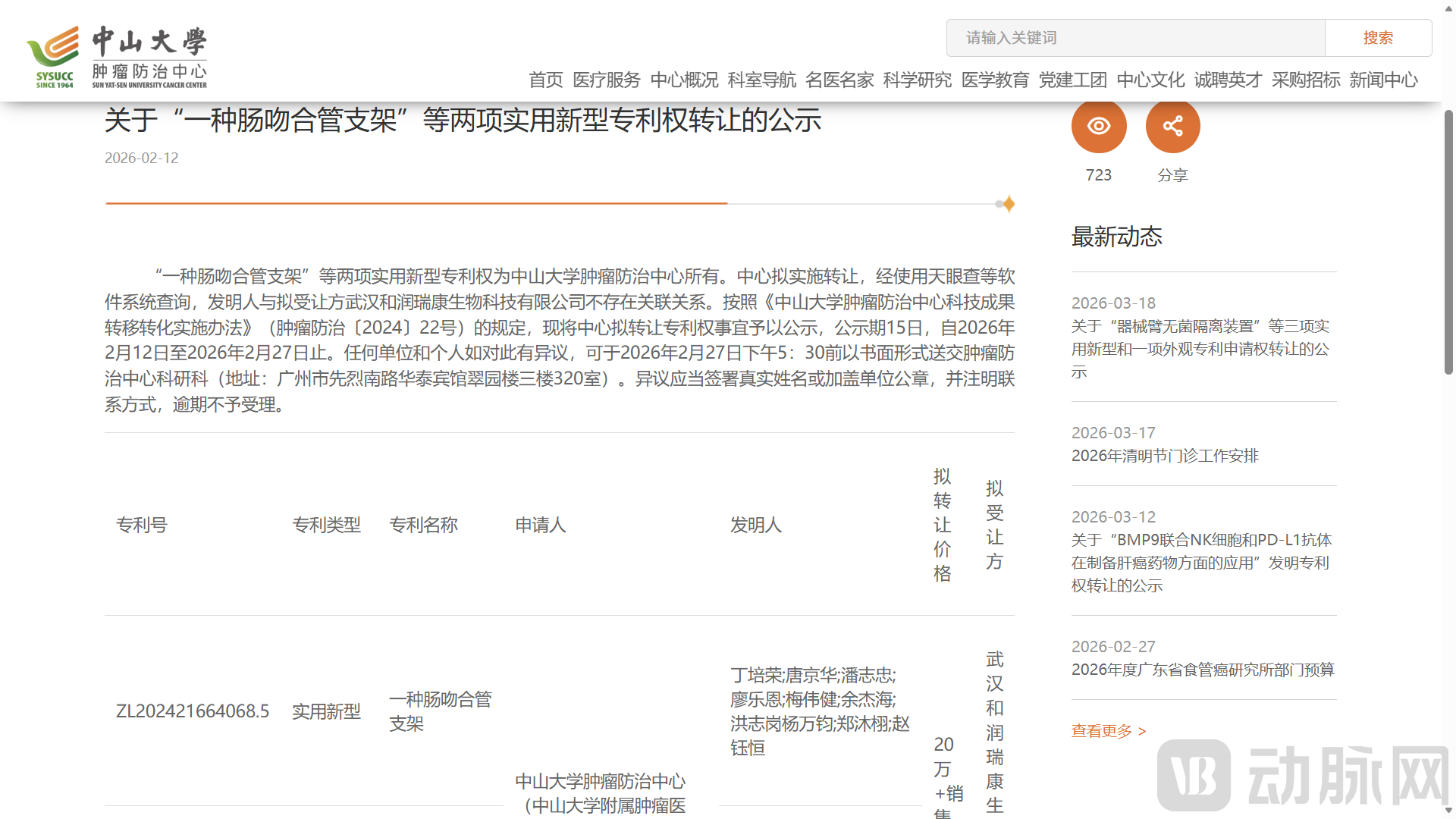
Image from the official website of Sun Yat-sen University Cancer Center
This batch of patents focuses onPostoperative Anastomotic Leak, Stoma Drainage Dislodgement and Obstruction Following Intestinal SurgeryTechnical innovations have been developed to address critical clinical pain points. One patented intestinal anastomosis stent features an integrated design combining an elastic stent, an intestinal cannula, and a negative-pressure tube. It incorporates multiple fixation methods, such as inflatable fixation rings and anchor pins, and innovatively employs biofilm coating and negative-pressure adsorption of the intestinal cannula. This design enables direct fecal discharge through the cannula, significantly reducing the risk of anastomotic leakage and infection. Another patented ostomy drainage stent effectively resolves the common issues of slippage and clogging associated with traditional drainage stents through innovative designs, including a mushroom-head-like structure, lateral drainage holes, and a 3M adhesive fixation base. Both patents optimize and upgrade clinical instruments for intestinal surgery, offering both practicality and innovation.
Gastrointestinal diseases, such as intestinal tumors, intestinal perforation or rupture, volvulus, and bowel obstruction, are highly prevalent digestive system disorders in clinical practice.Intestinal Resection Surgeryis the core surgical approach for treating such diseases, whileIntestinal AnastomosisAs a critical procedure for reconnecting the intestine after resection of diseased tissue, its postoperative recovery outcome directly determines the success or failure of the surgery.
In current clinical practice,Anastomotic Leakageis the most serious postoperative complication of intestinal resection and anastomosis; to reduce this risk, the mainstream clinical approach adoptsDiversion StomaAs a protective measure, a temporary stoma is created in the patient’s body to divert feces externally and collect them using an ostomy bag, thereby reducing irritation of the anastomosis by intestinal contents.
However, diversion stoma surgery itself presents significant clinical drawbacks. It not only predisposes patients to various secondary complications during the surgical procedure and postoperative care, but the long-term use of ostomy appliances also severely impairs daily activities and quality of life, while causing both physical discomfort and psychological distress.
Furthermore, to address the issue of difficult defecation caused by stoma edema in some patients during the early postoperative period, clinical practice requires the use ofStoma Drainage Stentto provide guidance and support within the intestinal lumen; however, due to inadequate structural design, traditional ostomy drainage stents are highly prone to issues such as obstruction and dislodgement upon insertion into the intestinal lumen. This results in poor drainage efficiency and makes it difficult to achieve stable clinical drainage outcomes, thereby further increasing the difficulty of postoperative care and the risk to patient recovery.
In summary, there is an urgent clinical need for novel medical devices specifically designed for intestinal surgery that can effectively prevent anastomotic leakage, address the pain points of stoma drainage stent dislodgement and obstruction, while simplifying operational procedures and enhancing postoperative safety and patient comfort. The research, development, and application of such devices have become a key direction in the field of intestinal surgical diagnosis and treatment.
The two patented devices transferred in this transaction—the intestinal anastomosis stent and the ostomy drainage stent—feature targeted innovative designs that address core clinical challenges in colorectal surgery. They achieve breakthrough upgrades across multiple dimensions, including structural design, clinical efficacy, operational convenience, and postoperative patient experience. Compared with traditional clinical approaches and instruments, these devices demonstrate significant practical technical advantages and innovative value, providing a novel solution for postoperative protection and drainage care in colorectal surgery.
Among them, the core innovation of the intestinal anastomosis stent lies in creating“Synergistic Action of Elastic Stents, Intestinal Cannulas, and Negative Pressure Tubes for Intestinal Cannulas”The integrated core structure features a retractable elastic stent that conforms to the physiological anatomy of the intestinal anastomosis. It can be compressed for implantation and then expanded for fixation, adapting to various intestinal physiological environments. An intestinal cannula is embedded within the elastic stent and extends externally, allowing feces to be discharged directly through the cannula. This design fundamentally isolates intestinal contents from the anastomotic site, significantly reducing the risk of anastomotic leakage and infection, and thereby substantially lowering the incidence of anastomotic fistula, a serious postoperative complication.
Meanwhile, the stent is also designed with multiple fixation options.The outer wall of the elastic stent can be equipped with inflatable fixation rings., and the width of the fixation ring or multiple fixation rings can be adjusted at the front end according to requirements. The snap-fit connection design with anchor screws ensures a firm attachment between the stent and the intestine, preventing slippage caused by intestinal peristalsis. The outer wall of the elastic stent is covered withBiological Coating, and can effectively reduce the friction and irritation of the stent against the intestinal wall, thereby minimizing damage to the intestinal tissue, whileBlind Hole and Side Wall Ventilation Hole Design of the Negative Pressure Tube for Intestinal Cannula, when used in conjunction with a negative pressure generation device, it enables tight adhesion between the intestinal cannula and the elastic stent, thereby preventing intestinal contents from entering the gap and further enhancing the stability of the device during use.
Furthermore, the implantation of this intestinal anastomosis stent is straightforward and does not require complex surgical procedures. It can be directly removed via endoscopic surgery at a later stage, which significantly simplifies the clinical workflow compared to traditional diverting ostomy and reduces secondary surgical trauma to patients.
Whereas ostomy drainage stents are designed for traditional drainage stentsProne to Slippage, Prone to Cloggingthe core issue to achieve structural innovation, through“Mushroom-like base structure + circumferentially evenly distributed lateral drainage holes”The design not only significantly increases the contact area with the intestinal wall, structurally preventing stent slippage after insertion into the intestinal lumen, but also allows intestinal contents to flow smoothly into the drainage tube through multiple perforations, thereby effectively enhancing drainage efficiency and reducing the incidence of obstruction at its source.
Guide wire installed in the drainage tube, which can provide precise guidance for the entry of the drainage tube into the intestinal lumen, reduce the difficulty of clinical implantation procedures, and improve the precision and efficiency of the operation, while the symmetrically arrangedMounting Base with 3M Adhesive, which can be directly adhered and secured to the base of the ostomy bag, effectively counteracting displacement forces caused by intestinal peristalsis and the flow of intestinal contents, thereby further enhancing fixation stability and ensuring continuous and stable drainage.
Two patented devices precisely address the core clinical needs of intestinal surgery, balancingEase of Operation and Postoperative Patient Comfort. The intestinal anastomosis stent eliminates the need for ostomy bags, thoroughly addressing the key pain points associated with diversion ostomies; following structural optimization, the ostomy drainage stent significantly enhances the stability and smoothness of postoperative ostomy drainage. Together, these devices not only effectively improve patients’ postoperative quality of life but also reduce clinical nursing workload and postoperative secondary complications. They represent a significant technological innovation in the field of gastrointestinal surgical medical devices, holding substantial value for clinical application and widespread adoption.
From the perspective of the market environment, the global gastrointestinal stent market is continuing to expand, and the market size of hepatogastroenterology devices in China is also growing steadily.Minimally Invasive, Domestically ProducedEmerging as a core trend in the industry, imported brands still dominate the high-end market, but the acceleration of domestic substitution is providing fertile ground for local innovative medical devices.
Meanwhile, the accelerating aging of the population has driven up the incidence of intestinal tumors, bowel obstruction, and other conditions. This has led to a sustained increase in the rigid clinical demand for the prevention of anastomotic leakage and the optimization of stoma drainage. Furthermore, the widespread adoption of Enhanced Recovery After Surgery (ERAS) protocols has made intestinal stents—offering a combination of safety, patient comfort, and ease of use—the preferred clinical choice, thereby continuously unlocking market demand.
MedtecColospan CG-100YesColospan (Israel)R&DDisposable Endoluminal Bypass Device, receivedFDA "Breakthrough Device"Title: An Innovative Alternative to Traditional Diverting Stoma, Primarily for the Prevention of Anastomotic Leak in Colorectal Resection and Anastomosis. The product features a silicone tubular sheath structure, comprising a silicone tubular sheath, an inflatable balloon, an extraluminal fixation ring, and a dedicated delivery system. It isolates intestinal contents from the anastomosis site via bypass drainage. The combination of the balloon and extraluminal fixation ring ensures stable fixation while accommodating intestinal peristalsis. The device can be implanted endoscopically and removed externally shortly after surgery, eliminating the need for a second operation. It also reduces stoma-related complications and the likelihood of permanent stoma formation. Made of single-use silicone, it causes minimal irritation to the intestine and poses no risk of cross-infection.
This productCE Certified, it has been officially launched in the European Union and Israel, with implementation in core hospitals such as the Asklepios Altona Clinic in Germany. In the U.S. market, it has obtained FDA Investigational Device Exemption (IDE) approval and is currently conducting a pivotal, multicenter, prospective, randomized clinical trial across the United States and Europe. The Breakthrough Device Designation will accelerate its regulatory review for market entry in North America. Clinical applications have demonstrated a significant reduction in the incidence of anastomotic leakage and associated mortality, as well as a decrease in secondary complications. Currently focusing on Europe and Israel as core markets, the company has established a robust reimbursement model and leverages key opinion leaders (KOLs) in the field to promote clinical adoption. Aligning with the clinical trends toward minimally invasive surgery and enhanced recovery after surgery (ERAS), the product exhibits strong potential for global market expansion.
Boston Scientific Ultraflex Precision Colonic StentYesNickel-Titanium Alloy MaterialofSelf-expanding metallic colonic stent, a classic universal support device in the field of intestinal surgery, is primarily used for the palliative treatment of malignant colorectal strictures. It can also be clinically adapted for scenarios such as assisting drainage after ostomy surgery and providing luminal support after intestinal anastomosis. The product features a diamond-shaped structure woven from nickel-titanium alloy wires, combined with a distal flared design. Its self-expanding properties allow it to conform to the intestinal anatomy, offering strong resistance to compression, while the flared end reduces the risk of stent migration. The stent is implanted via endoscopic proximal release using a dedicated delivery catheter, ensuring compatibility with standard clinical endoscopic procedures. It exhibits low axial shortening after implantation and good adaptability to intestinal tissues; however, its position cannot be readjusted once released.
This product isGlobal Colonic Stent SectorAs a mainstream product, Boston Scientific leverages this device to hold a core share of the global intestinal stent market. It has extensive clinical applications in regions such as North America, Europe, and Asia-Pacific, making it a common choice for minimally invasive treatment of malignant colonic obstruction overseas. In the domestic market, it is a leading imported colonic stent product, primarily utilized in departments such as digestive endoscopy centers at tertiary hospitals, with high clinical recognition.
The transfer of thisIntestinal Anastomosis Stent and Ostomy Drainage StentPatents, leveraging precise capabilities in addressing clinical pain points and differentiated technological innovation advantages, combined with the high-growth dividends of the global and domestic intestinal surgical medical device markets, boast extremely broad market application and commercialization prospects.
From a market prospect perspective, the product can precisely target core departments such as gastrointestinal surgery and gastroenterology in tertiary A hospitals and specialized oncology hospitals. Meanwhile, with the advancement of tiered diagnosis and treatment and the enhancement of primary healthcare capabilities, it can gradually expand to secondary hospitals and ambulatory surgery centers, offering broad application scenarios.
Leveraging future industrialization based on patent commercialization, combined with comprehensive clinical promotion and channel development, the two patented devices are expected toIntestinal Anastomosis Protection and Ostomy Drainage Sub-sectorsRapid development not only provides the clinic with higher-quality, locally developed innovative solutions but also enables the swift realization of commercial value by leveraging industry trends, establishing the product as a high-quality domestic offering in the field of interventional devices for colorectal surgery, with both clinical application value and market potential.