

Nanjing Stomatological Hospital to License Portable Post-Extraction Cold Compress Device for RMB 50,000
Recently, Nanjing Stomatological Hospital released a public notice on the transformation of scientific and technological achievements, proposing to transfer, via an exclusive license,“A Portable Ice Compress Device for Post-Extraction Care”The relevant patents have been transferred to Jiangsu Qinfeng Medical Technology Co., Ltd., with a transfer amount ofRMB 50,000. The inventors of this patent areTang Jiali and Li Mengyuan。
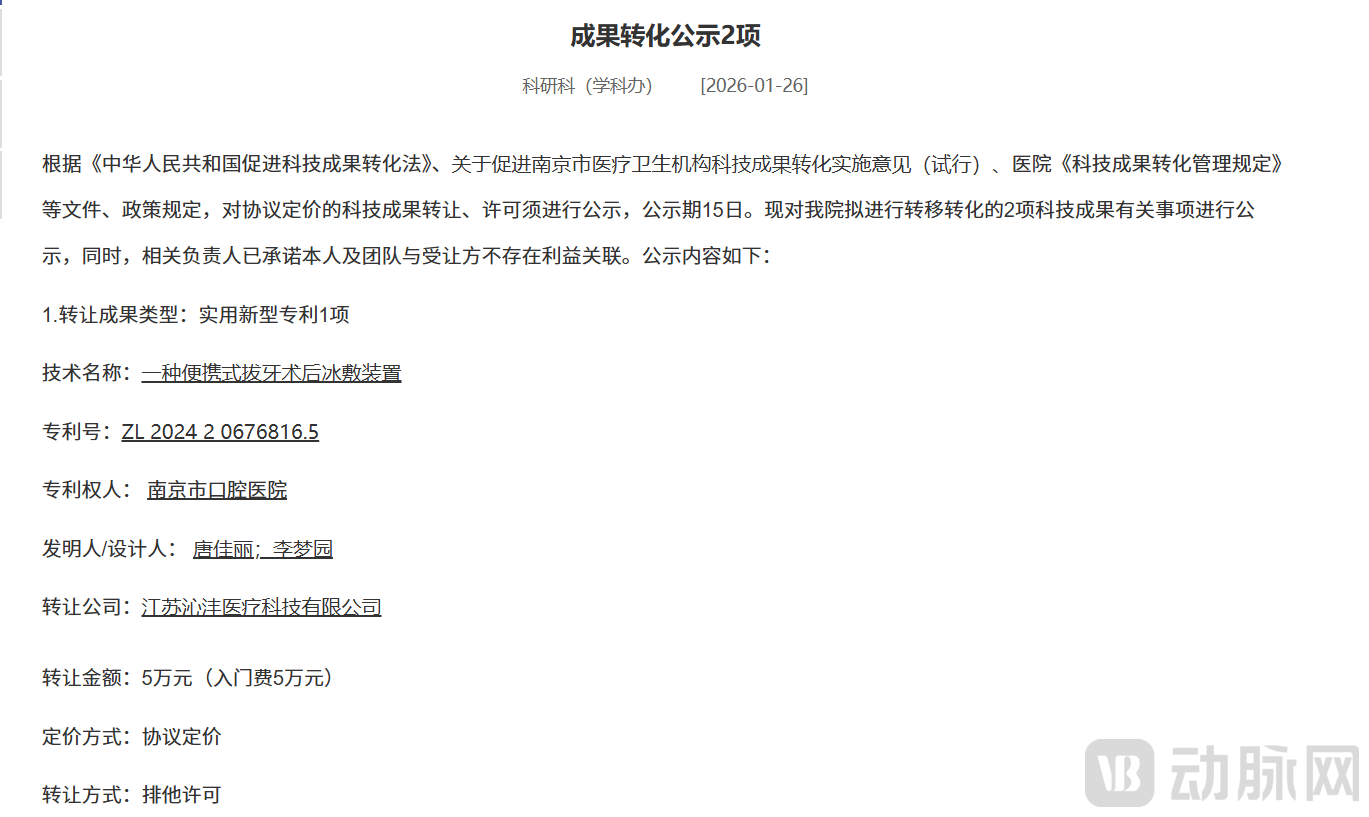
Image from the official website of Nanjing Stomatological Hospital
This technology isA Portable Ice Compress Device for Post-Tooth Extraction Care, specifically designed to address the clinical pain points of ice application following tooth extraction, belonging toOral Care Technology Field, with the core objective of providing tooth extraction patients with a convenient, stable, and well-fitting postoperative cold compress solution.
Post-Extraction Ice Pack CareHigh-frequency and essential demand: As a core method for alleviating postoperative swelling and pain and reducing local inflammation, cold compression has become a standard clinical nursing practice. However, the practicality deficiencies of existing cold compression solutions have become a key bottleneck restricting nursing experience and efficacy. Neither handheld homemade simple ice packs nor conventional wearable cold compression aids can balance ease of use with stability during application. These prominent pain points in clinical practice severely compromise patients’ postoperative care experience and the effectiveness of cold compression therapy.
From a usability perspective, existing cryotherapy methods exhibit significant limitations in design and adaptability.
On the one hand,Traditional homemade ice packs require patients to hold them against the cheek for extended periods during cold compress therapy., continuous exertion of hand strength can easily lead to fatigue and soreness, and the handheld method makes it difficult to ensure sustained, precise contact between the ice pack and the affected area. The ice application site is prone to shifting, resulting in uneven local cooling and failing to achieve the desired anti-inflammatory and swelling-reduction effects. This also restricts postoperative hand mobility for patients, impacting their daily lives.
On the other hand, existing wearable cold therapy devices mostly place ice packs via carriers such as masks and straps. Although this addresses the pain point of manual holding, the inherent weight of the ice packs themselves,After application, the device is prone to downward displacement or detachment due to gravity., misalignment between the ice application site and the surgical site after tooth extraction directly reduces the effectiveness of cold therapy; moreover, the ice pack compartments in such devices are predominantly designed as integrated units,Inability to Precisely Target Ice Application Based on the Tooth Extraction Site, which can easily cause deviation in the ice application area, resulting in unnecessary cold stimulation to non-surgical sites.
In addition,Existing wearable cryotherapy devices lack targeted, practical design., the ice pack lacks an effective fixation structure after placement, making it prone to falling off during daily activities such as bending over or lowering the head, thus requiring repeated adjustments. Meanwhile, condensation readily forms on the ice pack during cold therapy, easily dampening both the carrier device and the patient’s facial skin. This not only reduces comfort but may also cause discomfort due to prolonged contact of the skin with the wet, cold carrier. Furthermore, some devices are made of materials with poor breathability and skin-friendliness at the facial contact interface, leading to issues such as stuffiness and pressure marks during prolonged use, which further diminishes patient acceptance.
These issues directly lead toDual Limitations in the Practicality and Patient Experience of Ice Application After Tooth Extraction:Handheld methods are prone to causing fatigue and offer poor conformity, while wearable devices are susceptible to displacement and detachment, lacking precision in cold application. The absence of detailed design results in low usability and poor comfort. For post-extraction cold therapy, existing solutions fail to meet the clinical requirements for stability and precision, as well as patients’ needs for convenience and comfort. There is an urgent need for a portable cold compression device that ensures stable wear, precise cooling, and strong adaptability, thereby addressing the core bottlenecks in postoperative cold therapy care.
This portable ice compress device for post-extraction care comprehensively addresses the limitations of traditional icing solutions through targeted structural innovations and detailed optimizations.Prone to Displacement, Inaccurate, and Poor User Experienceapplication limitations, inWearing Stability, Precision of Ice Application, Ease of Use, and Wearing Comfort...thereby establishing significant advantages in these areas and providing more efficient and comfortable cold compress care solutions for patients following tooth extraction.
From the perspective of core structural innovation, patents are based onNose Pad Support Design and Detachable Connectionmethod, ensuring stable and secure attachment of the device without dislodgement.
On the one hand,Add a rigid plastic nose bridge support to the inner side of the mask body., which supports the weight of the mask body and ice pack through contact with the nasal bridge area, fundamentally addressing the issues of downward displacement and detachment caused by the gravity of the ice pack in traditional wearable cold compress devices. Meanwhile, the nose pad increases friction against the face, further enhancing wearing stability and ensuring continuous adherence of the cold compress to the affected area; on the other hand,The nose pad frame is connected via movable parts at the top and bottom, using a magnetic/Velcro attachment structure., which can be quickly attached to and detached from the mask body. If the movable part adopts an elastic band, it can accommodate mask bodies of different models and patients with varying facial contours, offering enhanced adaptability. Furthermore, the nose bridge support is reusable, balancing practicality and cost-effectiveness.
Furthermore, patents inDesign and Wearing Details of Cold Compress TherapyAchieve dual optimization, balancing cryotherapy efficacy with user experience.
In terms of ice pack design,A storage pocket with an independent compartment is provided on the outer side of the mask body, facing the cheeks., the multi-layered design allows for precise placement of ice packs according to the tooth extraction site, enabling accurate targeting of cold therapy and avoiding low-temperature stimulation to non-surgical areas;The containment bag is equipped with closure structures such as Velcro and zippers., effectively preventing the ice pack from falling off when the patient bends over or lowers their head. Each compartment contains a built-in desiccant to absorb condensation from the ice pack, preventing the mask and facial skin from getting wet and ensuring cleanliness during the cold compress application.
In terms of wearing details,The nose bridge support features a grid-patterned opening positioned directly opposite the nose and mouth., which neither impairs the patient’s normal breathing nor compromises the supportive structure of the nasal bridge frame, thereby avoiding excessive facial pressure;Ice silk fabric on both sides of the nose pad frame, with excellent moisture absorption and breathability, it enhances comfort during facial contact. Additional sponge or rubber padding can be installed to further reduce pressure on the nasal bridge and face, making it suitable for patients to wear for extended periods during ice therapy. Meanwhile, the overall device features a mask-style portable design that requires no hand-holding, completely freeing the patient’s hands and not interfering with post-operative daily activities.
These advantages directly enhance ice pack care following tooth extraction:Nose Pad Support StructureFundamentally resolve the issue of device displacement, ensuring the continuity and effectiveness of cryotherapy;Precision Layering and Closure DesignEnables more targeted ice therapy, preventing ice pack slippage and condensation issues;Portable Mask-Style Design + Skin-Friendly Detail Optimization, significantly enhancing the patient wearing experience and reducing postoperative care discomfort. For ice compress care after tooth extraction, this patented technology not only breaks through the usage limitations of traditional ice compress solutions but also achieves a triple improvement in wearing stability, precise ice application, and user comfort through structural innovation and meticulous attention to detail, providing strong support for the convenient and precise implementation of post-oral surgery ice compress care.
Currently, regarding ice pack care after tooth extractionWearing Stability, Precision of Ice Application, and Ease of Usecore needs, medical research institutions and device companies have accelerated related technology R&D and product layout, forming aStructural Optimization, Functional Adaptation, and Scenario Segmentationa market competition landscape centered on [core], with existing products mainly categorized intoMask-style ice pack, pressurized hot and cold therapy device, strap-on medical ice bagThree major categories, covering all scenarios in clinical medicine and home care.
Peking University School of StomatologyR&DMedical Mask-Style Ice Pack for Postoperative Care Following Apical Surgery, representing an early core technological achievement in mask-style ice compress devices, this product consists of a rectangular mask body, parallel ties, and a built-in rectangular ice pack. A pocket for the ice pack is formed on the inner side of the mask using non-woven fabric, which addresses the fatigue associated with traditional handheld ice packs while ensuring uniform ice compression pressure and preventing rapid melting of the ice pack. It has become the foundational design prototype for postoperative oral surgery mask-style ice compresses, providing structural reference for the development of subsequent similar products.
Henan Qingling Medical Technology Co., Ltd.ofLF-660 Pressurized Hot and Cold Therapy DeviceAs a professional medical-grade cold therapy device, it is designed to meet the needs of postoperative ice pack care in oral and maxillofacial surgery. Equipped with semiconductor refrigeration technology, the product achieves rapid cooling to 1°C within 10 seconds, with temperature control accuracy of ±0.5°C. Combined with a 7-level intelligent pulsating compression function, it promotes lymphatic return and reduces inflammatory exudate. The device also supports dual-channel temperature control and features a 360° conformal design, enabling precise local cold application for postoral surgical sites. Classified as a Class II medical device, it is a mainstream clinical-grade solution for postoperative oral ice therapy.
This patent proposes a portable ice compression device for post-extraction care, with its core innovation lying in the structural combination of a mask body and a detachable nose bridge support. By utilizing the nose bridge support to bear the weight of the ice pack, the invention addresses the common issues of detachment and displacement associated with traditional devices. Coupled with multi-compartment design for precise cold application and anti-condensation features, it achieves stable and targeted postoperative care. This technology integrates ice compression therapy with a portable mask form factor, significantly enhancing patient comfort and ease of use, representing an effective upgrade to oral postoperative care instruments.
In the future, postoperative oral care will evolve toward greater precision and convenience. Minimally invasive care devices tailored to clinical scenarios are expected to become a key focus of industry R&D, driving continuous advancements in structural optimization and functional integration of oral care instruments.