

Innorna's First-in-Class mRNA Therapy IN026 for Refractory Gout Receives FDA IND Approval, Pioneering Chronic Disease Treatment with mRNA Platform
For the 1.9 million patients worldwide with refractory gout, monthly treatment regimens are akin to a gamble—conventional gout medications often fail to take effect, leading to poor control of uric acid levels and subsequent impairment of quality of life due to joint deformities and chronic pain; meanwhile, recommended drugs have significant side effects, and patients gradually develop drug resistance, trapping them in a vicious cycle of helpless discontinuation and recurrent disease flare-ups.
According to data from the Global Burden of Disease Study (GBD 2021), there were over 55 million gout patients worldwide in 2020, with the prevalence rate continuing to rise. Epidemiological studies in China indicate that the prevalence of gout among adults is approximately 1–3%, corresponding to a patient population of around 14–40 million. Among these, about 3% of patients suffer from refractory gout; globally, approximately 1.9 million patients fail to achieve target serum uric acid levels under existing treatments. These patients have waited 16 years for new mechanism-based drugs without success.
Recently, Shenzhen-based biotechnology company Innorna announced that its mRNA therapy IN026 for refractory gout has received approval from the U.S. Food and Drug Administration (FDA) for its Investigational New Drug (IND) application. The therapy will be evaluated in Phase I clinical trials to assess its safety and preliminary efficacy in patients with refractory gout.
Leveraging INNORNA’s proprietary mRNA-LNP (messenger RNA-lipid nanoparticle) technology platform, which is specifically designed for repeated dosing and long-term disease control, IN026 has the potential to become a first-in-class mRNA protein replacement therapy for refractory gout and other chronic metabolic diseases.
This means that a Shenzhen-based biotech company has offered new hope for patients with refractory gout, who have faced a 16-year dilemma of “no new drugs available.”
1High Costs, Short-Lived Efficacy, and Frequent Side Effects: How Does INNORNA Leverage mRNA to Break Through in Gout Treatment?
Gout is a metabolic disorder characterized by the deposition of monosodium urate crystals triggered by hyperuricemia. Refractory gout is defined as a condition in which patients experience frequent flares (≥2 episodes per year despite standardized treatment); present with multiple or progressive tophi; or fail to achieve the target serum uric acid level (<360 μmol/L) despite adequate dosage and duration of therapy.
Traditional first-line medications are primarily divided into two categories: xanthine oxidase inhibitors that suppress uric acid production (such as allopurinol and febuxostat), and agents that promote uric acid excretion, such as benzbromarone. Both classes of drugs rely on renal function for uric acid clearance. Patients with refractory gout often respond poorly to these conventional therapies, leading to a generally unfavorable prognosis. Furthermore, significant long-term side effects frequently result in intolerance or discontinuation of treatment, creating a vicious cycle of recurrent disease flares.
Guidelines for Refractory Gout Recommend Pharmacotherapy—Uricase Agents (e.g., Pegloticase, a PEGylated Recombinant Uricase Formulation) Open an Alternative Pathway by Directly Delivering Exogenous Enzymes to the Human Body. This enzyme directly catalyzes the oxidation of uric acid to allantoin, a more soluble metabolite that is naturally excreted in urine. This mechanism does not increase renal burden and is not limited by renal function, providing an alternative metabolic intervention.
Since its FDA approval and market launch in 2010, pegloticase has faced clinical limitations—including strong immunogenicity, high cost, frequent infusion reactions, and susceptibility to drug resistance (with a significant proportion of patients developing anti-drug antibodies)—which have greatly restricted its widespread use. In other words, even patients with refractory gout treated with pegloticase may once again face the dilemma of having no available therapeutic options after six months of treatment. More notably, as the only globally approved medication for refractory gout, pegloticase has not yet been approved for marketing in China, and there are currently no approved generic or improved versions of the drug.
INNORNA’s strategy for breaking through the current impasse is to fundamentally “replace” protein production methods—by delivering mRNA encoding urate oxidase (UOX) to the liver, enabling autologous hepatocytes to continuously secrete endogenous UOX. This approach aims to reduce immunogenicity, thereby promoting systemic uric acid degradation and supporting repeated dosing and long-term disease control.
A simpler explanation is that INNORNA’s IN026 uses mRNA technology to “instruct” the liver, prompting hepatocytes in patients to act as “pharmaceutical factories” that produce enzymes capable of breaking down uric acid. This approach aims to explore a treatment regimen with lower side effects, allowing for repeated dosing and long-term control.
2Breaking the Gout Deadlock Is Just the Start: How INNORNA Is Pioneering a New Track in mRNA Therapeutics for Chronic Diseases?
The approval of IN026 also marks that, building on the strength of its vaccine pipeline validation platform, INNORNA has taken the lead in advancing mRNA therapeutics into the clinical development stage for chronic metabolic diseases, emerging as a pioneer in this emerging therapeutic category.
If mRNA-LNP therapy is likened to the Cinderella story—with LNP serving as the "pumpkin carriage" that precisely delivers therapeutic instructions to target cells, and mRNA acting as "Cinderella," who gracefully departs after fulfilling her mission before "midnight" strikes, without altering genes or leaving permanent traces—then safety risks are more controllable, and treatment can be repeated as needed. This characteristic makes mRNA inherently suitable for diseases requiring long-term, repeated dosing.
Although the analogy is simple, the underlying technical challenges are far from trivial. mRNA has a limited expression window after entering the human body, and repeated dosing may trigger immune rejection. The critical hurdle for mRNA therapeutics to transition from vaccines to chronic disease management is ensuring that the treatment can be safely administered repeatedly for long-term disease control, rather than being effective only as a one-time intervention.
INNORNA’s core breakthrough lies in: through rational design, identifying safer, more efficient, and more precise delivery methods.A key component within the LNP shell, known as "ionizable lipids," is one of the critical factors influencing whether mRNA can successfully enter target cells and determining the safety of delivery. Selecting the appropriate ionizable lipid can significantly reduce immune and toxic responses triggered by LNPs, thereby enabling repeated dosing—a pivotal step in advancing mRNA therapeutics from "single-dose vaccines" to "long-term treatments for chronic diseases." INNORNA has established one of the world’s largest proprietary lipid libraries centered on this component, with a design space covering over 100,000 molecular structures. To date, more than 6,000 candidates have been synthesized and screened, undergoing rigorous validation through in vitro cellular assays, small animal models, and non-human primate studies. This systematic approach has enabled the identification of optimal delivery solutions tailored to different diseases and tissues.
Currently, IN026 utilizes a liver-targeted delivery strategy. On a broader platform level, INNORNA’s LNP formulation has demonstrated the potential to deliver mRNA to various extrahepatic tissues—including immune cells, muscle, adipose tissue, and bone marrow—in preclinical studies, thereby laying the technical foundation for the company’s future pipeline expansion across additional therapeutic areas.
Meanwhile, INNORNA custom-designs mRNA to address the specific characteristics of different diseases, enabling more efficient and durable protein expression while minimizing unnecessary immune responses, thereby meeting the repeated dosing requirements for chronic conditions such as gout.
Essentially, IN026 represents a technological iteration within the mechanistic framework of its predecessor—likewise leveraging urate oxidase to degrade uric acid, but upgrading from "exogenous protein delivery" to "endogenous protein production.", aiming to overcome the clinical bottlenecks of existing uricase drugs, including strong immunogenicity, poor tolerability, and short duration of efficacy. If successful, IN026 will validate not only a novel drug for gout but also whether mRNA therapy can truly meet the long-term treatment needs of patients with chronic diseases. Of course, all this awaits further validation through clinical studies.
3Metabolic Diseases + Global Industrial Chain Layout: INNORNA Competes in the Global Next-Generation mRNA Race
Starting with IN026, INNORNA has demonstrated to the global biopharmaceutical industry a novel application of mRNA therapy in the field of chronic metabolic diseases—moving beyond the traditional confines of vaccines or acute treatments to leverage the programmable advantages of mRNA for chronic conditions requiring long-term management.
This development has also drawn the attention of leading international biopharmaceutical media outlets. In a report, a senior U.S. technology journalist who has long covered the RNA field pointed out that the significance of IN026 may extend beyond gout. Replacing traditional protein-based drugs with mRNA to enable the human body to produce required proteins on its own has long been an industry vision, and IN026 will serve as a critical test of whether this vision can be realized in the treatment of chronic diseases.
Driven by its forward-looking strategic layout in this technological direction, INNORNA has further expanded into the differentiated competitive arena of metabolic diseases, joining the ranks of the few global mRNA therapeutic companies that possess proprietary LNP platform technology, mRNA engineering capabilities, and end-to-end cGMP manufacturing capacity.
To date, INNORNA has completed four rounds of financing, raising a total of $150 million. The company has established a presence in multiple therapeutic areas, including metabolic diseases, autoimmune diseases, and infectious disease vaccines. It operates a global R&D and operational network spanning Hong Kong, Shenzhen, Nanjing, Shanghai, Berlin, Boston, and San Diego. This infrastructure includes an R&D center covering nearly 10,000 square meters, CMC process scale-up and pilot production facilities, and a liposome manufacturing base, all supported by a global team of approximately 170 employees.
Notably, INNORNA has established a vertically integrated manufacturing system encompassing lipid synthesis, mRNA production, LNP formulation, and cGMP downstream processing. This end-to-end in-house production model not only mitigates risks associated with external supply chain dependencies but also accumulates process know-how and iterative data, thereby shortening the development cycle for future assets and enhancing capital efficiency.
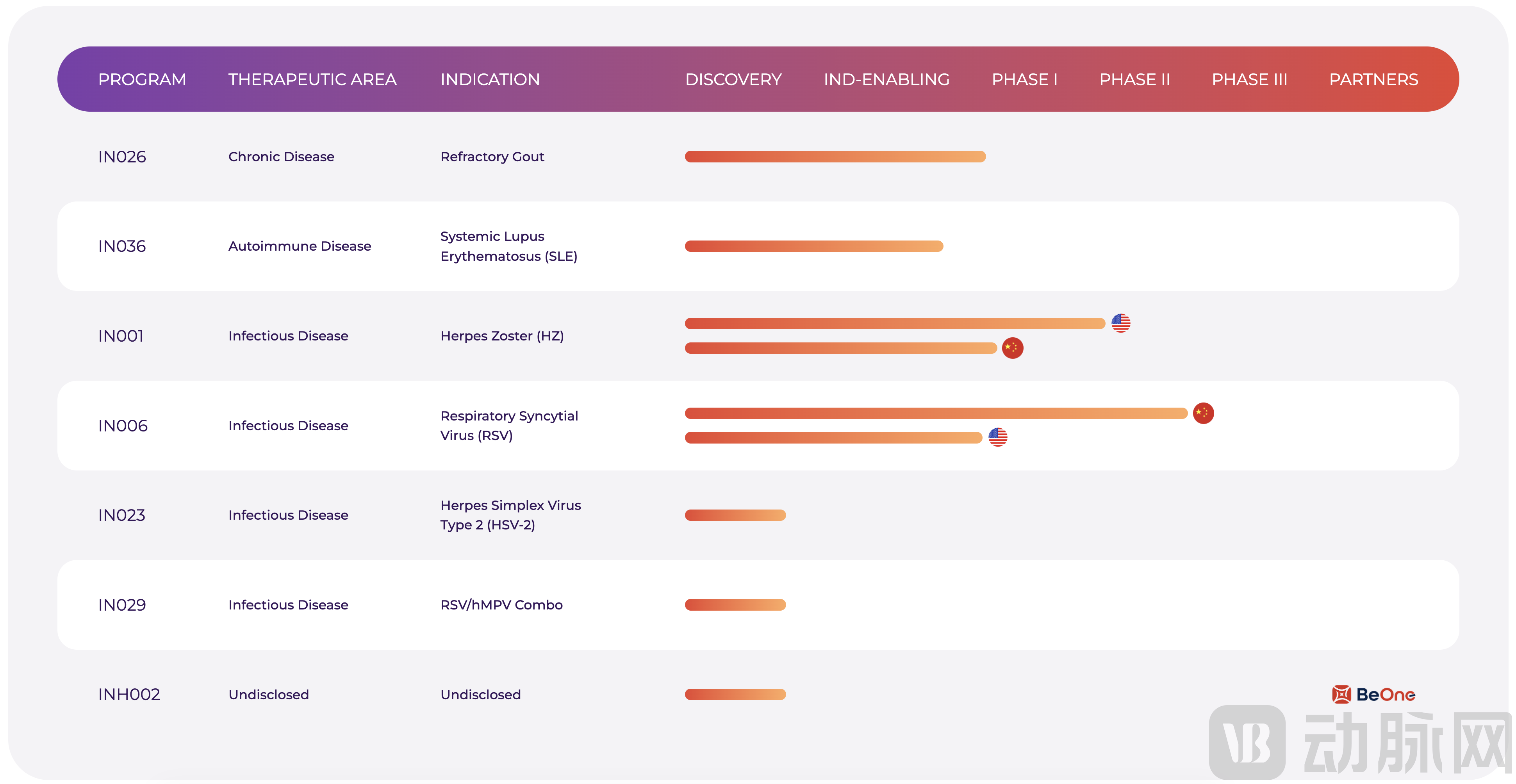
INNORNA’s Pipeline Portfolio (Image source: official website)
On a global scale, mRNA technology is transitioning from its emergency application in infectious disease vaccines to becoming a next-generation platform therapy for complex chronic diseases. The underlying rationale is to fully leverage the core advantages of mRNA-LNP—high safety, precision, and programmability—to develop diverse therapeutic options with superior efficacy and improved accessibility.
Meanwhile, multinational pharmaceutical companies’ interest in next-generation mRNA therapeutics is shifting toward high-prevalence chronic diseases and complex conditions. The cost advantages and patent barriers associated with independently built mRNA-LNP platforms will drive the rise of business development (BD) activities and expansion into overseas markets.In terms of external collaborations, INNORNA’s LNP platform has been validated by global partners. In 2022, the company entered into a global strategic partnership with BeOne (BeiGene).
For the 1.9 million patients with refractory gout, IN026 represents not only a new therapeutic possibility but also the hope for a better quality of life. Gout affects over 55 million people worldwide. If the safety and efficacy of mRNA protein replacement therapy are clinically validated in refractory gout, it is worth anticipating whether this technological approach can benefit a broader population of gout patients and even those with other metabolic diseases.
Note: IN026 is currently in the clinical development stage and has not yet been approved for marketing. This article does not constitute medical or investment advice.