

Tongji Hospital of Huazhong University of Science and Technology to Transfer SCFA LC-MS/MS Detection Patent for RMB 320,000
Recently, in accordance with the relevant regulations on the management of scientific and technological achievement transformation, Tongji Hospital affiliated to Tongji Medical College of Huazhong University of Science and Technology has“A Method for Detecting Short-Chain Fatty Acids Using Liquid Chromatography-Tandem Mass Spectrometry”Official public notice regarding matters related to the commercialization of scientific and technological achievements. The achievement is proposed to be priced through negotiated agreement.320,000 yuantransferred to Keerpu Xin (Wuhan) Biopharmaceutical Co., Ltd. for RMB, with the inventor beingCheng Liming and Shen Ying。
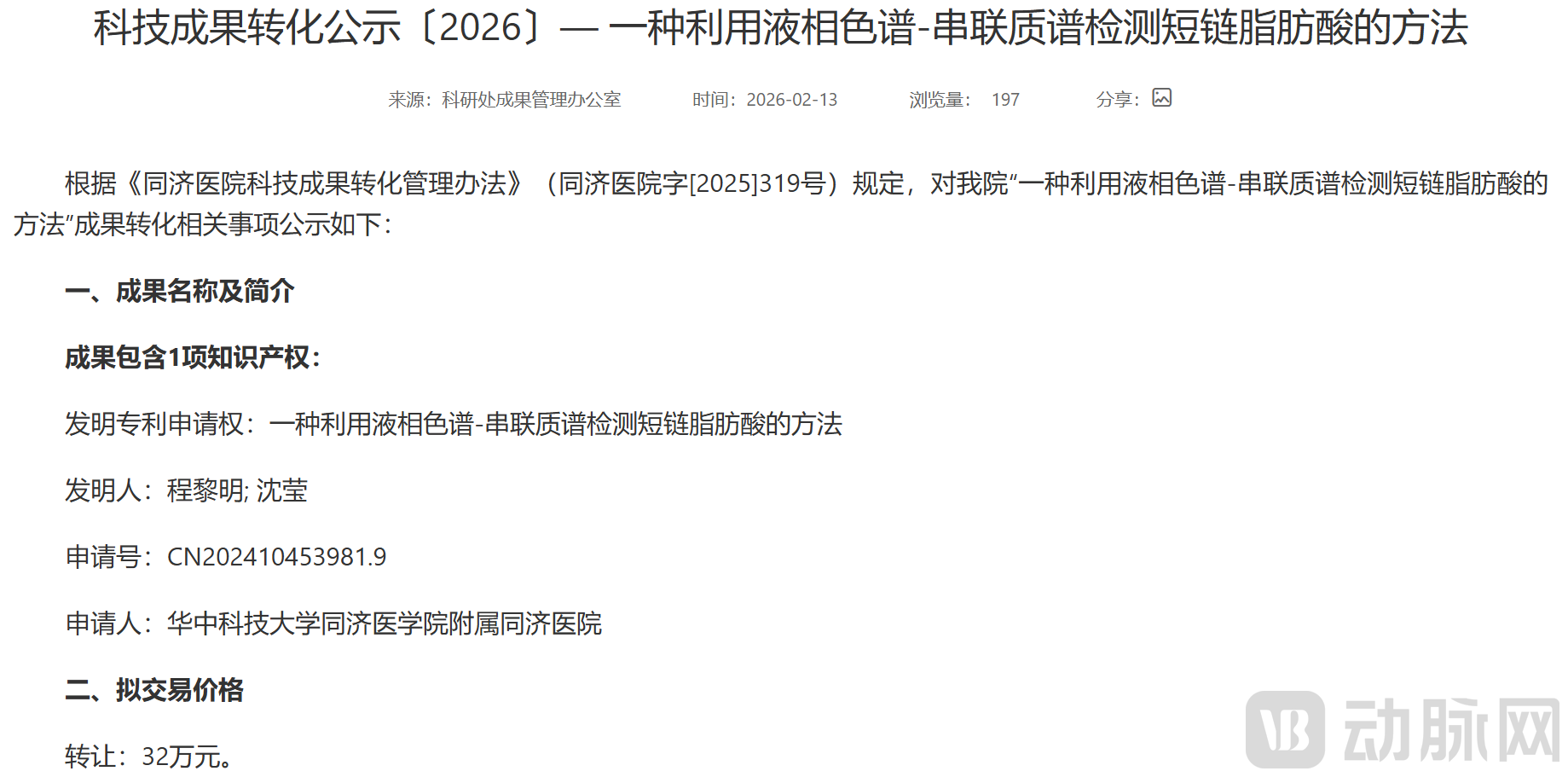
Image from Tongji Hospital, Tongji Medical College, Huazhong University of Science and Technology
This patent primarily providesA Minimalist Pretreatment and Quantitative Detection Method for Short-Chain Fatty Acids in Body Fluid Samples, by simultaneously adding an internal standard working solution and an amino-containing derivatization reagent to the test sample for rapid derivatization, directly precipitating proteins and enhancing mass spectrometry response signals, thereby eliminating traditional solid-phase extraction or liquid-liquid extraction steps, and achieving high-throughput, low-cost, and precise detection of short-chain fatty acids using liquid chromatography-tandem mass spectrometry.
Short-Chain Fatty Acids (SCFAs)Also known as volatile fatty acids, this term primarily refers to fatty acids containing two to six carbon atoms, including formic acid, acetic acid, propionic acid, and butyric acid, as well as small-molecule organic acids involved in the tricarboxylic acid (TCA) cycle, such as pyruvic acid, citric acid, and oxalic acid. As a class of critically important metabolic signaling molecules, short-chain fatty acids are mainly produced by the anaerobic fermentation of undigested carbohydrates and dietary fiber by colonic bacteria. They serve not only as the primary energy source for the proliferation and functional maintenance of colonic epithelial cells but also as key substances for maintaining the intestinal barrier and regulating systemic immune homeostasis.
In the mechanisms of clinical diseases,Abnormal short-chain fatty acid profiles are clearly causally or concomitantly associated with the onset and progression of multiple major diseases.For example, metabolic dysregulation of the tricarboxylic acid (TCA) cycle is closely associated with diabetes, kidney disease, and cancer; meanwhile, oxalate readily forms crystals in the renal tubules, leading to kidney injury. Furthermore, short-chain fatty acids play a crucial role in gut-brain axis communication, and their abnormal abundance is highly correlated with obesity, inflammatory bowel disease, and even neuropsychiatric disorders such as autism and Parkinson’s disease. Therefore,Achieving Precise Quantitative Determination of Short-Chain Fatty Acids, which holds significant medical value for in-depth exploration of the gut microbiome and host metabolism, as well as for facilitating clinical auxiliary diagnosis of related diseases.
However, in the face of highly promising clinical testing demands, existing diagnostic methodologies have revealed significant limitations.
Traditionally, the detection of short-chain fatty acids has mostly employedSpectrophotometry, enzymatic assay, or high-performance liquid chromatography, but these methods generally suffer from limited detection sensitivity and poor reproducibility, and it is extremely difficult to achieve simultaneous determination of multiple low-molecular-weight organic acids.Gas Chromatography-Mass SpectrometryAlthough it is a commonly used method at present, due to the high volatility and wide concentration range of short-chain fatty acids, samples must undergo complex esterification derivatization reactions during pre-treatment to reduce polarity. This process is not only extremely cumbersome but also highly prone to causing volatilization losses of the target analytes during derivatization and injection, thereby introducing significant detection errors.
In recent years,Liquid Chromatography-Tandem Mass SpectrometryDue to its absolute superiority in the analysis of non-volatile polar compounds, it is consideredDetermination of Low-Molecular-Weight Organic AcidsThe Most Promising Technology. However, due to the strong polarity of low-molecular-weight organic acids such as short-chain fatty acids, they are extremely difficult to retain effectively on conventional liquid chromatography columns. Furthermore, highly polar analytes tend to distribute deep within the droplets after entering the electrospray ionization source of a mass spectrometer, resulting in poor ionization efficiency and significant suppression of the MS response signal. Meanwhile, body fluid samples contain a large amount of interfering substances. To eliminate matrix effects, traditional methods rely on liquid-liquid extraction or solid-phase extraction techniques, which consume expensive disposable cartridges in large quantities, for purification.
These pain points have placed existing mass spectrometry testing solutions under pressureHigh costs, lengthy processes, and signal distortiondilemma, making it difficult to meet the urgent needs of modern medical testing laboratories for high-throughput and large-scale testing.
In the face of the above“Poor retention, low ionization efficiency, and cumbersome sample preparation”common industry pain points, the team started from the underlying chemical mechanisms and developed a set of“A Minimalist LC-MS/MS Detection Strategy Combining Internal Standard Precipitation with Amino Derivatization”This patented technology eliminates the time-consuming and labor-intensive processes of solid-phase extraction and liquid-liquid extraction. Through ingenious reagent formulation and chemical reaction design, it simultaneously achieves sample purification and signal amplification within an extremely short period.
In terms of specific operational steps,, testing personnel only need toExtract 1–100 μL of the micro-volume test sample(e.g., urine or plasma), and mix it with an isotopic internal standard working solution at a specific ratio. This internal standard working solution not only serves for precise quantitative calibration in subsequent steps but also acts as a precipitant, efficiently precipitating minor interfering proteins in the sample, thereby eliminating the need for complex solid-phase extraction cleanup procedures from the outset.
In terms of Mechanism Innovation, in the technical proposalIntroduced the “amino-containing derivatizing agent” reaction step. The research team selected specific reagents, including 4-methyl-1,2-phenylenediamine, o-phenylenediamine, and 4,5-dimethoxy-1,2-phenylenediamine, as derivatization agents, and incubated them at a high temperature of 110–130 °C for 15–25 minutes. This derivatization reaction introduced phenyl groups with significant steric hindrance and strong hydrophobicity into the short-chain fatty acid molecules, completely reversing the unfavorable situation caused by their excessive polarity.
Following derivatization, short-chain fatty acids (SCFAs), which are typically difficult to capture, exhibit enhanced retention on reversed-phase liquid chromatography columns and improved ionization efficiency upon entering the mass spectrometer, thereby amplifying the MS response signals. Furthermore, this amino-containing derivatizing agent significantly enhances the thermal stability of the analytes, effectively preventing thermal degradation of SCFAs during analysis and fundamentally eliminating chromatographic peak tailing, thus avoiding the costs associated with repeat injections due to poor peak shape.
In clinical trial validation, this minimalist workflow delivered exceptionally strong performance. Data demonstrate that the technologySignificantly reduce reagent and consumable costs, minimizing sample volume to the limitUnder such conditions, it can still deliver high-precision quantitative analysis results comparable to or even surpassing those obtained through traditional complex extraction methods, fully meeting the clinical standards for routine and large-scale screening of short-chain fatty acids in body fluids.
Currently, the clinical translation of metabolomics has entered an accelerated phase. As core metabolic signaling molecules, short-chain fatty acids have formed a competitive landscape in their detection sector characterized by “leadership from top-tier enterprises and follow-up from small and medium-sized enterprises.” The industry is focusing on technological breakthroughs and product commercialization that emphasize high throughput, low cost, and precision.
In terms of specific competitive product industry layout, focusing on the clinical translation of high-throughput metabolomics“Metabolon”has demonstrated a strong first-mover advantage. Leveraging its underlying technologies in untargeted and targeted metabolomics, the company has launchedMature Mass Spectrometry Testing Service for Short-Chain Fatty Acids, and focusing on research into tumor cell metabolism and the gut microbiome,Developed a Precise Quantitative Tool, aiming to provide in-depth support for biomarker screening in pharmaceutical R&D by analyzing changes in metabolic flux.
“MetWare”then focus intently on“Liquid Biopsy” Kits for Prognosis of Chronic Metabolic Diseases and Early Cancer ScreeningIn terms of development, Maiwei Metabolism not only provides CRO services for scientific research testing covering short-chain fatty acids and lipidomics, but also translates these well-validated metabolite targets into in vitro diagnostic products that can be routinely implemented in hospitals at all levels.
In addition, “"Biotech"Companies have also launched high-throughput targeted assays for short-chain fatty acids, further advancing the clinical utility of metabolite biomarkers in auxiliary diagnosis.