

Shanghai Children's Medical Center to Transfer "Five-in-One Antiepileptic Drug Concentration Assay Kit and Its Application" Patent for RMB 20 Million
Recently, the Shanghai Technology Exchange released an announcement on completed patent transfer transactions, indicating that the Shanghai Children’s Medical Center affiliated with Shanghai Jiao Tong University School of Medicine intends to transfer its “Five Antiepileptic Drug Concentration Assay Kit and Its Applications"Patent transferred to MASSWILL. The transfer fee isRMB 20 million. The inventor of this patented technology isPan Qiuhui, Li Huaiyuan, You Guoling, Ma Ji, Chen Yi, Qin Yujie.
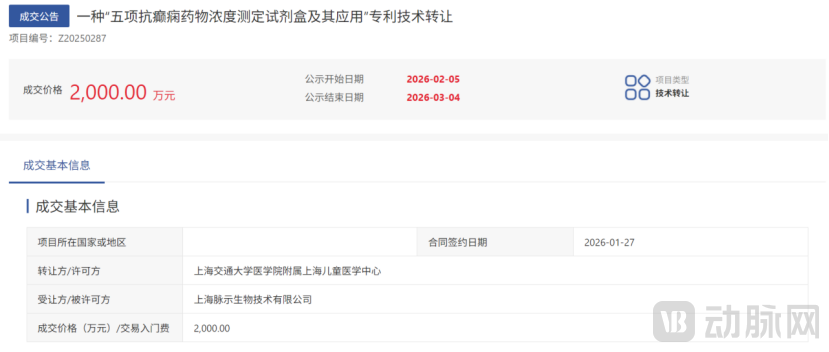
Image source: Official website of the Shanghai Technology Exchange
Epilepsy is a common and complex neurological disorder, characterized as a chronic condition resulting from recurrent epileptic seizures caused by highly synchronized neuronal discharges.Pharmacotherapy is the first-line treatment for epilepsy in clinical practice, typically administered as monotherapy or combination therapy. A wide variety of antiepileptic drugs are commonly used in clinical settings, including valproic acid, clonazepam, levetiracetam, oxcarbazepine metabolites (primarily 10,11-dihydro-10-hydroxycarbamazepine), and topiramate, among others.
Antiepileptic drugs have a narrow therapeutic window, significant toxicity, and a high propensity for adverse reactions, necessitating regular monitoring of plasma drug concentrations. Furthermore, there is considerable interindividual variability in patient response to these medications. Therefore, to ensure the safety and efficacy of pharmacotherapy, timely and accurate therapeutic drug monitoring (TDM) must be implemented in clinical practice to regularly measure drug levels in patients and formulate optimal individualized dosing regimens. However, traditional products for antiepileptic drug detection face numerous prominent challenges in clinical applications.
First, the limited scope of detection makes it difficult to meet the monitoring needs for combination drug therapy.In clinical practice, patients with epilepsy often require monotherapy or combination therapy, involving commonly used medications such as valproic acid, clonazepam, levetiracetam, oxcarbazepine metabolite (10,11-dihydro-10-hydroxycarbamazepine), and topiramate. However, traditional testing products are mostly single-drug test kits or can only cover 2–3 drugs, failing to simultaneously measure the concentrations of five core medications. This necessitates multiple sample collections and repeated tests for patients on combination therapy, which not only increases patient discomfort and healthcare costs but may also delay timely adjustments to dosing regimens due to prolonged testing turnaround times.
Second, insufficient accuracy and stability of detection affect diagnostic and treatment judgments.Antiepileptic drugs have a narrow therapeutic window, significant toxicity, and considerable inter-patient variability, necessitating extremely high precision in test results. Traditional testing products suffer from poor adaptability of the linear range and elevated coefficients of variation (CV); some products exhibit within-run CVs exceeding 15% and suboptimal between-batch consistency, leading to substantial fluctuations in test results. Furthermore, certain products employing detection technologies such as high-performance liquid chromatography (HPLC) are susceptible to sample matrix interference, resulting in recovery rates deviating from the standard range (85.0%–115.0%). This makes it difficult to accurately reflect the actual drug concentration in patients, potentially causing clinicians to misjudge, which may lead to adverse reactions due to overdose or disease recurrence due to underdosing.
Third, the product exhibits poor stability, with limitations on storage and use.The calibrators and quality control materials in traditional test kits are mostly liquid formulations. Due to the lack of effective preservation and stabilization processes, they are prone to matrix degradation and microbial contamination. These issues result in a short shelf life (typically 3–6 months) and necessitate strict frozen storage at temperatures below -20°C, thereby increasing warehousing and transportation costs. Furthermore, some products exhibit insufficient stability after opening, requiring use within 1–2 days; otherwise, testing accuracy may be compromised, causing significant inconvenience for batch testing in clinical laboratories.
Fourth, the operational process is complex, resulting in relatively low detection efficiency.The sample pretreatment steps for traditional diagnostic products are cumbersome, involving multiple operations such as extraction, centrifugation, and derivatization. This process is not only time-consuming (requiring 1–2 hours per sample) but also demands high technical proficiency from laboratory personnel, making it prone to errors caused by variations in manual handling. Furthermore, some products exhibit poor compatibility with detection instruments, requiring the use of dedicated equipment, which limits their promotion and application in primary healthcare institutions.
Compared with traditional anti-epileptic drug testing products, the Five-Item Anti-Epileptic Drug Concentration Assay Kit has achieved comprehensive upgrades and innovations across multiple dimensions, including detection coverage, performance accuracy, storage and usage, and operational procedures. It provides a more efficient, precise, and convenient solution for clinical therapeutic drug monitoring of anti-epileptic medications, effectively addressing many limitations of existing testing methods and accommodating diverse clinical testing needs as well as application scenarios in healthcare institutions at various levels.
First, simultaneous detection of multiple drugs, covering core clinical needs.This kit innovatively enables the simultaneous detection of five antiepileptic drugs: valproic acid, clonazepam, 10,11-dihydro-10-hydroxycarbamazepine (the metabolite of oxcarbazepine), levetiracetam, and topiramate, comprehensively meeting the monitoring needs for both monotherapy and combination therapy in clinical practice. With a single patient sample, the concentrations of all core drugs can be determined, improving detection efficiency by more than 50% and significantly reducing patient discomfort from sampling as well as the consumption of medical resources.
Second, it offers superior testing performance with precise and reliable results.The kit employs liquid chromatography-tandem mass spectrometry (LC-MS/MS), combined with specific internal standard design (isotope-labeled internal standards such as valproic acid-d4 and clonazepam-d4), to effectively mitigate sample matrix interference. The linear detection ranges for the five drugs fully cover the clinical therapeutic concentration intervals, with correlation coefficients (r) of no less than 0.9900 and linear relative deviations within ±15%. Both intra-assay and inter-assay coefficients of variation are controlled within 15.0%, and accurate recovery rates remain stable within the range of 85.0%–115.0%. The coefficient of variation at the limit of quantitation is ≤20%, with relative deviations within ±15%. The detection sensitivity and accuracy reach industry-leading levels, providing precise data support for the formulation of individualized clinical dosing regimens.
Third, breakthroughs in stabilization technology have made storage and use more convenient.The kit’s calibrators and controls are formulated as lyophilized preparations. By incorporating 0.03%–0.07% sodium azide as a preservative and employing an optimized lyophilization process—comprising gradient cooling condensation (pre-cooling below −30°C and condensation below −50°C), vacuum drying, and staged heating with temperature holding—the formulation effectively prevents matrix degradation and microbial contamination. The product remains stable for 12 months when stored under refrigeration at 2–8°C, and retains stability for up to 7 days after opening under the same conditions. This significantly reduces storage and transportation costs, making it suitable for use across healthcare institutions of varying levels.
Fourth, optimized operational workflows to accommodate efficient clinical testing.The kit simplifies the sample pretreatment process, requiring only 40–60 μL of serum. After vortexing with the internal standard diluent and centrifugation, the sample is ready for injection and analysis, reducing the turnaround time per sample to under 30 minutes. Furthermore, the kit is highly compatible with mainstream liquid chromatography-tandem mass spectrometry (LC-MS/MS) systems, such as the Shimadzu LCMS-8050CL and Waters Xevo TQ-S, eliminating the need for proprietary equipment. It also provides standardized chromatographic and mass spectrometric parameter settings, thereby lowering the technical barrier and facilitating adoption in primary-care laboratories.
In the field of antiepileptic drug concentration monitoring, various technological products demonstrate their respective advantages and innovations. From the optimization of multi-target detection to upgrades in detection technologies and improvements in testing efficiency, these advancements provide diverse, high-quality solutions for clinical therapeutic drug monitoring.
Beijing Shuimu Jiheng Biotechnology Co., Ltd. submitted the “Quality Control Materials, Kits, and Methods for Detecting Antiepileptic Drug Concentrations in Human Blood Matrices“Patent for Invention (Publication No. CN117825592B) provides a kit and method for detecting the concentrations of antiepileptic drugs in human blood matrices. By processing animal whole blood, serum, or plasma, matrix effects are reduced and impurity interference is removed, thereby enhancing the stability of the kit. Through improved testing parameters, oxcarbazepine and carbamazepine-10,11-epoxide are effectively separated. Ten antiepileptic drugs and two active metabolites exhibit good linearity within their respective linear ranges, with satisfactory accuracy and precision, strong specificity, and high stability, meeting the detection requirements for commonly used antiepileptic drugs in human blood matrices.”
Aiwan Medicine'sTDM Kit for Antiepileptic and Mood Disorder Drugs, utilizing LC-MS/MS technology to detect the concentrations of antiepileptic and mood disorder medications and their related active metabolites for quantitative analysis. This involves monitoring drug concentrations in various body fluids, primarily plasma drug concentrations, to design rational dosing regimens. Timely monitoring during pharmacotherapy allows for prompt adjustment of medication plans, thereby enhancing therapeutic efficacy while avoiding or reducing adverse toxic reactions.
Developed by Shimadzu (Shanghai) Experimental Equipment Co., Ltd.Comprehensive Panel for the Simultaneous Detection of 26 Antiepileptic Drugs, requiring only a single injection and completing analysis within 5 minutes, significantly improving analytical efficiency and detection throughput; it meets the demand for simultaneous quantification of 26 antiepileptic drugs in blood, addressing the challenges of low sensitivity, weak anti-interference capability, and limited throughput in clinical therapeutic drug monitoring (TDM), thereby facilitating blood concentration monitoring of antiepileptic drugs.