

Tongji Hospital of Huazhong University of Science and Technology to Transfer Patent for Ultrasound-Enhanced and X-ray Dual-Imaging Arterial Catheter Needle at RMB 210,000
Recently, Tongji Hospital Affiliated to Tongji Medical College of Huazhong University of Science and Technology released a public notice on the conversion of scientific and technological achievements, proposing to transfer its “An Arterial Puncture Trocar with Dual Visualization via Ultrasound Enhancement and X-ray”The patent is assigned to Wuhan Constant Science&Technolony Co., Ltd. The assignment fee isRMB 210,000. The inventor of this patent isZheng Hongbo; Luo Ailin; Zhou Biyun; Li Shiyong。
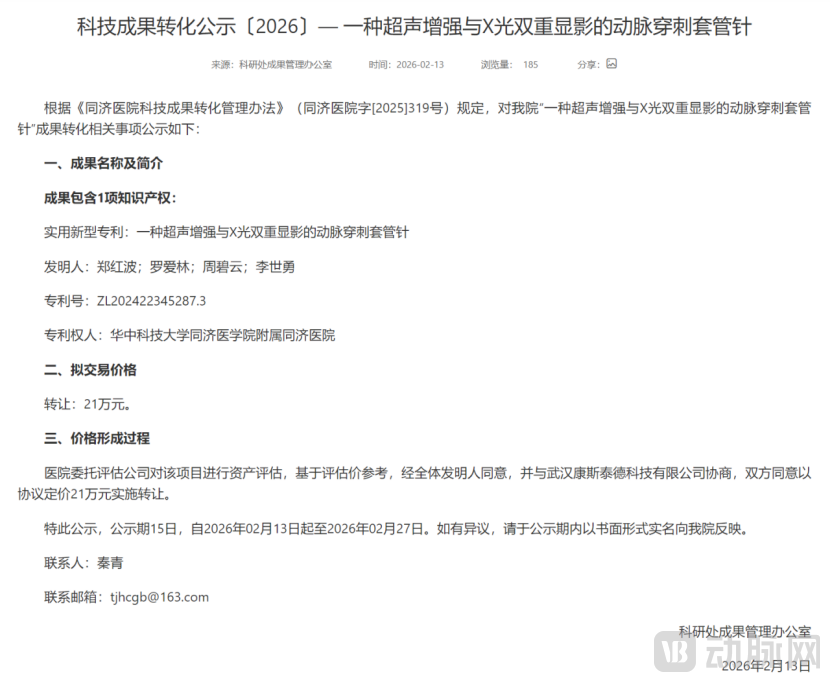
Image from the official website of Tongji Hospital, Tongji Medical College, Huazhong University of Science and Technology
“An Arterial Puncture Trocar with Dual Visualization via Ultrasound Enhancement and X-ray“Utility model patent: Innovative improvements addressing clinical pain points such as visualization and localization in traditional arterial puncture devices. Through multi-layered structural design, it optimizes puncture procedures and fixation efficacy, effectively enhancing the success rate of arterial puncture and clinical safety.”
The rapid advancement of medical imaging technology has led to the increasingly widespread application of ultrasound assistance and X-ray visualization techniques in vascular interventional procedures, providing critical technical support for clinical operations. However, existing arterial puncture cannulas, which are indispensable in core clinical procedures such as vascular interventions and intensive care, struggle to keep pace with technological developments and clinical demands. These products exhibit significant technical limitations in both ultrasound-enhanced visualization and X-ray visibility. Furthermore, their transparent blood flashback chambers tend to fill rapidly with blood, making it difficult to accurately assess the position of the needle tip. Consequently, they fail to simultaneously meet the multiple core clinical requirements for high-precision localization, clear imaging, and effective evaluation of needle tip position. As a result, current products reveal numerous pain points and challenges in clinical practice that urgently need to be addressed.
First, insufficient ultrasound imaging capability, existing products cannot achieve ultrasound-enhanced positioning of the needle core. For patients with difficult arterial localization due to anatomical variations, obesity, or other factors, even with ultrasound guidance, significant human and material resources are still required, resulting in high difficulty and low efficiency of puncture procedures.
Second, difficulty in assessing needle position, the transparent blood flashback chamber of traditional products is easily filled rapidly with arterial blood; when puncture time is prolonged, it becomes difficult to promptly determine whether the needle has been accurately placed in the artery, which may lead to repeated punctures.
Third, significant safety hazards associated with flexible tubing, conventional arterial catheters lack radiopacity under X-ray; if the catheter fractures due to forceful manipulation, operational errors, or accidental cutting, it becomes difficult to locate rapidly, often necessitating surgical removal and thereby increasing the risk of complications such as infection, hemorrhage, and organ injury.
Fourth, Lack of Operational Assistance Design, lacking effective anchoring points during puncture, insufficient post-procedural fixation stability, and single functionality, failing to meet multiple clinical needs such as puncture, blood sampling, and infusion, thereby increasing medical workflow complexity and patient discomfort.
This arterial puncture cannula, featuring dual visualization under both ultrasound enhancement and X-ray, leverages multiple technological innovations to achieve a comprehensive upgrade over traditional products, with significant core advantages.
1. Breakthrough in Dual-Imaging TechnologyA corrugated helical groove segment is positioned adjacent to the needle core’s cutting edge, creating a high-echo reflection surface that enables enhanced visualization and localization under ultrasound guidance. This significantly improves the accuracy of determining arterial entry and reduces the risk of accidental puncture. The soft catheter is constructed from radiopaque polymeric materials, such as polyurethane, offering excellent fluoroscopic visibility and fracture resistance. In the event of breakage, fragments can be rapidly localized and retrieved under fluoroscopy, thereby avoiding the need for surgical intervention.
2. Innovation in Needle Position Assessment System, the blood return section is equipped with a pressure diaphragm and a conical tower structure. The conical tower is filled with a column of green sterile water, and its internal cross-sectional area decreases progressively from bottom to top. Arterial pulsations can drive the water column via the pressure diaphragm to generate amplified fluctuations, enabling clear determination of whether the needle tip remains within the artery, even when the blood return chamber is fully filled with blood.
3. Optimization of Operational and Fixation DesignThe flexible tube advancement composite section is equipped with slidable wing plates, which serve as a pushing point during needle insertion and can be slid post-procedure to contact the patient’s body and adhere securely, thereby increasing the load-bearing area and enhancing stability. On the other side of the composite section, a branch tube with a three-way stopcock valve is provided, enabling direct blood sampling and infusion without additional punctures. Additionally, it features connectors compatible with syringes, monitoring devices, and other equipment, achieving multifunctional integration.
4. Enhanced Clinical Utility Through Detailed Design, the blood return section is equipped with a detachable hemostatic plug to effectively prevent blood spillage and can be connected to a syringe for heparin lubrication of the lumen. The stylet adopts a hollow steel structure, with a 2-cm corrugated section at the tip that balances ultrasound visibility and puncture sharpness. The overall design meets the practical needs of clinical operation.
Amid the trend toward greater precision, safety, and multi-modality imaging compatibility in puncture devices, numerous industry products and patents have pursued technological innovations centered on core needs such as enhanced visibility, operational optimization, and safety protection. This has yielded a range of representative achievements focused on improving puncture positioning accuracy and reducing clinical procedural risks. The specific technical breakthroughs and product designs are outlined below.
Xinnuopu AccuSafe Atrial Septal Puncture GuidewireAdopting an integrated design, it combines the functions of “puncture” and “track establishment” into one, eliminating the need for separate puncture needles and exchange guidewires. This simplifies the procedure and reduces the risks of air embolism and cardiac injury. The product is equipped with an intelligent safety protection mechanism and features a U-shaped memory tip that automatically bends back after penetrating the septum, significantly lowering the potential risk of serious complications such as cardiac tamponade. The guidewire offers enhanced proximal support and a tapered, flexible distal end, ensuring sufficient track stability while maintaining agile navigability within the enlarged left atrium. Radiopaque markers at both ends of the guidewire provide clear visibility under X-ray, and its characteristics are compatible with ICE (Intracardiac Echocardiography) imaging, enabling adjustments with millimeter-level precision.
Yichao Medical Technology (Beijing) Co., Ltd. applied for the “A High-Frame-Rate, Wide-Field-of-View Ultrasound Needle Visualization System"Invention patent: A system-level technology in the field of ultrasound-guided needle visualization. Addressing industry pain points associated with traditional ultrasound needle visualization techniques, such as low frame rates and narrow fields of view that easily lead to localization errors, this innovation integrates dual-imaging technologies using plane waves and focused waves with needle track image stitching. It delivers an ultrasound-guided needle visualization solution featuring high frame rates and a wide field of view. While preserving image resolution, it achieves both high frame rates and a wide field of view for needle visualization, accurately capturing the needle tip position and insertion path during clinical procedures, thereby effectively resolving the localization errors inherent in conventional techniques."
“An Ultrasound-Enhanced Visualization Puncture NeedleUtility Model Patent (Authorization Announcement No.: CN218852784U) introduces structural innovations to address the pain point of poor ultrasound visibility in traditional puncture needles. A first flat surface and wave-like protrusions are arranged on the outer side wall of the needle body, increasing the lateral ultrasound reflection area via the flat surface and the longitudinal reflection area via the protrusions. This design directs more ultrasound waves to reflect perpendicularly back to the ultrasound probe, significantly enhancing ultrasound imaging clarity. The needle hub features orientation markers that allow alignment with the probe according to the puncture angle, further improving positioning accuracy and making it suitable for puncture procedures in various scenarios, including blood vessels and organs.