

Tongji Hospital of Huazhong University of Science and Technology to Transfer Patent on Gut Microbiota Biomarkers for Pediatric Functional Abdominal Pain Syndrome at RMB 208,000
Recently, Tongji Hospital affiliated with Tongji Medical College of Huazhong University of Science and Technology“Application of Gut Microbiota Biomarkers in Pediatric Functional Abdominal Pain Syndrome”public notice on the technological achievement transformation of the invention patent. The said achievement is proposed to be priced through agreement, atRMB 208,000at a price to Meiyitian Biopharmaceuticals (Wuhan) Co., Ltd. The inventor of this patent isZou Biao, Shu Sainan, Shen Hexiao, et al.
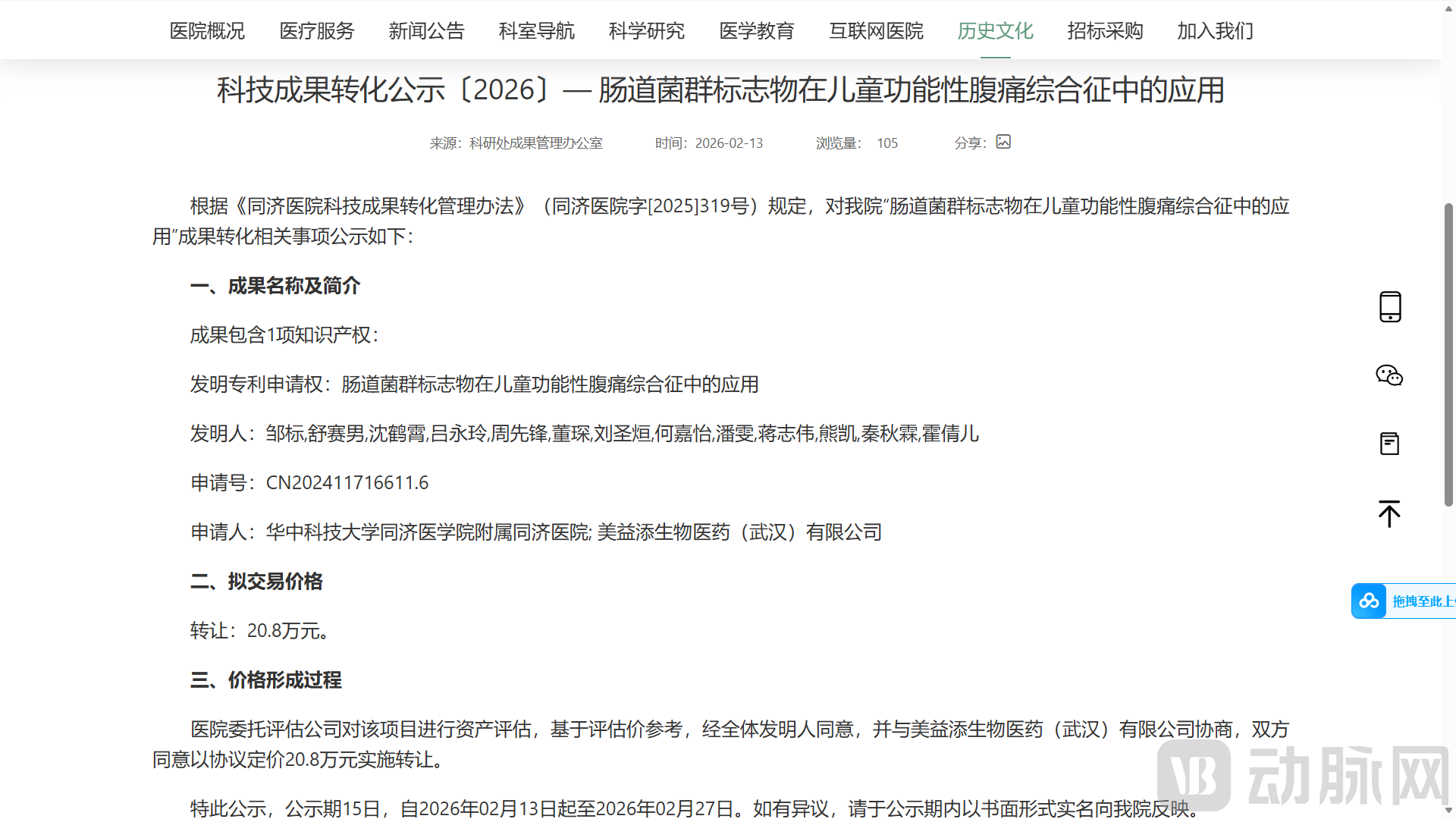
Image from the official website of Tongji Hospital, Tongji Medical College, Huazhong University of Science and Technology
This patent mainly providesA Non-Invasive Method for Assisted Diagnosis and Prediction, by extracting microbial genomes from stool samples of the enrolled children for metagenomic sequencing,Specific detection of Bacteroides vulgatus, Ruminococcus, and LachnospiraceaeThe relative abundance of these three gut microbiota biomarkers was used to construct a prediction system to assist in the diagnosis of functional abdominal pain syndrome in children.
Pediatric Functional Abdominal Pain Syndromes (FAPs), Also Known as Chronic Idiopathic Abdominal Pain, refers to a functional disorder characterized by persistent or frequently recurring abdominal pain lasting more than six months, which is unrelated or only minimally related to organic gastrointestinal lesions. According to the Rome IV diagnostic criteria, episodes of abdominal pain in nonspecific functional abdominal pain are typically not clearly associated with physiological events such as eating, defecation, or menstruation.
Reportedly, the global prevalence of functional abdominal pain disorders in children is approximately 11.7%, with a rate of about 13% in Asia. In China, the prevalence among children aged 4 to 18 years accounts for more than half of all pediatric abdominal pain cases and shows a gradually increasing trend. However, due to age-related limitations and constrained cognitive abilities, affected children often provide inaccurate descriptions of the location and characteristics of their abdominal pain, which can easily lead to the condition being overlooked or a shift in diagnostic and therapeutic focus.
Frontier research indicatesGut Microbiotahas become an important factor in the development and persistence of the disease, with its clinical symptoms correlating toAbnormalities in Central Pain Modulation, Reduced Visceral Pain Threshold, and Visceral Hypersensitivity Resulting from Brain-Gut Interactionsclosely related. However, current clinical interventions for this disease are limited, primarily consisting of comprehensive approaches such as cognitive behavioral therapy, dietary adjustments, and probiotics. There is a lack of specific gut microbial biomarkers in clinical laboratory practice that can objectively predict outcomes and assist in diagnosis.
In response to the aforementioned clinical challenges in diagnosis, the research team at Tongji Hospital, affiliated with Tongji Medical College of Huazhong University of Science and Technology, has conducted an in-depth study on the association between the composition of gut commensal microbiota and functional abdominal pain syndrome in children.
To identify detection biomarkers with high specificity, the research team established stringent inclusion and exclusion criteria and collected43 CasesFecal samples were collected from patients diagnosed with functional abdominal pain syndrome in children, and 43 fecal samples from healthy children were matched as a control group. The team employedCetyltrimethylammonium Bromide MethodMicrobial genomic DNA was extracted from the samples, and high-throughput metagenomic sequencing was performed using a sequencing platform to obtain raw data. Quality control and host sequence removal were conducted using KneadData, followed by in-depth bioinformatics analysis using LEfSe software.For the first time, researchers have identified a significant association between three prokaryotic species—Bacteroides vulgatus, Ruminococcus, and Lachnospira—and functional abdominal pain syndrome in children at the species level.Abundance statistics from metagenomic sequencing confirmed that, compared with healthy controls, the relative abundances of these three target bacterial species were markedly reduced in fecal samples from affected children. This fundamental finding successfully fills a gap in the application of gut microbiota profiling to diagnostic technologies for this disease.
Based on the identification of core biomarkers, this patent further utilizes these three microorganismsDevelopment of a Prediction System for Pediatric Functional Abdominal Pain Syndrome Using Relative Abundance as the Core Detection Variable. To rigorously validate the clinical evaluation performance of this prediction system, the research team independently collected fecal samples from eleven affected children and eleven healthy children for specializedModel Validation Using the Receiver Operating Characteristic (ROC) Curve. Binary logistic regression analysis of taxonomic abundance data visually revealed the predictive power of different bacterial species combinations in clinical statistical data.
Experimental results indicated that when a single bacterial species was used for model prediction, *Bacteroides vulgatus* demonstrated significantly superior predictive capability for the disease compared to other individual species. Furthermore, the combined use of *Bacteroides vulgatus*, *Ruminococcus*, and *Lachnospiraceae* as detection variables exhibited excellent diagnostic predictive performance.
Broadening the Industrial Perspective toThe Macro-Ecosystem of In Vitro Diagnostics and Microbiome Medicine, adjunctive diagnostics based on gut microbiomics are in the midst of intense commercial competition. With the widespread adoption of high-throughput sequencing technologies and the maturation of AI-driven multi-omics algorithms, gut microbiota testing has fully transitioned from traditional research services to the implementation phase as compliant medical devices and companion diagnostics.
XBiomeAs the first AI-driven pharmaceutical company in China dedicated to gut microbiome therapeutics, it is leveraging an innovative drug development model and a big data analytics platform to deeply focus on the development of companion diagnostics and patient stratification biomarkers. Its core business aims toUnraveling the Therapeutic Foundations of Immune Microecological Therapy for Complex Diseases Such as Cancer and Autoimmune Disorders, therebyConstruction of Gut Microbiota Profiles for Patients with Different Responses, providing a clear diagnostic basis for developing more precise fecal microbiota transplantation (FMT) protocols.
Realbiofocuses onEarly Microbiome Screening and Pathogenic Microorganism Diagnosis for Gastrointestinal Tumors. Leveraging its advanced high-throughput sequencing and bioinformatics analysis capabilities, the company has launchedCore Diagnostic Products for Early Screening of Colorectal CancerBy precisely capturing specific aberrant changes in the gut microbiome, its technology enables non-invasive and effective interception of precancerous lesions, securing a significant share in the niche market of early microecological screening for major diseases.
Overall, the competitive landscape in the current microbiome diagnostics sector is largely concentrated onEarly Screening for Major Diseases, Companion Diagnostics, and Pan-Health Microbiome Assessment. Major industry leaders are establishing formidable competitive barriers by leveraging precise diagnostic targets for specific diseases or underlying AI-driven big data platforms, and the overall industry landscape is rapidly shifting toward“Disease-Specific Testing” and “Integrated Diagnosis and Treatment”Directional Evolution.
The patent for the application of gut microbiota biomarkers, transferred by Tongji Hospital affiliated with Tongji Medical College of Huazhong University of Science and Technology, provides a non-invasive auxiliary diagnostic tool for pediatric functional abdominal pain syndrome with high sensitivity and specificity. Against the industrial backdrop of precision microbiome medicine steadily permeating clinical practice, the translational implementation of this foundational discovery not only substantially advances the research and development of related test kits and prediction systems, but also opens new avenues for medical R&D aimed at developing specific live biotherapeutic products to intervene in pediatric gastrointestinal dysfunction.