

Tongji Hospital Licenses Pediatric Wound Debridement Device Patent for RMB 215,000
Recently, Tongji Hospital Affiliated to Tongji Medical College of Huazhong University of Science and Technology released a public notice on the transformation of scientific and technological achievements. The hospital intends to transfer its proprietary technology through negotiated pricing.“A Debridement Device for Pediatric Surgical Wounds”The relevant patents have been assigned to Zhongke Yichuang Biotechnology (Suzhou) Co., Ltd. for use, with the transfer fee denominated in RMB.RMB 215,000. The inventor of this patented technology isLi Dandan。
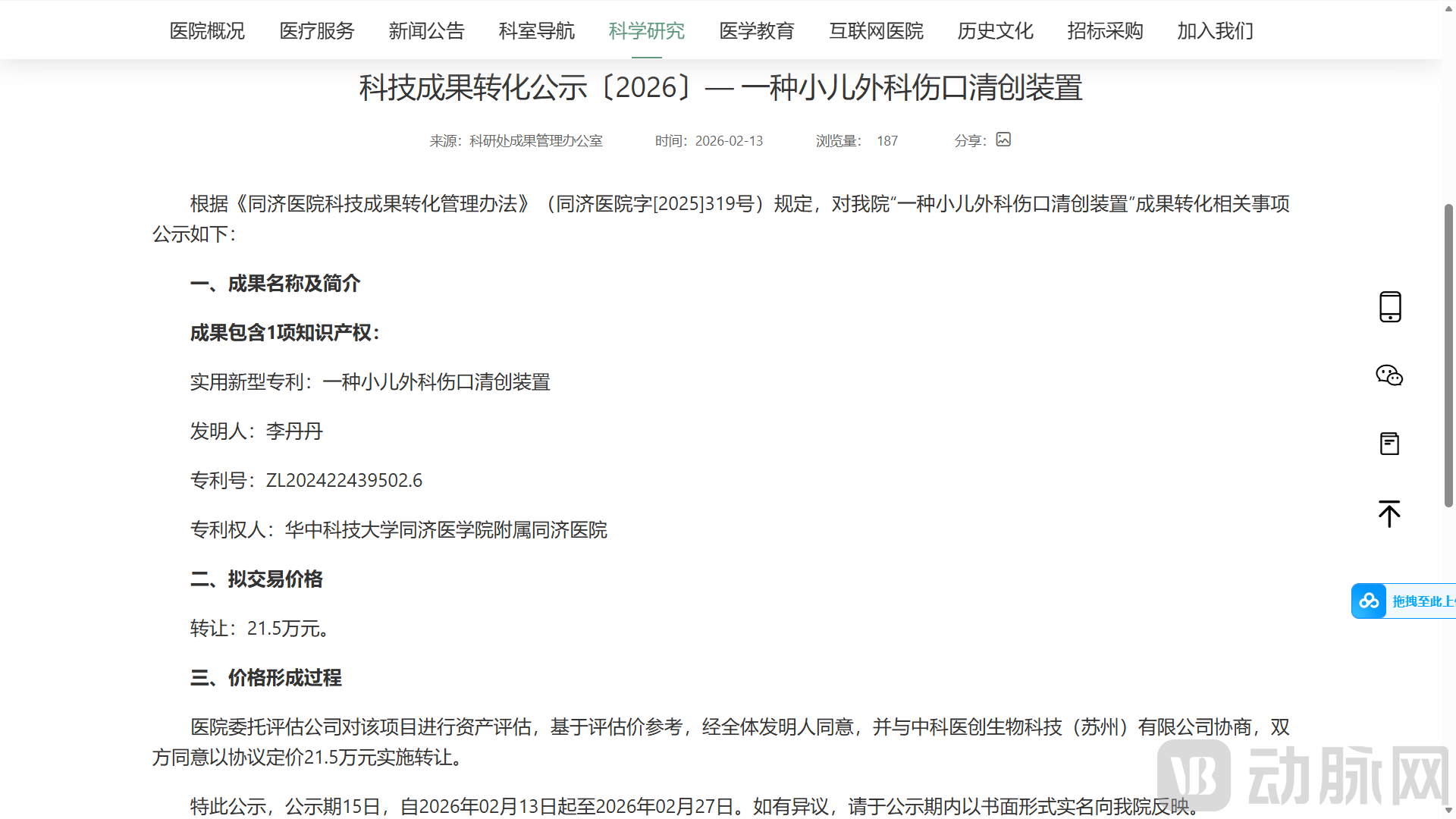
Image from the official website of Tongji Hospital, Tongji Medical College, Huazhong University of Science and Technology
This technology isA Pediatric Surgical Wound Debridement Device, belonging toMedical Device Sector, specifically designed for wound debridement in pediatric surgical clinical practice. Its core purpose is to address the issues of patient discomfort and non-compliance during debridement caused by excessively low temperatures of disinfectants in traditional pediatric debridement devices, while simultaneously optimizing the convenience and practicality of debridement procedures.
Pediatric Surgical Wound DebridementIt is a fundamental and critical clinical therapeutic procedure. The core requirement is to efficiently remove necrotic tissue, blood clots, and foreign bodies from the wound while maximizing the child’s comfort during treatment and minimizing resistance, thereby balancing operational convenience with environmental cleanliness. This is particularly important for younger children, for whom a gentle and humanized debridement approach is essential.
Clinically, traditional open debridement requires medical staff to manually wipe and irrigate wounds. This approach is not only inefficient but also poses a risk of secondary injury to pediatric patients due to improper control of force. Furthermore, the lack of protective design in open procedures exposes children directly to the debridement process, often triggering intense fear and resulting in non-compliant behaviors such as crying and evasion, which significantly compromise the progress and efficacy of debridement.
However, conventional pediatric debridement devices currently used in clinical practice, while simplifying certain procedural steps, still present significant clinical pain points:
First,Disinfectant Solution Without Heating Function, direct irrigation of wounds with disinfectants at room temperature or even low temperatures can easily irritate the delicate wound tissue in pediatric patients, causing stinging and discomfort, and exacerbating their resistance; this issue is particularly prominent during the autumn and winter seasons.
Second,Fixed Device Height, it cannot be flexibly adjusted according to the height of pediatric patients, their positioning, and the operational needs of medical staff. Young children are required to passively maintain specific positions, which often leads to crying and fussiness. Meanwhile, healthcare professionals must bend over or lean forward during procedures, increasing physical fatigue and the risk of operational errors.
Third,Waste-Free Centralized Collection System, during debridement, wastewater and waste fluids flow indiscriminately, which not only contaminates the operative environment but also predisposes the wound to secondary contamination, thereby increasing the risk of wound infection.
In addition,Existing debridement devices lack user-friendly designs to prevent direct line-of-sight exposure., the child can clearly see the wound and the debridement procedure, which is highly likely to cause psychological trauma and even lead to resistance toward subsequent medical interventions; meanwhile,Some devices rely on manual delivery of disinfectant., lacks an automated pumping structure, features a cumbersome operational procedure that is difficult for a single person to complete and requires coordination among multiple medical staff, thereby increasing healthcare labor costs; furthermore, the volume of disinfectant delivered is difficult to control precisely, leading to inadequate irrigation or waste.
Therefore, existing pediatric surgical wound debridement techniques suffer from drawbacks in practical application, including poor patient comfort, low compliance, inadequate operational adaptability, and suboptimal environmental control. There is an urgent need for a humanized, adjustable, and automated improved debridement device to meet the clinical demand in pediatrics for upgraded debridement therapy that is gentle, efficient, and convenient.
This pediatric surgical wound debridement device features targeted innovative design to address the shortcomings of existing clinical technologies, focusing onComfort, Adaptability, Human-Centered Design, ConvenienceTechnological Upgrades Across Four Core Dimensions: Comprehensively Optimizing the Clinical Operational Experience and Therapeutic Outcomes of Pediatric Wound Debridement, with Significant Core Technical Advantages:
Precision Temperature Control for Disinfectant Significantly Enhances Debridement Comfort
Added to the disinfectant delivery path of the deviceHeating Block, internalIntegrated Helical Copper Tube, Staggered Baffles, and Electric Heating Element, the flow straightener extends the path of the disinfectant solution, enabling the heating element to thoroughly and uniformly heat the solution within the copper tube. The heating temperature can be flexibly adjusted via the control panel, thereby fundamentally preventing discomfort caused by cold disinfectant irritating the pediatric patient’s wound, significantly reducing resistance behaviors, and enhancing comfort during the debridement process.
Highly Flexible and Adjustable, Adaptable to Multi-Scenario Clinical Operations
Driven by a lifting motor that rotates the lead screw, the lifting block moves smoothly up and down along the guide rod., enabling highly flexible adjustment of core components such as the heating block and water basin, precisely accommodating pediatric patients of varying heights and positions, while allowing medical staff to maintain comfortable operating postures, thereby reducing operational fatigue and the risk of errors, and meeting the diverse needs of debridement procedures in pediatric clinical practice.
Humanized Anti-Glare Design to Alleviate Pediatric Patients' Psychological Fear
The top of the water tank is specially equipped with baffles and circular openings., the child's limbs are inserted through the circular opening to complete debridement. The baffle effectively blocks the child's line of sight, preventing direct visualization of the wound and the debridement procedure. This alleviates the child's fear and resistance on a psychological level, enhances treatment compliance, and ensures the smooth progression of the debridement operation.
Centralized Collection of Waste Fluids to Maintain a Clean and Safe Operating Environment
Device ConfigurationIndependent Wastewater Tank, connected to the bottom interior of the water reservoir via a catheter, allowing wastewater and waste fluids from debridement to flow directly into a waste collection tank for centralized storage and subsequent unified discharge through a drain outlet. This effectively prevents environmental contamination and secondary wound infection caused by uncontrolled spillage of waste fluids, thereby enhancing the cleanliness of the operational environment and treatment safety.
Automated Disinfectant Delivery Enhances Clinical Operational Efficiency
Disinfectant Solution Tank with Dedicated Pump Assembly, enabling automated aspiration and delivery of disinfectant to replace traditional manual operations. This not only simplifies the debridement process, reduces the difficulty for single-operator procedures, and lowers medical labor costs, but also ensures precise control over disinfectant volume, preventing inadequate irrigation or waste of solution, thereby significantly improving the operational efficiency of clinical debridement in pediatrics.
Compact and Rational Structural Design, Convenient and Easy-to-Control Operation
Integrated Design of the Device, with all components securely sealed and logically arranged. Core operations can be performed via the control panel located on the exterior of the basin, enabling one-touch height adjustment, disinfectant heating, and pump start/stop functions. The system is simple and intuitive to operate, allowing medical staff to quickly become proficient, and is suitable for various clinical scenarios such as emergency care and routine debridement.
Overall, this device perfectly addresses the core pain points of existing pediatric debridement techniques through multiple targeted structural and functional innovations. It meets clinical demands for enhanced patient comfort, operational convenience, treatment safety, and versatile adaptability, thereby providing a superior medical equipment option for surgical wound debridement in pediatric patients.
In the field of pediatric surgical wound debridement instruments, as clinical demand for more comfortable, patient-centered, and intelligent treatment continues to rise, medical device companies both in China and abroad have been focusing onTemperature-Controlled Disinfectant, Operational Adaptability, Child-Friendly Designfocusing on core areas for R&D and product iteration, domestic companies have risen rapidly through targeted functional innovations, while international brands leverage their technological expertise to dominate the high-end market, forming“Foreign Investment Leading, Domestic Products Catching Up, Niche Innovation”market competition landscape.
Henan Yubo Medical Device Manufacturing Co., Ltd.FocusTraumatic Wound Debridement DeviceTemperature Control FunctionR&D, its core productsMedical Trauma Debridement MachineEquipped with core functionalities for disinfectant delivery and precise temperature control, the device allows flexible adjustment of irrigation fluid temperature. This fundamentally prevents cold disinfectant from irritating wounds, meeting the debridement needs of sensitive populations such as pediatric and elderly patients. Additionally, the device can be used for irrigation and disinfection of skin and mucous membranes following animal scratches or bites, covering a wide range of clinical scenarios. The product has obtained the Medical Device Operation License, and its temperature-controlled debridement technology has been implemented in clinical practice, becoming a standard piece of equipment for pediatric trauma debridement in primary healthcare institutions.
Henan Qingling Medical Technology Co., Ltd.Deep DiveMedical Debridement DeviceR&D, launchedQingling Multifunctional Ultrasonic Pulse Therapy Instrument (Medical Wound Debridement Device)Has obtained the Class II medical device registration certification from the NMPA, and completed clinical validation at tertiary A hospitals such as Henan Provincial People's Hospital and The First Affiliated Hospital of Zhengzhou University. Its other productQS-830 Medical Wound Irrigation System with Pulsed Water Jet Technology, equipped with an intelligent customization system for efficient wound cleansing.
Shenzhen Pumen Technology Co., Ltd.As a leading enterprise in China's high-end medical equipment sector, it has launchedCareMaster-E Ultrasonic Debridement DeviceFocused on ultrasonic debridement therapy for human wounds, this device combines pressurized irrigation with negative pressure drainage using high-efficiency 25 kHz ultrasound to precisely remove bacteria and necrotic tissue from wounds. Equipped with a high-resolution touchscreen display, it supports multi-level adjustments, features detachable tips adaptable to various wound types, and offers compact, user-friendly operation. Developed by Shenzhen Pumen Technology Co., Ltd., the product leverages precise fluid control and a gentle debridement mode suitable for the clinical management of moderate to severe wounds in pediatric surgery. It has been adopted by the pediatric and surgical departments of numerous provincial-grade tertiary hospitals, becoming one of the core devices for pediatric debridement in high-end medical institutions.
In summary, this patented pediatric surgical wound debridement device precisely addresses the core clinical pain points in pediatric debridement.Precise temperature control of disinfectant, highly flexible equipment adjustment, ergonomic design to prevent direct exposure, centralized waste fluid collection, and automated transportSuch innovative designs have enhanced the comfort, convenience, and safety of debridement procedures, providing more suitable medical device solutions for wound debridement in pediatric surgery.
In the future, as the demand for humanized and specialized medical devices in pediatrics continues to rise, the sector for pediatric debridement instruments will evolve toward intelligent functionality, child-friendly design, and technological integration. Such targeted innovative designs will become the mainstream focus of industry R&D, continuously driving technological upgrades and optimizing clinical applications of pediatric debridement equipment, thereby better meeting the diagnostic and therapeutic needs of pediatric clinical practice.