

Dongguan People's Hospital to Transfer CT-Guided Puncture Navigation Patent for RMB 250,000 Plus 5% Royalty
Recently, Dongguan People's Hospital released a public notice on the proposed conversion of its patented scientific and technological achievements, intending to transfer its independently developed“A CT-Guided Puncture Navigation Method, Device, and Terminal Equipment”The patent is proposed to be transferred to Dongguan Yixing Medical Technology Co., Ltd. via assignment of patent rights, with a proposed transaction price ofA one-time transfer fee of RMB 250,000 plus a 5% royalty on annual net sales, the inventors of this patent areGao Yun and his team。
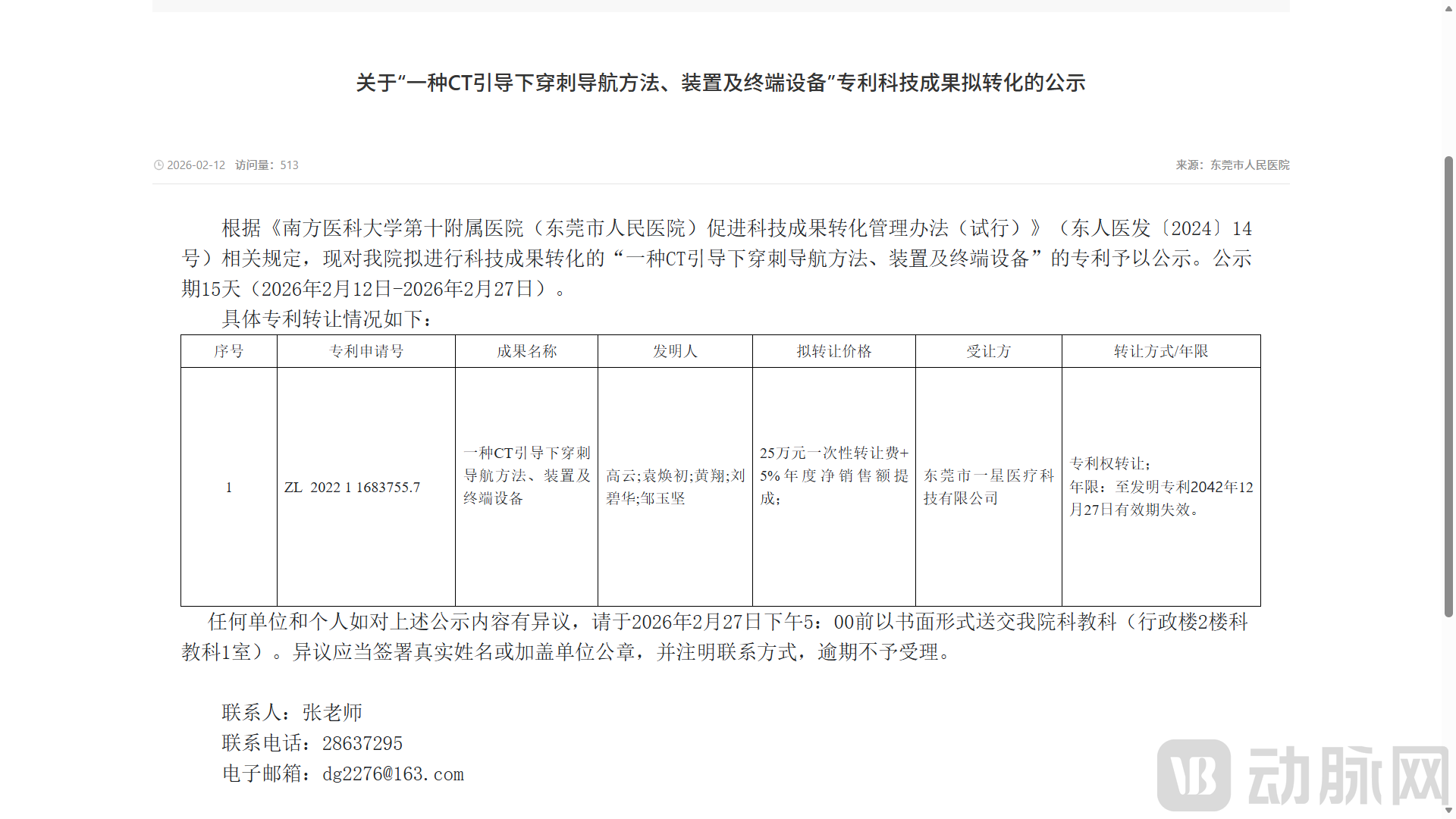
Image source: Official website of Dongguan People's Hospital
This patent focuses onCT-Guided Percutaneous Biopsy Technology, to address industry pain points associated with traditional blind puncture procedures—such as the inability to monitor in real time the relative positions of instruments and human anatomical structures, which often leads to repeated punctures and patient complications—we have innovatively developed a suite ofAn Integrated Puncture Navigation Solution Combining Laser Positioning, Image Registration and Fitting, and AI-Based Recognition and Tracking, throughLaser positioning marker lines calibrate the puncture site; dual-view cameras combined with convolutional neural networks identify the needle position; real-time registration and visualization align the puncture needle with CT images of the lesion plane., thereby achieving precision and visualization in puncture procedures without requiring special modifications to standard clinical puncture needles. It is compatible with existing clinical workflows and holds significant potential for clinical adoption.
Puncture BiopsyIt is a key minimally invasive technique for clinically diagnosing the nature of deep-seated lesions in the lungs and other internal organs. By precisely obtaining lesion tissue with needle-like instruments for pathological examination, it serves as the core basis for differentiating between benign and malignant lesions and formulating subsequent diagnosis and treatment plans. Due to its minimal trauma to the patient’s body, rapid postoperative recovery, and high clinical tolerance, this technique has become an important means for clinical lesion diagnosis.
Among clinical guidance techniques for needle biopsy, CT guidance has become the mainstream approach for biopsies of pulmonary lesions and other targets, owing to its unique advantages of high-resolution imaging, clear delineation of lesion location, and immunity to interference from factors such as gas. It holds an irreplaceable position in clinical practice.
However, current CT-guided needle biopsy protocols still suffer from numerous significant drawbacks, making it difficult to meet the clinical demands for precise and safe procedures:
First, CT scans require a relatively long time for single-image acquisition., failing to generate dynamic monitoring images during the puncture procedure and thus unable to provide real-time imaging guidance for physicians;
Second, CT imaging generates X-ray radiation., continuous operational scanning can pose certain health risks to patients and surgical staff;
Third, traditional procedures rely on freehand blind puncture., physicians can only determine the puncture site and needle trajectory based on preoperative CT images. During the procedure, they rely solely on clinical experience to judge the relative position of the needle and the lesion, which constitutes a stepwise blind puncture technique. This approach prevents real-time monitoring of the spatial relationship between surgical instruments and the patient’s internal anatomical structures, frequently leading to repeated punctures. Consequently, it exacerbates physical trauma to the patient and significantly increases the risk of post-procedural complications such as hemorrhage and infection, thereby severely compromising the precision and safety of clinical interventions.
To address the numerous pain points of existing technologies, there is an urgent clinical need for a practical and efficient CT-guided puncture navigation device. This device aims to resolve the core challenges of real-time visualization and precise positioning during puncture procedures. By reducing radiation exposure and lowering the complexity of clinical operations, it enhances the accuracy of puncture procedures, fundamentally minimizing patient injury and complications caused by repeated punctures, thereby addressing the clinical shortcomings of current CT-guided puncture biopsy techniques.
This CT-guided puncture navigation technology and its supporting devices are grounded in the actual clinical needs of puncture biopsy, achieving multiple innovative breakthroughs in technical principles, functional design, and clinical adaptability. Compared with traditional CT-guided puncture procedures, it demonstratesPrecision, Visualization, Intelligence, and UniversalityIts significant technical advantages, core innovations, and application benefits are reflected across multiple dimensions.
In terms of the precision of positioning and guidance, Technological InnovationIntegration of Laser Positioning and Precision Mechanical Positioning Technologies, by projecting positioning marker lines via the upper and horizontal lasers, the needle entry point and puncture scanning plane can be rapidly and accurately aligned with the preset reference points. Coupled with a PLC control system that drives servo motors to achieve precise vertical and horizontal positioning of the device, intraoperative adjustments can be flexibly performed using a foot switch or touchscreen, thereby ensuring the accuracy of puncture positioning from the initial stage of the procedure; meanwhileDual-view image acquisition of the needle using axial and sagittal cameras, leveraging a trained convolutional neural network to automatically identify the tail features of the puncture needle and precisely locate its axial and sagittal coordinates. It also performs professional corrections for coordinate errors and calculates the needle tip position in real time through coordinate computation, thereby ensuring comprehensive accuracy in puncture localization.
In the Visualization and Intelligence of Operational Procedures, this technology overcomes the technical limitations of traditional blind puncture,Accurately aligns and registers the real-time position of the needle during puncture with the CT scan images of the target lesion plane., synchronously displaying the relative positions of the needle and the patient’s internal anatomical structures and lesions on dual monitors; meanwhile, the guide laser beam projected by the overhead laser forms a projection of the needle tail on the display to assist in guidance, with the needle position data update frequency reaching>5–10 times/second, enabling near real-time dynamic visualization of the virtual biopsy needle, allowing physicians to intuitively monitor the entire puncture procedure. This completely resolves the critical challenge in traditional procedures where the relative positions of instruments and anatomical structures cannot be accurately determined, thereby achieving visualized and intelligent navigation throughout the puncture process. By fundamentally reducing the incidence of repeated punctures, it significantly lowers the risk of patient physical trauma and postoperative complications such as bleeding and infection.
In terms of the universality of clinical adaptation and promotion, this technology has undergone highly practical innovative design,There is no need to attach additional devices such as wires or light sources to the puncture needle, nor is there a need to use customized special puncture needles. The system can directly accommodate various types of puncture needles routinely used in clinical practice, aligning closely with the mainstream puncture procedures currently adopted in hospitals. Physicians do not need to significantly adjust their operational habits, which substantially reduces the learning curve for technology adoption and lowers the threshold for clinical application, thereby demonstrating strong potential for clinical promotion.
Furthermore,The supporting device balances convenience and flexibility in its hardware design,The base equipped with movable casters enables flexible device mobility. The movable articulated arm and rotating arm, paired with stepper motors, allow for flexible adjustment of the laser and camera positions and angles according to clinical operational scenarios. The dual-display design facilitates surgical observation of navigation images from different perspectives, comprehensively adapting to puncture procedure requirements for various anatomical sites, such as the lungs, and diverse clinical scenarios, thereby enhancing the practicality and adaptability of the technology in clinical applications.
Meanwhile, this technology can reduce the need for repeated CT scans, thereby mitigating the health risks associated with X-ray radiation exposure to both patients and healthcare providers, thus balancing the dual requirements of operational safety and diagnostic efficacy.
The interventional radiology navigation equipment sector, where current CT-guided puncture navigation devices are positioned, is ushering in dual development opportunities driven by technological upgrades and market expansion, with the overall market exhibitingSteady Growth, Accelerated Localization, and Diversified Technological Integrationdevelopmental characteristics.
In terms of market landscape, international giants dominate the high-end segment by leveraging their accumulated technological expertise, while domestic manufacturers are accelerating their breakthroughs. They have not only significantly increased the localization rate of core components, thereby reducing equipment application costs, but are also gradually capturing the majority share of the domestic market by capitalizing on advantages in localized clinical adaptation and cost-effectiveness. Furthermore, their product reach is expanding from tertiary hospitals to grassroots medical institutions at the prefecture and city levels.
Meanwhile, national policies supporting innovative medical devices, improvements in the health insurance payment system, and growing clinical demand for greater precision and safety in minimally invasive surgery have further stimulated market demand, creating a favorable policy and clinical application environment for industry development.
Yida Health’s IQQA-Guide Puncture Navigation System is the first Class III medical device approved in China for navigated puncture of solid organs in the lungs and abdominal soft tissues., having secured the NMPA’s “Green Channel” designation for innovative medical devices and holding FDA certification, its core components consist of the main unit, an electromagnetic generator, and proprietary navigation software, and it is required to be used in conjunction with specific electromagnetic instruments. This product features“IQQA Personalized 3D Fully Quantified Organ Electronic Map”Supported by core technologies, the system enables precise navigation planning based on patient CT data preoperatively and achieves intraoperative surgical navigation via electromagnetic positioning. It provides comprehensive, quantitative navigation throughout procedures involving soft-tissue organs, along with intelligent automatic tracking of surgical targets and real-time localization and guidance using 3D quantitative imaging. Compared with conventional CT-guided methods, it enhances the accuracy of puncture procedures, reduces the number of needle insertions and intraoperative CT scans, and is suitable for various minimally invasive interventional procedures, including puncture biopsy, ablation therapy, and drug injection for the lungs and abdominal solid organs.
IQQA-Guide, a needle biopsy navigation system, boasts extensive and mature market deployment. It has been implemented in hundreds of renowned hospitals both domestically and internationally, covering numerous top-tier Grade A tertiary hospitals in China while also entering the mainstream U.S. healthcare market. This product has not only become a critical adjunct for minimally invasive interventional procedures for thoracic and abdominal tumors in core medical institutions within first-tier cities, but also leverages Medda Health’s technological infrastructure to facilitate the downward distribution of high-quality medical resources. It has been widely adopted in prefecture-level hospitals as well as medical institutions in remote and ethnic minority regions, thereby enhancing precise surgical diagnostic and therapeutic capabilities at the grassroots level. With a wealth of clinical application cases, its related clinical research and application outcomes have been published in numerous professional journals. Furthermore, backed by a mature technical framework and extensive clinical validation, IQQA-Guide has emerged as a benchmark product in the field of CT-guided needle biopsy navigation, establishing significant brand recognition and technical influence within the industry.
RuideTai Intelligent Puncture Surgery Laser Positioning System is a high-end innovative medical device that has obtained the National Class III Medical Device Registration Certificate.Preparation, alsoNational Pre-Review Products, primarily based on the world's first“Isocenter + Cartesian” Composite Spatial Localization Architecture, it is not merely a positioning tool, but an integrated surgical guidance platform that combines intelligent planning, coordinate resolution, and laser positioning. The system achieves full coverage of puncture angles, providing stable guidance for punctures at any angle even under complex patient positions and anatomical conditions, thereby accommodating challenging scenarios involving cross-sectional or multi-needle punctures. Its proprietary software enables physicians to directly plan the optimal puncture path within the CT image coordinate system. By translating digital parameters into laser positioning instructions through a high-precision coordinate transformation model, the system intuitively projects the entry point, angle, and depth onto the patient’s body surface. This eliminates the need for attaching skin markers throughout the procedure, effectively avoiding errors caused by marker displacement and visual interpretation, while significantly enhancing the precision and operational flexibility of puncture procedures.
The market deployment of this system is advancing rapidly, with installations completed in numerous medical institutions across China. It has accumulated extensive clinical experience in puncture procedures involving solid organs in the thoracic and abdominal cavities, establishing itself as a critical guidance device for minimally invasive interventional surgeries. As a regional innovation achievement in high-end medical devices, the product was selected for local pilot programs on the integrated application of innovative medical devices and recognized as the first-of-its-kind major technical equipment at the local level, garnering policy support and acknowledgment. Leveraging its strong adaptability and simplified operational workflow, the system not only facilitates complex puncture procedures in tertiary hospitals but also provides technical support for the decentralization of medical resources, catering to percutaneous interventional needs across medical institutions of varying tiers. Consequently, the brand’s industry influence in the puncture navigation sector is steadily growing. Furthermore, building on the technological foundation of this system, the company has extended its R&D efforts to develop related surgical robot products, forming a progressive product portfolio.
The CT-guided puncture navigation technology and device involved in this patent, based on the technical design of laser positioning and AI recognition fusion, combinesPrecision, Visualization, and Clinical Universalitycharacteristics, it has promising market prospects under the current market development trends.
As the patented achievements are successfully commercialized and industrialized, leveraging the practicality and adaptability of the technology itself, and aligning with the development trends of localization and accessibility in China’s puncture navigation equipment market, this technology and device are poised to establish differentiated application advantages in clinical scenarios such as thoracic and abdominal puncture biopsy. This will further enrich the product portfolio of domestically produced puncture navigation equipment, create greater opportunities for clinical application and market promotion, and provide new practical directions for technological innovation and clinical implementation within the industry.