

Tongji Hospital of Huazhong University of Science and Technology to Transfer Thyroid Positioning Cervical Pillow Patent for RMB 50,000
Recently, Tongji Hospital affiliated to Tongji Medical College of Huazhong University of Science and Technology released a public notice on the transformation of scientific and technological achievements. The hospital intends to transfer"Thyroid Positioning Neck Pillow"The relevant patents were assigned to Hunan Tiweikang Medical Supplies Co., Ltd., with an assignment fee of RMB¥50,000。
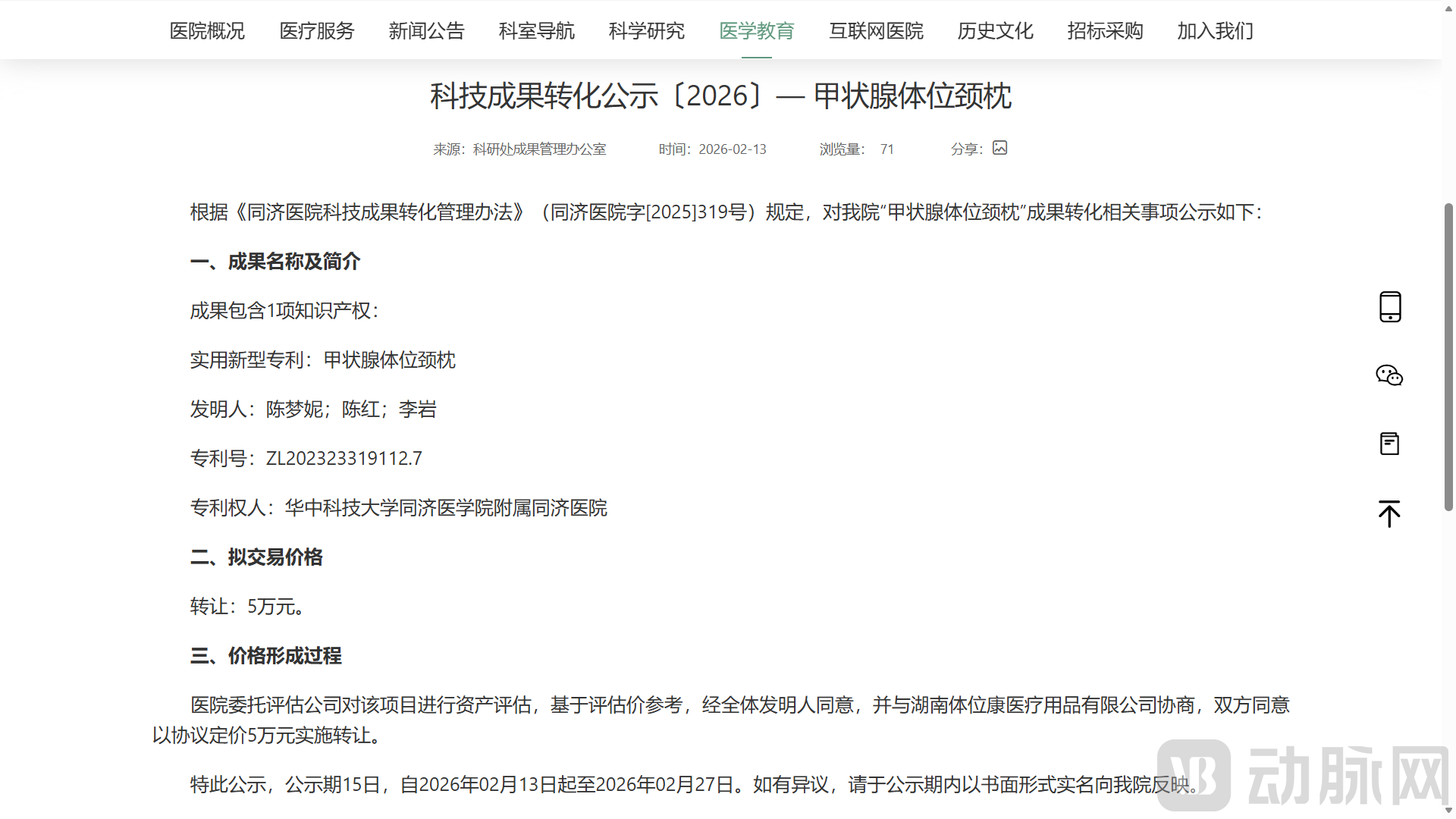
Image from the official website of Tongji Hospital, Tongji Medical College, Huazhong University of Science and Technology
This thyroid positioning neck pillow is a utility model patented medical device developed by Tongji Hospital, affiliated with Tongji Medical College of Huazhong University of Science and Technology, primarily used forThyroidectomy (Open/Endoscopic) and Other Head and Neck Surgeries, providing precise and customized positional support for the patient's head and neck, addressing the pain points associated with traditional positioning pads, while enhancing patient comfort during surgery and reducing the risk of postoperative complications.
In thyroid and head and neck surgery,Precise Support and Fixation of Patient Head and Neck PositioningIt is key to ensuring the smooth conduct of surgery and reducing postoperative complications. However, current clinical positioning cushions present significant pain points in terms of individual fit, operational convenience, and safety protection, which not only increase the difficulty for medical staff but also elevate patients’ intraoperative discomfort and the risk of postoperative positional complications, thus becoming a core issue urgently needing breakthrough in clinical practice.
Traditional positioning cushions are available in integrated and modular designs, neither of which can meet the need for personalized support:The integrated design adopts a standardized approach, suitable only for patients with standard body types. It fails to conform to the varying physiological cervical curves of different patients, resulting in inadequate exposure of the surgical field and causing patient discomfort due to localized pressure. Although the modular design allows for simple component adjustments, it lacks a systematic fitting mechanism, leading to insufficient precision. Furthermore, its fragmented components give rise to operational and management challenges.
At the level of surgical operations, traditional positioning pads significantly increase labor costs and pose a risk of contaminating the surgical field.During the suturing phase, the split-type positioning cushion requires manual removal of the shoulder pad, which risks contaminating the surgical field through accidental contact; its scattered components are also prone to loss or damage. Conversely, the integrated positioning cushion lacks adjustable support height and angle, necessitating patient repositioning during surgery—a cumbersome process that may compromise precise surgical positioning and disrupt procedural workflow.
In terms of patient safety and comfort, the lack of protective design in traditional positioning pads leads to a high probability of postoperative complications.The support surface is mostly made of ordinary hard materials, which cannot conform to the physiological curves of the head and neck, easily causing local pressure and muscle soreness. Additionally, there is no specialized head fixation structure, so patient head movement may affect surgical precision. Meanwhile, after suturing, the body position cannot be quickly and smoothly restored, easily leading to abnormal blood supply in the patient's head and neck. Combined with intraoperative compression, this significantly increases the risk of postural complications such as postoperative headaches and neck stiffness.
Furthermore,Existing positioning pads fail to account for the fixation requirements of anesthesia-related equipment, creating a gap in clinical safety protection.Tracheal intubation anesthesia is required for thyroid and head and neck surgeries. Traditional positioning cushions lack dedicated structures for securing the endotracheal tube, causing the intubation filter to directly contact the patient’s face, which can easily lead to pressure injuries. Furthermore, the absence of a fixed placement site for the endotracheal tube makes it prone to displacement and traction, thereby compromising anesthetic efficacy and posing potential risks to surgical safety.
Overall, current products in the field of thyroid surgery positioning support have yet to form an integrated solution that combines adaptability, convenience, safety, and comfort. Significant shortcomings remain in personalized support, surgical operation, equipment management, and patient protection. There is an urgent need for specialized positioning support devices featuring adjustability, robust fixation, and protective capabilities to overcome technical bottlenecks in the industry.
Positioning Cushion for Thyroid and Head and Neck SurgeryPoor individual fit, cumbersome operation prone to contamination, and high complication rates due to inadequate protectionthe industry's pain points, the patented thyroid positioning neck pillow technology developed by Tongji Hospital, affiliated with Tongji Medical College of Huazhong University of Science and Technology,Modular collaborative design of base + support mechanism + fixation mechanism, integrating adjustable, ergonomic, and multi-functional protective features, forming an integrated solution across positioning adaptation, surgical procedures, and patient safety, breaking through the limitations of traditional positioning pad designs, and providing clinical practice with precise, convenient, and safe surgical positioning support solutions.
The core advantages of this technology lie inAdjustable Layered Support Structure: Precisely Addresses Individual Fit Challenges, Balancing Surgical Field Exposure with Ergonomic Support.Abandoning traditional standardized design, a layered support mechanism is composed of adjustment, cervical spine support, and head support components. The telescopic rod at the base allows flexible adjustment of support height to accommodate the neck requirements of patients with different body types. The cervical spine support component uses memory foam to conform to the physiological curves of the neck and head, relieving local pressure while fully exposing the thyroid surgical area. The head support component features a funnel-shaped head and neck support groove, providing conforming support for the head, maintaining a natural position of the head and neck, and reducing intraoperative discomfort.
At the level of surgical procedures and safety, innovative contactless adjustment and restoration of patient positioning are achieved, fundamentally avoiding contamination of the surgical field and reducing labor costs.No disassembly of any components is required; intraoperative position fine-tuning and positional restoration during the suturing phase can be achieved solely through a telescopic rod, maintaining a no-touch approach to the surgical field throughout the procedure and eliminating contamination risks. The integrated base combines shoulder, neck, and head support components, addressing the issues of scattered, easily lost parts and high management costs associated with split-type products. Furthermore, patient positioning can be adjusted without moving the patient, significantly simplifying operations and enhancing surgical efficiency.
Meanwhile,Integrated Design of a Multifunctional Fixation Device: Filling the Gap in Anesthesia-Related Protective Accessories to Achieve Dual Protection Through Head Immobilization and Standardized Placement of Anesthesia Equipment.A fixation mechanism is added to the top of the head support assembly, where the Velcro component effectively secures the patient’s head to prevent intraoperative movement and displacement, thereby ensuring surgical precision. The stand hook allows for standardized fixation of the anesthesia endotracheal tube, preventing facial pressure injuries caused by the tube filter and avoiding displacement or traction of the tube, thus safeguarding anesthesia efficacy and airway patency. Additionally, protective cotton padding layered with memory foam support provides comprehensive, multi-dimensional comfort and protection for the head and neck.
This technology demonstrates significant efficacy in preventing and controlling postoperative complications, substantially reducing the incidence of position-related complications through scientific support and stable recovery positioning.Ergonomic support from memory foam reduces compression and traction injuries to head and neck tissues during surgery; smooth positional restoration driven by a telescopic rod prevents abnormal blood supply caused by sudden postural changes. This provides full-process protection from intraoperative support to postoperative recovery, effectively reducing the risk of complications such as postoperative headache, neck stiffness, and orthostatic hypotension, thereby improving patients' postoperative rehabilitation outcomes.
In addition,The technology adopts a modular, simplified design that balances clinical practicality with scenario adaptability, offering strong compatibility and ease of maintenance.The device features a modular assembly design, enabling convenient installation and use, allowing for rapid deployment in surgical procedures without complex operations. The memory foam of the cervical support component is covered with a protective sleeve that can be easily removed, cleaned, and replaced, meeting clinical sterility requirements. The equipment is compatible with open and endoscopic thyroidectomy procedures as well as various head and neck surgeries, eliminating the need to switch devices based on surgical type. This enhances the utilization efficiency of medical equipment and reduces investment costs.
In the clinically essential sector of positioning support for thyroid and head and neck surgeries, domestic and international enterprises and medical institutions are centering their efforts aroundInnovative Positioning Pad Structure, Precision Head and Neck Fixation, Ergonomic Adaptation, etc.R&D efforts and product commercialization are being advanced, creating a diversified competitive landscape characterized by standardized product portfolios from foreign enterprises, clinically customized innovations from domestic companies, and the translation of patented technologies from medical institutions. Product technology roadmaps encompass traditional integrated and modular positioning pads, inflatable positioning pads, and carbon fiber head-and-neck immobilization frames, with varying R&D progress and product positioning among different stakeholders.
Aerospace Center HospitalR&DInflatable Thyroid Surgery Positioning PadAs a customized innovation representative for domestic medical institutions, the product has been granted utility model patents. Its core design replaces traditional rigid supports with an inflatable structure, allowing flexible adjustment of support height and firmness by regulating inflation volume. This specifically addresses the poor individual adaptability of traditional positioning pads, optimizes head and neck positioning for thyroid surgery, and the patented product is currently in clinical trial phases.
Hua Xi Er MedicalofCarbon Fiber Surgical Head Frame + U-Shaped Head Rest Combination ProductAchieving large-scale clinical application, it has become the mainstream precision fixation device for head and neck surgeries. Its lightweight, high-strength carbon fiber construction features low X-ray attenuation, ensuring compatibility with intraoperative CT and X-ray imaging. The three-pin fixation system allows precise control of fixation force to prevent scalp pressure injuries, while the U-shaped headrest conforms to the physiological contours of the head, reducing the risk of facial pressure ulcers and providing stable head fixation for thyroid surgeries.
In the future, the field of positional support for thyroid surgery will evolve toward personalized precision fitting, multifunctional integration, operational convenience, and scenario-specific specialization. Integrated products featuring ergonomic design, adjustability, multiple protection modules, and adaptability to various surgical settings—including open and endoscopic procedures—will become the core focus of market R&D and implementation. Meanwhile, domestic products will achieve technological breakthroughs by deeply addressing clinical pain points, accelerating the industrial commercialization of patented technologies, gradually disrupting the market dominance of imported general-purpose products, and driving the industry toward specialized and refined upgrades that better align with actual clinical needs.