

Beijing Frontier Brain-Computer Interface Institute Officially Launched to Advance Clinical Translation and Core Technology Innovation
On March 27, at the Brain-Computer Interface Innovation and Development Forum held during the 2026 Zhongguancun Forum Annual Conference—co-hosted by the Ministry of Industry and Information Technology and the Beijing Municipal People’s Government—the Beijing Institute for Frontier Brain-Computer Interfaces was officially established. Led by Xuanwu Hospital of Capital Medical University, with Zhao Guoguang, the hospital’s president, serving as Chief Scientist, the institute represents a key initiative to respond to national strategic deployments for future industries and to strengthen Beijing’s innovative leadership in high-end medical equipment. Its establishment marks a new phase for China’s brain-computer interface field, characterized by clinical deep-needs-driven development and full-chain systematic translation.
The Beijing Frontier Brain-Computer Interface Research Institute addresses the urgent needs of over 100 million patients with neurological disorders in China, focusing on tackling core technologies and clinical translation in the field of brain-computer interfaces (BCI). The institute brings together senior experts such as Luo Minmin, Director of the Beijing Institute for Brain Science and Brain-Inspired Intelligence, and Jiao Liqun, Vice President of Xuanwu Hospital of Capital Medical University, striving to resolve the structural imbalance characterized by “technology outpacing application scenarios.” Relying on Xuanwu Hospital of Capital Medical University, the institute has established a medical-engineering interdisciplinary R&D model. In the future, it will build six common support platforms covering neuroelectrophysiological data resources, intelligent algorithm development, device development and testing, preclinical validation, biobanking, and clinical validation with third-party evaluation. This initiative aims to create multimodal neurological disease databases, large-scale neuroelectrophysiological models, and treatment protocols for neurological disorders, thereby forming a complete chain from data acquisition to validation.
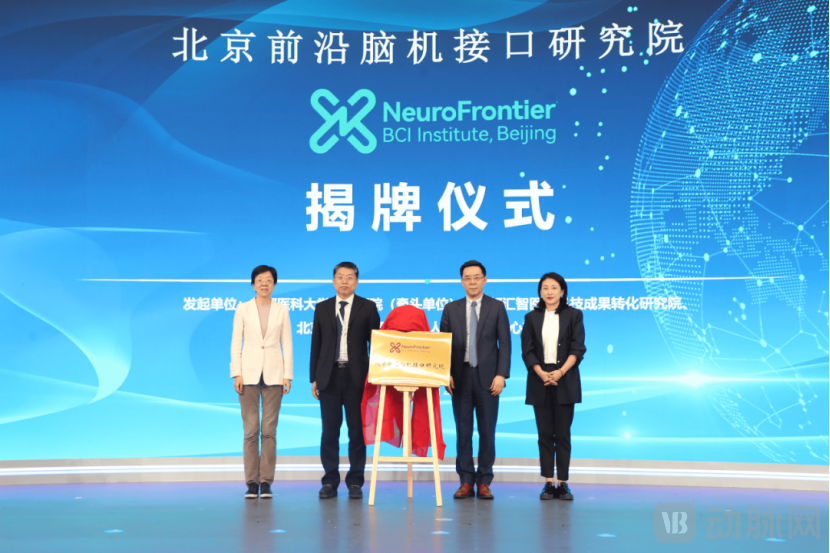
At the event, Gu Jinxu, Member of the Party Leadership Group and Deputy Director of the Beijing Municipal Bureau of Economy and Information Technology; Zhao Guoguang, President of Xuanwu Hospital; Liu Li, Member of the Working Committee and Deputy Director of the Administrative Committee of the Beijing Economic-Technological Development Area; and Wu Xia, Managing Director of CICC Capital, jointly unveiled the plaque for the Beijing Institute of Frontier Brain-Computer Interface.
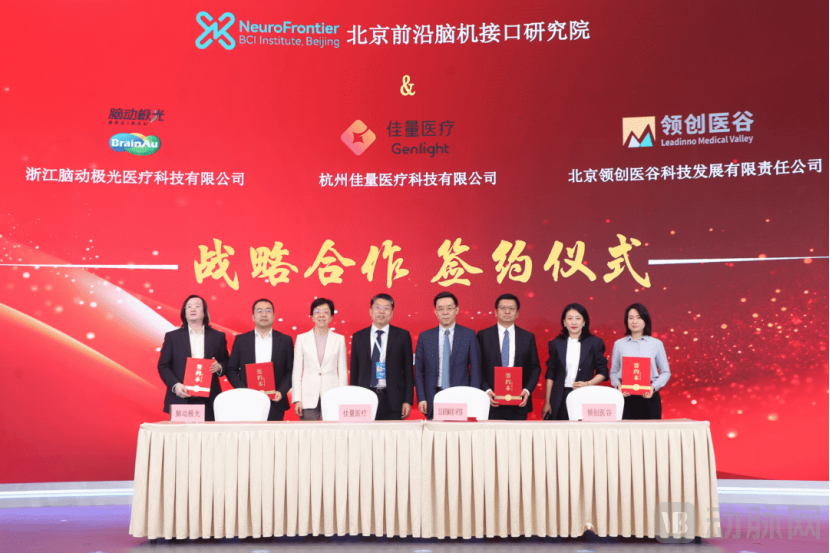
Jiao Liqun, Director of the Beijing Advanced Brain-Computer Interface Research Institute and Deputy President of Xuanwu Hospital, signed cooperation agreements on behalf of the Institute with the heads of three partner enterprises: Cai Longjun, CEO of Zhejiang Brain Aurora Medical Technology Co., Ltd.; Cao Peng, CEO of Hangzhou Jialiang Medical Technology Co., Ltd.; and Ding Shan, Co-founder and COO of Beijing Lingchuang Medical Valley Technology Development Co., Ltd. In the future, the Institute and industry partners will jointly advance R&D and clinical validation in key areas, including multimodal neurological disease databases, large-scale neurophysiological models, and closed-loop neuromodulation brain-computer interface products, thereby fostering an innovative ecosystem that integrates medicine with engineering and promotes collaboration between academia and industry.
Building on a solid scientific foundation that includes the world’s first clinical application of epidural brain-computer interfaces (BCIs), and with the establishment of a systematic R&D and translation platform, an innovation loop centered on clinical value—integrating the entire chain from “clinical research” to “technology development” and “industrial implementation”—is accelerating. In the future, the Beijing Institute for Advanced Brain-Computer Interface aims to become a leading domestic and world-class platform for BCI R&D and translation, contributing Chinese wisdom and solutions to the rapid global development of the BCI industry, ensuring that cutting-edge technologies tangibly benefit a broad patient population.