

CAMS Cancer Hospital Shenzhen to Transfer Gas Sampling Bag Valve Patent for RMB 50,000
Recently, the Shenzhen Hospital of the Cancer Hospital, Chinese Academy of Medical Sciences, released a public notice on the transfer of scientific and technological achievements, proposing to assign its utility model patent for “Gas Sampling Bag Valve” to Shanghai Shunchao Digital Technology Co., Ltd. The transfer fee is50,000 yuan. The inventor of this patent isDuan Boshi.
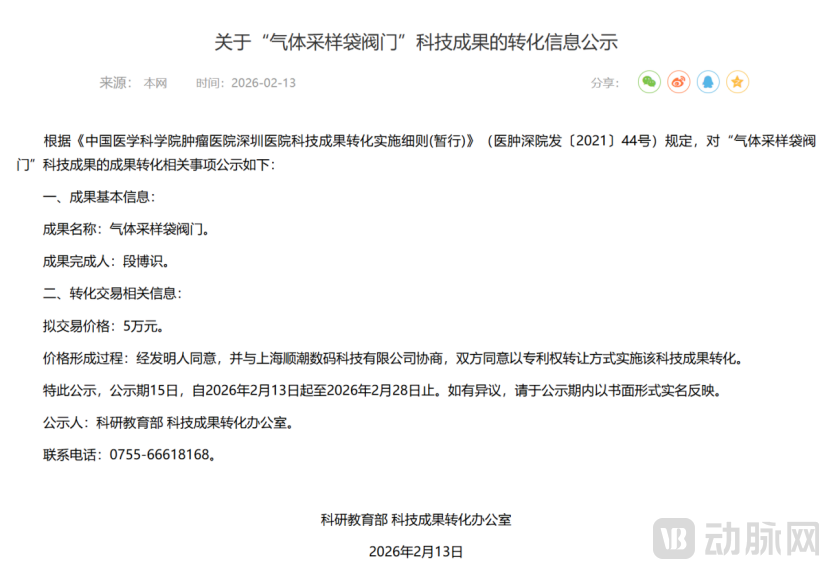
Image from the official website of Shenzhen Hospital of the Cancer Hospital, Chinese Academy of Medical Sciences
Gas Sampling Bag ValveIt is a core accessory for gas sampling bags in the medical device field, serving as the control switch for gas sample collection, storage, and release, and is a key component that ensures the air-tightness of the sampling bag and prevents sample contamination.
In the clinical practice of medical gas sampling and testing, traditional gas sampling bag valves serve as core components for the collection, storage, and transport of gas samples. However, significant defects in their structural design and sealing mechanisms have become key issues affecting sampling accuracy and operational efficiency. These specific pain points are manifested in three aspects:
Gas samples are prone to contamination, resulting in poor accuracy for the analysis of low-concentration volatile organic compounds.Traditional valves mainly consist of the valve body, switching knob, fasteners, and sealing gaskets. The valve core achieves sealing by contacting the air outlet of the fastener through a top gasket, with the gas in full contact with the rubber sealing gasket. During use, organic compounds volatilize from the rubber material and integrate into the collected gas samples, interfering with sample composition. This contamination issue is particularly problematic in the detection and analysis of low-concentration volatile organic compounds (VOCs), as it directly causes deviations in test results from actual values, failing to provide accurate data support for clinical diagnosis and scientific research analysis.
The product's structural design is complex, resulting in low efficiency in both production and usage.The fasteners of traditional valves require simultaneous machining of both internal and external threads. The external threads are used to connect with the internal threads of the valve body, while the internal threads are designed to accommodate the external threads of the valve core. This dual-thread machining process increases the complexity of production procedures, which not only reduces valve manufacturing efficiency but also elevates the rate of machining errors during production, resulting in a higher product failure rate. Meanwhile, the complex threaded mating structure adds to the intricacy of clinical operations; the time-consuming adjustment required for thread engagement between the valve core and the fastener diminishes the efficiency of gas sampling.
The reliability of the sealing structure is significantly influenced by installation procedures.The sealing efficacy of traditional valves is highly dependent on the installation precision of rubber gaskets; any deviation or wear of the gasket can lead to air leakage at the connection between the valve and the sampling bag film. Given the complex operational environment of clinical sampling, it is difficult to ensure that each installation meets precise sealing requirements, thereby further increasing the risk of sample leakage and contamination.
This patent for gas sampling bag valves features breakthrough innovations in structural design and sealing principles. Comprising three core components—the body, the valve core, and the fasteners—it fundamentally addresses the pain points of traditional products by optimizing component fit and sealing structures, thereby demonstrating significant core advantages and innovative features.
1. Simplified structure, significantly improved production and usage efficiency.The patented product abandons the traditional double-thread design of fasteners. A first external thread is provided on the outer periphery of the lower part of the valve core, and a second external thread is provided on the outer periphery of the lower part of the fastener; both engage with the same internal thread on the inner wall of the lower part of the valve body for connection. This simplifies the machining process of components, significantly improves valve production efficiency, and reduces the failure rate caused by complex structures. In clinical practice, the installation and debugging steps for the valve core and fastener are more concise. Manual rotation of the valve core’s gas nozzle tube enables on/off control of the valve, significantly enhancing operational convenience and effectively improving the efficiency of gas sampling.
Second, optimization of the sealing method to prevent gas sample contamination at the source.Structural matching seals are employed to minimize contact with rubber sealing elements. The hollow structure at the lower part of the valve core is designed in a trumpet shape, with a smaller opening at the upper end and a larger opening at the lower end. The top profile of the fastener precisely matches this structure, achieving airway sealing through tight contact between the two components. This design eliminates the need for rubber gaskets in the core sealing area, thereby fundamentally reducing contamination of gas samples by rubber volatiles. By minimizing the contact area of rubber sealing elements, the probability of contamination is reduced. Only a small number of sealing elements are installed in the groove beneath the protrusion of the valve core and at the lower end of the second external thread of the fastener. Furthermore, the gas contacts only the small end face of the sealing elements. Meanwhile, the threaded structure surrounding the sealing elements restricts gas movement and convection near the seals, maximizing the reduction of contamination impact from rubber sealing elements on the sample. This design is particularly suitable for gas sampling involving low-concentration organic volatiles.
3. Upgraded airtightness design, significantly improving sealing reliability.Multi-groove sealing ring design: Two, three, or more grooves can be arranged longitudinally on the lower part of the valve core protrusion, with a sealing ring installed in each groove. This multi-layered sealing structure significantly enhances the air tightness between the valve core and the body, reducing the risk of gas leakage.Anti-displacement design for sealing rings: A smooth cylindrical surface is set between the groove and the first external thread to effectively prevent the sealing ring from sliding into the threads, which could compromise the sealing effect, thereby ensuring the stability of the sealing structure.Reinforced sealing for sampling bag connection: A sealing washer is installed at the lower end of the second external thread of the fastener, creating a tighter seal at the connection between the valve and the gas sampling bag film, thus preventing air leakage at the sampling bag connection point.
Fourth, the components fit together precisely, ensuring high operational controllability.The length of the valve core’s gas nozzle tube exceeds that of the upper portion of the main body, leaving part of the nozzle tube exposed outside the main body to facilitate gas sampling operations. The protrusion in the middle of the valve core prevents it from passing completely through the main body, thereby providing positional limitation during installation and ensuring precise component fit. During clinical procedures, the valve core and fastening can be precisely adjusted by rotating the gas nozzle tube.contact state of the components, enabling precise opening and closing of the valve.
In the field of gas sampling, valves serve as core components of gas sampling bags. Their structural design, sealing performance, and cost-effectiveness directly impact sampling accuracy, operational efficiency, and resource utilization. In response to these critical requirements, various R&D entities have continuously pursued technological innovation and product optimization, resulting in the emergence of numerous patented products and high-quality complementary solutions that combine practicality with innovation.
“A Gas Sampling Bag Valve and a Gas Sampling Bag”Utility Model Patent (Publication No. CN223782665U): The split-type plug-fit design of the valve body and base enables non-destructive separation of the sampling bag from the valve, allowing the valve to be individually recovered and reused, thereby significantly reducing consumable waste. Meanwhile, the tapered transition end of the plug-fit section and the locking mechanism ensure both airtightness and secure connection between the valve body and the base, while facilitating easier assembly and disassembly. This design is compatible with various gas sampling bags, balancing practical usability with resource efficiency.
Self-sealing structure valve specially designed for gas sampling bags, developed by Dalian Haide Technology Co., Ltd.The self-sealing structure eliminates rubber contamination at its source by discarding traditional soft rubber seal designs. Instead, it achieves sealing through the tight junction of smooth surfaces made from plastics (such as PE, PP, and PTFE), metals (such as copper and stainless steel), or ceramics. These sealing surface materials are chemically resistant, corrosion-resistant, and non-leaching of organic compounds, thereby completely avoiding contamination of gas samples by rubber seals. The structure is adapted to the low-pressure sampling requirements of medical applications. In view of the low inflation pressure (3–6 kPa) characteristic of medical gas sampling bags, the valve’s volume and weight have been optimized to achieve a compact, lightweight, and exquisitely designed form factor. This facilitates sampling operations in clinical settings, ensures convenient opening and closing, and maintains rigorous sealing integrity even under low-pressure conditions.
DuPont's Tedlar gas sampling bags,It features the unique advantages of combining DuPont PVF polymer film with PTFE valves. The PVF film layer, approximately 0.05 mm thick, offers excellent chemical stability, UV resistance, and anti-aging properties, making it resistant to both prolonged sun exposure and acid/alkali corrosion. This makes it ideal for sampling tasks in outdoor or complex operating conditions. The PTFE (Teflon) valve, made from polytetrafluoroethylene, exhibits minimal gas adsorption and provides superior sealing performance, maintaining zero leakage even after more than 1,000 open-close cycles.