

Affiliated Hospital of Nantong University to Transfer Pharmaceutical Grinding Device Patent for RMB 50,000
Recently, the Affiliated Hospital of Nantong University released a public notice on the transformation of scientific and technological achievements, whereby the hospital intends to grant non-exclusive licenses for“A Drug Grinding Device for Drug Safety Testing”The relevant patents were assigned to Nanjing Feiqi Industry and Trade Co., Ltd., with an assignment fee of50,000 yuan. The inventors of this patent areNi Ronghua and Wu Wenyi。
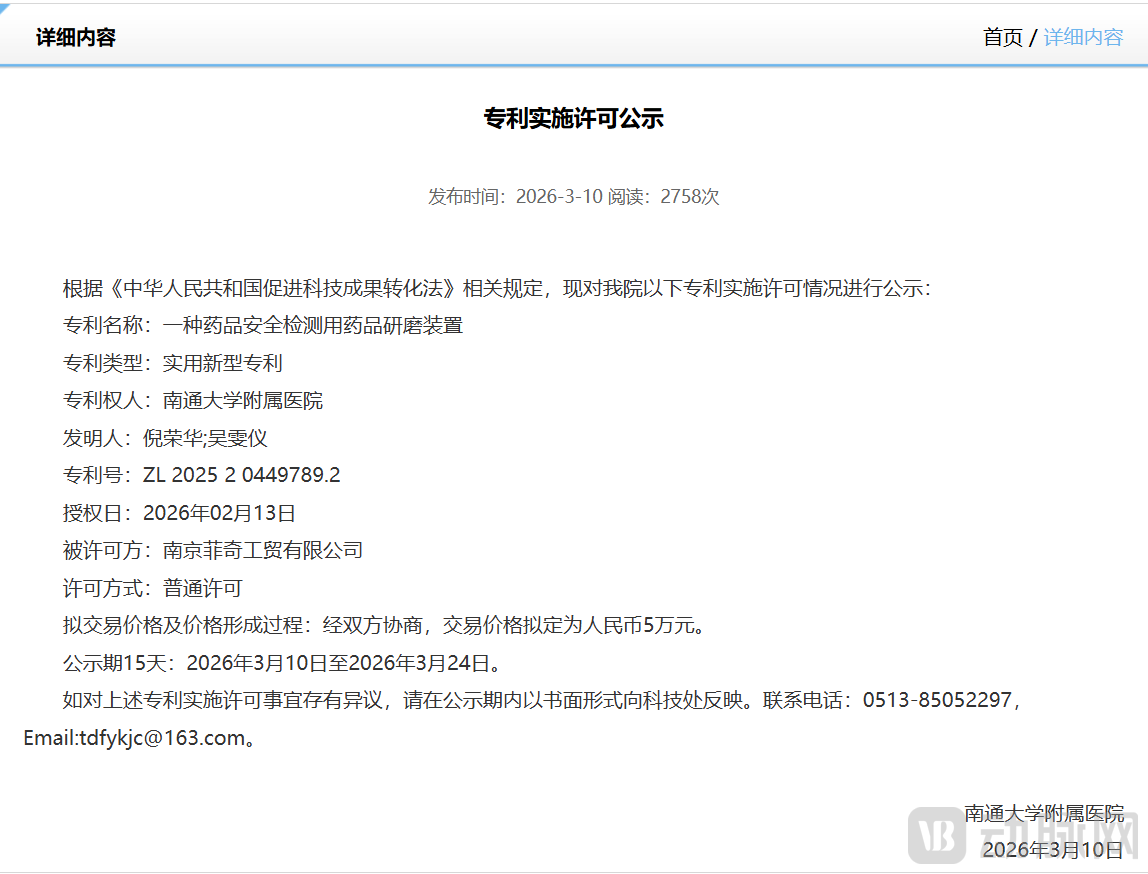
Image from the official website of Affiliated Hospital of Nantong University
This technology is aDrug Grinding Device Dedicated to Drug Safety Testing, affiliated withTechnical Field of Pharmaceutical Testing Equipment, its core function is to efficiently and thoroughly crush and grind solid pharmaceuticals during the drug safety testing process, producing drug powders that meet testing requirements. This addresses the issue of incomplete grinding associated with traditional milling devices, thereby providing a homogeneous sample basis for subsequent safety tests, including analyses of drug composition, quality, and heavy metals.
Drug Safety Testing: Drug Grindingis the core process of pre-analytical processing,Grinding EffectDirectly determines the accuracy of subsequent tests for ingredients, heavy metals, and other parameters, while pharmaceutical grinding equipment currently available on the market has long facedInsufficient grinding, poor process integration, and inadequate adaptabilitythe triple pain points, which have become the key bottleneck constraining the standardized and efficient advancement of drug testing.
In terms of grinding performance, existing equipment mostly adopts a single-stage grinding structure and lacks a pre-crushing stage., large solid drug substances are difficult to refine and grind, leading to issues such as uneven particle size and residual coarse particles. The compliance rate for particle size in some processed drug powders is low, which directly results in inadequate dissolution of subsequent samples and significant deviations in test data, failing to accurately reflect the actual quality of the drugs. Even though a few devices are equipped with crushing capabilities, design flaws in the interface between the crushing and grinding stages often cause drug accumulation, further reducing grinding efficiency and making it difficult to meet the stringent requirements for sample uniformity in drug testing.
At the level of equipment use and design, existing grinding devices suffer from unreasonable structures and low levels of automation.Some devices lack dedicated flow-guidance and positioning structures, making drugs prone to spillage and jamming during crushing and grinding. This not only results in sample waste but also increases the risk of cross-contamination due to residual samples within the equipment. Multiple steps, including feeding, grinding, and collection, often require manual assistance, which not only increases the workload of testing personnel but also reduces sample processing efficiency due to the variability of manual operations. Such systems are ill-suited for batch testing requirements. Furthermore, the collection components are cumbersome to disassemble and reassemble, with poor positioning stability, leading to a high risk of powder leakage.
In terms of adaptation and precision polishing, existing equipment features a monolithic polishing structure design with fixed arrangement and spacing of polishing protrusions., unable to adjust based on pharmaceutical properties such as tablet hardness and particle size, resulting in poor adaptability to drugs with different characteristics, such as hard tablets and soft capsule contents. This leads to either insufficient grinding of hard drugs or excessive grinding and caking of soft drugs, making it difficult to achieve precise grinding. Meanwhile, the grinding chamber lacks an effective barrier structure, causing some drugs to fall through without being fully ground. Additionally, there is no screening mechanism for qualified ground powder, leading to a mixture of unqualified particles and compliant powder, which further compromises the accuracy of subsequent test results.
Furthermore, existing equipment still suffers fromHigh Difficulty in Cleaning and MaintenanceThe crushing chamber and grinding chamber feature complex structures with predominantly fixed connections, lacking dedicated cleaning channels and detachable components. This makes it difficult to thoroughly remove drug residues after testing, facilitating bacterial growth and cross-contamination, thereby violating sterile requirements for pharmaceutical testing. Furthermore, the core grinding components exhibit insufficient wear resistance; prolonged use leads to protrusion wear and increased grinding gaps, which not only exacerbates inadequate grinding but also raises equipment maintenance and replacement costs.
For the Grinding Stage in Drug Safety TestingIncomplete grinding, poor process integration, and low operational efficiencythe core pain points, the team of Ni Ronghua and Wu Wenyi from the Affiliated Hospital of Nantong University developed the patented technology "A Drug Grinding Device for Drug Safety Testing," which“Pre-crushing + Fine Grinding” Stepwise Design + Multi-component Collaborative OptimizationCreate an integrated grinding solution, with comprehensive upgrades from the grinding process and structural design to practical application, thoroughly addressing the industry limitations of traditional devices, such as single-function grinding, suboptimal performance, and cumbersome operation.
This technology achieves a core breakthrough in the grinding process, breaking away from the traditional model of direct grinding by conventional equipment.Innovative "Crush First, Grind Later" Stepwise Processing System, fundamentally resolving the issue of insufficient grinding of large drug chunks. A dedicated crushing mechanism performs pre-treatment on the drugs: the materials to be ground are guided by a flow plate into the space between extrusion plates featuring staggered crushing protrusions. An actuator drives the extrusion plates to move toward each other, crushing large drug chunks into smaller, easily grindable pieces, thereby laying the foundation for fine grinding. This innovation fills the gap left by traditional equipment, which lacks a standardized pre-crushing process, and significantly improves the completeness and uniformity of grinding.
At the structural design level, this technology achievesMulti-Structure Collaborative Optimization + Precision Transmission Design, resolving the challenges of drug accumulation, poor connectivity, and low grinding efficiency associated with traditional equipment. A multi-dimensional flow guidance system is established, where the automatic opening and closing support plate of the crushing mechanism, combined with a guide plate featuring a sloped surface, ensures that drugs fall without accumulation; meanwhile, baffles on the outer side of the grinding chamber guarantee that all materials enter the grinding area. A high-efficiency grinding structure is designed, in which the interlocking grinding protrusions of the grinding balls and the grinding shell, coupled with the precise transmission of the grinding drive motor, achieve fine grinding. The through-slot at the bottom of the grinding shell simultaneously completes the screening and discharge of qualified powder, realizing an integrated “grinding + screening” process. The collection and fixation structure is optimized, featuring a slidable collection box with positioning bolts to enable quick disassembly/assembly and sealed collection, thereby improving material retrieval efficiency and meeting actual testing requirements.
Furthermore, this technology possesses in practical applicationsHigh automation, strong adaptability, and easy maintenancesignificant advantages, fully meeting the standardized requirements for pharmaceutical safety testing. The entire process—crushing, feeding, grinding, and collection—is driven by automation without manual intervention, which reduces workload, avoids human operational errors, and enhances the standardization and efficiency of sample processing; the actuator can flexibly adopt forms such as electric linear actuators or hydraulic rods, while staggered grinding protrusions are adapted to solid pharmaceuticals with different properties, such as hard tablets and granules, thereby meeting diverse sample processing needs; the modular design of equipment components, featuring a pull-out detachable collection box and a simple grinding chamber structure, facilitates cleaning and prevents cross-contamination, complying with aseptic requirements for pharmaceutical testing. Meanwhile, the core grinding components exhibit excellent wear resistance, reducing maintenance and replacement costs, thus laying a solid foundation for large-scale application and promotion.
The current market for grinding equipment used in pharmaceutical safety testing has formed a competitive landscape in which domestically produced equipment focuses on practicality, while imported brands concentrate on high-end precision; both domestic and foreign enterprises are centered aroundGrinding Efficiency, Grinding AdequacyConducting technological R&D and product upgrades, includingStepwise Grinding, Automated Operationhas become a core direction for industry innovation, with existing competitors mainly divided intoDomestic Practical Equipment, Domestic Patented Innovative Equipment, Imported High-End Grinding EquipmentThree major categories, with each brand focusing differently on R&D and product commercialization progress:
Hebi Tianguan Instrument & Meter Co., Ltd.As a representative enterprise in the field of domestic sample preparation and grinding equipment, its core productsGJ-6B Sealed Laboratory Sample Preparation PulverizerAchieved commercial mass production, this device is a standard piece of grinding equipment commonly used in pharmaceutical testing laboratories. It supports the simultaneous operation of six hoppers, enabling the concurrent grinding of six different materials. The feed particle size is ≤13 mm, and the output particle size can reach 80–300 mesh. Equipped with an electronic timer for automatic control of grinding time, and featuring a sealed design with sound-absorbing cotton lining inside the cabinet, it ensures clean, contamination-free processing and low-noise operation. This significantly reduces laboratory costs and enhances basic grinding efficiency. The product has undergone multiple rounds of technical optimization and is widely applied in China’s food and drug testing, metallurgy, and other sectors.
Zhuhai Institute for Food and Drug ControlofAutomatic Sampling and Grinding Device for Traditional Chinese Medicine Materials, the device has been granted a national utility model patent and represents an innovative instrument in the field of traditional Chinese medicine (TCM) testing. Its core innovation lies in the integration of an automatic sampling system with a grinding chamber; it employs servo motors to drive the grinding components and combines a servo motor with a screw conveyor for precise sampling. This design addresses the limitations of traditional TCM grinding methods, which rely on manual labor and suffer from low efficiency and poor quality consistency, thereby achieving full automation of the sampling-to-grinding process. Currently, this patented technology is in the stage of performance optimization and scenario expansion, and has not yet achieved large-scale mass production.
Kangmei PharmaceuticalofUltrafine Pulverizing Equipment for Traditional Chinese Medicinal Materials, this equipment has been granted a patent. It focuses on the ultrafine grinding needs of traditional Chinese medicinal materials. By coordinating the operation of a grinding tank and a solid-gas separation tank, it achieves repeated crushing of coarse particles, utilizes negative pressure to extract and collect qualified powder, and requires no manual intervention throughout the entire process, significantly improving grinding fineness and production efficiency. Currently, this equipment has been implemented in Kangmei Pharmaceutical’s processing line for traditional Chinese medicinal materials, primarily serving internal production processes, and has not yet been promoted to the testing laboratory sector.
In summary, the core R&D trends in the current pharmaceutical grinding equipment industry areAutomation, Step-by-Step Processing, Scenario-Based Approach, domestically produced equipment is currentlyFrom “Basic Grinding” to “Automation + Niche Scenarios”, while imported brands focus on“High-Precision + End-to-End Solution”, but there remains a significant gap in the market: existing equipment mostly features integrated two-stage grinding or single-grinding structures, lacking an independent, standardized pre-crushing mechanism and a stepwise grinding system with precise flow guidance. The adequacy of grinding for large, hard chemical pharmaceuticals still needs improvement, and some innovative patented devices focus solely on traditional Chinese medicine. Therefore, there is an urgent need for innovation and upgrading of generalized pharmaceutical testing and grinding equipment.
The patented technology of "crushing first, then grinding" developed by the Affiliated Hospital of Nantou University precisely fills this market gap, and itsIndependent Crushing Mechanism + Precision Flow-Guiding System + Integrated Grinding and Screening Design, it not only balances the practicality and cost-effectiveness of domestically produced equipment but also achieves a significant improvement in grinding sufficiency. Compared with high-end imported equipment, it is better suited to the generalized needs of domestic drug testing laboratories, demonstrating strong competitive advantages and promotion value.