

PUMC Announces $140,000 Patent Transfer for Integrated Active-Passive Scoliosis Correction and Smart Monitoring System
Recently, Peking Union Medical College Hospital released a public notice on the transformation of scientific and technological achievements, proposing to“Integrated Active-Passive Correction and Intelligent Monitoring Adaptation System and Equipment for Scoliosis”Transfer of Related Patent Achievements to Chengdu Xinchuangsenya Technology Co., Ltd., Proposed Transaction PriceRMB 1 million。
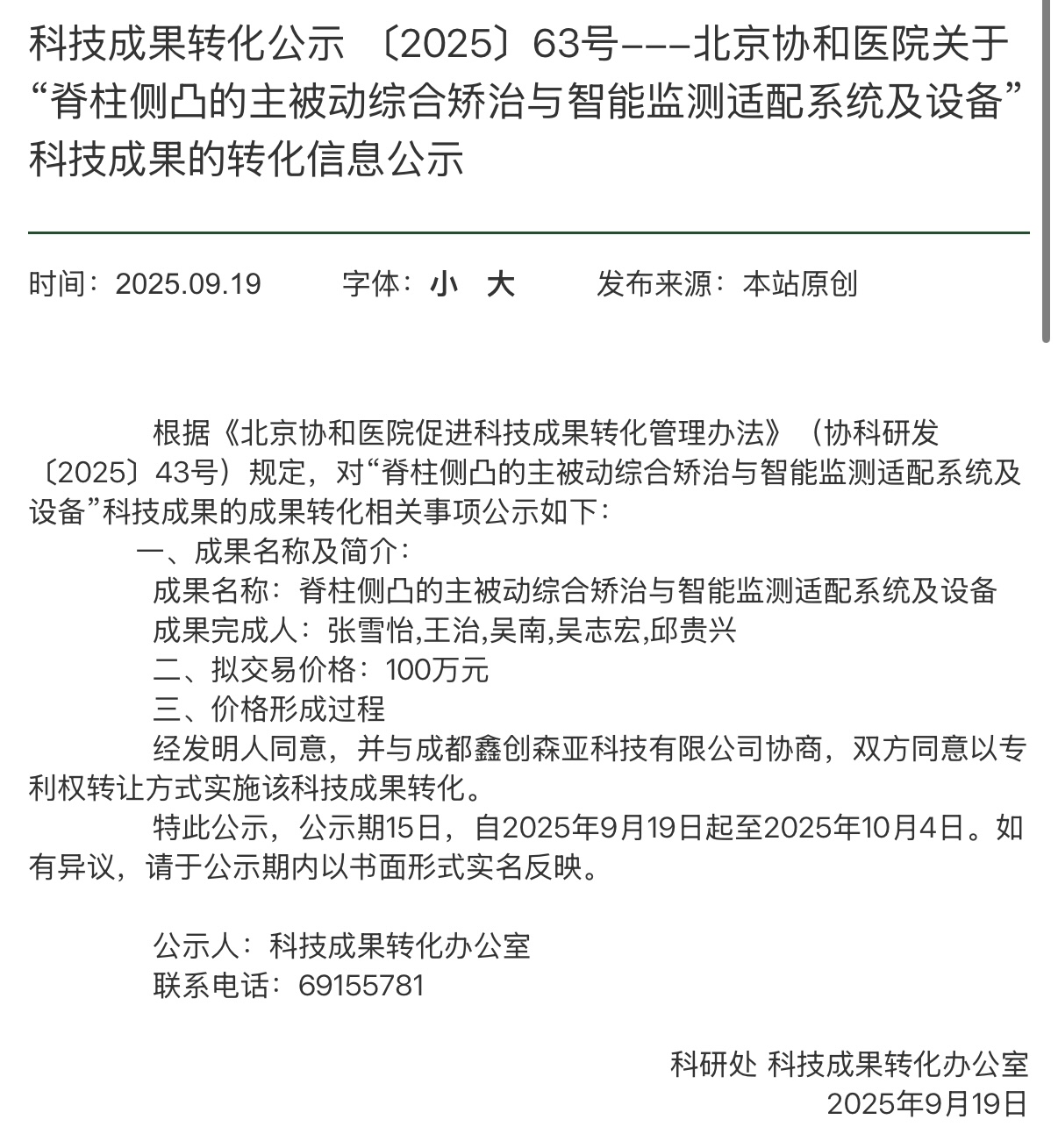
Image from the official website of Peking Union Medical College Hospital
This achievement was developed byTeam of Zhang Xueyi, Wang Zhi, Wu Nan, Wu Zhihong, and Qiu GuixingR&D, with the core innovation lying in breaking through the limitations of traditional single-mode passive correction for scoliosis,"Integrated System of 'Orthotic Passive Correction + Smart Sensing Textile Kit for Active Motion Monitoring'", enabling full-process quantitative tracking of orthotic force, rehabilitation posture, and recovery outcomes through flexible strain sensing and pressure monitoring. Compatible with various standard orthoses, it fills the clinical gap in precise monitoring of rehabilitation training in non-wearable brace states, providing a more comprehensive and efficient intelligent management solution for non-surgical intervention of scoliosis.
Scoliosisis a type ofSpinal “lateral bending, anteroposterior deformity, and three-dimensional rotation of the spine”three-dimensional orthopedic deformity characterized by [core features], this condition is highly prone to rapid progression of curvature during the adolescent growth spurt. In severe cases, it can lead to impaired cardiopulmonary function, postural deformity, low back pain, and a significant decline in quality of life. Among its various forms, adolescent idiopathic scoliosis is the most prevalent and widely concerned type in clinical practice.
Currently, clinical interventions for mild to moderate scoliosis are primarilyNon-surgical Treatmentas the first choice, mainstream options includeOrthotic fitting, specific rehabilitative exercise training, or a combination of both approaches. In the current system of correction and monitoring, most technologies rely solely on orthoses to provide passive corrective forces. Although some smart braces have built-in temperature or pressure sensors, they can only achieve rough monitoring of patients' wearing duration and compliance. They cannot accurately identify and quantitatively analyze active movement posture, action standardization, and training intensity during the rehabilitation training phase when patients are not wearing orthoses.
Publicly available intelligent orthotic systems of the same type generally fix the pressure monitoring module to the orthosis body, which only covers the detection of corrective pressure during brace wear and fails to cover the rehabilitation training phase after brace removal, thus making it difficult to form"Passive Correction + Active Rehabilitation"full-process closed-loop management.
Such technical deficiencies directly prevent clinicians from objectively assessing whether patients have completed their training as prescribed, whether their exercise movements meet the required standards, and whether long-term corrective progress is controllable. They also make it difficult to continuously, quantitatively, and visually track rehabilitation outcomes. With the increasing clinical emphasis on non-surgical interventions for scoliosis“Whole-process management, precision assessment, personalized guidance, and intelligent follow-up”As demands continue to rise, the industry urgently needs a comprehensive orthotic treatment and monitoring system that can simultaneously support passive correction with braces and active rehabilitation through exercise, is compatible with various types of orthoses, and features real-time monitoring, data quantification, efficacy evaluation, and feedback capabilities.
This integrated active-passive correction and intelligent monitoring adaptation system and equipment for scoliosis has completed the transition fromFrom Treatment Modalities and Monitoring Technologies to AdaptationSexcomprehensive innovation, establishing prominent technological advantages and core competitiveness.
This achievement completely breaks through the bottlenecks of traditional non-surgical interventions for scoliosis, which are characterized by "predominantly passive correction, limited monitoring methods, and difficulties in quantifying rehabilitation outcomes."Pioneering the Integrated Dual-Mode Technical Route of “Passive Orthotic Correction + Active Exercise Rehabilitation”, which not only retains the orthosis’s stable passive corrective effect on the trunk but also adds active rehabilitation training monitoring capability in the non-orthosis-wearing state, truly achieving full-cycle, all-scenario closed-loop management.
At the hardware level,The system innovatively integrates a multi-zone pressure monitoring module and a flexible strain-based tensile sensing module., the former enables precise pressure acquisition and long-term efficacy tracking for different types of scoliosis with left or right convexity, while the latter utilizes flexible textile carriers to conform to key body areas such as the shoulders, elbows, waist, and knees, sensitively capturing changes in human posture. This approach addresses the issues of inaccurate data collection and poor comfort associated with traditional rigid sensors in non-wearable states.
At the algorithm and software levels, the project utilizesIntelligent recognition logic such as Euclidean distance matching and cosine similarity quantitative evaluation, automatically evaluates the compliance rate and completion duration of training exercises. By integrating wireless transmission with a visual interactive system, it enables doctors and patients to monitor key indicators in real time, such as corrective pressure, training quality, and recovery trends, thereby significantly improving rehabilitation adherence and intervention efficiency.
Meanwhile,The intelligent sensor textile kit features broad-spectrum compatibility, directly interfacing with various standard orthoses available on the market without the need for customized modifications., significantly lowering the barriers to clinical implementation and reducing usage costs. Compared with existing technologies, this system offers multiple advantages, including precise monitoring, user comfort, broad adaptability, and intelligent quantification. It comprehensively addresses core issues such as incomplete monitoring, inaccurate assessment, and inconvenient management, demonstrating strong potential for clinical adoption and scalability.
With growing attention to adolescent spinal health and the comprehensive promotion of early screening and treatment for scoliosis, this technology holds broad potential for clinical application and commercialization.
Domestic scoliosis correction and intelligent monitoring products have already formedMedical-grade braces, smart monitoring devices, posture screening instrumentsThe three major mainstream categories are undergoing a rapid upgrade toward personalization, digitalization, and intelligence. Driven by policies promoting the widespread screening of adolescent spinal health and the continuously growing clinical demand for non-surgical interventions, traditional braces are gradually evolving into3D Printing Customization, Pressure Sensing, Data VisualizationDirectional iteration has led to the widespread adoption of portable, radiation-free monitoring devices in scenarios such as school-based screening, home management, and outpatient follow-up.
The industry as a whole is demonstrating steady demand growth, continuous technological iteration, and expanding application scenarios; however, most products remain concentrated in either single-function correction or single-parameter monitoring, with few capable of covering“An Integrated System for Full-Process, Quantifiable Assessment of ‘Brace-Based Passive Correction + Active Rehabilitation Training After Brace Removal’”still relatively scarce, with a clear gap in technology and product supply in the market.
United Imaging Healthcare CoolAlign Intelligent Spinal OrthosisThis is a digital intelligent orthotic product designed for patients with mild to moderate scoliosis. It leverages AI algorithms and 3D body scanning technology to achieve personalized shape design, and is manufactured using integrated 3D printing. The overall structure conforms to the contours of the human torso, balancing corrective efficacy with wearing comfort. The product features built-in intelligent pressure monitoring units that can real-time collect pressure data at the contact points between the orthosis and the body. Through accompanying software, it enables visual presentation of wearing status and treatment information. As a Class II medical device, it is primarily applied in clinical conservative treatment scenarios for scoliosis.
Leveraging the company’s strategic layout in medical digitalization and clinical services, this product has been deployed in practical applications across multiple healthcare institutions in China. It primarily addresses the non-surgical intervention needs for adolescent idiopathic scoliosis, providing clinicians with an integrated solution ranging from personalized brace design to intelligent monitoring. As attention to adolescent spinal health management continues to grow, CoolAlign is steadily expanding its application scenarios by combining conservative correction with intelligent monitoring, thereby gradually establishing a solid foundation for clinical adoption and promotion.
Fusote Xiaoshu Classmate Spinal Detectoris a product focused onPortable Medical Device for Non-Invasive Spinal Morphology Detection and Long-Term Health MonitoringUtilizing radiation-free 3D optical imaging and multi-sensor fusion technology, the system rapidly captures morphological data of the human back and reconstructs 3D spinal posture through digital twin algorithms, intuitively visualizing key features such as scoliosis and postural abnormalities. The product is easy to operate, safe, and non-invasive, supporting rapid detection in both home and outpatient settings. Its companion mobile application enables data recording, trend tracking, and the delivery of professional recommendations, thereby addressing both clinical auxiliary assessment and public health management needs. It is suitable for monitoring spinal development in adolescents, initial screening for spinal abnormalities, and long-term follow-up during rehabilitation.
This product is currently widely used in scenarios such as public welfare spinal health screenings on school campuses, outpatient assessments in medical institutions, follow-up monitoring in rehabilitation departments, and home-based self-management. It has gained recognition from schools, healthcare providers, and household users due to its convenience, non-invasiveness, and repeatability. Leveraging Fusote’s product portfolio and screening service system in the field of spinal health, the “Xiaoshu Tongxue” Spinal Detector continues to extend its reach into primary healthcare and daily health management settings. By continuously improving the end-to-end service workflow of screening, monitoring, and tracking, it has established a mature application model and solid market foundation in the early detection and intervention of adolescent spinal health issues.
This patented system and device for active-passive integrated correction and intelligent monitoring adaptation of scoliosis precisely aligns with urgent clinical needs and the direction of market upgrades, leveragingIntegrated Passive Correction and Active Rehabilitation Dual-Mode System, Precise Monitoring via Flexible Sensors, Full-Cycle Quantitative Assessment, and Broad-Spectrum Adaptability of Multi-Modal Orthosessuch core advantages, effectively filling the critical gaps in the current market where products suffer from limited functionality, incomplete scenario coverage, and non-closed-loop rehabilitation management.
Amid the growing emphasis on adolescent spinal health management and the rapid proliferation of intelligent rehabilitation devices, this technology not only meets the clinical standardized management requirements of hospital rehabilitation and orthopedic departments, but also supports long-term follow-up after school-based screenings and home-based rehabilitation training. It boasts prominent advantages, including strong clinical applicability, wide-ranging application scenarios, and significant potential for expansion. Consequently, it holds broad prospects for market translation and large-scale application in the field of non-surgical, intelligent correction of scoliosis.