

Tongji Hospital, Huazhong University of Science and Technology, Lists Lipid-Hydrocolloid Composite Dressing Patent for Transfer at RMB 250,000
Recently, Tongji Hospital Affiliated to Tongji Medical College of Huazhong University of Science and Technology released a public notice on the transformation of scientific and technological achievements. The hospital intends to transfer the relevant technologies through negotiated pricing.“A Preparation Device for Lipid Hydrocolloid Composite Dressings and Its Preparation Method”The relevant patents were assigned to Wuhan Tianlin Xinchuang Consulting Management Co., Ltd. for use, with the transfer fee denominated in RMB250,000 yuan. The inventor of this patented technology isYang Yan and Her Team。
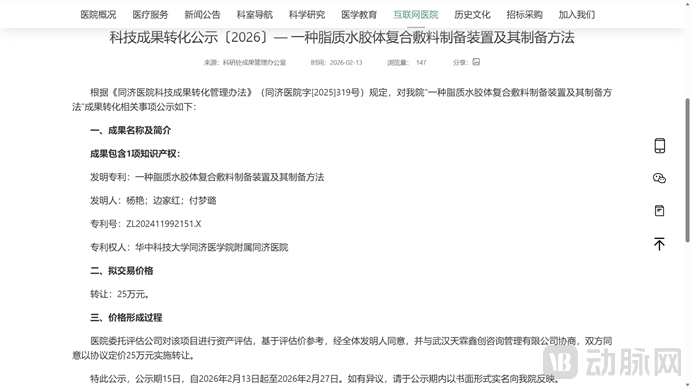
Image from the official website of Tongji Hospital, Tongji Medical College, Huazhong University of Science and Technology
The core application of this technology is forEfficient, Low-Cost Preparation of High-Quality Lipid Hydrocolloid Composite Wound DressingsThe prepared lipid-hydrocolloid composite dressing is a novel wound dressing that provides a moist environment for wounds, prevents moisture loss and wound adhesion, and can incorporate antimicrobial agents to achieve antibacterial effects, making it suitable for the treatment and care of wounds.
Lipid Hydrocolloid Composite DressingAs a new type of medical wound dressing with advantages such as moisturizing and anti-adhesion properties, market demand continues to rise, but the industrial preparation of this category has long facedDifficulties in Controlling Final Product Purity, Low Production Efficiency, and High Equipment CostsThe core challenge is that existing processes struggle to balance product quality, production efficiency, and industrialization costs, becoming a key technical bottleneck for the industry's large-scale development.
From the perspective of product quality control, insufficient dissolution of hydrophilic polymers and residual particulate impurities are common industry pain points.Current preparation equipment relies solely on simple stirring blades to mix raw materials, lacking structures for particle crushing and directional collection. This necessitates prolonged stirring time to promote dissolution, yet it remains difficult to avoid particle residue. Such residue not only compromises core performance metrics of the dressing, such as conformability and moisture retention, but may also irritate the wound surface, causing secondary injury. Meanwhile, residual particles tend to adhere to the inner walls of the equipment and stirring components, resulting in difficult and costly cleaning processes. This also poses a risk of cross-contamination, thereby affecting the quality of subsequent product batches.
From the perspective of improving production efficiency, there are obvious shortcomings in the equipment functional design and process integration of the existing technology.The polymer dissolution stage lacks crushing assistance, significantly prolonging the mixing cycle and becoming a bottleneck in production efficiency. Moreover, mixing and impurity collection cannot be performed simultaneously, and equipment cleaning requires separate disassembly, further extending the production process and making it difficult to meet market supply demands for large-scale mass production.
More importantly,Existing preparation technologies suffer from poor equipment compatibility and high input costs, creating barriers to entry for the industry.Different lipid components exhibit significant variations in physicochemical properties, requiring distinct heating temperatures. Existing technologies necessitate separate water bath heating equipment for each lipid component, substantially increasing procurement, space, and operational energy consumption costs. Even with modifications to a single water bath system, precise and independent temperature control for different lipid components cannot be achieved, which may lead to alterations in the properties of the lipids and adversely affect the final performance of the dressing.
Additionally,Current preparation processes suffer from low standardization, making large-scale mass production difficult.Small and medium-sized manufacturers often rely on semi-automated processes with manual assistance, where human errors in steps such as raw material feeding and temperature control lead to significant product quality fluctuations. Meanwhile, companies equipped with automation typically use general-purpose mixing and heating equipment that is not customized for the specific characteristics of dressing materials. These systems lack integrated functions for stirring, heating, and impurity collection, require manual intervention for inter-equipment coordination, and thus struggle to achieve continuous industrial-scale production, making it difficult to consistently ensure high product yield rates.
Addressing the industry pain points of difficult-to-remove particulate residues, high costs of heating equipment, and low production efficiency in the preparation of lipid-hydrocolloid composite dressings, the team led by Yang Yan, Bian Jiahong, and Fu Menglu from Tongji Hospital, Tongji Medical College, Huazhong University of Science and Technology, developed the patented technology “Preparation Device for Lipid-Hydrocolloid Composite Dressings and Preparation Method Thereof,”With an integrated mixing structure of “stirring and crushing + scraping filtration” and a water bath heating design featuring “multiple temperature zones in a single device”Develop a comprehensive preparation protocol that optimizes every stage—from raw material mixing and temperature-controlled heating to final product purification—thereby overcoming the traditional limitations of balancing quality with cost.
This technology is inRaw Material Mixing StageAchieve core innovation, breaking through the traditional simple mixing mode,Triple-Processing Structure: Mixing + Crushing + Real-Time Scraping and Filtration. Its stirring mechanism is equipped with a crushing sleeve that grinds and breaks down polymer particles during mixing, significantly accelerating dissolution and shortening the mixing cycle. The accompanying scraping assembly rotates in linkage with the stirring mechanism to continuously remove particles adhering to the tank wall and sleeve surface; these particles are intercepted and collected by a filter screen, enabling simultaneous stirring and impurity removal. This design not only prevents residual particles from compromising dressing quality but also eliminates the need for subsequent equipment disassembly and cleaning, thereby enhancing production efficiency. Furthermore, the scraping assembly is connected to an external lifting plate via magnetic attraction, allowing for quick removal and cleaning, which ensures convenient operation and reduces maintenance costs.
Heating and Temperature Control Stage, Technological InnovationDesign of a Single Water Bath + Dual Heating Chambers + Multi-Zone Heating Solution with Adjustable Heat Transfer, significantly reducing equipment investment and operation and maintenance costs. Abandoning the traditional model of multiple independent water bath heating devices, this system divides a single water bath tank into two heating chambers—upper and lower layers—using partitions to accommodate different lipid components. By coordinating the rotation of sealing plates and heat-conducting plates via a control mechanism, it achieves thermal isolation or heat conduction between the upper and lower regions of the water bath tank. This enables precise temperature control for both heating chambers, meeting the differentiated heating requirements of various lipid components. A single unit replaces multiple devices, while also simplifying operations and reducing energy consumption.
The most core technological breakthrough lies inDeep Adaptation Between Device and Process,Achieving Dual Value: Efficient Preparation and High-Quality Final Products.Leveraging optimized device architecture, a standardized and procedural preparation method has been established. Core process parameters are clearly defined, including 15 minutes of polymer stirring for dissolution, a molding temperature of 40–60°C, and a molding pressure of 0.2 MPa, thereby achieving standardized control over the entire manufacturing process to minimize human error and ensure consistent product quality. The lipid components are thoroughly mixed with the polymer colloidal solution under precise temperature control to form a stable emulsion. The resulting dressing exhibits high purity and uniform component distribution, enabling superior performance in core clinical functions such as moisturization and anti-adhesion.
Furthermore,The technology combines the advantages of structural integration and operational ease, making it suitable for industrial-scale mass production.The preparation device features an integrated design that combines a mixing tank, water bath, stirring mechanism, and control system. These components operate in coordination to achieve an all-in-one process for raw material mixing, heating, and transportation, ensuring smooth workflow continuity and eliminating the need for manual material transfer. Temperature regulation is easily accomplished by rotating a dial, while the scraping assembly allows for magnetic attachment and detachment. Operations such as discharge and water injection are conducted through dedicated pipelines. The overall operation is simple enough for personnel to master after brief training, thereby reducing labor costs. This facilitates widespread adoption across dressing manufacturers of various scales and provides an efficient and viable technical solution for the industrial mass production of lipid-hydrocolloid composite dressings.
In the field of lipid hydrocolloid composite dressings and their preparation technologies, focusing on"Enhance product performance, optimize production efficiency, and reduce overall costs"the core demands, domestic and international enterprises and institutions have formed a competitive landscape characterized by “foreign brands dominating the high-end market + local companies accelerating technological breakthroughs.” Currently, similar competing products mainly focus onFunctional Upgrade and Preparation Process Optimization of Finished DressingsTwo Major Directions: Technical Pathways and R&D Progress Vary by Entity, Jointly Driving the Industry Toward High Quality, Low Cost, and Large-Scale Development.
Urgotul lipidocolloid dressing by Laboratoires Urgo (France).The finished dressing adopts a “lipid-colloid composite + polyester mesh” structure, with core ingredients including sodium carboxymethyl cellulose, petrolatum, and liquid paraffin. Urgo SSD additionally incorporates silver sulfadiazine to provide antimicrobial functionality, making it suitable for diverse scenarios such as acute wounds, chronic ulcers, and burns, while offering the core advantages of non-adherence and moisture retention. Its manufacturing process emphasizes optimizing the compatibility between the antimicrobial agents and the hydrocolloid matrix, achieving uniform dispersion of components through precise temperature-controlled mixing. The product has obtained an NMPA import registration certificate.
Winner Medical Deploys Finished High-End Hydrocolloid Dressings and Automated Production Lines.On the finished product side, we have developed high-end products such as silicone foam dressings and hydrocolloid dressings, breaking through the technological bottlenecks of traditional gauze. On the production side, we have adopted automated production lines and introduced Internet of Things (IoT) technology to achieve intelligent control over the entire process, keeping the product defect rate below 0.1% and significantly improving preparation efficiency and finished product stability.
In summary, by innovating equipment structure and standardizing processes, this hydrocolloid dressing preparation technology provides an innovative solution that balances quality and mass-producibility, thereby addressing the core contradictions of “low purity, high cost, and low efficiency” in dressing production.