

Anhui Medical University First Affiliated Hospital to Transfer Neurology Hand Rehabilitation Device Patent for RMB 52,000
Recently, the First Affiliated Hospital of Anhui Medical University released a public notice on the transformation of scientific and technological achievements, proposing to transfer its “Neurology Department Hand Exerciser"Utility model patent transferred to Yizhu Duoyi (Anhui) Digital Technology Co., Ltd. The transfer fee is"52,000 yuan. The inventor of this patent isXiang Miaomiao, Wang Xiaoxia.
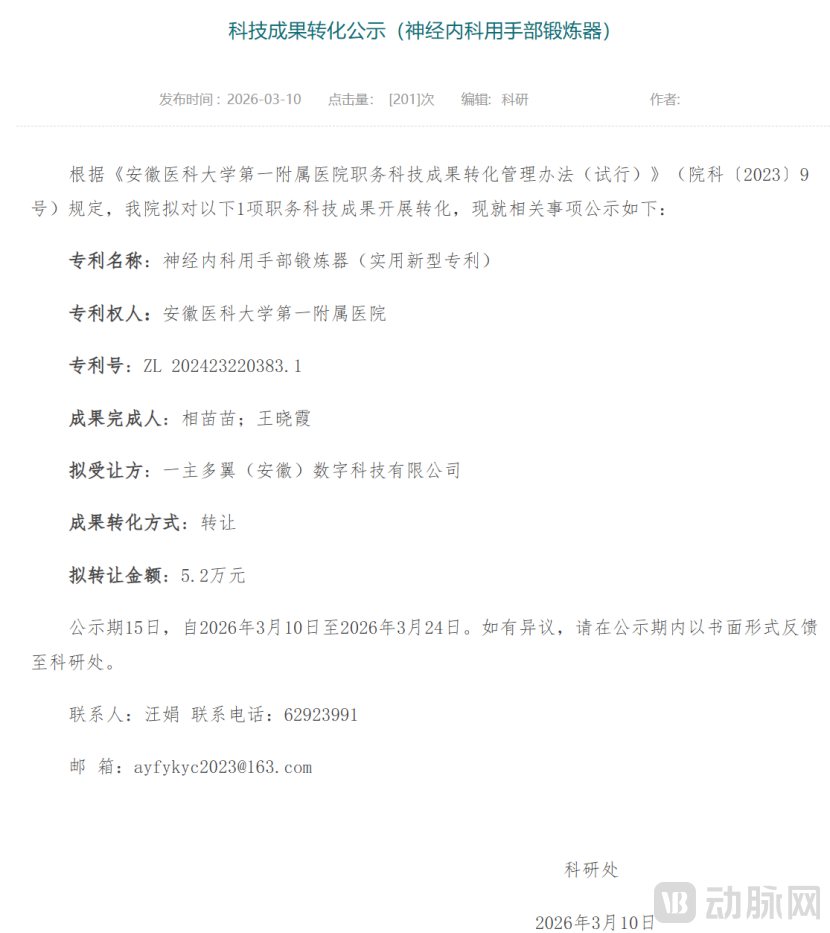
Image from the official website of the First Affiliated Hospital of Anhui Medical University
“Hand Exerciser for Neurology Department“This utility model patent is specifically designed for hand function rehabilitation in neurology, with its core purpose being to assist patients with impaired hand function due to conditions such as stroke and peripheral neuropathy in carrying out stepwise rehabilitation training for hand strength, dexterity, and coordination. Through its scientifically engineered structure, it achieves multi-dimensional rehabilitative exercise benefits, catering to the full spectrum of hand training needs from the early to late stages of rehabilitation.”
In clinical practice within neurology, hand function rehabilitation exercises constitute a crucial therapeutic intervention for patients with stroke, peripheral neuropathy, and other conditions. Traditional hand exercise devices employ multi-intensity structural designs to accommodate the needs of patients at different stages of rehabilitation; however, their clinical application is plagued by significant challenges and dilemmas, with the core issue centering on the contradiction between structural design and clinical practicality.
First, redundancy in the gripping components results in resource waste.Traditional exercise devices require separate handgrip components, such as pull rings and handles, to be individually configured for each structure accommodating different exercise intensities. The provision of multiple sets of handgrip components not only increases the manufacturing cost of the equipment but also results in idle resources and waste of parts, which is inconsistent with the principle of economical use of clinical devices.
Second, inadequate device compatibility.Some traditional hand exercisers feature a fixed-height design and cannot adjust to accommodate patients of varying statures or different rehabilitation scenarios (such as sitting or standing positions). This limitation often leads to improper posture during exercise, which not only compromises the efficacy of rehabilitation training but may also cause secondary hand injuries due to improper force application.
Third, the design of the intensity adjustment structure is cumbersome.In traditional exercise devices, the structures for different intensity levels are mutually independent. When patients need to switch exercise intensities, they must change their grip position or adjust multiple mechanical components, resulting in a cumbersome operational process. For neurology patients whose hand function has not fully recovered and who have poor limb coordination, independently switching intensities is highly challenging, often requiring assistance from medical staff or family members, thereby increasing the labor costs associated with clinical rehabilitation.
Fourth, poor component integration.The exercise components of traditional exercisers are distributed separately, lacking a unified storage and fixation structure. These devices occupy considerable clinical space, and their components are prone to loosening or damage during movement and storage, thereby reducing the service life of the equipment.
This patented product features targeted innovations in its structural design to address clinical pain points. Centered on the core design philosophy of single-component adaptability to multiple strengths, adjustability, and high integration, it offers significant technical advantages and innovative characteristics compared to traditional products, as detailed below.
First, the single pull-ring is designed with a multi-intensity exercise structure to achieve resource intensification.The product features several evenly spaced hand exercise components, with exercise intensity progressively increasing from front to back. By engaging the sliding adjustment seat with the chute of the base block, the position of a single pull ring can be adjusted across different exercise components. This design eliminates the need for separate gripping parts for each component, structurally resolving the issue of redundant gripping mechanisms in traditional products and significantly reducing both manufacturing and usage costs.
Second, the positioning structure ensures adjustment stability and enhances clinical safety.The sliding adjustment base is equipped with a positioning assembly consisting of a movable plate, a positioning pin, and a second spring. After the pull ring position is adjusted, the positioning pin can be inserted into the positioning hole of the base block under the elastic force of the spring, thereby achieving a secure connection between the pull ring and the exercise component. Meanwhile, both the sliding adjustment base and the slide groove adopt an inverted "T"-shaped cross-sectional design to prevent vertical detachment of the base body, effectively preventing loosening of the pull ring during patient exercises, thus enhancing the stability and safety of the device.
Third, the lifting mechanism enables free height adjustment, enhancing clinical adaptability.The product features a lifting mechanism composed of a vertical cylinder, a movable rod, and positioning bolts. The movable rod is equipped with multiple positioning slots along its vertical axis. By loosening or tightening the positioning bolts, the height of the storage housing and exercise assembly can be adjusted to accommodate patients of different heights and various training postures. This ensures that patients perform exercises with proper form, thereby safeguarding the effectiveness of rehabilitation training.
Fourth, the friction component features a gradient strength design for more convenient adjustment.The hand exercise component consists of a movable bar and a friction assembly. The cylinder lengths of the friction assembly decrease sequentially from front to back, gradually increasing the compression of the first spring inside the cylinder. This provides graded frictional resistance to the movable bar, achieving natural stratification of exercise intensity. Patients can switch intensity levels simply by sliding the pull ring, ensuring simple operation that can be performed independently, thereby reducing clinical labor costs.
Fifth, a highly integrated structural design saves clinical space.All hand exercise components are housed within a storage casing with a bottom opening. In the non-exercise state, the components are compactly integrated, and the base blocks interlock to form a unified structure, significantly reducing the equipment’s footprint. Furthermore, the storage casing provides effective protection for the components, minimizing the risk of loosening and damage, thereby extending the service life of the device.
In the field of hand function rehabilitation within neurology, a continuous stream of innovative training devices and patented technologies has emerged, offering diverse solutions tailored to the hand rehabilitation needs of patients with neurological injuries.
Neural Interface-Driven Hand Function Assistance System Developed by Shanghai Haimeikang Intelligent Medical Technology Co., Ltd., it is the first neural interface hand exoskeleton product in China to receive medical device registration approval. Designed specifically for patients with neurological impairments such as stroke and traumatic brain injury, its core functionality enables hand rehabilitation training through electromyographic (EMG) signal capture and mind-controlled actuation. The device features a glove-like soft exoskeletal structure; an EMG acquisition module on the forearm captures signals from flexor and extensor muscles, analyzes the patient’s movement intent, and drives the exoskeleton to perform actions such as reaching, fist clenching, and grasping. This allows patients to actively participate in the rehabilitation process, thereby promoting neuroplasticity and functional recovery.
SY-HR08P Brain-Controlled Hand Functional Rehabilitation Robot Developed by Siyi Intelligence, is the world’s first brain-computer interface (BCI) soft robotic hand for functional rehabilitation. It monitors and analyzes patients’ brain signals to identify the movement intentions of the affected hand, converting these signals into movements of an exoskeleton robotic hand. This helps restore motor function in hemiplegic hands, enables patients to fully engage in active rehabilitation training, and accelerates neurological recovery.
Utility Model Patent Application for “A Finger Exerciser for Neurology Nursing” Filed by Linfen People’s Hospital(Patent No. CN222033546U), specifically designed for neurological nursing care, with a core focus on rehabilitation of finger flexion and extension strength. The device features a portable, wearable structure comprising a main finger exerciser unit, finger cots, adjustable springs, and straps. During use, the back of the hand is placed against the main unit, fingers are inserted into the corresponding finger cots, and the straps are secured to the arm using Velcro. The tension of the springs can be adjusted according to the patient’s rehabilitation stage, enabling graded resistance training for finger movements.