

Capital Medical University Affiliated Beijing Luhe Hospital to Transfer Adjustable-Flow Drainage Tube Patent for RMB 36,000
Recently, Beijing Luhe Hospital, affiliated with Capital Medical University, released a public notice on the transformation of scientific and technological achievements, proposing to transfer its “A Flow-Adjustable Drainage Tube"The utility model patent is transferred to Beijing Fenglin Technology Co., Ltd. The transfer fee is"36,000 yuan. The inventor of this patent isWang Chunxue.
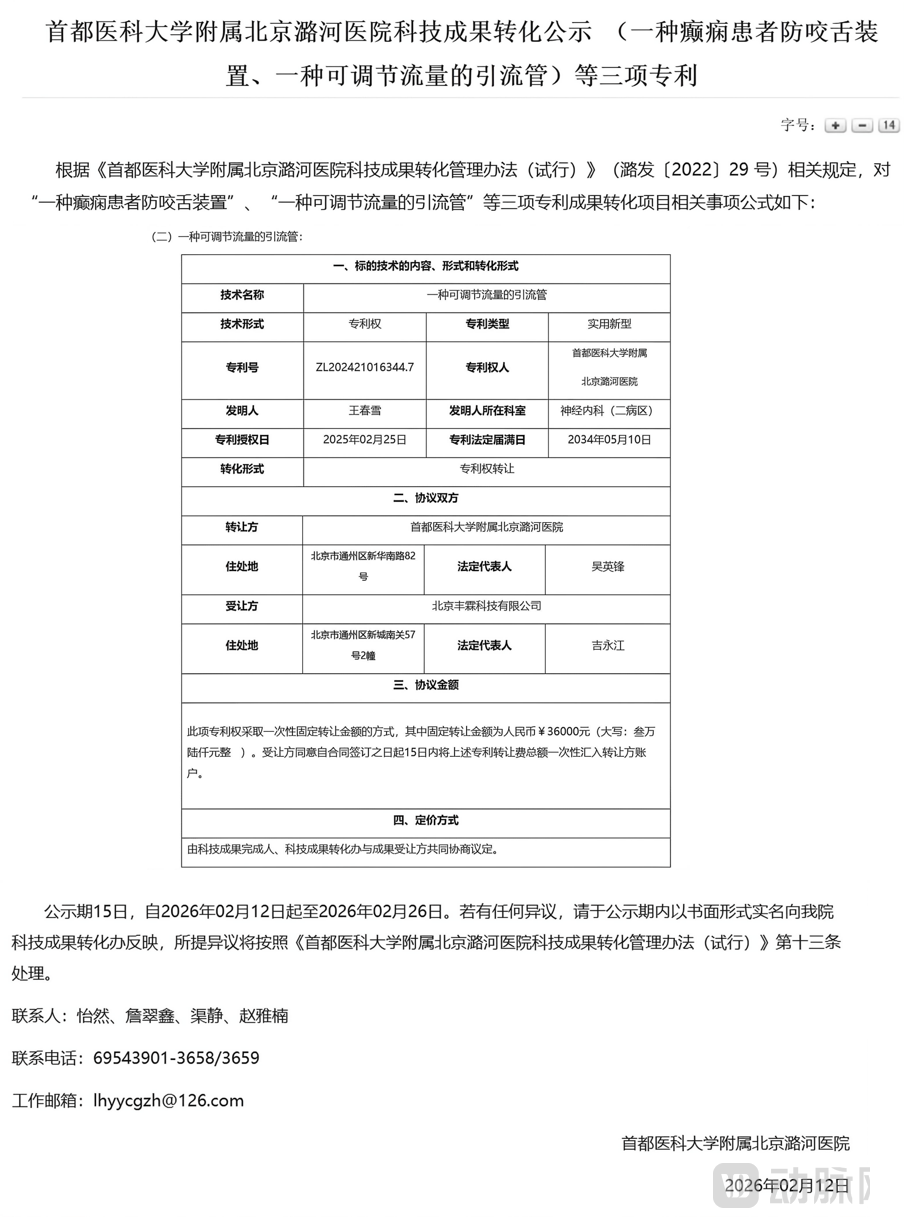
Image from the official website of Beijing Luhe Hospital, Capital Medical University
“A Drainage Tube with Adjustable Flow Rate"The utility model patent includes a drainage tube and an independent PVC adjustment component. The adjustment component is sleeved on the drainage tube through a sleeve, and drives the card to engage with the C-type baffle inside the adjustment cylinder via a pin, achieving stepwise flow regulation by adjusting the compression height of the fixed extrusion block. The adjustment component can be disassembled for high-temperature sterilization and reused. Its external structure requires no modification to the drainage tube, making it compatible with various conventional drainage tubes. It features a simple design, easy operation, and low cost."
Surgical drainage is a critical clinical procedure for preventing postoperative infections and promoting wound healing. The precise regulation of drainage flow directly impacts therapeutic outcomes; however, traditional drainage tubes and their accompanying flow-regulation devices exhibit numerous technical limitations in clinical practice. The core pain points are concentrated in the following areas.
First, the flow regulation effect is unstable, leading to low resource utilization and waste.Some traditional drainage tubes employ elastic fixation clips to regulate flow by compression, requiring continuous manual pressure on the clip’s protrusion to compress the tube. Upon release, the clip reverts to its original position, failing to maintain stable flow control and thus unable to meet clinical demands for sustained and precise flow regulation. Certain flow-controllable drainage products integrate the adjustment mechanism with the drainage tube, utilizing a cam-based compression principle for flow regulation. Although this approach offers higher adjustment efficiency, the entire unit must be discarded after use because the adjustment mechanism cannot be detached for reuse. This results in significant waste of medical resources and increases the cost of clinical consumables.
Second, the complex structure leads to high manufacturing and usage costs, limiting the product's application scope.Some adjustable-flow drainage catheters adopt a multi-component linkage structure, utilizing components such as rollers, sprockets, and threaded rods to regulate flow. These systems require separate locking mechanisms to fix the flow rate, resulting not only in complex structural design and higher manufacturing costs but also in cumbersome clinical procedures that increase the operational burden on healthcare professionals. Other drainage catheters achieve flow regulation by modifying the catheter body itself, incorporating flow-control balloons within the lumen, or adding puncture guide needles and negative pressure devices. Such designs require matching with specific catheter specifications and clinical scenarios, making them incompatible with standard drainage catheters and thus significantly limiting their application scope.
Third, the cost of intelligent adjustment is excessively high, and basic drainage catheters lack flow regulation functionality.A minority of smart drainage tube devices achieve flow regulation through electronic components such as controllers, coils, and magnets. Although these devices offer high regulation precision, they require core components like communication circuits and control chips, resulting in complex structures and high manufacturing and maintenance costs. This makes them difficult to popularize in primary healthcare institutions and routine clinical settings. Conventional drainage tubes paired with standard clinical drainage bags lack flow regulation mechanisms, leading to uncontrollable flow rates. Consequently, they fail to meet the differentiated drainage flow requirements for different patients and surgical sites, thereby hindering the personalized implementation of clinical diagnosis and treatment.
“An Adjustable-Flow Drainage Tube"The utility model patent consists of two parts: a drainage tube and an independent adjustment component. The adjustment component is made of PVC material, achieving precise and stable flow regulation through the collaborative design of a sleeve, an adjustment cylinder, and a compression piece. Compared to traditional products, it offers the following advantages and innovations."
First, the flow rate adjustment is stable and precise, with easy operation.Multiple C-shaped stoppers are arranged vertically within the adjustment sleeve of the adjustment component, with spacing between adjacent stoppers. By rotating the insertion pin, the locking tab engages with stoppers at different heights, thereby fixing the downward compression height of the compression block. This enables stepwise adjustment of the drainage tube’s compression degree, allowing for precise flow control. The bottom surface of the compression block is arc-shaped to match the circular cross-section of the drainage tube, ensuring more uniform compression. Furthermore, the entire adjustment process is completed simply by rotating the insertion pin, making operation simple and efficient for medical personnel.
Second, the adjustment component is reusable, conserving medical resources.This patent employs a modular design with separate drainage tubes and adjustment components. During use, the adjustment component is sleeved onto the exterior of the drainage tube for assembly; when not in use, the adjustment component can be detached from the drainage tube, sterilized at high temperature, and reused. The adjustment component is made of PVC material, offering excellent corrosion resistance, high-temperature resistance, and mechanical strength, thereby meeting the requirements for repeated sterilization and reuse. This fundamentally addresses the resource waste associated with traditional integrated products and reduces clinical consumable costs.
Third, no modification of the drainage tube is required, allowing for a wide range of applications.The adjustment component of this patent features an external structure that can be directly sleeved onto conventional clinical drainage tubes without requiring any modification to the drainage tube itself. It is compatible with surgical drainage tubes of various specifications and types, and can be applied to drainage procedures in multiple departments, including general surgery, orthopedics, and thoracic surgery, with no limitations on clinical application scenarios.
Fourth, the structure is simple, with low manufacturing and usage costs.The adjustment component of this patent consists solely of basic parts, including a sleeve, an adjustment frame, an adjustment cylinder, a compression block, a connecting rod, and an insertion pin. It contains no complex linkage assemblies or electronic components, resulting in a simple manufacturing process and low raw material costs. Meanwhile, the inner wall of the sleeve is equipped with a rubber ring and a soft pad, which not only increases friction with the drainage tube to ensure stability after assembly but also prevents damage to the drainage tube during compression, thereby further enhancing the product's practicality.
5. Visual adjustment to enhance operational precision.The adjustment barrel is made of transparent material, allowing for direct visual observation of the engagement position between the card and the stopper. When combined with scale markings, it enables visualized flow regulation, helping medical personnel quickly monitor drainage volume and further enhance the precision of clinical procedures.
In the technological innovation of clinical drainage devices, precise flow regulation and stable tubing connections are core directions for enhancing drainage safety and compatibility. Multiple utility model patents have been developed with targeted designs around this central need, each featuring distinct technical focuses and clinical application scenarios.
“Weihai Shichuang Medical Technology Co., Ltd. applied for the “A Controllable Flow Drainage Tube“Utility Model Patent (Authorization Announcement No. CN208726526U): A flow-regulating balloon is disposed within the drainage lumen of the main body of the drainage tube, connected via a balloon catheter to a one-way inflation valve and an exhaust three-way valve. Inflation and deflation control the expansion or collapse of the balloon, thereby altering the effective cross-sectional area of the drainage lumen to regulate the drainage rate. When uninflated, the balloon occupies minimal space. The device features a simple structure and ease of operation, addressing the clinical challenge of difficult flow control associated with traditional drainage tubes, and is suitable for clinical drainage scenarios at multiple anatomical sites.”
Sichuan Provincial People's Hospital's application for “A Drainage Device with Anti-Dislodgement and Flow Regulation Functions“Utility model patent (Authorized Publication No. CN221384565U) employs threaded engagement to drive spring strips and rubber blocks to compress and secure the interface with the delivery tube, preventing accidental dislodgement due to external pulling forces. It utilizes an inclined sliding sleeve and a toggle wheel moving along guide grooves to compress the infusion tube, enabling precise regulation of drainage flow rate. Meanwhile, sealing plugs prevent leakage and damage. The design is practical, adaptable to various clinical drainage scenarios, and enhances usage stability and patient comfort.”
Changzhou No. 3 People's Hospital applied for the “Adjustable Drainage Rate Device for Fluid Accumulation DrainageUtility Model Patent (Authorization Announcement No. CN219440159U), specifically designed for the drainage of pleural and pericardial effusions, consists of three mechanisms: a main body, a limiting mechanism, and an adjustment mechanism. The limit block and fixing plate are quickly connected via a snap-fit block-and-slot structure, facilitating convenient positioning and fixation of two drainage tubes. A gear train drives the movement of a screw rod and a threaded hole plate, causing a pressure block to compress the drainage tubes to regulate flow rate. This design supports independent speed adjustment for a single tube or synchronized adjustment for dual tubes, without requiring modification of the drainage tubes themselves, thereby reducing costs. Motion guide rails ensure adjustment stability, meeting the differentiated flow control requirements for clinical thoracic and cardiovascular surgical effusion drainage.