

Suzhou Institute of Nano-Tech and Nano-Bionics, Chinese Academy of Sciences, to Transfer Novel CTC Capture Method for RMB 350,000
Recently, the Shanghai Technology Exchange released a public notice on the transfer of patent rights, indicating that the Suzhou Institute of Nano-Tech and Nano-Bionics, Chinese Academy of Sciences, intends to transfer its “A Method for Capturing Circulating Tumor Cells"The patent for invention is transferred to Nanjing Kangzhinuo Technology Co., Ltd. The transfer fee is"350,000 yuan。
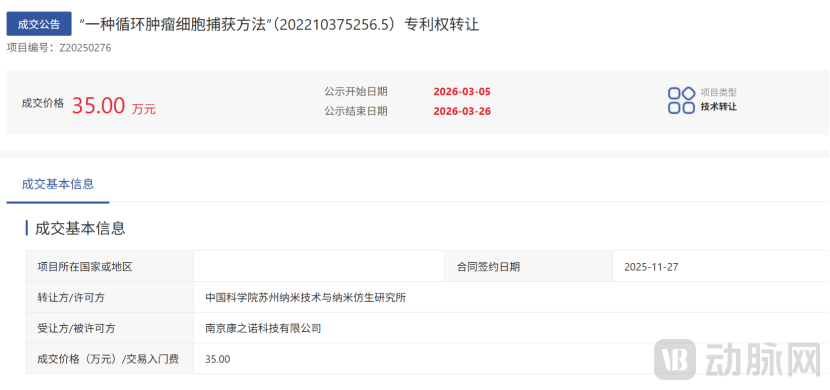
Image source: Official website of the Shanghai Technology Exchange
Currently, cancer-related diseases are among the major global health challenges, causing approximately 8 million deaths annually, a figure projected to rise rapidly in the future. Therefore, the development of cancer treatments and early diagnostic technologies is of critical importance. In recent years, driven by continuous advancements in modern biological technologies, the primary diagnostic and therapeutic approaches for cancer patients have been gradually shifting from traditional standard models to precise, personalized paradigms. The isolation and detection of Circulating Tumor Cells (CTCs) represent one of the key research areas enabling personalized precision medicine for oncology patients.
Circulating Tumor Cell (CTC) detection is one of the core technologies in precision oncology. In current clinical practice, CTC capture techniques are primarily categorized into two major types: immunoaffinity-based methods and physical property-based methods. Although microfluidic chip platforms have become mainstream, they still face numerous technical bottlenecks, with specific pain points as follows.
Immunoaffinity MethodCapture is achieved by binding specific antibodies to surface markers on circulating tumor cells (CTCs). Mainstream platforms employ magnetic separation, substrate-based, or microchip-based capture methods. However, two critical issues persist: First, due to CTC heterogeneity, targeting with a single antibody often leads to the loss of certain CTC subpopulations during enrichment, failing to capture all CTC subtypes. Second, strong binding between CTCs and antibodies on the capture material surface causes cellular damage, significantly reducing CTC viability and hindering downstream analyses such as culture and sequencing.
Physical Property Capture MethodThis is a capture method based on the physical characteristics of circulating tumor cells (CTCs), such as size and density, primarily employing techniques like density gradient centrifugation, membrane filtration, and microchip platforms. Its core limitation is the inability to precisely identify the types of isolated and enriched cells, allowing only for a qualitative “present or absent” determination. Meanwhile, abnormal immune cell profiles in cancer patients, along with bacterial or viral infections, can lead to interference from abnormal monocytes, significantly reducing the accuracy of CTC isolation and resulting in a high false-positive rate.
Mainstream Microfluidic Chip PlatformsDespite advantages such as miniaturization and portability, existing products still exhibit significant limitations. For instance, certain microfluidic chips for the isolation of circulating tumor cells (CTCs) in neuroblastoma, although combining physical enrichment via micropillar arrays with specific capture using GD2 antibodies, still suffer from issues including loss of CTC subpopulations, poor cell viability, and low separation accuracy. Furthermore, their complex chip structures are not conducive to downstream sequencing and culture. Meanwhile, CTC diagnostic devices based on gel patches, which rely solely on fluorescent antibody labeling, are prone to interference from antibody false positives, resulting in insufficient precision in CTC localization.
Currently, the vast majority of circulating tumor cell (CTC) capture technologies suffer from common issues of low purity and poor viability. Furthermore, traditional CTC culture employs a 2D adherent model, where the culture microenvironment differs significantly from the in vivo environment. As the number of passages increases, cell survival declines, and their intrinsic characteristics are prone to alteration. Meanwhile, captured cells must be released from the device, a process that further compromises cell viability and makes it impossible to assess the survival status of the captured cells, thereby severely affecting the accuracy and efficiency of subsequent analyses.
“A Method for Capturing Circulating Tumor Cells” Invention Patent establishes a novel CTC capture approach based on 2D array hydrogel chips and 3D culture. Through technological innovation, it addresses the core pain points of traditional methods, achieving high-purity, high-viability capture and precise identification of CTCs. Its advantages and innovations are mainly reflected in the following four aspects.
First, the innovative design of the capture system.Pioneering a technical approach that integrates red blood cell lysis, hydrogel chip-based microwell sedimentation, in situ 3D culture, fluorescent antibody labeling, and dual identification of proliferation characteristics, this method utilizes regularly arranged microwells to achieve high-throughput 2D cell arrays. Simultaneously, the hydrogel chip provides a weakly adhesive, affinity-rich microenvironment for circulating tumor cells (CTCs), which not only prevents heterogeneous cell aggregation but also offers an adaptable microenvironment for 3D culture, thereby systematically avoiding the cell damage issues associated with traditional methods.
Second, the precision of CTC identification has been improved.By overcoming the limitations of traditional single-antibody labeling or physical characteristic screening, this approach employs a dual identification criterion combining specific fluorescent antibody binding with cell proliferation and spheroid formation characteristics, alongside morphological observation. This effectively resolves the issue of inaccurate CTC localization caused by antibody false positives. For breast cancer samples, the use of at least two fluorescent antibodies from a combination of Anti-CD45, Anti-EPCAM, and Anti-Cytokeratin 8/18/19 further enhances the specificity of CTC identification.
Third, dual assurance of CTC activity and purity.This method eliminates the need for post-capture cell release by enabling in situ 3D culture directly on the chip, thereby completely avoiding cell damage during the release process and preserving the high proliferative capacity of captured circulating tumor cells (CTCs). During cultivation, most blood cells undergo natural apoptosis, whereas CTCs survive and proliferate into spheroids, achieving natural enrichment of CTCs. Combined with dual identification criteria, this approach significantly enhances CTC purity. Experimental results confirm that the captured CTCs exhibit high expression of tumor-associated genes such as HER2, EPCAM, and CK, with no interference from contaminating cells.
Fourth, practicality of technology and cost advantages.The hydrogel chip fabrication process employed in this invention is simple: after constructing a template via soft lithography, the hydrogel solidifies to form the final structure. Compared with traditional microfluidic chips with complex architectures, this approach significantly reduces manufacturing costs. Meanwhile, the capture procedure is straightforward, sample processing is rapid, and culture conditions are easily implemented in clinical laboratories. Moreover, captured circulating tumor cells (CTCs) can be directly subjected to downstream analyses on the chip, such as picking, PCR, and sequencing, without the need for additional sample transfer, thereby enhancing the clinical utility of the technology.
5. Personalized optimization of culture media and chips.Custom-designed DMEM/F12 composite medium supplemented with fetal bovine serum, growth factors, protein factors, and TGF-β receptor inhibitors. The viscosity of the medium is adjusted to 20–50 mPa·s by adding collagen and methylcellulose, which ensures the in vitro survival and proliferation of circulating tumor cells (CTCs) while preventing heterogeneous cell aggregation in 3D cultures. The hydrogel chip can be surface-modified using various methods, such as dopamine and polyethyleneimine, and the blind well dimensions can be tailored to meet the CTC capture requirements for different types of tumors.
In the commercial application of circulating tumor cell (CTC) capture and detection, multiple mature technologies with distinct advantages have been successfully deployed as products and platforms, becoming essential tools for CTC testing in clinical oncology management.
CellSearch SystemThis is a brand-new product for the enumeration analysis of circulating tumor cells (CTCs), developed by Veridex, a subsidiary of Johnson & Johnson. It is the first and only FDA-approved commercialized assay for the management of malignant tumors that detects and enumerates circulating tumor cells (CTCs) in blood. Based on immunomagnetic bead affinity capture technology, it uses anti-EpCAM antibody-coated magnetic beads to specifically bind to EpCAM antigens on the surface of CTCs, thereby achieving enrichment and enumeration of CTCs.
ISET Technologyis a simple and easy-to-use tumor cell size-based separation method provided by Rarecells Diagnostics. The system offers extremely high sensitivity, enabling the isolation of rare circulating tumor cells (CTCs) and circulating tumor microemboli (CTMs) from blood while preserving their morphology and structural integrity, thereby allowing further in vitro diagnostic testing on intact CTCs or CTMs.
ClearCell FX SystemIt is a typical commercialized product of microfluidic chip technology. Based on the dual technologies of microfluidic inertial focusing and immune affinity, it achieves inertial focusing enrichment of CTCs through the hydrodynamic effects of microfluidic chips, and then realizes specific capture by combining with antibody-modified micropillars. Combining the high throughput of physical enrichment with the high specificity of immune capture, the chip features a high degree of integration and requires a small sample volume, enabling efficient enrichment and precise identification of CTCs.