

Shanxi Medical University to Transfer Novel Tag-Assisted Liquid-Phase Synthesis Patent for Eptifibatide at RMB 520,000
Recently, Shanxi Medical University plans to“A Diphenylphosphinyloxydiphenylmethylamine Tag-Assisted Liquid-Phase Total Synthesis Method for Eptifibatide”Transfer of patent rights for invention patents, with the transferee being Shangxi Deyuantang Pharmaceutical Co., Ltd., and the proposed transfer amount isRMB 520,000.00。
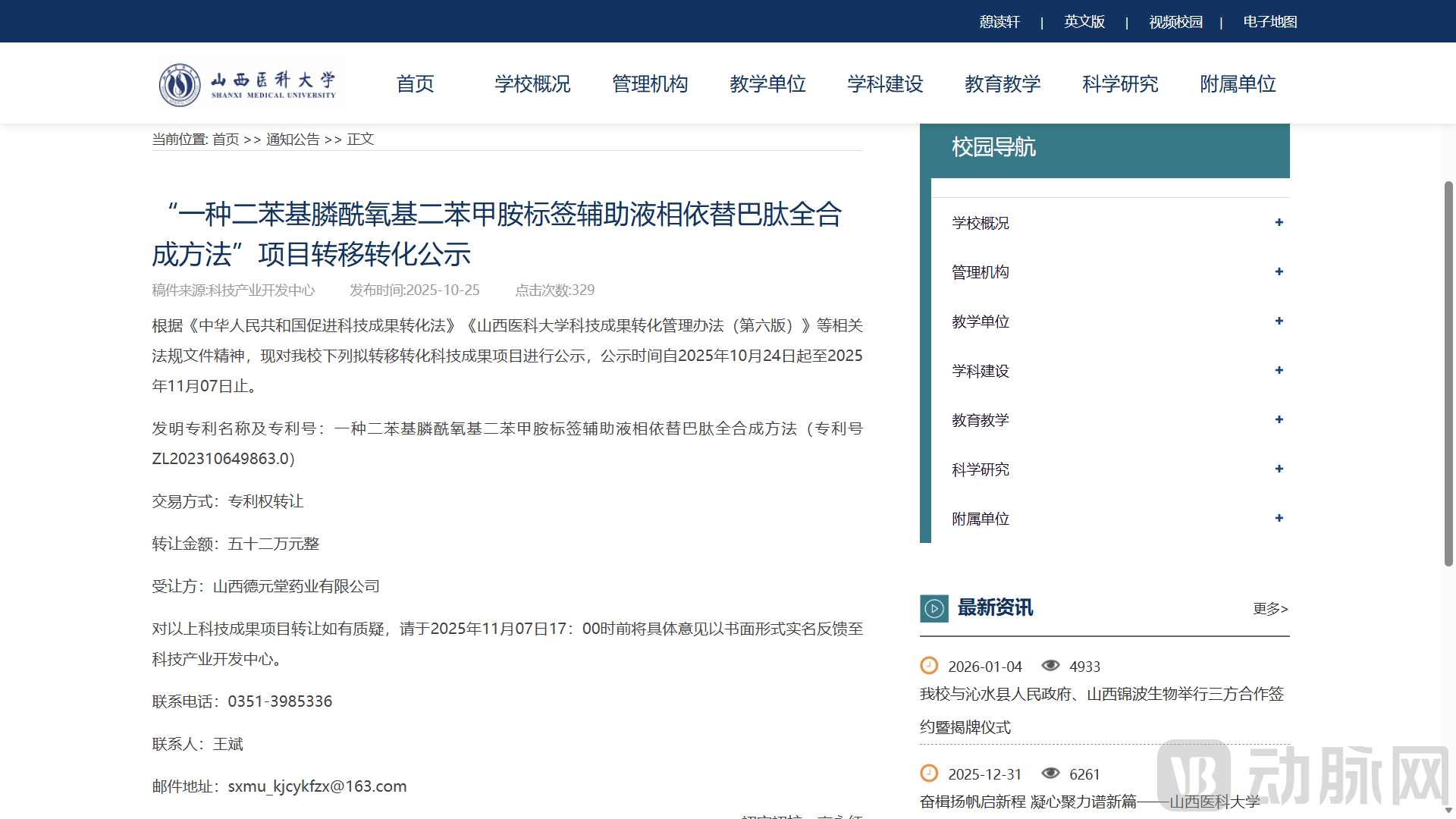
Image from the official website of Shanxi Medical University
This patent isFields of Organic Synthesis and Peptide Chemical SynthesisThis innovative technology employs a small-molecule tag, diphenylphosphinyloxydiphenylmethylamine, to replace the high-molecular-weight resins traditionally used as carriers and C-terminal carboxyl protecting groups in solid-phase peptide synthesis. By innovatively integrating the advantages of both liquid-phase and solid-phase peptide synthesis techniques, it enables a simple, efficient, green, and cost-effective total synthesis of eptifibatide. This approach addresses critical industry challenges associated with conventional eptifibatide synthesis processes, including significant raw material waste, high costs, difficulties in scaling up production, and severe environmental pollution.
Myocardial InfarctionIt is a highly prevalent cardiovascular critical condition in clinical practice and has become a major threat to the life and health of middle-aged and elderly populations. Related conditions it triggers, such as acute coronary syndrome and ST-segment elevation myocardial infarction, are characterized by rapid disease progression and high mortality rates. There is an urgent and sustained clinical demand for highly effective and safe targeted therapeutic agents.
EptifibatideAs a cyclic peptide cardiovascular drug, it is clinically recognized as the "gold standard" antiplatelet agent. As a novel glycoprotein receptor antagonist on blood cell membranes, it effectively improves peripheral blood flow and tissue perfusion, playing an irreplaceable role in the clinical treatment of acute coronary syndrome and ST-segment elevation myocardial infarction. With its prominent advantages of significant efficacy and low toxic side effects, it has become the preferred drug in clinical practice. Along with the continuous increase in clinical diagnosis and treatment demands, the market demand for its active pharmaceutical ingredient (API) is also steadily growing year by year.
Eptifibatide is a C-terminally amidated peptide, a cyclic heptapeptide derived from specific snake venom. The active pharmaceutical ingredient (API) of this drug currently used in clinical practice mainly relies onSolid-Phase Peptide Synthesis and Traditional Liquid-Phase Peptide SynthesisPrepared using two technical processes, both synthetic methods must adhere to the principle of peptide chain extension from the C-terminus to the N-terminus. The carboxyl group of the first amino acid at the C-terminus is first formed into an amide bond with the carrier group, so that after the final cleavage of the peptide chain, a C-terminal amidated peptide chain is formed, completing the basic synthesis of eptifibatide.
However, both existing synthetic processes suffer from technical defects that are difficult to overcome.Solid-Phase Peptide SynthesiswithVarious Types of Polymeric ResinsAs the core carrier, these resins not only involve cumbersome preparation processes and high procurement costs but also suffer from low loading capacity, which directly limits the production efficiency of eptifibatide, hinders large-scale mass production, and fails to meet the growing market demand;Traditional Liquid-Phase Peptide SynthesisThis results in a cumbersome purification process. After each amino acid coupling reaction, purification via chromatography or recrystallization is required. This process not only consumes substantial amounts of chemical reagents and production time, significantly increasing economic costs, but also generates large volumes of reagent waste, causing serious environmental pollution and failing to align with the industry’s green manufacturing principles.
The clinical demand for eptifibatide continues to rise, leading to a widening supply gap in the active pharmaceutical ingredient (API) market. Meanwhile, the shortcomings of existing synthetic processes—particularly in terms of production scale, economic cost, and environmental sustainability—are becoming increasingly pronounced. These limitations not only fail to meet the clinical need for large-scale, stable supplies of eptifibatide API but also contradict national guidelines promoting the green development of the API industry.
In this context,Development of a Novel Synthesis Method for Eptifibatide Integrating the Advantages of Solid-Phase and Liquid-Phase Peptide Synthesis Technologies, Featuring Simplicity, High Efficiency, Green Economy, and Scalable Production, which has become a key requirement for addressing the challenges in the clinical supply of medications and promoting the high-quality development of the active pharmaceutical ingredient (API) industry for cardiovascular drugs, and is also an inevitable trend for technological upgrading in the industry.
The core innovation of this liquid-phase total synthesis technology for eptifibatide, assisted by a diphenylphosphinyloxydiphenylmethylamine label, lies inReplacing the polymeric resins used in traditional solid-phase peptide synthesis with small-molecule tags of diphenylphosphinyloxydiphenylmethylamine, meanwhileUse this label as the C-terminal carboxyl protecting group for amino acids to carry out the total synthesis of eptifibatide., innovatively integrating the technical advantages of liquid-phase peptide synthesis and solid-phase peptide synthesis to create a novel synthesis system that combines the strengths of both, thereby fundamentally addressing many pain points associated with traditional synthesis processes.
This small-molecule tag possessesExcellent Solubility in Reaction Media, meanwhilePossesses unique auxiliary peptide chain precipitation and purification properties, during the synthesis process, the tag molecules themselves, various intermediate compounds loaded with tags, and deprotected intermediates can rapidly precipitate in low-polarity ether or alkane solvents. Purification is achieved through simple solid-liquid filtration, eliminating the need for complex chromatographic or recrystallization purification after each amino acid coupling step as required in traditional liquid-phase synthesis. This approach also removes the dependence on expensive high-molecular-weight polymeric resin supports inherent to solid-phase synthesis, significantly reducing the waste of raw materials such as chemical reagents, amino acids, and coupling agents, and substantially lowering production costs.
At the level of synthetic process,This technology features a standardized, recyclable process for amide coupling and deprotection reactions.The peptide chain elongation process is simple to operate and highly controllable. The reaction conditions for key steps, such as cleavage and oxidative cyclization, are mild, while the purification methods at each stage are simple and efficient. This enables continuous, large-scale production of eptifibatide, effectively enhancing production efficiency.
From the perspective of environmental protection,This technology not only reduces raw material consumption and the emission of reagent-related pollutants, but also avoids the environmental pollution caused by the large-scale generation of polymeric resin waste in solid-phase synthesis., which is highly aligned with the national guidelines on promoting the green development of the active pharmaceutical ingredient (API) industry, achieving a dual integration of economic efficiency and environmental benefits.
In addition,This technology employs a targeted protection strategy for the reactive groups of amino acid side chains, combined with compatible deprotection reagents, coupling reagents, and cleavage reagents., ensuring high selectivity and high yield in the synthesis process. The final eptifibatide product can be further purified via preparative chromatography columns, effectively guaranteeing product purity and quality, thereby providing a stable and reliable technical solution for the industrial-scale production of eptifibatide active pharmaceutical ingredient (API). The implementation of this technology empowers the upgrading of eptifibatide API production, while its innovative synthetic approach offers valuable reference for the peptide drug field. Upon future industrialization, it will facilitate high-quality development across the relevant industry chain and enhance market competitiveness.
Platelet GPIIb/IIIa Receptor Antagonists as Antithrombotic Therapy for Acute Coronary Syndrome and the Perioperative Period of PCIAs core therapeutic agents, this drug class currently exhibits an overall landscape characterized by market segmentation, dominance by domestic products, and supplementation by innovative therapies. Influenced by escalating clinical demands, policy regulations, and competitor product iterations, the sector presents both competitive pressures and development opportunities. In the global market, although these drugs account for a relatively small share of the overall antiplatelet market, they maintain rigid demand in high-risk ischemic scenarios. North America and Europe remain traditional core markets where originator drugs retain certain advantages, while emerging markets in Asia-Pacific and Latin America have become growth engines driven by the rapid increase in percutaneous coronary intervention (PCI) procedures. In the Chinese market, high-level import substitution has been achieved; generic drugs occupy the vast majority of market share due to their cost and channel advantages, whereas originator drugs persist only in a few high-end clinical scenarios.
Tirofiban is a mainstream non-peptide small-molecule platelet GPIIb/IIIa receptor antagonist in the field of clinical antiplatelet therapy.,Originally developed by Merck & Co., Inc. (USA), it is now widely used in China. The mainstream clinical formulations are tirofiban hydrochloride concentrate for injection and tirofiban hydrochloride and sodium chloride injection, both of which are included in Category B of the National Reimbursement Drug List as prescription drugs. Administered primarily via intravenous infusion, it can be co-administered with heparin through the same infusion line, offering high clinical convenience. Its core indications focus on the prevention of cardiac ischemic events in unstable angina and non-Q-wave myocardial infarction. It is also a key medication during the perioperative period of percutaneous coronary interventions (PCI), such as coronary angioplasty and intracoronary atherectomy, effectively preventing cardiac ischemic complications caused by sudden coronary occlusion. In clinical practice, the infusion rate can be flexibly adjusted based on the patient’s condition and renal function to meet diverse diagnostic and therapeutic needs.
Tirofiban has established a mature and stable presence in both the global and Chinese cardiovascular drug markets.Numerous domestic enterprises have obtained production approvals for tirofiban-related formulations, with the majority of their products having passed or being deemed equivalent to passing the consistency evaluation. The competitive landscape is characterized by high concentration among leading enterprises, supplemented by smaller and medium-sized players. The implementation of national centralized procurement has driven a significant decline in the market price of tirofiban and facilitated the rapid penetration of its sales channels into lower-tier markets. Usage volume in county-level and other grassroots medical institutions has seen substantial growth, becoming the core driver of market expansion in China. Currently, stock levels of tirofiban are ample across medical institutions at all levels, and relevant clinical practice guidelines have become more mature, contributing to its widespread application in clinical antiplatelet therapy.
Bevibapide Citrate Injection (brand name: Beitaining) is a Class 1 innovative drug independently developed by Bio-Thera Solutions., a peptide-based platelet GPIIb/IIIa receptor antagonist, is available in an injectable formulation. It is currently a prescription-only medication and has not yet been included in the National Reimbursement Drug List. By blocking the binding of ligands to platelet GPIIb/IIIa receptors, this drug inhibits platelet cross-linking and aggregation. Additionally, it reduces vascular smooth muscle proliferation, thereby lowering the risk of arterial re-occlusion. Its antithrombotic effect is precise and offers concurrent vascular protection. The primary indication is for patients with acute coronary syndrome undergoing percutaneous coronary intervention (PCI), as it can reduce the risk of procedure-related complications such as vessel occlusion and stent thrombosis. Clinically, it is administered via intravenous bolus prior to the procedure followed by continuous infusion post-procedure. It should be used in conjunction with baseline antiplatelet therapy. Relevant laboratory tests must be completed before administration, and the dosage should be precisely adjusted based on individual patient conditions.
The efficacy and safety of beviprant citrate injection have been thoroughly validated through multicenter clinical trials. It demonstrates significant and reversible inhibition of platelet aggregation, markedly reduces the risk of postoperative adverse events, and is associated primarily with mild adverse reactions, indicating a favorable overall safety profile. As such, it represents a novel option for antithrombotic therapy during the perioperative period of percutaneous coronary intervention (PCI) in patients with acute coronary syndrome (ACS). Its market strategy focuses on China’s cardiovascular diagnosis and treatment sector. Leveraging its status as an innovative drug and its clear clinical value, the product is gradually being adopted in medical institutions at all levels that perform PCI procedures. The company is concurrently pursuing inclusion in the National Reimbursement Drug List. With deeper clinical promotion and the implementation of reimbursement policies, the drug is poised to secure a significant position in the antiplatelet medication market.
The diphenylphosphinyloxydiphenylmethylamine label-assisted liquid-phase total synthesis technology of eptifibatide involved in this patent, by virtue ofGreen, Low-Cost, Scalableits core advantages, boasting broad market prospects in the field of eptifibatide active pharmaceutical ingredient (API) production.
On the one hand,This technology innovatively integrates the advantages of liquid-phase and solid-phase peptide synthesis, eliminating the reliance on expensive high-molecular-weight resins required by traditional processes., significantly reducing raw material consumption and production costs through the precipitation and purification properties of small-molecule tags, while also minimizing pollutant emissions. This approach aligns with national policy directives promoting green development in the active pharmaceutical ingredient (API) industry, delivering substantial cost-saving and environmental benefits to manufacturers. Consequently, it offers strong price and production competitiveness for eteplirsen in the market under the volume-based procurement framework.
On the other hand,Eptifibatide, as a clinically recognized highly effective antiplatelet agent, retains irreplaceable clinical value in high-risk ACS and complex PCI procedures., as the standardization of diagnosis and treatment continues to drive domestic market demand, this technology effectively enhances the supply capacity of eptifibatide active pharmaceutical ingredients (APIs), aligning with the large-scale needs of clinical practice and the market, thereby providing core technical support for the eptifibatide API and formulation markets.
Furthermore, the tag-assisted liquid-phase peptide synthesis approach of this technology can be extended to other C-terminal amidated peptide drugs. With broad technological applicability, it will not only help companies establish a differentiated competitive advantage in the eptifibatide market but also leverage its scalability to uncover additional market opportunities in the field of peptide drug synthesis, offering both immediate commercial viability and long-term potential for technological expansion.