

Henan University of Science and Technology First Affiliated Hospital to Transfer AR and 3D Reconstruction-Based Anesthesia Puncture Navigation System for RMB 50,000
Recently, the First Affiliated Hospital of Henan University of Science and Technology released a public notice on the conversion of its scientific and technological achievements, proposing to transfer its “An Augmented Reality and 3D Reconstruction-Based Visual Navigation System for Anesthetic Puncture“The invention patent was assigned to Luoyang Xingfei New Material Technology Co., Ltd. The assignment fee is”50,000 yuan. The inventor of this patent isLiu Jin, Luo Mengxu, Xie Xiaojuan, Ma Ligang, Wang Yaotang, Xie Leli.
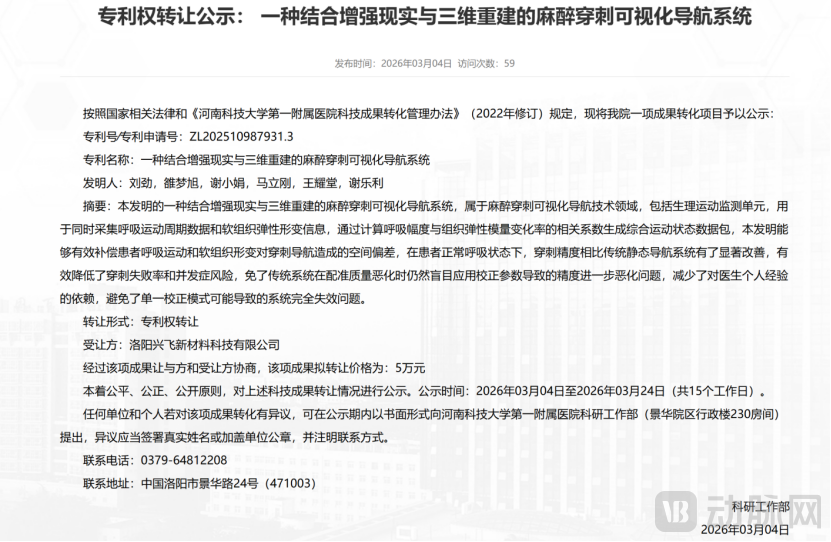
Image from the official website of the First Affiliated Hospital of Henan University of Science and Technology
“An Augmented Reality and 3D Reconstruction-Based Visual Navigation System for Anesthetic Puncture” belongs to the technical field of visual navigation for anesthetic puncture. It includes a physiological motion monitoring unit designed to simultaneously acquire respiratory cycle data and soft tissue elastic deformation information, generating a comprehensive motion status data packet by calculating the correlation coefficient between respiratory amplitude and the rate of change in tissue elastic modulus.
Traditional anesthesia puncture navigation technologies and related products rely on static imaging data and fixed anatomical reference points for path planning and navigation. In clinical practice, due to limitations in technical design, they present multiple pain points and challenges that directly affect the precision, safety, and efficiency of puncture procedures, as detailed below.
First, it cannot compensate for spatial positional deviations caused by physiological motion.Respiratory movements, heartbeats, and minor postural shifts occurring during anesthetic puncture cause real-time changes in the spatial position of target anatomical structures. Traditional navigation systems lack effective mechanisms to identify and compensate for such dynamic variations, leading to a significant decline in puncture accuracy and a substantially increased risk of procedural failure and complications such as pneumothorax and vascular injury.
Second, there is a lack of capability to handle the elastic deformation of soft tissues.When a biopsy needle contacts and compresses soft tissue, the tissue undergoes varying degrees of elastic deformation, altering the original anatomical structural relationships. However, traditional products cannot perceive such deformations in real time or provide targeted compensation, resulting in significant deviations between navigation information and actual anatomical positions, thereby further reducing navigation accuracy.
Third, there is no mechanism for dynamic assessment and adaptive adjustment of registration quality.In clinical settings involving patient motion artifacts, the quality of image registration undergoes dynamic fluctuations over time and in relation to motion amplitude. Traditional systems are incapable of real-time assessment of registration reliability and fail to dynamically adjust correction strategies in response to quality variations. Consequently, they continue to apply original correction parameters indiscriminately even when registration quality deteriorates, leading to further degradation of navigation accuracy.
Fourth, there is an overreliance on physicians' individual clinical experience.Due to the aforementioned technical limitations, the success of traditional puncture navigation procedures relies heavily on the physician’s individual experience and tactile feedback. For clinicians with limited experience, this often leads to errors in judging the puncture trajectory, which not only prolongs the procedure time but also increases the uncertainty of clinical outcomes.
This invention patent combines augmented reality and 3D reconstruction for an anesthesia puncture visualization navigation system, addressing the core pain points of traditional products.By driving technological innovation, we have constructed a triple-coupled adaptive closed-loop mechanism that integrates physiological motion sensing, quality assessment, and dynamic correction. Compared with existing technologies, this approach achieves multiple breakthroughs in precision, safety, and intelligence.
First, establish a physiological motion-adaptive dynamic compensation mechanism to enhance puncture accuracy. The system is equipped with a physiological motion monitoring unit, which, throughStrain-based respiratory sensors and contact ultrasound transducers synchronously acquire respiratory cycle data and soft tissue elastic deformation information, calculate the correlation coefficient between the two to generate a comprehensive motion status data package, effectively compensate for spatial deviations caused by patient respiratory motion and soft tissue deformation, significantly improve puncture accuracy under normal breathing conditions, and reduce the failure rate and risk of complications.
Second, an innovative multimodal information entropy-based registration quality assessment mechanism was developed to enable real-time quantitative monitoring.Introduce a multimodal registration quality assessment unit to calculate spatial position entropy, texture feature entropy, and motion consistency entropy, which are fused with weights of 40%, 35%, and 25%, respectively, to generate a comprehensive quality assessment index for real-time quantitative monitoring of navigation system reliability. Meanwhile, the index is used to categorize correction intensity into three levels—high, medium, and low—corresponding to application ratios of 100%, 60%, and 30% for correction parameters, thereby preventing accuracy degradation caused by blind correction when registration quality deteriorates.
Third, establish a complete adaptive learning loop to reduce reliance on physicians' experience.Construct an adaptive learning loop that progresses from physiological motion perception to quality assessment and then to dynamic correction. The dynamic compensation and adjustment unit can receive navigation performance evaluation data from the augmented reality navigation unit, optimize the mapping relationship between the quality index and correction intensity based on the gradient descent algorithm, automatically optimize correction strategies according to the physiological characteristics and motion patterns of different patients, improve navigation accuracy for specific patient populations, and significantly reduce reliance on physicians’ individual experience.
Fourth, design a hierarchical visual augmented reality navigation interface to improve human-computer interaction efficiency.The augmented reality navigation unit overlays corrected navigation information onto real-time medical images, employing a tiered visual encoding scheme based on correction confidence levels—high confidence is represented by solid green lines, medium confidence by dashed yellow lines, and low confidence by semi-transparent red lines. This enables physicians to intuitively assess the reliability of navigation data and make informed clinical decisions, thereby enhancing the safety and efficiency of puncture procedures and reducing average puncture time.
Fifth, a multi-coupled adaptive mechanism ensures system stability and prevents the failure of a single correction mode.Through innovative data flow and control flow designs, the system’s functional modules achieve deep synergy and intelligent coordination. Even in extreme scenarios such as severe patient coughing or sudden changes in body position, the system maintains basic navigation capabilities by dynamically adjusting correction intensity, thereby avoiding the complete system failure often associated with traditional single-mode correction approaches.
In the clinical application and market deployment of visualization navigation systems, a variety of commercially available products with mature technologies and distinct features have established their respective technical advantages and application scenarios. Covering both high-end imported equipment and innovative domestically produced systems, these solutions have achieved technological breakthroughs across multiple dimensions, including multimodal navigation fusion, intraoperative imaging support, and AI-driven intelligent empowerment.
Medtronic StealthStation™ S8 Surgical Navigation SystemSeamlessly integrating AR overlay technology with optical navigation, the system provides real-time augmented reality guidance to physicians, ensuring precise control throughout the entire process from preoperative planning to intraoperative execution. Leveraging SyncAR® technology, it overlays 360° rendered vascular structures, tumor boundaries, and white matter fiber tracts (DTI) onto the microscope eyepiece, supporting adjustments for opacity and focus switching. The system integrates dual-mode optical and electromagnetic navigation to track instrument positions in real time, synchronously displaying virtual probes alongside critical anatomical structures. It supports integration with O-arm intraoperative CT, microscopes, and third-party instruments, adapting seamlessly to existing operating room workflows. Coordinated by dual 27-inch touchscreens and a sub-millimeter precision robotic arm, the system covers surgical procedures ranging from the skull base to the sacrum, making it particularly suitable for high-difficulty surgeries such as glioma resection and aneurysm clipping.
Siemens Healthineers' Cios Spin Mobile C-arm SystemDesigned specifically for plastic surgery, trauma surgery, and spinal surgery, it provides intraoperative assessment with precise 3D imaging, enabling surgeons to perform intraoperative corrections based on the images and verify the results. Equipped with advanced flat-panel technology and offering versatility, it supports a variety of procedures involving both 2D and 3D imaging, including angiography. It also seamlessly integrates with the NaviLink 3D digital navigation system to provide surgical navigation, and features high generator power to address the challenges associated with imaging larger patients or dense anatomical structures. Additionally, it offers a range of optional software packages, including the Easy 3D package for rapid and efficient setup and image acquisition, as well as the Screw Scout package, which enables the system software to identify and automatically annotate screws in 3D X-ray images.
Huasheng Medical's "Xiao Beidou Polaris" AI-Powered Precision Ultrasound System for Anesthesia and Pain ManagementFocusing on anesthesia and pain management, this system redefines precision ultrasound guidance with AI-based nerve recognition and intelligent puncture technology as its core. Features such as an extra-large touchscreen, a convenient storage tray, long-lasting battery life, professional disinfectant cup holders, and one-touch electric height adjustment are designed to maximize convenience for healthcare professionals. The Holo Beam holographic focusing platform delivers full-field focusing with high frame rates and powerful processing capabilities, optimizing imaging quality. AI technology deeply enhances the puncture process: WiNerve accurately identifies nerves, WiNeedle improves needle visibility, WiGuide magnetic navigation provides precise guidance, and laser navigation offers unique innovation. Furthermore, the wiLearn Pro teaching software, integrated with the Huasheng Cloud Platform, provides abundant educational resources to facilitate learning and exchange among physicians, offering a new solution for anesthesia and pain diagnosis and treatment that is precise, efficient, and safe.