

Nantong University Licenses Innovative Self-Cleaning Thyroid Endoscope Patent for RMB 50,000
Recently, the Affiliated Hospital of Nantong University released a public notice on patent licensing, proposing to license its invention patents"A Self-Cleaning Lens Thyroid Endoscope"Licensed to Shanghai Muyi Biotechnology Co., Ltd. on a non-exclusive basis, with the transaction price negotiated by both parties asRMB 50,000。
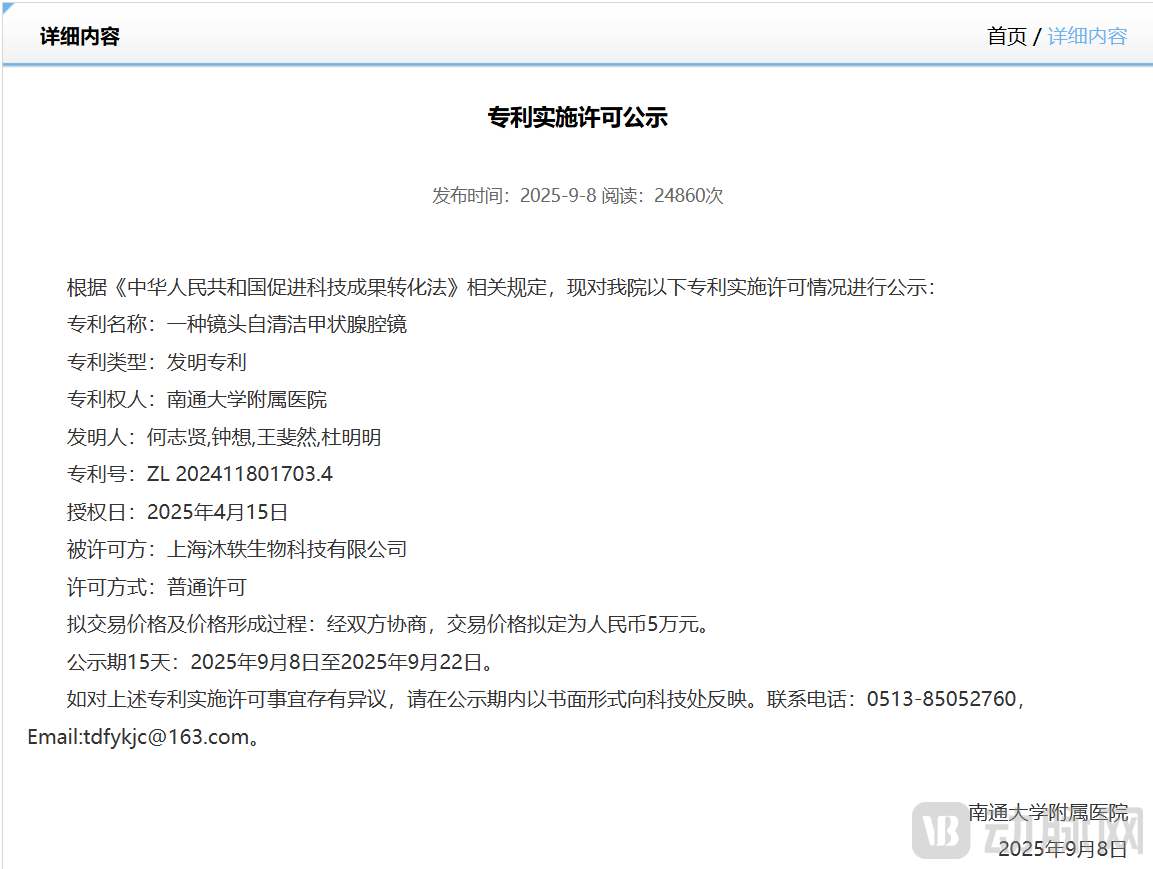
Image from the official website of Affiliated Hospital of Nantong University
This patent is byHe Zhixian, Zhong Xiang, Wang Feiran, Du MingmingJoint R&D, with the core innovation lying inAn integrated automatic scrubbing and rinsing cleaning system is equipped for thyroid endoscopes., enabling lens cleaning without removing the endoscope from the patient’s body. This solution addresses key industry pain points in traditional thyroid endoscopic surgery, where lenses are prone to contamination by lipid and oily residues, manual cleaning is cumbersome and increases infection risk, and equipment wear is accelerated. It achieves sterile, automated, real-time cleaning of the endoscopic lens, significantly enhancing the operational efficiency and safety of thyroid endoscopic procedures.
Thyroid DiseasesIt is a common endocrine system disease in clinical practice, and some conditions require surgical treatment. With the development of minimally invasive surgery techniques,Endoscopic Thyroid SurgeryIt has become one of the mainstream clinical treatment regimens. This approach utilizes thyroid endoscopy, an advanced medical device, to access the patient’s body through minimal incisions, providing the surgeon with a visualized operative field. Compared with traditional open thyroid surgery, it offers significant advantages, including minimal trauma, faster postoperative recovery, and inconspicuous neck scarring. These benefits greatly reduce surgical pain for patients and enhance cosmetic outcomes, making it a preferred option for the clinical management of thyroid diseases.
However, in the actual clinical application of thyroid endoscopic surgery, this device presents unavoidable operational defects that have become a key issue affecting the surgical process. Due to the unique internal environment of the human body during surgery, the endoscopic lens is highly susceptible to contamination by substances such as lipid deposits and blood stains. Once the lens is obscured, it directly results in a blurred surgical field, severely interfering with the surgeon’s precise judgment and manipulation of the operative site, thereby hindering the smooth progress of the procedure.
Currently, clinical approaches to addressing lens occlusion are relatively passive, requiring the endoscope to be removed from the patient’s body for manual cleaning. After cleaning, strict sterilization of the lens is necessary to meet surgical aseptic requirements before it can be reinserted into the patient to continue the procedure.
This operational workflow is not only cumbersome and complex, consuming valuable surgical time and reducing efficiency, but also increases the potential risk of surgical site infections due to the repeated insertion and removal of the endoscope, thereby posing hazards to patient safety. Meanwhile, frequent manual cleaning and disinfection cause varying degrees of wear and tear on the lens and shaft of the endoscopic equipment, shortening its overall service life and consequently increasing medical institutions’ costs for equipment investment and maintenance.
In the current clinical landscape, there is an urgent technical demand within the industry.There is an urgent need to develop a technical solution that enables lens cleaning during thyroid endoscopy without the need to remove the device., ensuring both effective cleaning and the maintenance of a sterile surgical environment, thereby overcoming many limitations of existing technologies and making thyroid endoscopic surgery more efficient and safer.
The core innovation of this self-cleaning lens for thyroid endoscopy lies in"Developed an 'integrated automatic cleaning system that can be completed without removing the endoscope'",Highly integrated scrubbing, irrigation, and suction functions within the endoscopic accessory structure, fundamentally overcoming the technical limitations of traditional endoscopic thyroid surgery that requires manual instrument exchange for cleaning, while offering multiple technological advantages and clinical innovative value.
In terms of structural design, the deviceInnovative Design: An Inclined Elliptical Transparent Plate Conforming to the Laparoscopic Lens as a Protective Layer,Equipped with an automatic scrubbing device consisting of a rotation-driven mechanism, arc-shaped drive rod, elastic pull cord, and scrubbing strip., through the coordinated transmission of the ring gear and gears, drives the cleaning strip to precisely scrub up and down along the surface of the transparent plate; it also features an adaptive structure with limit slots and limit blocks to ensure stable tension of the pull rope during cleaning, prevent elastic fatigue, and achieve efficient and rapid removal of stains.
MeanwhileA retractable irrigation device was developed as a supporting component.,Built-in dual-channel irrigation lines for povidone-iodine and normal saline, it can deploy a conduit plate as needed to precisely spray fluid for cleaning and disinfection directly beneath the transparent plate. Equipped with a filter-equipped suction conduit and a negative pressure pump, it can instantly aspirate the irrigation fluid, preventing residue buildup from obstructing the visual field, thereby meeting both cleanliness and sterility requirements. Furthermore, the device features an operation panel and controller with integrated scrubbing and irrigation buttons, enabling electrically linked control of all cleaning components. This design ensures ease of use and accommodates the emergency operational needs of clinical surgeries.
From a clinical application perspective, the innovative design of this technology effectively addresses the core pain points of traditional endoscopes. It eliminates the need to interrupt surgery for endoscope insertion and removal, significantly saving time spent on manual cleaning and sterilization, thereby enhancing the overall operational efficiency of thyroid endoscopic surgeries. By fundamentally reducing the risk of surgical infections associated with repeated endoscope handling, it strengthens procedural safety. Furthermore, it prevents wear and tear on endoscopic equipment caused by frequent manual cleaning, extending device lifespan and lowering equipment maintenance and investment costs for healthcare institutions.
andSynergistic Design of Transparent Shield Protection, Automatic Wiping, and Dual-Channel Flush-and-Aspirate Function, it can continuously ensure the clarity of the endoscopic field during surgery, providing stable support for the surgeon's precise judgment and manipulation, thereby allowing the minimally invasive advantages of thyroid endoscopy to be more fully realized in clinical practice.
The global market for minimally invasive surgery continues to expand, with a considerable compound annual growth rate. This trend indicates substantial potential for market adoption in the clinical application of thyroid surgery and provides valuable insights for the intelligent and user-friendly upgrading of endoscopic medical devices.
The current market for thyroid endoscopic instruments and related lens-cleaning devices is experiencing steady growth, driven by the widespread adoption of minimally invasive surgery. Meanwhile, the broader market for minimally invasive surgical instruments demonstrates significant development potential, propelled by both policy initiatives and clinical demand. National payment reforms and the advancement of tiered diagnosis and treatment systems are encouraging hospitals at all levels to increase the penetration rate of minimally invasive procedures, with county-level hospitals emerging as a key source of incremental growth. As clinical demands for surgical efficiency and safety continue to rise, endoscopic instruments are being compelled to upgrade toward intelligence and functional integration. Innovations in the industry are increasingly focused on features such as in-situ lens cleaning and sterile operation.
Blue Sail Surgical’s RenoVue Disposable Endoscopic Closed-Loop Lens Cleaning Trocar is the world’s first innovative device for endoscopic lens cleaning., it has been approved for inclusion in the National Special Approval Procedure for Innovative Medical Devices and officially launched on the market. At its core is an integrated closed-loop cleaning system that combines minimally invasive channels with cleaning flow paths. It also incorporates key design features such as pulsed air-bubble flow, a unique W-shaped bottom structure, and intelligent touch-free activation. This system enables in-situ cleaning of endoscopic lenses without the need for removal from the body, effectively preventing fogging and avoiding secondary contamination. It is compatible with mainstream brands of endoscopic instruments available on the market, and its operation aligns with surgeons’ clinical habits, requiring no changes to existing surgical workflows.
The product’s market applications cover laparoscopic minimally invasive surgical scenarios across multiple specialties, including hepatobiliary, gastrointestinal, esophageal, urological, and obstetrics and gynecology departments. It has been implemented in clinical surgeries of varying complexity and has gained recognition from clinicians for its in-situ cleaning and high-efficiency cleansing capabilities. Currently, the product is established in the domestic minimally invasive surgery market and, leveraging Bluestar Surgical’s comprehensive industry chain layout, is gradually expanding into the global market. It has become an essential accessory for endoscope lens cleaning in minimally invasive surgeries, meeting the needs of laparoscopic procedures at medical institutions of all levels.
KARL STORZ HOPKINS® Rubina endoscopes are premium optical endoscopic products in the global endoscopy field.Built upon the classic Hopkins rod lens system and specifically designed for fluorescence imaging technology, this endoscope integrates seamlessly with the IMAGE1 S Rubina imaging system. It allows flexible switching between white light and near-infrared (NIR/ICG) fluorescence modes without refocusing, providing ample illumination of the surgical field and optimized tissue focus. Available in various angles of view and diameters to accommodate diverse surgical requirements, the system features a camera head that withstands high-temperature and high-pressure sterilization, balancing professional imaging quality with clinical practicality.
This product’s market applications span minimally invasive surgical procedures across multiple specialties, including thyroid, hepatobiliary and pancreatic, and gastrointestinal surgery. It is a commonly used device in complex procedures such as total thyroidectomy and cervical lymph node dissection, and is widely adopted in tertiary hospitals and high-end medical institutions both domestically and internationally. As a core component of Karl Storz’s comprehensive minimally invasive surgical solution, it has become a classic endoscopic product in minimally invasive surgery, thanks to its stable imaging performance and adaptability to diverse clinical scenarios. Leveraging the brand’s global footprint, it also holds a significant position in the international market for minimally invasive surgical instruments, providing reliable imaging support for various delicate minimally invasive procedures.
The self-cleaning lens thyroid endoscope covered by this patent, as a specialized innovative product in the field of thyroid endoscopy, has a very broad market prospect.
First,The product precisely fills the market gap for self-cleaning devices specifically designed for thyroid endoscopy., compared with general-purpose cleaning products, it features a proprietary structural design tailored to the equipment characteristics and contamination scenarios of thyroid surgery, offering stronger adaptability and better alignment with actual clinical needs.
Second,An Integrated Scrubbing, Irrigation, and Suction Cleaning System Addresses the Core Challenges of Traditional Endoscopic Thyroid Surgery, which can effectively improve surgical efficiency, reduce the risk of infection and equipment wear, and meet the core clinical demands for functional upgrades of minimally invasive instruments.
Third, leveraging the industry wave of domestic substitution and the market trend of minimally invasive surgery penetrating lower-tier markets,The product can meet the high-end demands of complex thyroid surgeries in Grade A tertiary hospitals., and also leverage practical functional design,Adapting Minimally Invasive Surgical Procedures for Primary Healthcare Institutions, with extensive market coverage.
Furthermore, the product’s technical design also provides a reference for the intelligent and specialized upgrading of endoscopic instruments. In the future, it can further expand its application scenarios through technological iterations, demonstrating strong market competitiveness and promotional value in the market for minimally invasive thyroid surgical instruments.