

Capital Medical University Affiliated Beijing Luhe Hospital to Transfer Patent for a Novel Device to Prevent Lower Limb Deep Vein Thrombosis at RMB 45,000
Recently, Beijing Luhe Hospital Affiliated to Capital Medical University released a public notice on the transformation of scientific and technological achievements, proposing to transfer its patent rights through assignment.“A Device for the Prevention of Lower Extremity Venous Thrombosis”The relevant patents have been assigned to Beijing Kangnuo Zhuoshang Technology Achievement Transformation Co., Ltd., with a transfer fee of RMBRMB 45,000. The inventor of this patented technology isCai Yafei and Zhang Weidong。
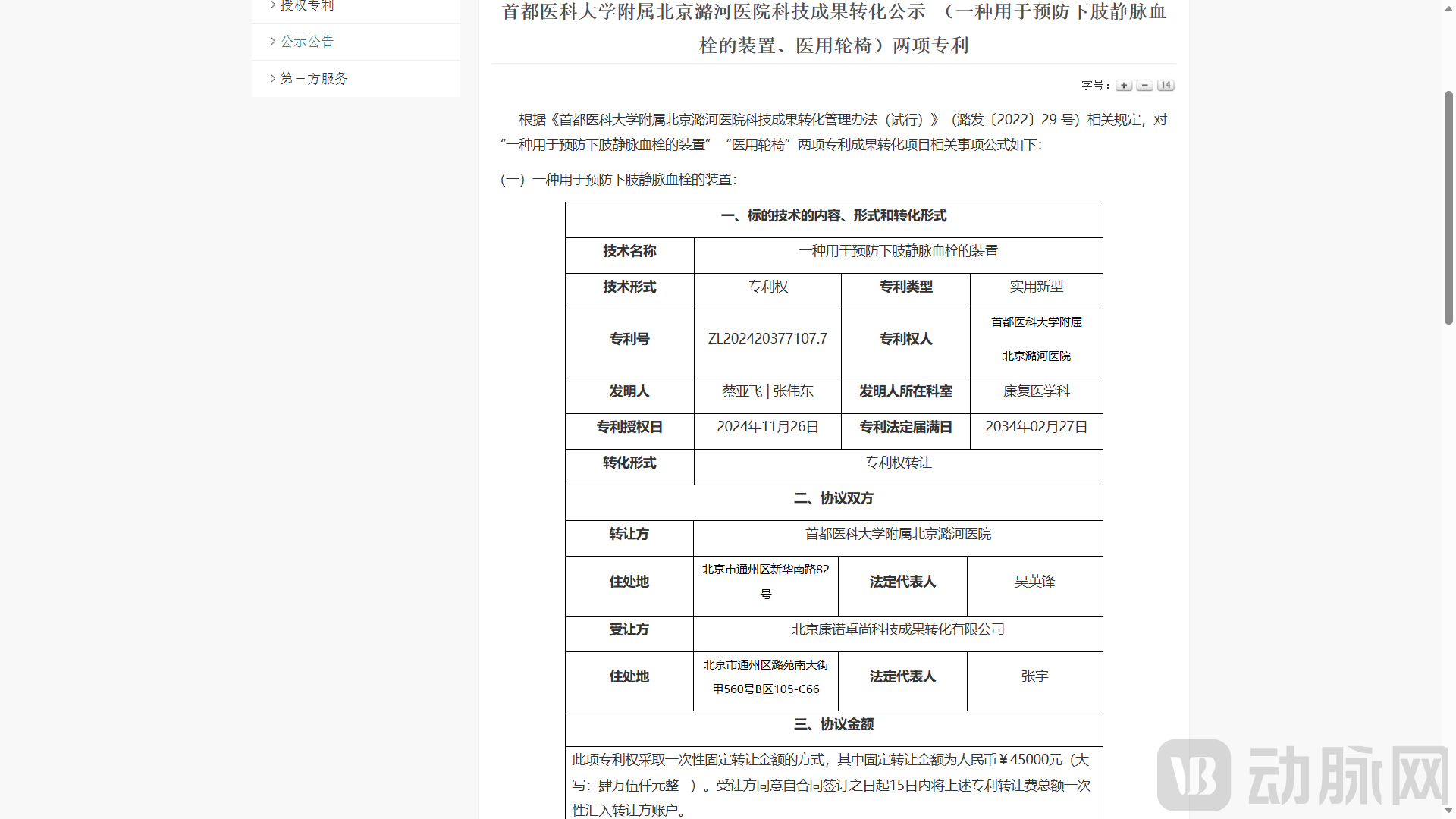
Image source: Official website of Beijing Luhe Hospital, Capital Medical University
This technology isA Utility Model Medical Device for the Prevention of Lower Extremity Venous Thrombosis, specifically designed for patients at high risk of lower extremity deep vein thrombosis (DVT) due to prolonged bed rest and hypercoagulability, such as those with stroke. It addresses the limitations of existing blood circulation assistance devices, which lack ankle pump assistance and feature uncontrolled compression pressure that can easily cause skin breakdown. By combining water circulation massage with passive simulated ankle pump exercises, the device promotes venous return in the lower extremities, thereby preventing DVT at its source.
Prophylaxis of Lower Extremity Venous ThrombosisIt is a core component of clinical nursing for high-risk populations, such as stroke patients and those on bed rest after surgery. Efficient and safe methods to promote venous return are directly related to the prevention and control of complications and the rehabilitation process in patients.
However, in current clinical scenarios for thrombosis prophylaxis,Inherent Defects in Traditional Pneumatic Compression Devices Lead to a Concentrated Outbreak of Pain Points:Current preventive measures primarily rely on simple limb compression and massage, lacking support for assisted ankle pump exercises. This functional limitation significantly compromises thrombosis prevention efficacy, making it difficult to fundamentally enhance lower extremity muscle contraction and venous return.
Such scenarios pose multiple challenges for both caregivers and patients:For Patients, the pressure output of traditional inflatable compression devices is uncontrollable, prone to excessive compression force or localized over-compression, which not only reduces user comfort but also easily causes skin breakdown, particularly in patients who are bedridden for prolonged periods and have poor skin condition, thereby increasing the risk of secondary injury; furthermore, simple squeeze massage can only promote superficial blood flow and fails to simulate the ankle pump movement’s effect in enhancing deep venous return in the lower extremities, significantly compromising the specificity and effectiveness of thrombosis prevention.
For caregivers,, traditional devices have limited functionality and require additional assistance for patients to perform ankle pump exercises, which increases the workload of nursing staff and occupies time that could otherwise be dedicated to critical tasks such as condition monitoring and rehabilitation guidance, resulting in a waste of nursing resources. Particularly in departments with a large patient volume and staffing shortages, it is difficult to achieve comprehensive and routine manual assistance for ankle pump exercises, severely limiting the overall effectiveness of thrombosis prevention efforts.
Currently, mainstream solutions for the prevention of lower extremity venous thrombosis still rely onIntermittent Pneumatic Compression DevicePrimarily, some hospitals have attempted to combine manual massage and passive limb movements to compensate for functional deficiencies. However, these methods are cumbersome, time-consuming, and labor-intensive, with low standardization in manual operations, resulting in inconsistent preventive efficacy. Although a few improved compression devices have added auxiliary functions such as heating, they still fail to address the core lack of ankle pump assistance. Moreover, these devices suffer from drawbacks such as uncontrollable pressure and poor conformity to the limbs, making it difficult to accommodate the lower extremity characteristics of patients with different body types. Some devices also exhibit low patient compliance due to excessively rigid materials and complex donning procedures.
In addition,Current solutions generally lack personalized adjustment capabilities., unable to adjust massage intensity and modes based on patients’ limb conditions and tolerance levels; furthermore, the contact materials of some devices are prone to causing skin allergies, further diminishing the user experience. These pain points have created an urgent market demand for a thrombosis prevention device that integrates functionality, ensures safety and comfort, and enables synchronized massage and ankle pump exercises. Such a device would fill the gap left by traditional solutions in terms of “high efficiency, safety, and adaptability,” thereby addressing the core challenges in the prevention of lower extremity venous thrombosis.
This lower-extremity venous thrombosis prevention device, leveraging an innovative water-flow-driven design and multi-dimensional functional adaptability, specifically addresses the core pain points of traditional thrombosis prevention devices, demonstrating“Functional Integration, Safety and Comfort, Precise Adaptation”Three Core Advantages: Delivering More Efficient and Patient-Centered Thrombosis Prevention Solutions for High-Risk Populations, Including Stroke Patients and Postoperative Bedridden Individuals.
Hydrotherapy Massage + Passive Ankle Pump: Dual Action to Enhance Thrombosis PreventionDriven by circulating water flow, the device provides comprehensive hydro-massage to the feet, ankles, and lower legs. Meanwhile, the drive structure of the foot massage module moves with the water flow to facilitate dorsiflexion and plantar flexion, simulating professional ankle pump exercises. Additionally, the hollow design of the ankle massage module offers ample space for ankle movement, enabling simultaneous massage and passive ankle pump therapy.
Under the dual-action mechanism, it not only promotes superficial blood circulation but also deeply stimulates lower limb muscle contractions, significantly enhancing venous return efficiency from the lower extremities. This approach fundamentally reduces the risk of thrombosis, achieving a qualitative improvement in targeted thromboprophylaxis and efficacy compared to traditional single-mode compression massage devices.
Flexible Contact + Adjustable Control: Safe Adaptation for an Enhanced User Experience.All components of the device that come into contact with the patient’s skin are equipped with a medical-grade silicone layer, which is soft, skin-friendly, and conforms closely to the limbs. This design thoroughly addresses the issue of skin damage caused by uncontrolled pressure in traditional pneumatic compression devices. Additionally, the foot and leg massage sections feature built-in massage nodules arranged according to acupoint locations. Water flow drives these nodules to press against the skin, providing acupoint stimulation, thereby combining thrombosis prevention with the restoration of limb muscle strength.
Furthermore, the device features an independent water circuit design with dual massage chambers, coupled with a water pressure valve on the inlet pipe, to precisely control water pressure and flow rate. This allows for flexible adjustment of massage intensity based on the patient’s limb condition and tolerance level. Additionally, the heating and temperature control mechanism within the circulating water tank maintains the water at a preset temperature, enhancing the comfort of hydrotherapy massage and significantly improving patient compliance.
Human-Centered Design + User-Friendly Operation, Adapting to Diverse Clinical Scenarios.The leg massage section of the device features an axially aligned zipper for rapid opening and closing, facilitating easy donning by patients of varying body types. The recessed design at the junction between the foot and ankle massage sections creates a heel restraint area, enhancing foot stability during movement and preventing displacement that could compromise the efficacy of the massage and ankle pump therapy.
The overall structure features no complex or redundant design.The core circulating water tank is simply connected to the massage device via water pipes, with water circulation automatically driven by a pump. This eliminates the need for manual operation by medical staff, thereby freeing up nursing resources and allowing healthcare professionals to focus on critical tasks such as patient monitoring and rehabilitation guidance. Furthermore, the device is adaptable to various clinical settings, including bedside care and rehabilitation rooms, meeting the needs of high-risk thrombosis populations such as stroke patients, postoperative bedridden patients, and orthopedic patients in recovery, demonstrating strong versatility.
The market for current lower extremity venous thrombosis prevention devices has taken shape“Pneumatic compression as the core, hydrotherapy as the new innovation, and in-house hospital R&D as the supplement”the diversified landscape, with domestic and international enterprises and medical institutions centering on“Enhance thromboprophylaxis efficacy, optimize user experience, and adapt to clinical scenarios”Strategic layout centered on core needs, with products demonstrating differentiated development in drive mechanisms, functional integration, and pressure control, among whichIntegrated Functionality, Human-Centered Experience, and Composite Technologyhas become the mainstream R&D direction for next-generation products.
Beijing Longma Futu Technology Co., Ltd. DVT Air Pressure Therapy Device,As a representative domestically produced pneumatic compression anti-thrombosis device, it has obtained the Class II Medical Device Registration Certificate and is widely compatible with high-risk thrombosis departments such as orthopedics, general surgery, and intensive care units (ICU). Its core advantages lie in multi-specification adaptability and standardized compression. The product consists of a main unit, air tubing, and pressure leg sleeves. The pressure leg sleeves are available in full-length and segmented designs, covering various compression areas including the entire leg, calf, and foot. Constructed from TPU nylon and non-woven fabric, the device accommodates different patient limb characteristics. By applying periodic pneumatic pressure to the lower extremities, it facilitates the rapid return of venous blood and tissue fluid, effectively addressing blood stasis. With multiple models such as DVT-PT and DVT-MX, it meets the basic anti-thrombosis needs across diverse clinical scenarios, making it a mainstream basic anti-thrombosis device in hospitals across China.
Rui典 Arjo Huntleigh Flowtron Excel Intermittent Pneumatic Compression SystemAs an internationally renowned device for thrombosis prevention, it is a classic model widely used in clinical practice by healthcare institutions worldwide, suitable for pre- and post-operative thrombosis prophylaxis across multiple departments, including orthopedics, neurosurgery, and oncology. Its core advantages lie in its clinical adaptability and compression safety. By applying intermittent gradient compression to the lower limbs via calf sleeves or full-leg sleeves, it significantly increases deep venous blood flow velocity while promoting fibrinolysis, thereby reducing the risk of thrombus formation at its source without causing side effects such as bleeding or ecchymosis. The product offers a variety of sleeve sizes, including standard, large, and specialized versions for obese patients, ensuring precise fit according to patient body type. It also allows for flexible adjustment of inflation pressure, enabling safe use even in patients with special conditions such as unilateral leg amputation or leg ulcers. The Flowtron ACS900 Pulsatile Compression Antithrombotic System, part of the same series, features an upgraded compression mode that further enhances blood flow propulsion efficiency.
Shenzhen Weidamei Medical Co., Ltd. DVT Series Leg Compression Sleeves,As a professional provider of ancillary supplies for thrombosis prevention, our flagship product features user-friendly inflatable cuffs with multi-brand compatibility. The cuffs are available in various configurations with 3, 4, or 6 independent air chambers. Designed ergonomically with a tapered shape, they are suitable for both left and right legs. The tubing and connectors are positioned on both sides to avoid pressure on the patient’s skin, thereby enhancing comfort during prolonged wear. Made from soft, breathable PET non-woven fabric, the cuffs undergo biocompatibility testing. Each cuff is subjected to 100% leak testing prior to shipment to ensure stability during pressurization. Furthermore, the product is compatible with the majority of DVT pump systems currently on the market, allowing flexible integration with host units from different brands, making it a key ancillary choice for clinical intermittent pneumatic compression devices.
In summary, this device for the prevention of lower extremity venous thrombosis,Centered on circulating water flow, it innovatively integrates hydrotherapy massage, passive ankle pump exercises, and acupoint stimulation.It specifically addresses the industry pain points of traditional pneumatic compression devices, such as single-functionality, uncontrollable pressure, and susceptibility to causing skin damage. It combines safety, comfort, and ease of operation, adapts to different patients and clinical scenarios, and effectively reduces the nursing workload. Its technical design, which integrates hydrotherapy with ankle pump exercises, breaks away from the industry’s traditional reliance on simple physical compression, driving the development of deep vein thrombosis (DVT) prevention devices for the lower extremities toward functional integration and technological convergence.
In the future, such innovative devices for multidimensional physical intervention are expected to become the mainstream choice for thrombosis prevention in high-risk populations, while also providing new directions for the industry’s research and development of precision and intelligent technologies.