

Tongji Hospital of Huazhong University of Science and Technology to Transfer Portable Arm-Worn Blood Pressure Monitoring Device for RMB 220,000
Recently, Tongji Hospital affiliated with Tongji Medical College of Huazhong University of Science and Technology released a public notice on the transformation of scientific and technological achievements. The hospital intends to transfer its intellectual property through negotiated pricing."Arm-Mounted Portable Blood Pressure Monitoring Device"Relevant patents have been transferred to Yiyixuan (Wuhan) Medical Technology Co., Ltd., with the transfer amount beingRMB 220,000. The inventors of this patent areLu Lijuan and Her Team。
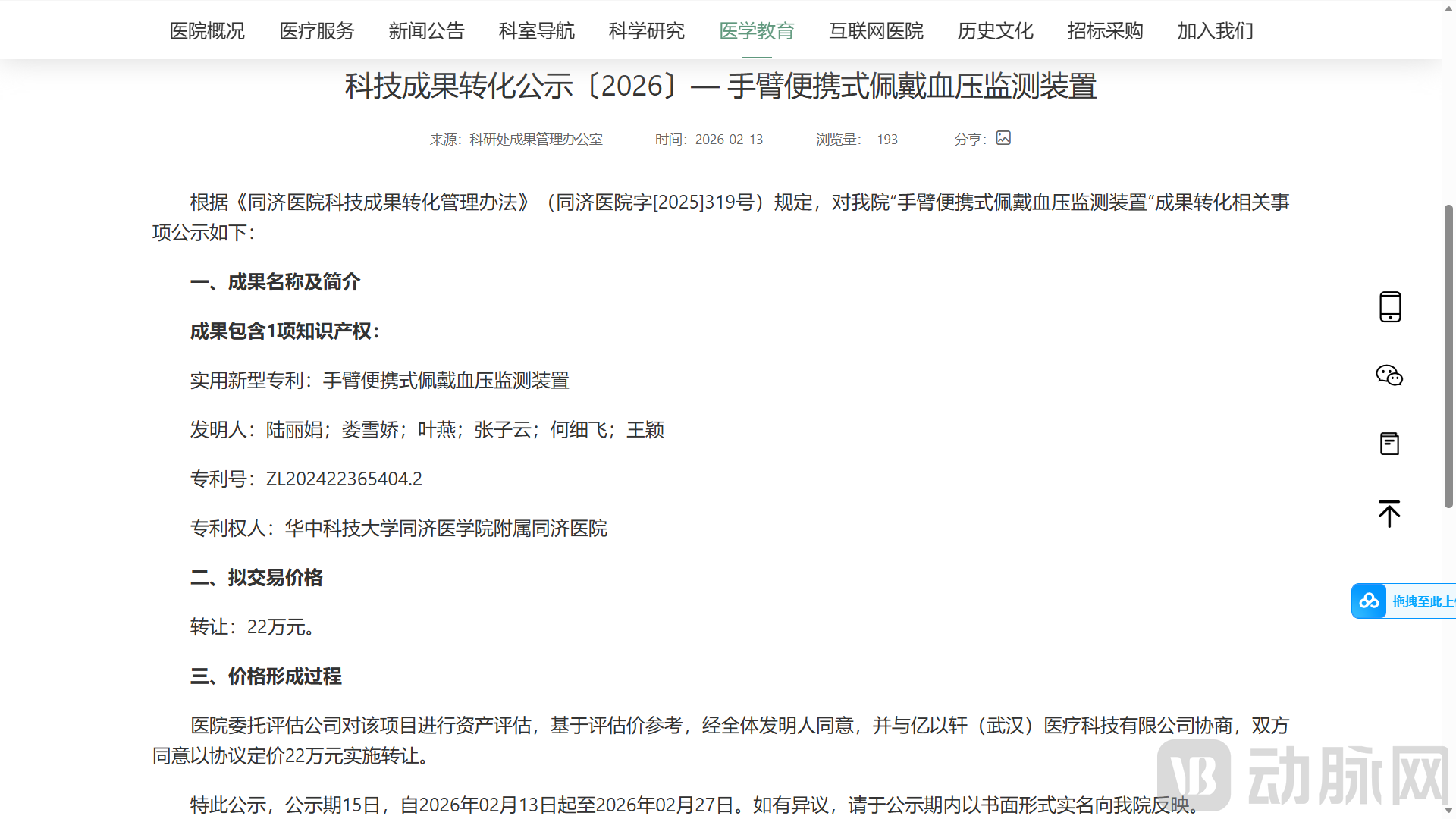
Image from the official website of Tongji Hospital, Tongji Medical College, Huazhong University of Science and Technology
This technology isUtility Model Patent Technology for an Arm-Worn Portable Blood Pressure Monitoring Device, designed for convenient, comfortable, and precise dynamic blood pressure monitoring of the human arm, while also supporting puncture site monitoring. It addresses many of the pain points associated with traditional blood pressure monitoring devices and is suitable for scenarios such as daily ambulatory blood pressure monitoring in hypertensive patients and clinical blood pressure monitoring.
Blood Pressure MonitoringIt is a core component of hypertension prevention, control, and clinical diagnosis and treatment. With the growing demand for the prevention and control of cardiovascular and cerebrovascular diseases, the need for ambulatory blood pressure monitoring devices in both medical and consumer settings continues to rise. Portable monitoring devices capable of real-time reflection of blood pressure changes have become a market necessity. While the upper arm, as the conventional site for blood pressure measurement, should serve as the primary platform for portable monitoring devices, existing arm-worn blood pressure monitors suffer from numerous critical pain points that severely hinder their clinical adoption and consumer promotion.
Traditional arm-worn blood pressure monitoring devices face core technological bottlenecks: on one hand,Significant Deficiencies in Fit and Comfort, some devices use circular elastic bands for arm attachment. Due to variations in users' arm circumferences, the elastic bands tend to generate significant rebound force after adjustment, compressing the arm and failing to achieve a comfortable yet snug fit. Prolonged wear can easily cause discomfort such as soreness, swelling, and numbness; on the other hand,Balancing Monitoring Methods and User Experience Is Challenging, traditional ambulatory blood pressure monitoring still relies primarily on fixed-interval spot measurements, failing to achieve true real-time dynamic monitoring. Moreover, some devices offer only a single non-invasive monitoring mode, making it difficult to meet the specific clinical needs for invasive catheter-based monitoring. Meanwhile, most devices lack intuitive display of monitoring values and are devoid of data review and alert functions, significantly compromising the monitoring experience.
From a practical application perspective, existing equipment still exhibits significant shortcomings in usability.Although clinical intra-arterial continuous blood pressure monitoring devices enable continuous monitoring, they are invasive and require wired connections to monitoring equipment. This severely restricts patient mobility, limiting their use to bedridden diagnostic and treatment scenarios and failing to meet the needs for daily activity and mobile monitoring. On the consumer side, while portable monitoring devices offer wireless convenience, they mostly feature a single-point measurement design with low data acquisition frequency. Consequently, they cannot reflect real-time blood pressure fluctuations. Furthermore, poor device fit often leads to data deviations, compromising accuracy. Meanwhile, existing devices lack ergonomic auxiliary designs; prolonged wear can cause slippage and poor contact due to arm sweating. Additionally, most device components are integrated without detachable, washable structures, making them prone to bacterial growth upon repeated use, which affects hygiene and device longevity.
Furthermore,Current Arm-Worn Blood Pressure Monitoring Devices Lack Unified Adaptation and Monitoring Standards, the lack of clear specifications for device adjustment ranges and unified parameters for sensor contact position and pressure results in significant deviations in monitoring data across different devices. The monitoring accuracy of some consumer-grade devices fails to meet medical reference standards, limiting their utility in clinical diagnosis and treatment. These issues have collectively trapped arm-worn blood pressure monitoring devices in a predicament characterized by “poor user experience, limited adaptability, and low accuracy.” There is an urgent market need for an arm-mounted portable blood pressure monitoring solution that offers strong adaptability, comfortable wearability, and the capability to support both non-invasive and invasive monitoring with real-time dynamic data acquisition, thereby addressing pain points across the entire process from wearing experience to adaptation for both clinical and consumer scenarios.
To address pain points such as poor fit, low comfort, and limited monitoring modalities associated with arm blood pressure monitoring devices, Tongji Hospital affiliated to Tongji Medical College of Huazhong University of Science and Technology has developed a portable arm-worn blood pressure monitoring device.withCentered on an adaptive comfort-fit structure and a non-invasive/invasive dual-mode monitoring design, fromWearing, Monitoring, MaintenanceMultidimensional Innovation: Creating a Superior Portable Ambulatory Blood Pressure Monitoring Solution.
Better Fit, More Precise Conformity:Abandoning the traditional elastic band design, it adopts a combined structure of monitoring strips, adjustment straps, and an outer sleeve, allowing flexible length adjustment according to arm circumference to avoid rebound compression. Paired with a fitting assembly consisting of airbags and micro-inflation fans, it enables precise regulation of airbag pressure, enhancing the device’s fit on the arm while balancing comfort and monitoring accuracy.
Dual-Mode Comprehensive Coverage with Real-Time Data: The monitoring strip integrates a blood pressure monitor and a puncture monitor, seamlessly adapting to both non-invasive daily monitoring and clinical invasive monitoring scenarios. Its built-in data collector enables real-time acquisition and wireless transmission of monitoring data, supporting connectivity with smartphones and patient monitors. Additionally, customizable blood pressure alarm thresholds facilitate dynamic blood pressure monitoring and abnormality alerts, overcoming the limitations of traditional spot-check measurements.
Easier Maintenance, Greater Durability:A detachable sweat-absorbing strip is installed on the inner side of the monitoring strap, enabling quick disassembly and cleaning via felt-strip adhesion. This design ensures hygiene while providing sweat absorption and anti-slip functionality. A protective component on the inner wall of the sweat-absorbing strip conforms to and protects idle monitoring devices, preventing damage from impacts and dust accumulation, thereby extending equipment lifespan. All components utilize a simple connection structure that requires no professional tools for operation, meeting the needs of both clinical and home use.
Portable and Unrestrained, Broader Application Scenarios:The device features a lightweight, wireless, and portable design that operates independently of monitoring equipment, allowing patients to move freely after wearing it. It is suitable for various scenarios, including clinical wards, home monitoring, and mobile use outside the hospital. Its multi-dimensional adjustable design accommodates diverse user groups, enhances patient compliance with monitoring, and effectively addresses the limitations of traditional devices in terms of scenario restrictions and poor user experience.
Arm-Worn Portable Blood Pressure MonitorAs a core device for hypertension prevention and control as well as daily health management, market demand continues to grow alongside rising awareness of chronic disease management, driving domestic and international medical enterprises to focus onPortability, Intelligence, and PrecisionExpand product R&D and upgrades. The current market has formed a competitive landscape where the intelligent iteration of traditional arm blood pressure monitors and the R&D of new wearable monitoring devices are proceeding in parallel. Leading companies are focusing on optimizing operational convenience, data intelligence, and wearing comfort. No product has yet achieved an integrated design for both non-invasive and invasive dual-mode monitoring.
Omron Healthcare (China) Co., Ltd., released in September 2025Four New Smart Risk-Alert Upper-Arm Blood Pressure Monitors, Including the A866T and HEM-7524, with a core focus on upgrading blood pressure risk identification, measurement guidance, and data service capabilities. The product features intelligent risk alerts, which classify and visually display blood pressure results in accordance with the "Chinese Guidelines for the Prevention and Treatment of Hypertension (2024 Revised Edition)." The A866T and HEM-7524 models have built-in intelligent voice modules that guide users to properly wear the cuff and maintain correct measurement posture, thereby reducing operational errors. The A866T can connect to the OMRON Plus APP to synchronize data, generate blood pressure reports, and provide abnormality alerts. All models are equipped with USB-C charging ports. The HEM-7524 and A862 models feature the "Flexi Fit Cuff" to enhance wearing convenience, further strengthening the intelligence and user-friendly design of traditional upper-arm blood pressure monitors by Omron Healthcare.
Jiangsu Yuyue Medical Equipment & Supply Co., Ltd., deeply engaged in the field of upper-arm blood pressure monitoring devices,Multiple mature products, including YE670E, YE692, and S67XR, are currently available., and continuously advance the intelligent and portable upgrades of its products. Among them, the YE670E is a classic upper-arm electronic blood pressure monitor, equipped with a 360° omnidirectional cuff, a backlit large screen, and voice broadcast functionality. It maintains pressure accuracy within 3 mmHg and supports memory storage for 90 sets of data, meeting the basic needs of home monitoring. The tunnel-style blood pressure monitor YE692, newly launched in 2026, ranked among the industry’s top 10 within three months of its release. Sales of the atrial fibrillation (AFib) blood pressure monitors S67XR and S68XR increased by over 100% year-on-year. These products focus on functional upgrades such as AFib monitoring and precise measurement. Meanwhile, Yuwell Medical has clearly stated its commitment to the “smart monitoring + wearable devices” direction, promoting the evolution of upper-arm monitoring devices from “data recorders” to “intelligent health managers,” thereby creating a closed-loop health management system.
The research and development of this device provides new insights for the technological upgrade of arm-worn portable blood pressure monitoring equipment. Its design direction, featuring adaptive wearability and dual-mode monitoring, aligns with industry trends toward greater comfort, multi-scenario adaptability, and intelligence in blood pressure monitoring devices. In the future, as demand for chronic disease management increases, the integration ofAdaptability, Functionality, and PortabilityMarket demand for blood pressure monitoring devices will continue to be unleashed, and innovative optimizations in their structure and functions will further promote the application and development of these devices in clinical diagnosis and treatment as well as in home health management.