

Jilin University to Transfer Two Novel Cross-Linking Mass Spectrometry Patents for RMB 40,000
Recently, Jilin University released a public notice on the conversion of scientific and technological achievements, proposing to transfer“A Bifunctional Protein Crosslinker and Its Preparation and Application” and “Method for Constructing Three-Dimensional Protein Structures Based on Specific Tyrosine Crosslinking”The relevant patent portfolio was transferred to Jilin Chuangli Biotechnology Co., Ltd. for a transfer fee of RMB40,000 yuan. The inventor of this patented technology isWei Zhonglin and His Team。
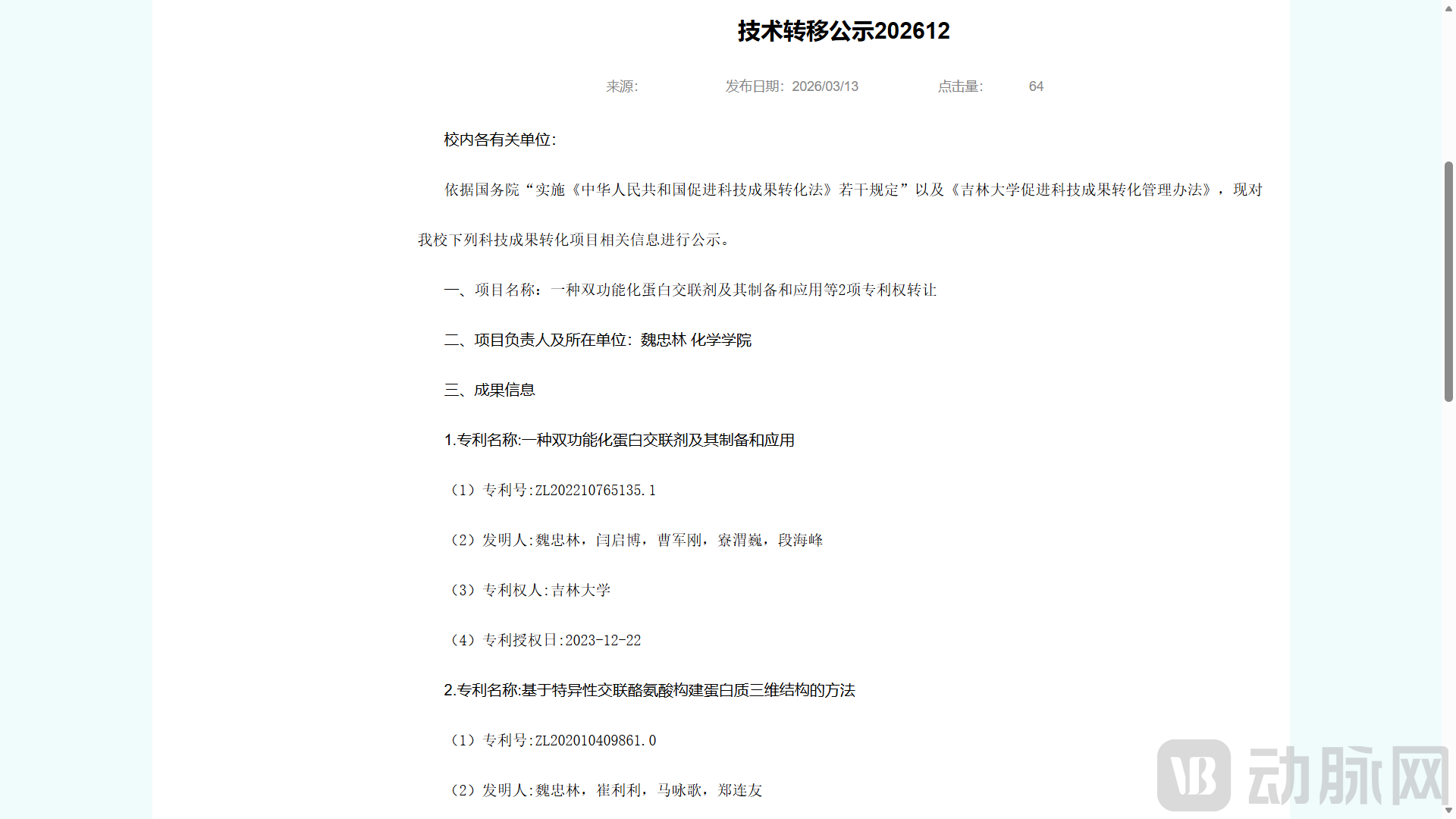
Image from the official website of Jilin University
Both of these technologies belong toCross-Linking Mass Spectrometry (XL-MS) Technology Field, is a series of innovative technologies developed by Jilin University for the elucidation of protein three-dimensional structures. The core of these technologies revolves around electro-click chemistry to achieve tyrosine-specific cross-linking, combined with methods such as electrochemical reduction and mass spectrometry analysis to deduce the three-dimensional structure of proteins, among whichA Fundamental Methodology for Tyrosine-Specific Single-Target Crosslinking, and the other isAdvanced Technology for Dual-Target Crosslinking of Tyrosine and HistidineTogether, they achieve technological iteration and complementarity, filling the gap in cross-linking mass spectrometry for tyrosine- and histidine-targeted analysis, and providing efficient experimental methods and tools for structural elucidation and interaction studies of protein/protein complexes.
Elucidation of Protein Three-Dimensional Structures and Protein Complex Interactions,It is a core step in elucidating the mechanisms of disease onset and progression, screening for biomarkers, and identifying drug targets, whileCross-Linking Mass SpectrometryAs a key tool in the field, it has become an important complement to traditional X-ray crystallography and nuclear magnetic resonance (NMR) spectroscopy, owing to advantages such as rapid analysis, low sample requirements, and the ability to capture weak interactions. However, in practical applications, cross-linking mass spectrometry (XL-MS) faces multiple industry challenges, including complex cross-linked fragments, low interpretation efficiency, and limited targeting specificity. These issues not only restrict the accuracy and scope of protein structure elucidation but also fail to meet the actual demands for in-depth protein research in the biopharmaceutical sector, thereby creating multidimensional market pain points.
From the perspective of core technical challenges, the complexity of cross-linked fragments and the structural heterogeneity of cross-linked products constitute the primary obstacle hindering the development of cross-linking mass spectrometry technology.In traditional cross-linking mass spectrometry (XL-MS) experiments, the enzymatic digestion of proteins after conjugation with cross-linking reagents generates a diverse array of cross-linked peptide fragments. This complexity leads to generally low data interpretation rates and limited efficiency in identifying cross-linking sites, requiring researchers to devote substantial effort to data screening and analysis, thereby significantly increasing both experimental and time costs. Furthermore, the widespread use of non-specific cross-linkers results in indiscriminate reactions with various amino acids, producing a large volume of off-target cross-linked products. This further exacerbates the difficulty of mass spectrometry data analysis, hinders the precise localization of key cross-linking sites within proteins, and compromises the accuracy of protein three-dimensional structure determination.
From the perspective of crosslinker development and application, existing crosslinkers exhibit significant limitations such as single-target specificity, low utilization efficiency, and poor adaptability, failing to meet diverse research needs.On the one hand, current mainstream crosslinkers primarily target lysine, glutamic acid, aspartic acid, and cysteine. There is minimal research on specific crosslinkers for the remaining 16 amino acids, such as tyrosine and histidine. As an essential amino acid, tyrosine is widely present in key proteins like myoglobin and tyrosine protein kinases, while the imidazole ring of histidine is closely related to the development of potential anticancer agents. This lack of targeted crosslinkers for these amino acids directly limits the ability of cross-linking mass spectrometry (XL-MS) to resolve the structures of more critical proteins. On the other hand, the few application-oriented crosslinkers available for tyrosine, such as NHS esters, suffer from short half-lives, prolonged reaction times, and susceptibility to hydrolysis in water, significantly compromising their practical efficacy. Furthermore, most existing crosslinkers lack cleavable properties, preventing the simplification of cross-linked fragments through controlled fragmentation, which further reduces the practicality of the technology.
From the perspective of existing cleavable crosslinker technologies, even though some R&D achievements have realized mass spectrometry-cleavable properties, they remain trapped in the dual dilemma of “single-target specificity” and “operational complexity.”Currently developed cleavable cross-linkers, such as those containing sulfoxide or glycosidic bond moieties, can generate characteristic fragments in mass spectrometry analysis. However, they remain limited to the traditional range of target amino acids and have not overcome the challenges of targeting tyrosine and histidine. Meanwhile, the synthesis of some cleavable cross-linkers involves cumbersome steps and high raw material costs. The harsh conditions required for the cross-linking reaction differ significantly from physiological environments, which can easily damage protein structures in practical experiments and compromise the authenticity of the cross-linking results.
Furthermore,The cleavage conditions for certain cleavable crosslinkers are difficult to control precisely.It is prone to incomplete or non-specific fragmentation, failing to effectively generate predictable characteristic fragments, which is detrimental to subsequent mass spectrometry sequencing and cross-linking site identification.
From the perspectives of technological integration and experimental methodology, although existing cross-linking mass spectrometry (XL-MS) techniques have made explorations in areas such as mass spectrometric analysis and structural modeling, they have yet to overcome the technical bottlenecks of “single-function capability” and “low workflow adaptability.”Most existing technologies focus solely on optimizing either the cross-linking reaction or mass spectrometry analysis, lacking a systematic, end-to-end design that encompasses the entire workflow of “cross-linking–enzymatic digestion–cleavage–mass spectrometry analysis–structure reconstruction.” This deficiency results in poor integration between steps and compromises overall experimental efficiency. Furthermore, in cross-linking studies involving rare amino acids such as tyrosine, current techniques struggle to combine specific cross-linking with controlled cleavage. They either fail to precisely target the amino acid of interest or require chemical reducing agents during the cleavage process, which can introduce additional impurities, disrupt the native protein structure, and reduce secondary fragmentation information, thereby further diminishing the accuracy of cross-linking site identification.
In addition,Lack of Standardized Design in Experimental Parameters for Certain Technologies, poor adaptability to different proteins and peptides makes it difficult to achieve stable application in various sample types such as angiotensin II, insulin, and bovine serum albumin, thereby limiting its widespread adoption in clinical and research settings.
The field of cross-linking mass spectrometry (XL-MS) has long been plagued by pain points such as complex cross-linked fragments, limited targeting to single amino acids, and reliance on chemical reducing agents for fragmentation. Jilin University has developed a series of patented technologies for tyrosine-targeted cross-linking, achieving a technological iteration from single-target to dual-target approaches. By deeply integrating specific targeted cross-linking with electrochemically controlled fragmentation, this core technology establishes a system for precise and efficient three-dimensional protein structure elucidation that is compatible with physiological environments. It comprehensively overcomes the limitations of traditional techniques and fills the industry gap in tyrosine- and histidine-targeted cross-linking.
The core advantages of this technological framework are manifested across four key dimensions:
Precise Targeting with Expanded Scope: Achieving Specific Cross-Linking from Tyrosine Single-Target to Tyrosine-Histidine Dual-Target.The first-generation technology pioneered the development of tyrosine-specific crosslinkers, achieving precise targeting via electro-click chemistry. The upgraded DBMT bifunctional crosslinker leverages a 1-methylurazole group to target tyrosine through electro-click chemistry and histidine through photo-reactive chemistry, becoming the first Y-H bifunctional crosslinker. It also enables precise differentiation of chain-terminal, intra-chain, and inter-chain crosslinking sites based on mass differences, significantly expanding the analytical scope of cross-linking mass spectrometry.
Controllable, green, and efficient cleavage: directional scission of S–S bonds achieved without chemical reductants.Both cross-linkers feature an electrochemically reducible disulfide (S–S) bond as their backbone. Applying a voltage of −3 V induces preferential fragmentation of the cross-linked products without introducing exogenous impurities, thereby preserving the native protein structure. This process generates characteristic fragment ions, simplifies mass spectrometry data interpretation, and significantly enhances the efficiency of cross-linking site identification.
The entire preparation and application workflow is mild, convenient, and combines excellent adaptability with practicality. The synthesis of the crosslinker requires only 3–4 simple reaction steps, using inexpensive and environmentally friendly raw materials. The crosslinking reaction is conducted in a physiological buffer at pH 7.4 under ambient or low-temperature conditions, thereby preserving the native conformation of proteins to the greatest extent. Subsequent enzymatic digestion and mass spectrometry analysis employ standardized parameters, ensuring high compatibility with conventional laboratory equipment and seamless integration throughout the entire workflow.
Wide sample compatibility and standardized analysis workflow.The technology has successfully validated the cross-linking analysis of peptides/proteins with varying molecular weights, including angiotensin II, insulin, ubiquitin, and bovine serum albumin, enabling precise identification of cross-linking sites. Meanwhile, a standardized structural analysis workflow using Gaussian View 6 and PyMOL 2.3 has been established. This approach allows for rapid determination of cross-linking types based on mass spectrometry mass differences and facilitates three-dimensional structure derivation through software modeling, thereby forming a reproducible and scalable analytical method.
This technological framework marksFirst-generation tyrosine-specific crosslinkers, next-generation Y-H bifunctional crosslinkersThe successive emergence of these tools has established a system for resolving the three-dimensional structures of proteins that is target-specific, features controllable cleavage, and employs mild operating conditions. This advancement has refined the core toolkit of cross-linking mass spectrometry (XL-MS) technology, providing critical technical support for biomedical fields such as disease mechanism research, biomarker screening, and anti-cancer drug development.
Currently, the development and commercialization of cross-linkers in the field of cross-linking mass spectrometry are mainly divided intoCommercialized Products from International Chemical Giants and Innovative R&D Technologies from Domestic Research InstitutionsTwo Major Camps: International Products withTraditional Amino Acid-Targeted Cleavable/Non-Cleavable Crosslinkersas the primary focus, large-scale commercialization has been achieved; in China,Focusing on the Innovative Design of Novel Cleavable Crosslinkers, with a focus on scientific research achievements, some technologies are close to industrialization, but there are no commercial products of tyrosine-histidine dual-targeting crosslinkers yet.
Sigma-Aldrich’s crosslinker product line features over 300 crosslinker-related products., covering homobifunctional and heterobifunctional crosslinkers. Functional groups include maleimide, NHS ester, and isothiocyanate, which primarily target amino and sulfhydryl groups in proteins, corresponding to amino acids such as lysine and cysteine. Some products support reaction modes such as click chemistry and photo-crosslinking. Its product portfolio comprehensively meets the needs of various scientific research scenarios, offers a high degree of customization, and holds a significant share in the global biochemical reagent market.
TDS, a Glycosidic Bond-Cleavable Crosslinker for Mass Spectrometry, Developed by the Dalian Institute of Chemical Physics, Chinese Academy of SciencesThe team led by Zhang Lihua at the Dalian Institute of Chemical Physics has developed trehalose di-N-hydroxysuccinimide ester (TDS), China’s first glycosidic bond-based mass spectrometry-cleavable crosslinker. Using trehalose as the scaffold molecule, TDS leverages the low-energy selective fragmentation characteristics of glycosidic bonds to achieve efficient analysis of cross-linked peptides. It also exhibits excellent biocompatibility and cell membrane permeability, enabling in situ cross-linking of protein complexes within living cells under minimal perturbation. This technology has identified over 3,500 pairs of cross-linked peptides from HeLa cells, achieving large-scale characterization of protein complexes in living cells. The related findings were published in Angewandte Chemie International Edition, and the technology is currently transitioning from laboratory research to industrialization.
Currently, commercialized products in the global crosslinker field still predominantly rely on traditional amino acid targeting. While the technology is mature, its targeting scope is limited and fails to meet the research needs for protein structures related to tyrosine and histidine. In the realm of scientific innovation, the focus is shifting towardCleavable, in situ cross-linking, high biocompatibilityIn this direction, domestic R&D has aligned with international standards, and some technologies have achieved leapfrog development; however, none have overcome the targeting challenges associated with tyrosine and histidine.
Tyrosine Single-Target Crosslinker and Tyrosine-Histidine Bifunctional Crosslinker (DBMT) Developed by Jilin University, it is the first technology globally to achieve tyrosine-specific cross-linking and the first to realize dual-targeted tyrosine-histidine cross-linking, filling a gap in the industry. It offers unique advantages in electrochemically controlled cleavage and mild reaction conditions. Compared with international commercial products and domestic research achievements, it demonstrates significant technological innovation and market uniqueness. Upon future industrialization, it will become a novel core reagent in the field of cross-linking mass spectrometry, meeting the market demand for research on tyrosine- and histidine-related proteins in the biopharmaceutical sector.