

Union Hospital Affiliated with Tongji Medical College of Huazhong University of Science and Technology to Transfer Automatic Dental Irrigation Device Patent for RMB 200,000
Recently, Union Hospital, Tongji Medical College, Huazhong University of Science and Technology, released a public notice on the conversion of scientific and technological achievements, proposing to transfer its “An Automatic Dental Irrigation Device"Patent assignment to Jiangsu Hongxin Medical Technology Co., Ltd., with an assignment fee ofRMB 200,000. The inventors of this patent are Wang Xianke and his team.。
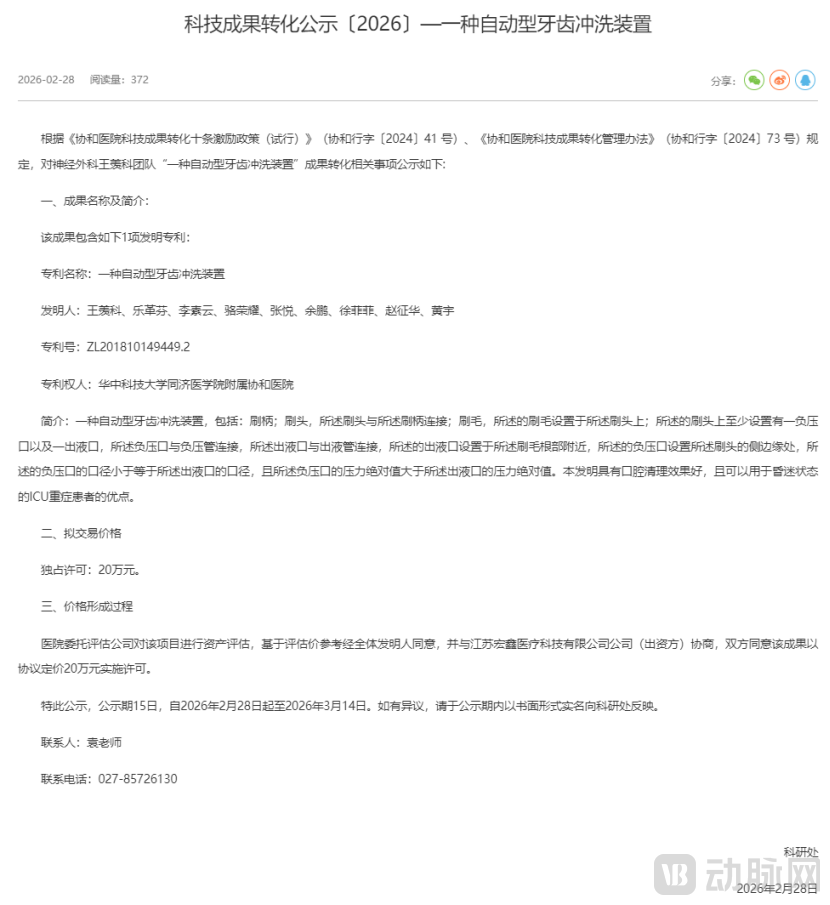
Image from the official website of Union Hospital, Tongji Medical College, Huazhong University of Science and Technology
Oral care is a common basic nursing procedure in clinical practice. With the increasing complexity of conditions among patients admitted to the intensive care unit (ICU), oral care has become particularly important in nursing operations, as oral pathogens play a direct role in the onset and progression of ventilator-associated pneumonia. This patent is specifically designed for clinical oral care, especially suitable for oral care scenarios involving critically ill patients in the ICU, achieving an innovative integration of toothbrushing and irrigation techniques.
Currently, the mainstream oral care methods and related products in ICU wards primarily include the cotton ball wiping method, conventional mechanical toothbrushing, and fully automatic toothbrushes designed for the general population. All three approaches and products present significant pain points in clinical application, making them ill-suited to meet the specialized nursing needs of critically ill ICU patients.
Consumables for Cotton Ball Wiping Method: The cotton ball features a rounded, blunt structure with low friction, making it ineffective at removing interdental residues and difficult to retrieve dislodged debris from the oral cavity. For patients with endotracheal intubation, obstruction by foreign bodies such as bite blocks and endotracheal tubes prevents thorough cleaning of hard-to-reach areas, including the inner tooth surfaces, interdental spaces, the base of the tongue, and the pharynx. Furthermore, it fails to effectively remove dental plaque, thereby increasing the risk of ventilator-associated pneumonia. Meanwhile, oral mucus in ICU patients tends to adhere to the surface of cotton balls, significantly reducing cleaning efficacy. This necessitates frequent replacement of cotton balls in clinical practice, leading to increased nursing costs and low cleaning efficiency.
Regular Toothbrush: Although it can reach multiple areas of the oral cavity and offers superior cleaning efficacy compared to cotton balls, it requires nurses to perform vigorous back-and-forth scrubbing motions. In patients with endotracheal intubation, this poses a high risk of tube displacement and presents significant operational difficulty. Furthermore, the scrubbing action can easily injure the gingiva; in ICU patients with thrombocytopenia, this significantly increases the risk of bleeding. Additionally, improper control during the procedure may induce elevated intracranial pressure, posing safety risks in clinical nursing practice.
Standard Automatic Toothbrush(Such as the relevant patented product with publication number CN102885656A): This category of products is specifically designed for the general population with normal oral function. It fails to account for the physiological characteristics of comatose ICU patients, such as trismus (lockjaw), excessive oral mucus, and abnormal microbial flora. Furthermore, since these patients are unable to voluntarily cooperate with rinsing maneuvers, the products cannot be used effectively in the ICU clinical setting, rendering their cleaning function completely ineffective.
The present invention relates to an automatic dental irrigation device that deeply integrates mechanical toothbrushing with negative-pressure suction irrigation technology. It features comprehensive innovative design addressing the pain points of clinical care in intensive care units (ICUs). Its core advantages and innovations are reflected in three dimensions: structural design, functional implementation, and clinical adaptability.
First, precision-oriented innovation in structural design.The brush head integrates a spray-type liquid outlet and negative pressure ports. The liquid outlet is located at the center of the brush head, near the base of the bristles, while the negative pressure ports (two or four) are evenly distributed along the lateral edges of the brush head. The diameter of the negative pressure ports is less than or equal to that of the liquid outlet, and the absolute value of the negative pressure exceeds that of the liquid outlet pressure, thereby achieving a balance between precise delivery of cleaning solution and rapid recovery of waste fluid. The bristles are divided into main bristles and shielding bristles; the main bristles surround the liquid outlet, and the shielding bristles cross in front of the liquid outlet to prevent excessive cleaning solution from entering the patient’s oral cavity while ensuring adequate wetting of the bristles. A raised rim is provided on the lateral edges of the brush head, with the negative pressure ports positioned on the beveled surface of the rim and oriented perpendicular to it. The minimum distance between the liquid outlet and the negative pressure ports is controlled within 2.5 mm to 6 mm, and the angle between the directions of liquid outflow and inflow ranges from 30° to 60°, forming an arc-shaped cleaning fluid path. This design ensures appropriate residence time of the cleaning solution among the bristles, enhancing cleaning efficacy while preventing fluid accumulation in the patient’s oral cavity.
Second, the automation and integration of functional implementation.Equipped with a vibrating handle, the brush head is connected to the handle via a connecting rod, eliminating the need for extensive manipulation by caregivers and reducing the risk of endotracheal tube displacement. Meanwhile, the vibration function enhances plaque removal efficiency, enabling automated mechanical cleaning. The accompanying charging base integrates a solution reservoir, waste fluid tank, negative pressure pump, and liquid pump. The liquid pump connects the solution reservoir to the outlet tube, while the negative pressure pump connects the waste fluid tank to the suction tube, thereby achieving automatic delivery of cleaning solution and automatic collection of waste fluid and oral secretions, thus completing an integrated “irrigation–cleaning–recovery” process.
Third, targeted optimization for clinical adaptability.The procedure requires only one nurse, reducing labor costs by 50% compared to traditional irrigation methods. The disposable toothbrush head ensures single-patient use, while the sterile-designed suction catheter minimizes the risk of cross-infection. The gentle stimulation from vibratory cleaning is better tolerated by both conscious and comatose patients; preliminary experiments have confirmed that it reduces agitation in comatose patients. Furthermore, post-procedure pharyngeal swab results showed statistically significant differences, indicating effective improvement of the oral microbiome. The device operates with minimal movement, eliminating clinical safety risks such as increased intracranial pressure or gingival injury, making it ideally suited for oral care in critically ill ICU patients, including those who are comatose, endotracheally intubated, or suffering from thrombocytopenia.
Currently, products in the oral care sector with functionalities similar to those of the present invention mainly include electric water flossers, medical oral irrigators, and electric vibrating toothbrushes. These three categories of products each possess distinct technical characteristics and application advantages, making them suitable for different oral care scenarios.
Electric Water FlosserBy pressurizing water through the pump body to generate high-pressure pulsed water jets, and paired with precision nozzles, oral irrigators can clean any area of the oral cavity. They are particularly effective at removing food debris and soft plaque from interdental spaces and deep within the gingival sulcus. The pulsed water flow provides gentle stimulation without direct contact with the tooth surface, causing no significant adverse irritation to teeth or gums. Easy to operate, they can complete interdental cleaning within 1–3 minutes. They are suitable for the general population wearing orthodontic appliances, having fixed prosthetic restorations, or requiring post-operative oral hygiene, as well as for individuals needing to clean tongue coating on the dorsal surface of the tongue. As an important supplementary tool for daily oral hygiene, examples include the Shuke portable oral irrigator and the utility model patent “An Electric Oral Irrigator” (Publication No. CN222889052U) filed by Guangdong Alpha Health Technology Co., Ltd.
Medical Oral IrrigatorDesigned specifically for clinical oral care, these devices are typically equipped with pumps featuring adjustable water pressure and nozzles of various specifications. Depending on the patient’s condition, different irrigation media such as physiological saline or disinfectant cleaning solutions can be selected. They are primarily used for wound cleansing following oral surgery or periodontal disease treatment, effectively removing wound exudate and debris to reduce the risk of infection. Some medical-grade models incorporate negative pressure suction functionality, combining irrigation with waste fluid recovery; however, they do not integrate mechanical cleaning structures and must be used in conjunction with a toothbrush, making them suitable for professional care scenarios following invasive oral procedures. Examples include the utility model patent “A Self-Controlled Oral Irrigator” (Announcement No. CN223248347U) applied for by Xiyuan Hospital of the China Academy of Chinese Medical Sciences, and the utility model patent “An Oral Irrigator” (Announcement No. CN223696049U) applied for by Shanghai Jianjia Chuangsheng Medical Technology Co., Ltd.
Electric Vibration ToothbrushElectric toothbrushes achieve dental surface cleaning through high-frequency vibrations. With uniform vibration frequency, they offer significantly higher cleaning efficiency than manual toothbrushes, effectively removing dental plaque from tooth surfaces. Most brush heads feature soft bristles to minimize gingival irritation. Certain medical-grade models have optimized brush head sizes for clinical scenarios (e.g., pediatric versions), enabling access to narrow areas within the oral cavity. These devices are suitable for routine oral care in hospitalized patients with normal oral function, helping reduce the workload of nursing staff and improve cleaning efficiency. As such, they serve as fundamental tools for mechanical oral care in clinical settings. Examples include the Bei Doctor Bass Electric Toothbrush by Xiaobei Technology and the Ruiwu Bubble Electric Toothbrush.