

West China Hospital of Sichuan University to Transfer Sf9 Cell DNA Quantification Method Patent for RMB 150,000
Recently, West China Hospital of Sichuan University released a public notice on the transformation of scientific and technological achievements, proposing to transfer“A Method for Detecting DNA Content in Sf9 Cells”The relevant patents have been assigned to WestVac Biopharma Co., Ltd. for a transfer amount of150,000 yuan. The inventor of this patent isLi Jiong and His Team。
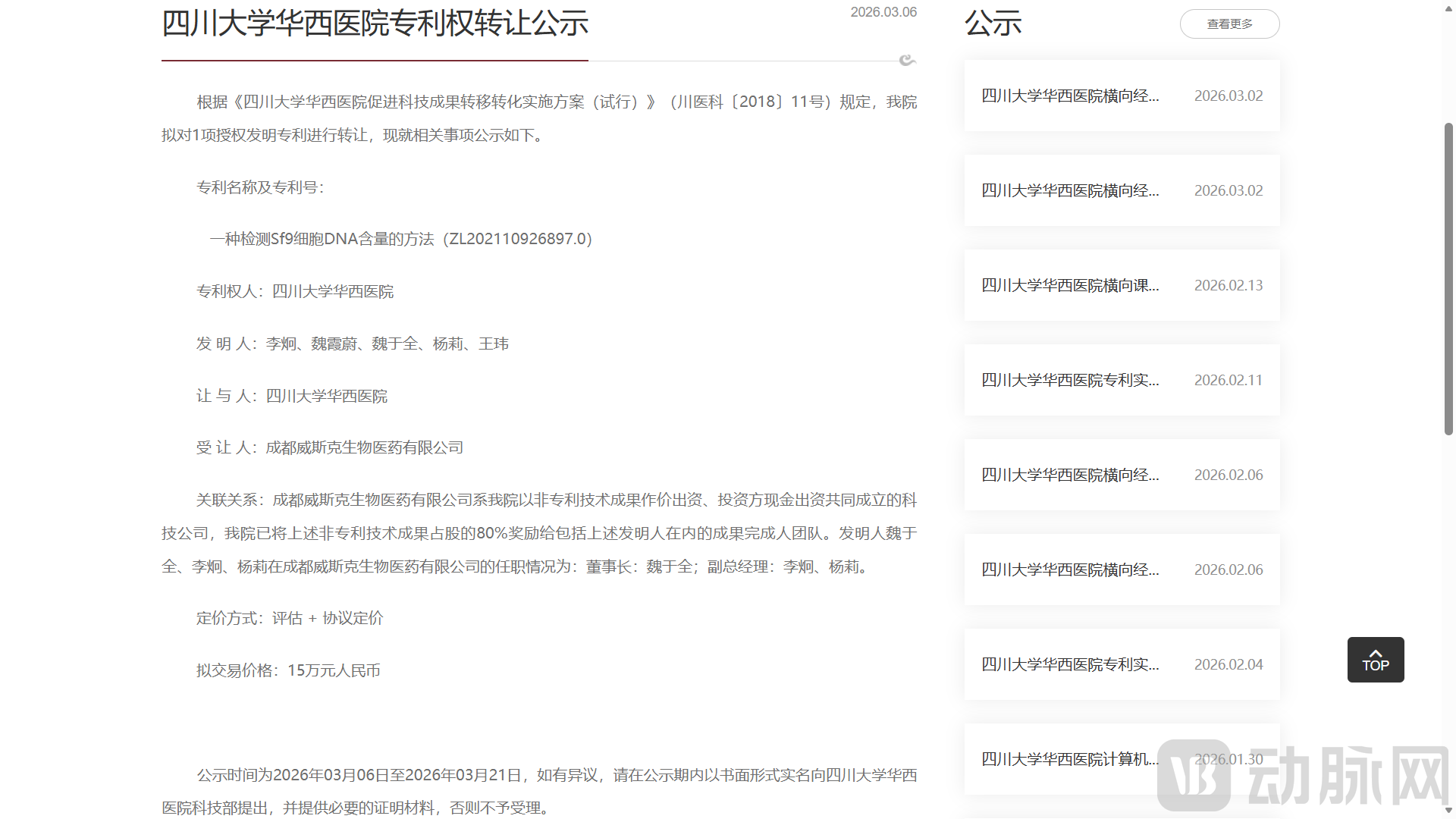
Image from the official website of West China Hospital, Sichuan University
This technology isA Real-Time Fluorescent Quantitative PCR-Based Method for Detecting Residual DNA in Sf9 Cells, core used forPrecise Detection of Residual Sf9 Cell DNA in Biologics Produced Using Sf9 Cells as Host, is a key testing technology for ensuring the purity and safety of biological products.
Sf9 CellsDue to its core advantage in the high-efficiency expression of recombinant proteins, it has become the mainstream host cell for the production of biologics such as recombinant vaccines, monoclonal antibodies, and protein therapeutics, butIssues Regarding the Detection of Residual Host Cell DNA in Manufactured ProductsThis has become a key bottleneck restricting the quality improvement and safe mass production of biological products. This cell expression system is widely used in the large-scale production of biological products, but residual Sf9 cell DNA poses potential carcinogenicity and immunogenicity, making it a core indicator for evaluating the quality of biological products. Existing detection methods have many prominent pain points in practical applications, seriously affecting the purity control of biological products and their clinical safety.
From a technical perspective,Design and Performance Specifications of Current Methods for Detecting Residual Sf9 Cell DNAThere are significant limitations.
On the one hand,Traditional nucleic acid detection primers lack specificity for Sf9 cellsSome detection primers are prone to non-specific amplification with DNA from other species, such as human and mouse sources, resulting in spurious peaks that interfere with test results. This makes it difficult to accurately distinguish Sf9 cell DNA from other exogenous DNA, leading to a high false-positive rate and failing to meet the specificity requirements for trace impurity testing in biological products. Meanwhile, existing detection methods have a narrow linear range and inconsistent amplification efficiencies, making them unable to cover the needs for detecting DNA residues at high, medium, and low concentrations in biological product manufacturing, thereby exhibiting insufficient sensitivity for detecting trace residual DNA.
On the other hand,Some existing detection methods exhibit poor accuracy and precision., the measured values deviate significantly from the theoretical values, and the test results exhibit high variability across different operators and testing times, with poor reproducibility. This lack of reliability in the test data fails to provide a precise quantitative basis for quality assessment of biological products. Furthermore, traditional detection methods suffer from low sensitivity, with high limits of quantification (LOQ) and detection (LOD), making it difficult to consistently detect trace amounts of residual Sf9 cell DNA in biological products. Such trace residues may still pose potential threats to the clinical safety of biological products, thereby failing to meet the stringent standards for impurity testing in the biopharmaceutical industry.
Furthermore,Current detection methods involve cumbersome operational procedures and exhibit poor adaptability., as it was not optimized for the characteristics of biologics expressed in Sf9 cells, it is susceptible to matrix interference during actual sample testing, resulting in significant fluctuations in spike recovery rates. Furthermore, the lack of a standardized testing system and supporting kits leads to inconsistent results across different laboratories, thereby increasing quality control costs and extending testing cycles for biologic manufacturers.
These issues directly lead to limitations in quality control and industrialization development of biological products:Insufficient specificity can lead to misjudgment of product quality, while a narrow linear range and low sensitivity prevent comprehensive monitoring of residues across the full concentration spectrum. Poor accuracy and precision hinder the consistent implementation of quality standards. For biological products manufactured using the Sf9 cell expression system, existing detection methods fail to meet the biopharmaceutical industry’s core requirements for high specificity, high sensitivity, and high accuracy in residual DNA testing. There is an urgent need for a highly specific, broadly linear, and highly sensitive assay for detecting residual Sf9 cell DNA, thereby overcoming a critical bottleneck in the quality control of biological products.
This Sf9 Cell DNA Residue Detection TechnologyBased on Specific Primer Design, Optimization of Fluorescence Quantitative PCR System, and Full-Dimensional MethodologyVerification, Comprehensive BreakthroughsOvercoming the technical limitations of traditional assays, it offers significant advantages in specificity, accuracy, and sensitivity, providing an efficient and reliable testing solution for quality control of biologics produced in the Sf9 cell expression system.
From the perspective of core primer design, the patent achieves precise recognition of Sf9 cell DNA through targeted proprietary design.The 16sF1/R1 primer pair (SEQ ID NO. 1–2), designed based on specific nucleotide sequences from GenBank, enables highly efficient amplification of Sf9 cell DNA without non-specific peaks, while showing no amplification signals for human or mouse cell DNA and blank controls. This completely addresses the challenges of non-specific amplification and high false-positive rates. Comparative validation across multiple primer sets demonstrated that this primer pair exhibits optimal amplification efficiency, with a standard curve correlation coefficient (R²) > 0.99, laying a stable foundation for quantitative detection.
ThisFurthermore, the patent achieves dual optimization in both detection systems and methods, balancing performance with practicality.Establish a standardized quantitative real-time PCR (qPCR) reaction system, coupled with optimized amplification and melting curve protocols, to ensure high amplification efficiency while eliminating non-specific interference, thereby enhancing result reliability. Quantification is performed using the standard curve method, enabling direct calculation of DNA content from Ct values. This approach offers simple operation and intuitive results, making it well-suited for routine laboratory testing workflows.
In terms of methodological performance, this technology achieves multidimensional breakthroughs, meeting the stringent requirements for the detection of trace impurities in biological products.Wide linear range, with good linearity in the concentration interval of 10,000–1 pg; genomic DNA detection range reaches 2,000 pg/μl to 0.2 pg/μl, covering the full concentration gradient for residual detection; high precision and accuracy, with deviation between detected and theoretical values <15%, RSD <15%, repeatability RSD <10%, intermediate precision RSD <30%, ensuring stable and reliable data; outstanding sensitivity, with a minimum stable detection limit of 0.02 pg/μl, accurate quantification at 0.2 pg/μl, limit of quantitation (LOQ) of 1 pg, and limit of detection (LOD) of 0.1 pg, effectively identifying trace residues.
Meanwhile,High Adaptability and Ease of Use, supported by a dedicated kit containing a complete set of reagents including Taq polymerase, primers, and standards, to standardize the detection process; in spike-and-recovery tests with actual samples, the recovery rates for high, medium, and low concentrations range from 50% to 150%, with an RSD ≤ 30%, demonstrating strong resistance to matrix interference, and can be directly applied to various Sf9 cell-derived biological products such as recombinant vaccines, monoclonal antibodies, and protein therapeutics.
These advantages directly empower quality control of biological products:Proprietary primers eliminate false-positive misjudgments, while a broad linear range and high sensitivity enable comprehensive residual monitoring across all concentration levels. High precision provides a reliable basis for quality determination, and standardized systems and kits simplify operations and reduce testing costs. This technology breaks through the bottlenecks of traditional assays, achieving triple enhancements in specificity, sensitivity, and accuracy. It provides core technical support for purity control and safe mass production of Sf9 cell-derived biologics, and offers a standardized solution for detecting residual host cell DNA from insect cells.
Currently, regardingHigh Specificity and High Sensitivity Requirements for the Detection of Residual Host DNA from Sf9 Insect Cells in Biologics Production, domestic biotechnology enterprises have accelerated the research and development of related test kits and the deployment of testing capabilities, forming aqPCR Fluorescent Probe Methodas the core,Full Coverage of Host Cell Product CategoriesIn this market competition landscape, leading companies have successfully commercialized Sf9 cell DNA residue detection products, while some enterprises have completed technological upgrades to their relevant testing capabilities.
Huzhou Shenke's Sf9 Residual DNA Fragment Analysis Kit,This is a specialized reagent for detecting residual Sf9 host cell DNA, capable of quantitatively analyzing the fragment size distribution of such residual DNA at various stages of biological product manufacturing. The product features a linear range of 3×10⁻³ to 3×10² pg/μL, excellent multi-fragment amplification efficiency, and strong standard curve correlation. It achieves a lower limit of quantification as low as 3.00×10⁻³ pg/μL, exhibits no interference from common engineered cell lines, and demonstrates favorable recovery rates, precision, and robustness. The assay supports automated extraction and detection, and is compatible with multiple mainstream instruments. Validated for performance in accordance with pharmacopoeial regulations and characterized by consistent batch-to-batch stability, this product serves as a core solution for enterprises conducting residual DNA testing in insect cell-derived products.
Jiangsu CoWin Century Biotechnology Co., Ltd. Focuses on the Upstream Nucleic Acid Testing Sector of Biopharmaceuticals, we have launched a series of residual host DNA detection kits for CHO, HEK293, Vero, and E. coli host cells. Based on the real-time quantitative PCR (qPCR) platform and utilizing the TaqMan probe method, these kits achieve a limit of detection at the femtogram (fg) level, with a broad linear range (3 fg/μL to 3 ng/μL). The precision coefficient of variation (CV) is <15%, and spike recovery rates range from 90% to 110%, demonstrating strong resistance to matrix interference. Currently, our product portfolio covers mainstream animal-derived and bacterial-derived host cells. We are advancing the development of a detection kit for Sf9 insect cells. Leveraging our extensive experience in optimizing qPCR systems, we have designed primers and probes targeting Sf9 cell-specific gene sequences and completed preliminary methodological validation. This initiative is expected to expand our capabilities into the field of insect cell expression system testing.
Suzhou ExCell Bio Co., Ltd. is deeply engaged in the fields of cell culture and quality control of biological products., we have launched the resiQuant series of residual host cell DNA detection kits (CHO/E. coli types), which employ TaqMan probe-based quantitative PCR methods and are accompanied by universal sample preparation kits. The DNA calibrators are traceable to national reference standards, ensuring high specificity and minimal batch-to-batch variability. These kits can specifically detect target host cell DNA without cross-interference. Currently, technical reserves have been completed for the Sf9 insect cell detection kit.
In summary,This Sf9 cell residual DNA detection technology is centered on specific primer pairs.,Achieve precise detection by integrating an optimized quantitative fluorescent PCR system and protocol.With excellent technical specificity, sensitivity, and accuracy, it enables quantitative analysis of trace residues across the full concentration gradient. Coupled with standardized kits, it meets the testing requirements for various Sf9 cell-derived biological products. It effectively addresses the technical pain points of traditional assays, providing reliable support for quality control of host cell DNA residues in biological products.
As the application of Sf9 cells expands in the biopharmaceutical sector, market demand for high-specification testing technologies continues to rise. In the future, these technologies will evolve toward process optimization and automation upgrades, with promising breakthroughs such as multi-target simultaneous detection. Furthermore, these advancements will further promote the standardization of quality control in biopharmaceuticals, thereby establishing a robust quality assurance framework for the industrial-scale production of biologics based on insect cell expression systems.