

Anhui Medical University First Affiliated Hospital to Transfer Patent for Invasive Arterial Blood Sampling Positioning Assistance System for RMB 110,000
Recently, the First Affiliated Hospital of Anhui Medical University released a public notice on the conversion of scientific and technological achievements, proposing to transfer its “Invasive Arterial Blood Sampling Localization Assistance System“Patent for invention transferred to Anhui Anji Industrial Co., Ltd. The transfer fee is110,000 yuan. The inventor of this patent isLiu Gangand his/her team。
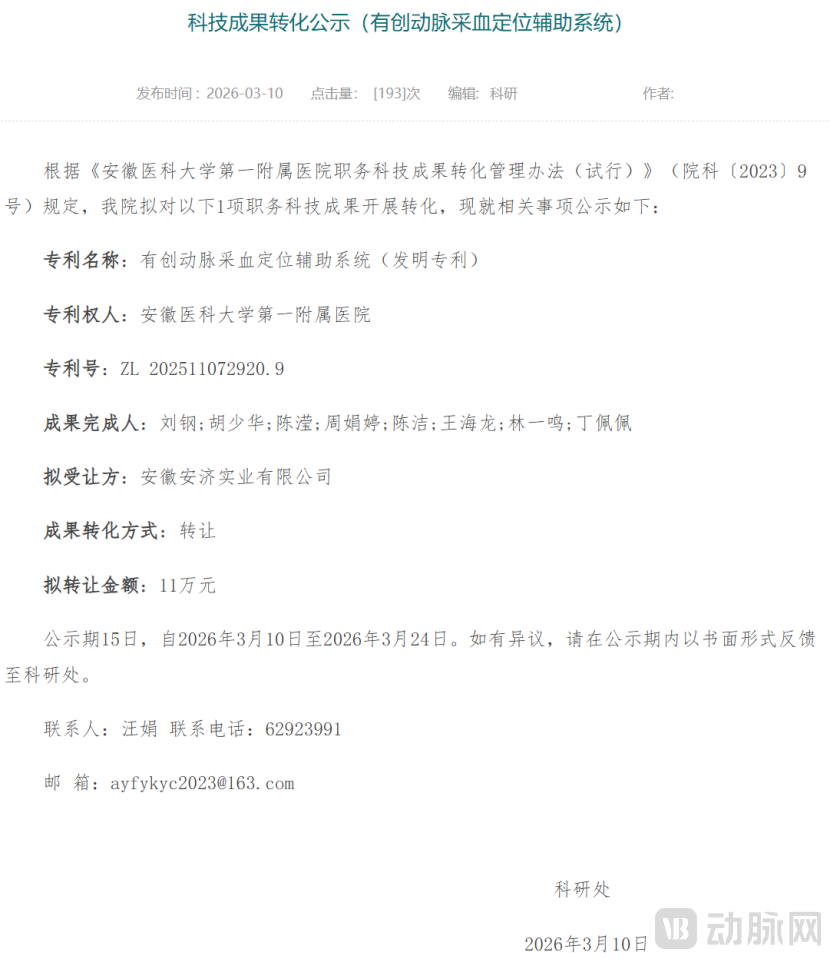
Image source: The official website of the First Affiliated Hospital of Anhui Medical University
“Invasive Arterial Blood Sampling Localization Assistance System"The invasive arterial blood sampling localization assistance system integrates ultrasound, puncture, and hemostasis hardware to achieve a closed-loop process for the entire operation. By acquiring multi-position ultrasound images along the arm and combining them with an image segmentation model to identify blood vessels and obstacle areas, it innovatively uses a puncture location selection coefficient for quantitative site selection and accurately evaluates the inclined needle insertion path. At the same time, based on standardized calculations of vascular parameters, it determines the extension angle and length of the blood collection needle, employs dual-image verification for positioning, automatically controls the puncture, avoids damage to surrounding blood vessels, reduces human error, minimizes repeated punctures, and enhances the precision and safety of blood sampling."and Operational Efficiency。
In clinical invasive arterial blood sampling procedures, although traditional ultrasound-assisted products and techniques for puncture site localization can achieve basic vessel identification, they face numerous technical bottlenecks in practical application. The core pain points are primarily the lack of assessment for oblique needle insertion paths and insufficient localization accuracy, as detailed below.
1. It only supports vertical needle insertion positioning, with no path assessment capability for angled needle insertion.Traditional products can only achieve vessel localization through ultrasound images from a single position, and this localization method is only applicable to vertical needle insertion. In clinical practice, to reduce the risk of vascular injury, an angled needle insertion approach is often adopted. However, traditional products cannot analyze the path of the blood collection needle during angled insertion via ultrasound imaging, nor can they determine whether other vessels, tissues, or other obstacles exist along the path. This limitation increases the likelihood of the needle puncturing adjacent vessels, causing additional harm to the patient.
Second, localization relies on manual judgment and lacks quantitative analytical standards.The selection of puncture sites using traditional ultrasound guidance relies entirely on the subjective clinical experience of healthcare providers, lacking objective quantitative assessment metrics. For patients with deeply situated vessels and complex surrounding tissues, this approach is prone to localization errors, leading to repeated needle insertions, which increases patient discomfort and prolongs the time required for blood collection procedures.
Third, the lack of standardized needle insertion parameter calculations results in poor operational consistency.In traditional practice, the needle insertion angle and depth for phlebotomy are controlled by healthcare professionals based on experience, lacking standardized calculations based on the actual depth and diameter of blood vessels. Significant operational variability exists among different practitioners, which can easily lead to complications such as puncturing the opposite vessel wall due to excessive insertion depth or failed blood collection due to improper insertion angles.
“Assistive Positioning System for Invasive Arterial Blood Sampling”This invention patent has created an integrated, intelligent solution for invasive arterial blood sampling localization. By integrating hardware and innovating algorithms, it specifically addresses the clinical pain points of traditional products. Its core advantages and innovations are reflected in three major dimensions: hardware design, algorithm models, and operational standardization.
First, an integrated hardware design enables a closed-loop process for the entire operational workflow.The device integrates the housing, display, ultrasound probe, lancet mounting assembly, hemostatic bandage, control buttons, and processor into a single unit. The ultrasound probe and lancet mounting assembly are precisely aligned, while the hemostatic bandage is integrated into the rear of the housing, enabling immediate wound dressing after blood collection. This design achieves a closed-loop workflow encompassing positioning, puncture, and hemostasis, significantly improving the efficiency of blood collection procedures. Additionally, the housing surface features an anti-slip treatment to enhance grip stability, making it well-suited for urgent clinical scenarios.
Secondly, multi-position ultrasound image analysis enables precise assessment of the angled needle insertion path.The system can move at a constant speed along the axial direction of the arm to acquire ultrasound images at multiple positions. By segmenting these images using a trained image segmentation model, it accurately identifies the first region containing the target vessel and the second region containing surrounding obstacles, thereby addressing the limitation of traditional single-position imaging in analyzing the puncture path. An innovative quantitative assessment metric for puncture site selection is proposed. By calculating parameters such as the shortest distance between the predicted needle path and surrounding obstacles, the number of obstacles along the path, and the depth of the target vessel, this method enables objective and quantitative selection of the puncture site. A higher coefficient indicates greater safety and rationality of the chosen puncture location.
Third, standardized calculation of needle insertion parameters to enhance the precision and consistency of puncture procedures.The system precisely calculates the extension angle and length of the blood collection needle using geometric formulas, based on the actual depth of the vascular puncture site and the cross-sectional radius of the target vessel. It restricts the needle’s insertion depth to a value less than the vessel radius to prevent puncturing the opposite vessel wall. Meanwhile, it converts pixel distances in ultrasound images to actual physical distances through image scaling factors, ensuring the accuracy of needle insertion parameters and achieving standardization and consistency in puncture procedures.
Fourth, dual-image verification ensures the precision of housing placement and positioning.After the system determines the vascular puncture site, it confirms the accurate placement of the housing by comparing the similarity of feature information between the ultrasound image corresponding to the puncture site and the real-time verification ultrasound image. When the similarity exceeds a preset threshold, the positioning accuracy is further enhanced by avoiding localization errors caused by housing displacement.
Fifth, automated puncture control to reduce manual operation errors.Once the housing position is confirmed, the processor can control the lancet installation assembly to automatically extend the lancet at a preset angle and depth based on the calculated needle insertion parameters. After blood sampling is completed, the lancet can be automatically retracted via an operation button, significantly reducing needle insertion deviations caused by manual operation and enhancing the stability of the puncture procedure.
In the field of arterial blood sampling localization, a series of innovative products and patented achievements have been successfully launched, each showcasing its technological advantages. From real-time visual puncture navigation and fully automated blood sampling procedures to intelligent precision control of puncture needles, these innovations address the clinical pain points of traditional blood sampling from multiple dimensions, driving technological upgrades and optimizing clinical applications in this field.
"Independently developed by Beijing Medis Medical Technology Co., Ltd."Ultrasound-Guided Electromagnetic Positioning Needle Puncture Device"Real-time visualization throughout the entire surgical procedure was achieved, with continuous real-time display of the puncture site status, planned puncture path, and needle tip position. The clinical navigation accuracy reached 1.5 mm. Clinical trial reports indicated that the first-pass puncture success rate using this device was 98.86%."
The application submitted by Ningbo Yinzhou People's Hospital for "A Device Capable of Identifying Arterial Location and Performing Blood Sampling“Invention Patent (Publication No. CN111012363B): Equipped with a Doppler ultrasound detector for arterial identification and a three-position clamping device to automate needle holding, puncture, and retraction. The arm fixation platform features multi-directional movement to accommodate different patients, while also enabling automatic vacuum tube transfer and sample output, thereby achieving full-process automation of arterial blood sampling and improving efficiency in emergency scenarios.”
Peking University First Hospital's application for “An Intelligent Arterial Blood Gas Puncture Needle“Utility model patent (Publication No. CN223220443U), integrating a negative pressure tube, drive unit, pressure sensor, and liquid level monitoring component, achieves automatic sliding of the puncture needle through micro motor drive. It pairs with a probe to identify blood vessels, provides real-time feedback on puncture force via the pressure sensor, controls blood collection volume through liquid level monitoring, and enables data interaction with terminals. This effectively prevents needle detachment and avoids accidental punctures, addressing the issues of traditional puncture methods that rely on experience and require repeated needle insertions.”