

Exclusive License Opportunity: AI-Powered Colorectal Cancer Immunotherapy Response Prediction System – 500K Upfront + 5% Royalty on Sales
Recently, the Sun Yat-sen University Cancer Center released a public notice on the transfer of patent rights, proposing to transfer its jointly held “Colorectal Cancer Immunotherapy Efficacy Prediction System"Patent assignment to Shenzhen Haotian Qichuang Technology Development Co., Ltd. The proposed transfer price is"500,000 + 5% commission on sales. The inventors of this achievement are Ding Peirong and his team.
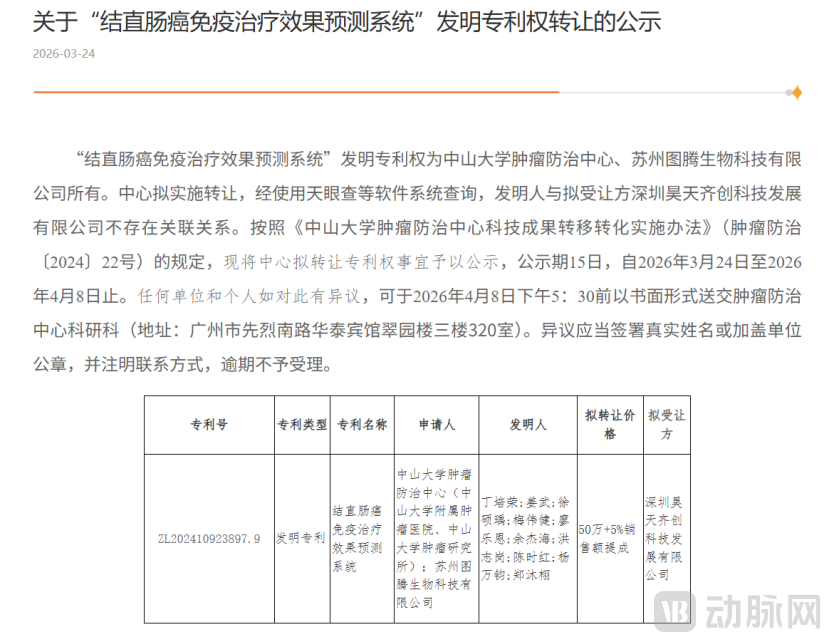
Image from the official website of Sun Yat-sen University Cancer Center
“Colorectal Cancer Immunotherapy Efficacy Prediction System“Patented invention: Based on AI pathomics and whole-slide digital images, predictions can be made directly using pre-treatment colonoscopic biopsy H&E slides. The system employs dual models to intelligently identify tissue and cell types, and utilizes original core parameters such as mucin area ratio and lymphocyte abundance to quantify the tumor immune microenvironment and generate an efficacy score, enabling precise stratification independent of MMR/MSI status. This technology overcomes traditional bottlenecks, including high detection costs, reliance on postoperative specimens, and inaccurate stratification. It efficiently identifies patients likely to benefit from immunotherapy, particularly those achieving complete response who may avoid surgery, offering advantages of low cost, ease of adoption, and high precision, with significant value for clinical translation and dissemination in primary care settings.”
Currently, traditional methods used in clinical practice to predict the efficacy of immunotherapy for colorectal cancer have many shortcomings and face multiple challenges in practical applications, including issues related to precision, accessibility, and applicability.
In terms of efficacy assessment criteria,Relying solely on dMMR/MSI-H as core biomarkers has significant limitations. Approximately one-third of dMMR patients still fail to benefit from immunotherapy in clinical practice, while some pMMR/MSS patients do respond to treatment, making precise patient stratification difficult.
At the level of test implementation,Conventional methods such as immunohistochemistry, PCR, and next-generation sequencing are not only costly and time-consuming but also demand advanced technical platforms and highly skilled operators, making them difficult to promote and apply in primary healthcare institutions.
In terms of specimen suitability,Most existing pathomics models are built on gross specimens obtained after surgical resection, making it impossible to acquire effective data prior to treatment, thereby forfeiting their clinical value in preoperative prediction and treatment regimen selection.
Furthermore, most models are derived from studies on other cancer types, such as lung cancer and melanoma, and fail to incorporate tumor microenvironment characteristics specific to colorectal cancer, including its unique mucinous components and the spatial distribution patterns of immune cells. Consequently, their predictive results deviate from clinical reality.
In response to the multifaceted challenges associated with the aforementioned conventional technologies, this patent achieves comprehensive innovation across three dimensions: technical architecture, computational scoring, and clinical application. It establishes a precise, practical, and widely accessible prediction system for the efficacy of immunotherapy in colorectal cancer. The specific advantages and innovations are as follows.
First, innovation in technical architecture.This patent achieves systematic innovation in its technical architecture by adopting an intelligent recognition scheme based on dual-model collaboration. It utilizes a tissue region recognition model based on the DenseNet architecture to effectively distinguish between different tissue types, such as tumor regions and mucinous components. Meanwhile, it relies on a cell recognition model built upon a Fully Convolutional Network (FCN) to accurately identify key cell types, including tumor cells, lymphocytes, plasma cells, and neutrophils. The system can directly analyze hematoxylin and eosin (H&E)-stained sections from pre-treatment colonoscopic biopsies, enabling comprehensive pre-treatment prediction without the need for surgical specimen acquisition or special immunohistochemical staining. Furthermore, the system establishes an original quantitative framework for the tumor immune microenvironment. By leveraging four core parameters—mucinous area ratio, lymphocyte abundance, plasma cell co-localization, and neutrophil co-localization—and integrating a co-localization coefficient algorithm, it achieves precise quantification of the spatial distribution relationships between immune cells and tumor cells.
Second, advantages in computation and scoring.In the parameter calculation and efficacy scoring phases, this patent demonstrates clear, rigorous logic and stable, reliable performance. The parameter settings align with clinical patterns: the mucus area ratio is negatively correlated with immunotherapy efficacy, whereas indicators such as lymphocyte abundance, plasma cell colocalization, and neutrophil colocalization are positively correlated with treatment outcomes. The system employs a quartile-based scoring rule, yielding results that are intuitive and clinically interpretable. Based on the scores, patients can be clearly stratified into three categories: immune-hot tumors, immune-intermediate tumors, and immune-cold tumors; higher scores indicate a more significant benefit from immunotherapy. Furthermore, the system adopts an area-weighted calculation method for tissue and cellular regions, which mitigates interference from factors such as limited sampling volume in endoscopic biopsies and tissue deformation, thereby further enhancing the stability and accuracy of predictive results.
Third, breakthroughs in clinical value.In terms of clinical application value, this patent represents a significant breakthrough. Among patients with deficient mismatch repair (dMMR), approximately 35.4% can be identified as having immune-hot tumors; these patients achieve a 100% complete response rate following neoadjuvant immunotherapy, thereby enabling the precise identification of a superior patient population eligible for surgery omission and organ preservation. Among patients with proficient mismatch repair (pMMR), approximately 25.5% are classified as having immune-hot tumors; this subgroup demonstrates a complete response rate of 57.1% and an objective response rate of 81.0%, with therapeutic efficacy significantly superior to that of conventional neoadjuvant chemotherapy regimens. From the perspective of clinical dissemination, the system requires only routine hematoxylin and eosin (H&E) slides and digital pathology scanning equipment for operation. Characterized by low detection costs, rapid analysis speed, and a low technical threshold, it is well-suited for implementation across healthcare institutions at all levels, particularly in primary care hospitals.
Currently, both domestically and internationally, a variety of commercially available testing products and cutting-edge predictive models for colorectal cancer immunotherapy prediction have emerged, each achieving breakthroughs in molecular subtyping, algorithmic modeling, and assay performance.
AmoyDx Human Microsatellite Instability (MSI) Detection Kit, used for the qualitative in vitro detection of MSI status in DNA from FFPE tissue samples of patients with solid tumors, serving as a companion diagnostic for the immunotherapy drug tislelizumab. It is the first MSI detection kit in China applicable to all patients with solid tumors, which can directly guide immunotherapy. Patients with positive test results can benefit from immunotherapy and have the potential for long-term survival.
PIANOS ModelBased on the advanced k-Top Scoring Pairs (k-TSP) algorithm, PIANOS analyzes tens of thousands of biological pathways to identify key “pathway combinations” that can stably distinguish between high- and low-risk patients, thereby constructing a robust and reliable classifier. Featuring platform independence, PIANOS does not rely on specific detection instruments or technical platforms, enhancing the generalizability of its results. Eliminating the need for normalization, the model assesses the relative activity of “pathway pairs” rather than absolute gene expression values, thereby bypassing complex data normalization procedures and enabling rapid, accurate evaluation of individual patient samples.
Tongshu Gene’s Proprietary 2B3D-MSI Detection Kit, significantly lowering the lower limit of detection (LOD) for tumor DNA content to 5%, its 2B3D-MSI testing technology has achieved a milestone “dual LOD breakthrough.” The sensitivity LOD breakthrough enables stable detection of microsatellite sequence differences as small as 2 base pairs (bp), outperforming common market solutions with thresholds of 2.5 nt or 3 bp, thereby ensuring high detection accuracy. The tumor content LOD breakthrough allows for precise detection with only 5% tumor DNA content, which is substantially lower than the technical requirements of competing products such as AmoyDx (30%) and Promega/Wondfo (10%).