

Shenyang Pharmaceutical University to Transfer SYPU2 Antimicrobial Peptide Patent for RMB 150,000
Recently, the Office of Scientific Research at Shenyang Pharmaceutical University released a public notice on patent transfer and licensing, proposing to"Antimicrobial Peptide SYPU2, Its Mutants, Derivatives, and Analogs"The patent is transferred to Maidikang (Liaoning) Stem Cell Regenerative Medicine Co., Ltd. via assignment of patent rights, with a proposed transfer amount of RMBRMB 150,000。
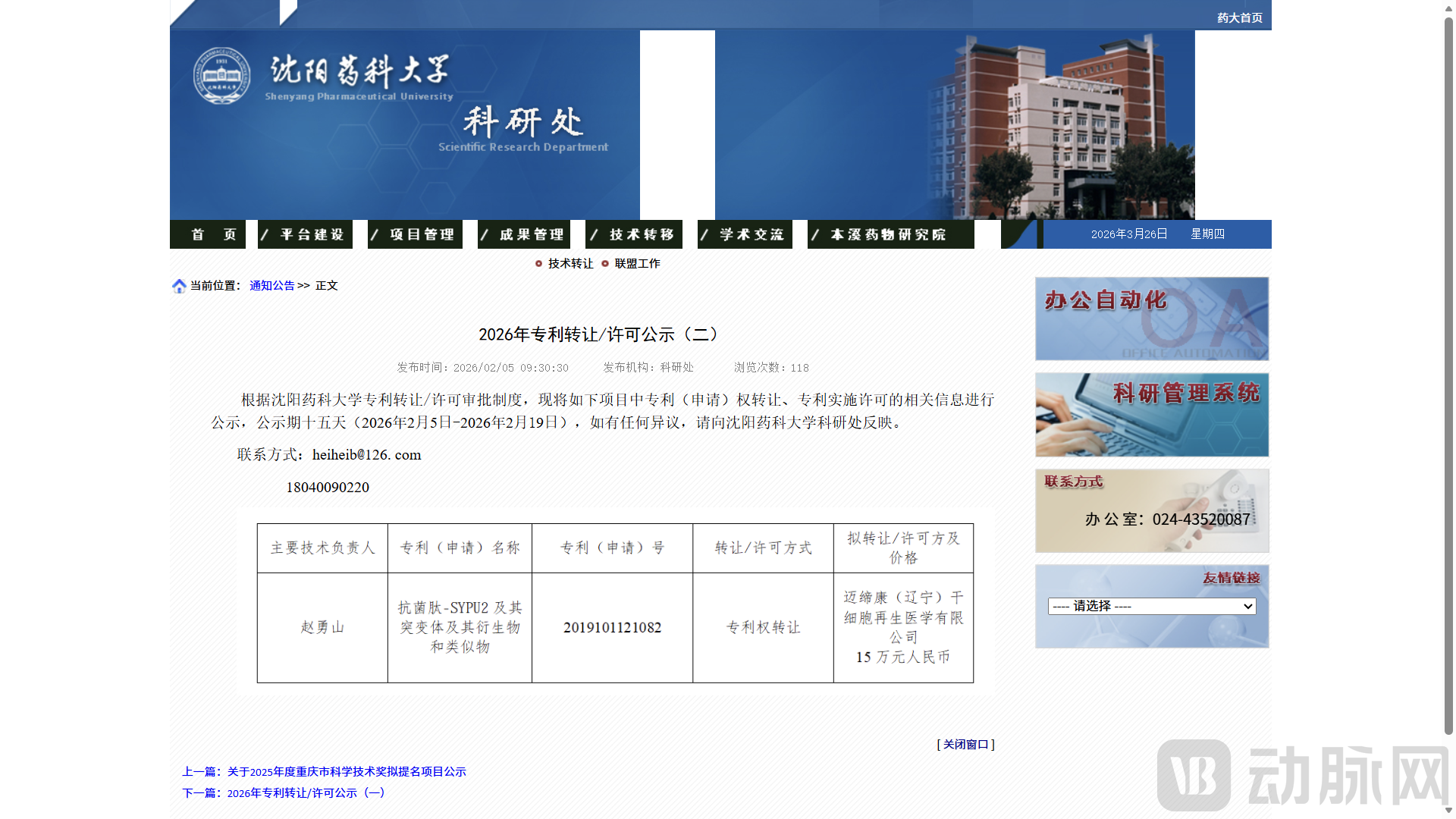
Image from the official website of Shenyang Pharmaceutical University
The core of this patent revolves aroundAntimicrobial Peptide SYPU2 Isolated and Purified from Scorpion VenomExpand technological innovation, not only analyzing its native amino acid sequence and achieving efficient expression and purification through genetic engineering, but also obtaining through site-directed mutagenesis technologyASK, GQ, and RQ Mutants, while simultaneously developing corresponding derivatives, analogs, and active fragments, thereby overcoming the industry pain points of high costs associated with the extraction of natural antimicrobial peptides and the expensive chemical synthesis. This series of antimicrobial peptides offers advantages such as low molecular weight, good water solubility, and no drug resistance, making them high-quality candidate drugs for replacing traditional antibiotics and providing a new technical direction and material basis for the research and development of antimicrobial agents.
Bacterial Infectious DiseasesIt is a common and frequently occurring clinical condition that can affect multiple tissues and organs in the human body, leading to various infectious diseases. It is also a key disease category requiring focused attention in clinical diagnosis and treatment. Currently, the core therapeutic approach for this type of disease in clinical practice is antibiotic therapy, which plays a critical role in controlling bacterial infections and saving patients' lives.
However, the long-term irregular use and even abuse of antibiotics have led to an increasingly severe problem of bacterial resistance. The continuous emergence of multidrug-resistant bacteria and superbugs has significantly diminished the therapeutic efficacy of traditional antibiotics, leaving some infectious diseases with no available treatment options. Therefore, the development of novel, highly effective antimicrobial agents that are less prone to inducing bacterial resistance has become a core requirement for addressing the challenges in the clinical treatment of bacterial infections.
Antimicrobial PeptidesOwing to their significant advantages, including low molecular weight, good water solubility, strong heat stability, non-immunogenicity, broad antimicrobial spectrum, absence of drug resistance, and unique mechanisms of action, they are widely recognized as the preferred alternative to traditional antibiotics and have become a key focus in the development of antimicrobial agents.
However, the industrialization and clinical application of antimicrobial peptides are currently constrained by numerous bottlenecks in preparation technologies:Extracting antimicrobial peptides from natural resources is plagued by high costs, low yields, and cumbersome processes, while chemical synthesis of these peptides is prohibitively expensive. Both approaches are difficult to scale up for mass production, failing to meet the demands of practical clinical applications.
Furthermore,Significant Gaps Remain in the Development and Mining of Natural Bioactive Peptide LibrariesScorpions, as a precious traditional Chinese medicinal material with over 2,000 years of pharmaceutical history, possess tail gland secretions containing numerous pharmacologically valuable active components. They serve as a natural reservoir of bioactive peptides enriched with various functional peptides. However, only a limited number of antimicrobial constituents have been isolated, purified, and structurally characterized from scorpions or their venom to date, resulting in relatively low levels of research, development, and utilization. Consequently, there is an urgent clinical and industrial demand for technologies and products that leverage this natural resource—scorpion venom—to develop novel antimicrobial peptides.
This patent technology related to the antimicrobial peptide SYPU2 is based onDevelopment of a Natural Bioactive Peptide Library from Scorpion VenomCore Focus: Achieving multiple innovations in technological R&D and practical application, demonstrating significant technical advantages and application value compared to traditional antimicrobial peptide preparation techniques and existing antimicrobial drugs, while boasting broad market prospects driven by industry development trends.
First, innovation in raw materials and screening,For the first time, the antimicrobial peptide SYPU2 was isolated and purified from scorpion venom, and its structure was fully elucidated. This work thoroughly explores the medicinal value of the scorpion, a traditional Chinese herbal medicine, fills the gap in the research and development of antibacterial active components in scorpion venom, and provides a novel natural material basis for the development of new antimicrobial peptides.
II. Molecular Modification Innovation, based on the native antimicrobial peptide SYPU2, three mutants—ASK, GQ, and RQ—were precisely obtained through site-directed mutagenesis. Corresponding derivatives, analogs, and active fragments were also developed, enriching the product portfolio of antimicrobial peptides. All mutants and derivative compounds retained excellent antibacterial activity, thereby broadening the application scenarios of this technology.
3. Innovation in Preparation Technology, leveraging genetic engineering technology to achieve high-efficiency expression and isolation/purification of the antimicrobial peptide SYPU2, its mutants, and derivatives; designed a standardized purification process incorporating steps such as metal ion chelation affinity chromatography, ultrafiltration, and ion-exchange chromatography; and defined key parameters including the optimal molecular weight cutoff for ultrafiltration membranes and processing temperature. This approach has overcome the technical bottlenecks of high costs associated with natural extraction and expensive chemical synthesis, enabling scalable, low-cost production of antimicrobial peptides and resolving core challenges in their industrial application.
4. Advantages of Product Characteristics, the developed series of antimicrobial peptides inherits the natural characteristics of low molecular weight, good water solubility, strong heat resistance, and non-immunogenicity. It also possesses the core advantages of no drug resistance and a broad antimicrobial spectrum, demonstrating effective bacteriostatic activity against common clinical pathogens such as Staphylococcus aureus, Pseudomonas aeruginosa, and Escherichia coli. Compared with traditional antibiotics that are prone to inducing drug resistance, it better meets the long-term needs of clinical antimicrobial therapy.
5. Flexible Application Forms, this series of antimicrobial peptides can be formulated into pharmaceutical compositions with pharmaceutically acceptable carriers or excipients, supporting various parenteral administration routes such as intravenous, intramuscular, and intranasal delivery. These formulations are adaptable to diverse clinical scenarios for treating different infectious diseases, thereby providing robust technical support for subsequent drug formulation development.
The global issue of bacterial antimicrobial resistance continues to intensify, and the traditional antibiotic market is undergoing transformation.Antimicrobial Peptides as Next-Generation Alternatives to Antibiotics, with market demand in the pharmaceutical and biopharmaceutical sectors continuing to rise, this technology, leveraging its mature preparation processes, superior bacteriostatic performance, and comprehensive product portfolio, can rapidly align with market needs such as clinical antibacterial drug development and biopharmaceutical industrialization, demonstrating strong market growth potential in the antibacterial drug sector.
The current antimicrobial peptide market is entering a crucial phase of global development,Policy Support, Upgrading Market Demand, and Technological IterationTriple forces are jointly driving the rapid development of the industry, which is characterized by continuous expansion in scale, constant broadening of application scenarios, and accelerated commercialization of technological R&D. Globally, the increasingly prominent issue of antibiotic resistance has led to a sustained surge in market demand for novel antimicrobial therapies. As a high-quality alternative to traditional antibiotics, antimicrobial peptides have become a focal point of R&D in the biopharmaceutical sector, with increasing investment in research and technological exploration. Their applications have gradually extended from the core pharmaceutical track to multiple niche sectors, including agricultural aquaculture, food processing, and beauty and personal care. Markets in different regions are exhibiting differentiated development trends, with the Asia-Pacific region emerging as a significant driver of industry growth.
Jiangsu Pulai Pharmaceutical Biotechnology Co., Ltd.'s core product is Peceleganan Spray., it is the first innovative cationic antimicrobial peptide drug in China to receive NMPA registration approval for market launch. The proposed indications include superficial secondary wound infections caused by Staphylococcus aureus, Pseudomonas aeruginosa, and other pathogens, covering scenarios such as burn injuries and physically induced wound infections.
This product is a Class I innovative drug with global intellectual property rights,Novel Design of Antimicrobial Peptide Molecules Based on the “Cell Membrane Discrimination Mechanism”, it is also the first ganamycin-class anti-infective drug in China to be named by the WHO. It demonstrates potent bactericidal efficacy against multidrug-resistant bacteria and other superbugs, has completed multiple pivotal clinical studies, and has shown excellent therapeutic outcomes. Furthermore, Pulay Medicine possesses internationally leading platforms for the de novo design of antimicrobial peptide drugs and for innovative peptide formulations, along with a dedicated peptide formulation production line, establishing a solid foundation for industrialization. Leveraging the current growth momentum in the antimicrobial peptide industry, combined with its mature industrialization layout and commercial collaboration model, Pulay Medicine holds a significant first-mover advantage in the niche market of antibacterial treatment for wound infections. With the future launch of its core products and the advancement of its pipeline candidates, the company is poised to further capture market share in topical antimicrobial peptide drugs and become one of the leading enterprises in China’s antimicrobial peptide pharmaceutical sector.
Beijing Zhongnong Yingtai Biotechnology Co., Ltd.'s core product is cecropin antimicrobial peptides., developed under the National 863 Program, this cecropin antimicrobial peptide product boasts leading industrialization capabilities both domestically and internationally and holds independent invention patents. Currently, the product is primarily applied in the field of feed additives, providing antibiotic alternatives for livestock, poultry, and aquaculture industries. Its product portfolio includes series such as Taisusheng, Xileping, and Taihesu.
Leveraging bioengineering technology for large-scale production, this product offers broad-spectrum antibacterial activity, enhanced animal immunity, and growth promotion, with no risk of drug resistance or residues. It can synergize with antibiotics to improve bactericidal efficacy. With a solid foundation for industrialization, it is a representative product in the field of livestock antimicrobial peptides. The company has achieved remarkable results in the industrial mass production of antimicrobial peptides. Its products align closely with the national policy direction of “reducing and replacing antibiotics,” supported by mature market channels and high industry recognition. As the trend toward green and healthy development in China’s aquaculture and livestock sectors deepens, market demand for green antibacterial alternatives continues to rise. Relying on its mature industrialization capabilities and market layout, the company is poised to further expand the market space for cecropin antimicrobial peptides in the feed additive sector. Meanwhile, the company is extending its core technologies into diverse fields such as cosmetics and food preservation. Through continuous technological innovation and application expansion, it is expected to achieve coordinated multi-sector development and consistently consolidate its leading position in the industrial-grade antimicrobial peptide industry.
Technologies Related to the Antimicrobial Peptide SYPU2 and Its Mutants, Derivatives, and Analogs Covered by This Patent, it possesses significant development advantages and broad market prospects in the current antimicrobial peptide market environment. Based on the development of a natural bioactive peptide library from scorpion venom, this technology fills the gap in the research and development of antibacterial active ingredients from scorpion venom. The innovative model, which combines natural attributes with genetic engineering modifications, ensures that the developed series of antimicrobial peptides retain core characteristics such as broad-spectrum bacteriostatic activity and no drug resistance. It can precisely meet the core clinical needs for anti-infection in the pharmaceutical field, supports various parenteral administration routes, and adapts to treatment scenarios for different infectious diseases, providing a high-quality technical and material foundation for the research, development, and commercialization of pharmaceutical-grade antimicrobial peptide drugs.
Meanwhile, leveraging mature genetic engineering production processes, this technology has overcome the traditional bottlenecks of natural extraction and chemical synthesis, enabling large-scale, low-cost production of antimicrobial peptides. This advantage not only facilitates industrialization in the pharmaceutical sector but also extends to non-medical fields, aligning with market demand for cost-effective antimicrobial peptide products across various sectors and demonstrating potential for multi-scenario applications.