

Sichuan University Licenses Novel Mandibular Advancement and Bite-Opening Orthodontic Appliance for RMB 1 Million Plus 5% Royalty
Recently, Sichuan University released a public notice on the transformation of scientific and technological achievements, indicating that the university intends to grant non-exclusive licenses for"An Appliance for Mandibular Advancement and Bite Opening"Transfer of relevant patents, with the transfer amount beingRMB 1 million + 5% sales commission. The inventors of this patent areZhao Zhihe and his team。
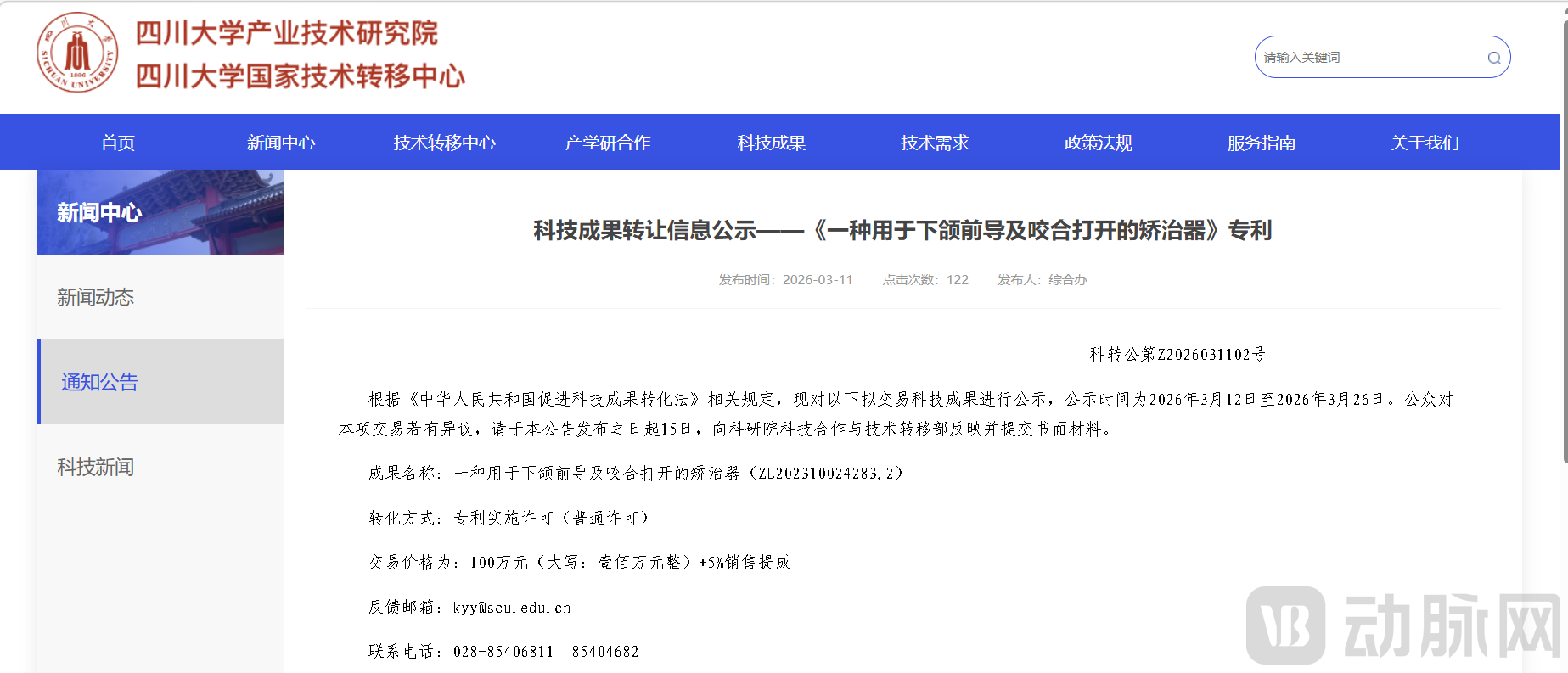
Image from the official website of Sichuan University
This technology isA Mandibular Advancement and Bite-Opening Appliance for Orthodontic Applications, primarily targeting clinically commonAngle Class II Malocclusion(Manifested as a distal molar relationship, maxillary protrusion, or mandibular retrusion) This design is a novel orthodontic appliance that integrates aligner technology with the functional mechanisms of an activator. In simple terms, it achieves the orthodontic effects of guiding forward mandibular growth and opening the bite through the structural design of clear aligners, while simultaneously addressing many limitations of traditional treatment protocols.
Orthodontic Treatment with Mandibular Advancement and Bite Opening,It is the core approach for improving Class II malocclusion, and has become the mainstream early orthodontic solution for adolescents due to its advantage of guiding natural jaw growth through functional orthopedics. However, design flaws in the appliances have become a key bottleneck restricting treatment efficacy and patient experience. This treatment modality requires the appliance to achieve mandibular advancement positioning and bite opening. Traditional activators and existing clear aligner adjunct devices present numerous significant pain points in clinical application, severely compromising treatment effectiveness and patient compliance.
From a technical perspective, the structural design and functional configuration of existing orthodontic devices exhibit significant limitations.
On the one hand, traditional activators consist of a baseplate, guiding wires, and other components.Large overall volume and rudimentary retention design, not only is it extremely uncomfortable to wear, but its exposed structure also affects facial aesthetics, leading to poor compliance among adolescent patients. Since the efficacy of this treatment modality is highly dependent on wear time, inadequate compliance directly results in significantly compromised orthodontic outcomes. Meanwhile, traditional activators have limited control over tooth movement and cannot complete the entire course of treatment independently, requiring the use of other orthodontic appliances in the early and late stages. This leads to a substantially prolonged treatment duration and low orthodontic treatment efficiency.
On the other hand, existing mandibular advancement devices integrated with clear aligner technology mostly feature buccal precision wing support structures designed in the posterior regions of both the maxillary and mandibular arches.Such designs exhibit significant retention deficiencies, with poor positional stability of the wing-retainer clasps, leading to occlusal dislodgement and an inability to consistently maintain the mandibular advancement position.Moreover, the wing-base structure in the posterior region imposes significant limitations on tooth movement stages and orthodontic attachment placement, interfering with concurrent orthodontic procedures. Meanwhile, the physical obstruction caused by the wing base compromises the efficacy of bite opening, making it difficult to achieve precise vertical skeletal control and failing to meet the clinical demand for personalized treatment.
Furthermore,Poor Fit of Existing Clear Aligner Devices for Mandibular Advancement, the winged support structure in the posterior region features a standardized design that cannot be tailored to the patient’s growth pattern (horizontal, average, or vertical) or the core orthodontic objectives (primarily mandibular advancement or primarily bite opening). For patients requiring only minimal mandibular advancement with a primary focus on correcting deep overbite, it is difficult to achieve precise control over orthodontic force magnitude and direction, thereby failing to deliver personalized therapeutic outcomes. These limitations directly compromise both the clinical efficacy and patient experience of orthodontic treatment: poor appliance retention and low comfort lead to inadequate patient compliance and an inability to maintain the intended corrective position; unreasonable structural design interferes with tooth movement and restricts bite opening, reducing treatment precision; and lack of adaptability fails to meet diverse patient needs, making it difficult to achieve personalized guidance of jaw growth.
For the early orthodontic treatment of Angle Class II malocclusion, existing appliances struggle to meet the core clinical demands for retention stability, treatment precision, and patient compliance.There is an urgent need for a novel mandibular advancement and bite-opening appliance that offers reliable retention, strong adaptability, and a balance of aesthetics and functionality., breaking through the core bottleneck of orthodontic treatment.
This appliance is designed for mandibular advancement and bite opening,Innovatively connecting the upper and lower jaw appliances through interlocking finger-like structures in the anterior tooth region., breaking through the respective limitations of traditional functional appliances and clear aligners. By leveraging digital design, it precisely converts the patient’s mandibular advancement and bite opening into geometric parameters of the appliance. This not only achieves robust retention but also balances aesthetic discretion with precise control over tooth movement, offering a novel solution for the early treatment of Class II malocclusion.
From the perspective of core structure, the patent adopts a unique "anterior segment slot plate locking" design, achieving strong retention and positional locking of the aligner.
This technical solution eliminates the large-area baseplate of traditional activators and the posterior buccal shields of existing clear aligners. Its core feature lies in designing a downward-extending positioning slot plate on the inner surface of the upper aligner body to form a positioning groove, and an upward-extending positioning protrusion plate on the inner surface of the lower aligner body.
Double-Locking Mechanism:By precisely calculating the angular relationship between the side bevel angle (α) of the positioning boss and the side bevel angle (β) of the positioning slot plate (α ≥ β), and combining this with the width difference between the bottom width of the positioning groove and the thickness of the boss, a geometric interlock similar to an "undercut" is formed.
Anti-Slip Design:This coordination between the angular and width discrepancies enables the maxillary and mandibular appliances to interlock tightly when the patient’s mandible is in a protrusive position, effectively restricting mandibular retrusion. This completely resolves the technical challenges associated with traditional winged bite blocks, namely insufficient retention and propensity for nocturnal dislodgement. Furthermore, as this structure is located in the anterior region spanning teeth 3 to 3, it avoids the occlusal surfaces of the posterior teeth, thereby creating space for vertical control of the posterior dentition (such as bite opening).
In terms of clinical application and adaptability, this patent integrates the digital advantages of bracketless invisible orthodontic treatment, achieving precise positioning and personalized customization.
Precise 3D Positioning Control:Leveraging computer-aided design, the physician-prescribed sagittal mandibular advancement distance (SD) and vertical bite opening height (VH) are directly converted into the height of the positioning convex plate and the depth of the positioning groove. This parametric design ensures precise transmission of orthodontic forces, maximizing the guidance of jawbone growth and remodeling while avoiding temporomandibular joint burden caused by excessive opening or advancement.
Balancing Tooth Movement and Functional Orthopedics:Although the maxillary and mandibular appliances are connected via an anterior structure, this patented design allows for personalized adjustments in the posterior region based on the patient’s specific growth pattern (e.g., horizontal or vertical growth). For instance, posterior eruption voids can be designed to facilitate posterior tooth extrusion, or appliance thickness can be utilized to control posterior vertical dimension, thereby enabling mandibular advancement without compromising the simultaneous correction of dental issues such as deep overbite.
Enhancing Patient Experience:The device is constructed entirely from transparent polymer material, with the labial aspect extending to the cervical margin and the lingual aspect covering at least half of the dental crown. Compared to traditional metal appliances or plastic bases, this device features a significantly reduced volume, offering enhanced invisibility and comfort. It effectively addresses poor compliance among adolescent patients caused by aesthetic concerns and the sensation of a foreign body.
These technical features deliver substantial value to clinical orthodontics. The locking structure of the anterior alveolar plate addresses the bottleneck of poor retention in mandibular advancement during clear aligner therapy. Digital precision positioning replaces tedious manual adjustments, enhancing treatment predictability, while the transparent and slim design significantly improves patient compliance. This patent successfully integrates the biomechanical principles of functional orthopedics with the digital aesthetics of clear aligner therapy, marking a significant iteration in mandibular advancement techniques for orthodontics.
Currently, to address the core needs of mandibular advancement and bite opening in the correction of Angle Class II malocclusion, orthodontic companies and research institutions both domestically and internationally are accelerating technological R&D and product portfolio development, formingCentered on the integration of invisible aligner technology with functional orthopedics and personalized structural adaptationIn the competitive market landscape, leading companies have successively launched mandibular advancement treatment solutions incorporating digital design, while domestic enterprises have also achieved technological breakthroughs in the field of multi-functional appliances.
Align Technology’s Invisalign System clear aligners,As a leading global product in clear aligner therapy, it enables synergistic correction of mandibular advancement and tooth alignment through digital treatment planning. Leveraging 3D printing customization technology, it adapts to the diverse arch forms of different patients. The product has obtained NMPA certification in China and is widely used in clinical practice for the correction of mild to moderate Angle Class II malocclusion. Its derivative devices for arch expansion and mandibular advancement, targeting jaw development, are also undergoing continuous iteration and optimization.
The OER orthodontic aligner, independently developed by Zhengzhou Feita Medical Technology Group Co., Ltd.,It is a representative domestic product for multifunctional mandibular advancement and occlusal correction. This fully customized silicone appliance integrates the functions of an activator, a palatal expander, and an occlusal splint. Its guide groove design facilitates mandibular advancement and guides alveolar bone development. Manufactured using implant-grade medical silicone rubber through a multi-layer fusion pressing process, it is suitable for children aged 3–12 years in the primary and mixed dentition stages, addressing malocclusions such as deep overbite and mandibular retrusion. The product has undergone six years of clinical validation, holds 14 national patents, and is produced by the entity that established the national standard for “custom-made silicone rubber appliances.”
Domestic clear aligner companies such as SmarteeIt has also laid out R&D in the field of early correction mandibular advancement appliances, leveraging digital intraoral scanning and 3D printing technologies to develop advancement treatment protocols tailored to the jaw development characteristics of the Chinese population. By focusing on core technical aspects such as vertical control of posterior teeth and optimization of retention structures in the anterior region, its related products are undergoing continuous clinical application and technological iteration, further enriching the market options for domestically produced mandibular advancement appliances.
This mandibular advancement and bite-opening appliance is designed toThree-Dimensional Chimeric StructureAs a core innovation, it addresses the industry pain points of poor retention and compromised bite opening associated with traditional orthodontic appliances, offering multiple advantages including stable retention, precise correction, comfortable wear, and personalized fit. By deeply integrating clear aligner therapy with activator functionality, it enables the simultaneous execution of mandibular advancement, bite opening, and tooth movement, significantly enhancing the efficiency and efficacy of treating Class II malocclusion.
This technology provides a novel solution for early functional orthopedics in the field of orthodontics, offering significant reference for the industry’s transition toward digitalization, personalization, and high efficiency. It is expected to see broader clinical application and promotion in early adolescent orthodontic treatment in the future.