

Jinan University to Transfer β-Glucuronidase Patent for RMB 25,000
Recently, the University of Jinan issued a public notice on the conversion of scientific and technological achievements, proposing to transfer its “A β-Glucuronidase and Its Application"The invention patent was transferred to Shandong Hangcheng Enterprise Management Information Consulting Co., Ltd. The transfer fee is"RMB 25,000. The individuals who completed this achievement areGao Juan。
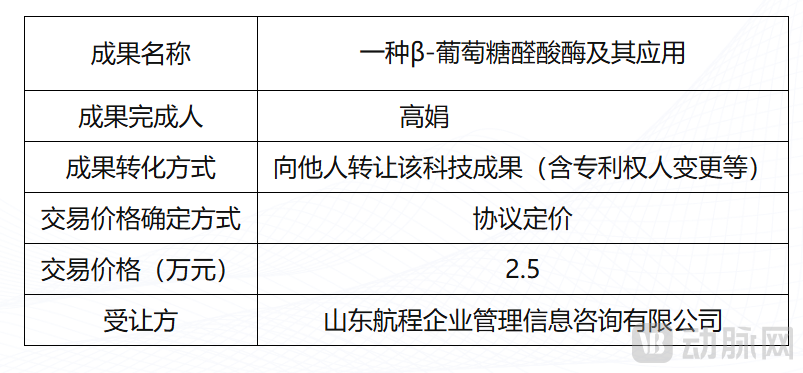
Image from the official website of University of Jinan
“A β-Glucuronidase and Its Application"This invention patent belongs to the fields of genetic engineering and fermentation technology, with its core focusing on the preparation of β-glucuronidase derived from Paenibacillus polymyxa and its application in bilirubin production. It represents a significant technological achievement in the field of biocatalysis. This β-glucuronidase can be used to obtain bilirubin from animal bile through simple steps. Compared with existing bilirubin extraction methods, this approach offers milder production conditions and yields bilirubin with higher purity, making it suitable for large-scale bilirubin production."
The core application scenario of β-glucuronidase is bilirubin preparation, while similar enzyme preparations are also applied in fields such as biocatalysis and clinical diagnostics. Traditional related products and processes suffer from multiple pain points and challenges in practical applications, as detailed below.
1. The core issue with the traditional preparation process of bilirubin.Bilirubin, as the core raw material for artificial Calculus Bovis, is traditionally prepared using bile from livestock such as pigs, cattle, and sheep. The conventional method employs high-temperature alkaline saponification, which requires conditions of pH 10–12 and 100°C to cleave the β-glucuronide bonds of conjugated bilirubin. This process not only consumes large amounts of alkaline reagents, thereby increasing environmental pressure and raw material costs, but also predisposes bilirubin to oxidative decomposition due to high temperatures, significantly reducing product yield. Furthermore, the substantial impurities remaining after saponification pose considerable challenges for subsequent purification, making it difficult to meet the clinical requirements for high-purity bilirubin.
Second, the industrialization bottlenecks of traditional β-glucuronidase preparations.Although existing studies have attempted to hydrolyze conjugated bilirubin using β-glucuronidase, the enzyme preparations employed are predominantly crude products derived from Escherichia coli. These preparations suffer from low expression levels, unstable enzymatic activity, and significant batch-to-batch variability, failing to meet the process requirements for large-scale production. Furthermore, such enzymes exhibit suboptimal physicochemical properties, including narrow pH and temperature tolerance ranges, which predispose them to inactivation during actual production processes, thereby further limiting their industrial application in bilirubin extraction.
Third, technical deficiencies in other application areas of β-glucuronidase.In the field of biocatalysis, traditional β-glucuronidases suffer from low catalytic efficiency and poor substrate specificity in applications such as the hydrolysis of glycyrrhizic acid and baicalin. In clinical oncology diagnostics, although human-derived β-glucuronidase holds potential application value, existing enzyme preparations for detection are characterized by low purity and insufficient sensitivity, making it difficult to achieve precise detection of tumor markers. Furthermore, in sectors such as feed processing, traditional enzyme preparations exhibit limited efficiency in hydrolyzing tea saponins, failing to effectively address the hemolytic issues associated with tea seed meal.
The β-glucuronidase derived from Paenibacillus polymyxa and its application technology developed in this patent achieve comprehensive breakthroughs addressing the pain points of traditional processes and products. The core advantages and innovations are reflected in aspects such as gene sequence, enzymatic properties, expression systems, and application processes.
First, the gene and protein sequences were designed de novo.We have, for the first time, obtained the amino acid sequence of β-glucuronidase with independent intellectual property rights (SEQ ID NO: 1) and its coding gene nucleotide sequence (SEQ ID NO: 2). This lays the foundation for high-efficiency expression and directed engineering of the enzyme preparation. Distinct from existing enzyme sequences derived from Escherichia coli, Bacillus subtilis, and other sources, this approach optimizes the physicochemical properties and catalytic performance of the enzyme at the source.
Second, superior enzymatic properties are well-suited for industrial-scale production.The enzyme exhibits an optimal pH of 5.5 and an optimal temperature of 45°C. It retains over 80% of its activity within the pH range of 4.0–7.0, and more than 60% within the pH range of 4.0–9.0. After incubation at 40–60°C for 1 hour, it still maintains over 50% of its enzymatic activity. With its broad pH adaptability and favorable thermal stability, this enzyme does not require complex process controls for temperature or acidity, making it well-suited for the environmental requirements of large-scale industrial production.
Third, efficient heterologous expression systems enable industrial-scale mass production.This enzyme can be highly expressed in an unoptimized Escherichia coli expression system, achieving an enzymatic activity of 95 U/mL and a protein yield of 0.92 g/L of culture, with a specific activity of 338 U/mg. These metrics are significantly higher than those of existing wild-type β-glucuronidase derived from E. coli. Furthermore, the mature expression system and low cultivation costs address the industrial bottlenecks of traditional enzyme preparations, namely low yield and batch-to-batch instability.
Fourth, a mild bilirubin preparation process improves product quality and yield.A bilirubin extraction process developed based on this enzyme uses animal bile as the raw material. High-purity bilirubin can be obtained through simple steps, including degreasing, enzymatic hydrolysis, organic solvent extraction, and purification. The reaction proceeds under ambient temperature and pressure, eliminating the need for high-temperature alkaline saponification and effectively preventing bilirubin oxidation. Experimental validation has demonstrated that the bilirubin produced by this process achieves a purity of 94.3%–95.8%, with a stable yield of 0.0289%–0.0298%. Furthermore, the process features simplified steps and reduced reagent consumption, offering both environmental sustainability and economic efficiency.
Fifth, the co-development of vectors and engineered bacteria achieves a closed technological loop.A pET-28a vector containing the enzyme-encoding gene and a recombinant Escherichia coli engineered strain (BL21(DE3)) were constructed. The engineered strain features a simple construction method and stable subculturing, making it directly suitable for industrial-scale fermentation production of enzyme preparations. Meanwhile, the modifiable nature of the vector provides a technical platform for subsequent directed evolution of the enzyme, thereby achieving a closed-loop technology system encompassing “gene–vector–engineered strain–enzyme preparation–application process.”
In the fields of bioengineering and pharmaceutical chemical engineering, β-glucuronidase has become a key biocatalyst for bilirubin preparation, tumor marker therapy, and other applications, owing to its core function of catalyzing the hydrolysis of β-D-glucuronide bonds. Related technological research and development, along with patent innovations, continue to advance.
“A β-Glucuronidase and Its Application in Bilirubin Production“Patent for Invention (Publication No. CN119432887B): A product containing β-glucuronidase is obtained through the construction of recombinant plasmids, transformation, expression, and separation and purification, which can be used for the preparation of bilirubin via porcine bile reaction. The β-glucuronidase provided by this invention exhibits high enzymatic activity and thermal stability, a broad adaptive pH and temperature range, and strong adaptability. Furthermore, metal ion solutions containing Fe²⁺ and Mg²⁺ promote the activity of β-glucuronidase, thereby enhancing its enzymatic performance. This β-glucuronidase enables high yield and purity in bilirubin production and can be widely applied in the manufacturing process of bilirubin.”
“β-Glucuronidase and Its Mutants, and Their Application in Bilirubin Production“Invention Patent (Publication No. CN117448304B), wherein the glucuronidase is derived from Escherichia coli, and the glucuronidase mutant is obtained by truncating amino acids at positions 360 to 376 in the amino acid sequence of the glucuronidase. The gene encoding the glucuronidase or its mutant is ligated with an expression plasmid to construct an expression vector, which is then introduced into a host strain to obtain a recombinant strain. Whole-cell catalytic cell paste is obtained by culturing the recombinant strain. The use of this recombinant strain or whole-cell catalytic cell paste in bilirubin preparation achieves high substrate conversion rates with fewer by-products. The preparation method is simple and convenient, featuring mild production conditions and minimal environmental pollution.”
“A β-Glucuronidase-Responsive Carbohydrate Derivative, and Its Preparation Method and Application“Invention Patent (Publication No. CN114957356B): This carbohydrate derivative uses a sugar precursor substrate as the starting material, which is modified with a chemical reporter group and a β-glucuronidase-responsive chemical structure. The chemical reporter group is used for labeling or therapeutic purposes, while the β-glucuronidase-responsive chemical structure features a self-immolative linker, such as a β-glycosidic bond, connected to glucuronic acid or its derivatives. Under the catalysis of β-glucuronidase, the β-glucuronidase-responsive chemical structure can be cleaved from the carbohydrate derivative, exposing hydroxyl groups on monosaccharides, disaccharides, or their derivatives. The carbohydrate derivative of the present invention can be extensively taken up by tumor cells and metabolized via glycometabolic pathways, thereby presenting non-natural sugars on the surface of tumor cells for tumor labeling and therapy.”