

Capital Medical University Beijing Shijitan Hospital to Transfer Microwave Water-Jet Surgical Robot System Patent for RMB 10 Million
Recently, Beijing Shijitan Hospital, Capital Medical University, released a public notice on the transformation of scientific and technological achievements, proposing to transfer its “A Microwave Water Jet Surgical Robot System"The patent for invention is transferred to Zhongke Huashen Technology (Beijing) Co., Ltd. The transfer fee is"RMB 10 million. The inventor of this achievement isChen Yongbing's Team。
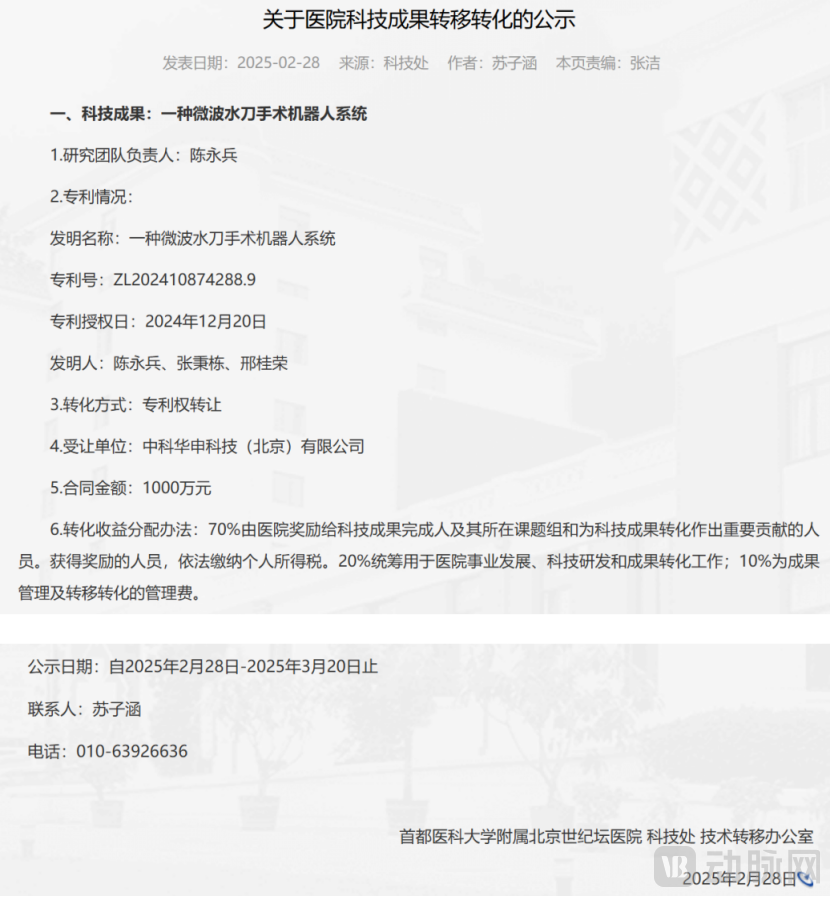
Image from the official website of Beijing Shijitan Hospital, Capital Medical University
Chen Yongbing is a Chief Physician at the Center for Oncology Nutrition and Metabolism, Beijing Shijitan Hospital, Capital Medical University. Holding an M.D. and postdoctoral credentials, he has dedicated many years to clinical practice, scientific research, and teaching in general surgery, while achieving significant accomplishments in the surgical treatment of abdominal tumors and medical technology innovation.
“A Microwave Water Jet Surgical Robot System“The invention patent pioneers the integrated design of microwave thermal effects and waterjet cutting technology, creating an all-in-one surgical robot system that combines precise soft tissue cutting, rapid planar hemostasis, and flexible multi-degree-of-freedom operation. This innovation addresses the core pain points of energy devices in traditional surgical robots and features uniquely designed structures such as serpentine joint tubes and cooling brackets, filling the technological gap in the integration of microwave waterjets with surgical robots. It was selected for the Top 100 New Technologies and Products list at the 2025 Zhongguancun Forum.”
Although minimally invasive surgical robots have achieved large-scale clinical application, design flaws in core energy-based devices have become a critical bottleneck for industry development. The specific pain points are manifested in four dimensions:
Limited to a single function with no capacity for multitasking, resulting in poor clinical adaptability.Mainstream surgical robots face a dilemma where their energy devices force a choice between cutting and hemostasis. Although water jets enable precise and rapid cutting of soft tissues and can be flexibly connected to suit minimally invasive surgery, they have very weak hemostatic capabilities, and the impact of the water flow can exacerbate bleeding in the surgical field. While electrosurgical knives and ultrasonic scalpels possess hemostatic abilities, they lack sufficient cutting precision. In particular, ultrasonic scalpels are limited by their linear propagation characteristics, failing to meet the demands for delicate manipulation in complex surgeries such as those for abdominopelvic tumors and osteosarcomas.
Core energy-based devices are scarce, with high technical barriers.Represented by the globally mature da Vinci Surgical System, its advantages lie in the flexible rotation of its robotic arms and high-precision operation. However, energy devices remain a persistent weakness, characterized by a limited variety and single-function capabilities. Furthermore, the core technologies for high-end energy devices are monopolized by foreign companies, making it difficult for Chinese-made robots to achieve compatibility breakthroughs, which restricts the clinical application of domestically produced surgical robots.
High risk of injury to the surgical field and significant potential for postoperative complications.Traditional energy devices lack effective temperature control designs. The tips of microwave and electrocoagulation instruments are prone to generating high temperatures during operation, causing thermal injury to the nerves and soft tissues surrounding the surgical site. Meanwhile, certain devices, such as ultrasonic scalpels, produce ultrasonic misting, which may increase the risk of tumor dissemination. Consequently, these devices are not suitable for oncologic surgeries characterized by a high risk of bleeding and stringent precision requirements.
Low operational flexibility and limited scenario adaptability.Most energy devices are connected to the robotic arm via a rigid structure, which limits operational degrees of freedom and prevents flexible, multi-angle adjustment of the instrument tip during surgery, making it difficult to meet the requirements for surgical maneuvers within the complex cavities of the human body.
This patent features an original design driven by clinical needs, achieving technological breakthroughs from four key perspectives: functional integration, structural innovation, clinical safety, and operational flexibility. It has become a high-end medical equipment technology that combines practicality with innovativeness. The specific advantages are as follows:
Functional Integration: Integrated Cutting and Hemostasis for Dual Efficacy Enhancement.This patent pioneers the deep integration of microwave thermal effects with waterjet cutting technology. A medical-grade booster pump pressurizes saline solution, which is then ejected through a nozzle to achieve rapid and precise resection of soft tissue, significantly reducing surgical time. Meanwhile, the microwave applicator enables extensive surface hemostasis across the resection plane, addressing the limitation of poor hemostatic efficacy associated with conventional waterjets. Additionally, the sprayed water flow prevents scab formation on the cut surface, further enhancing the synergistic effect of cutting and hemostasis. This technology is particularly suitable for high-bleeding-risk surgical scenarios, such as abdominopelvic tumor resections and osteosarcoma surgeries.
In terms of structural innovation, the system features a proprietary design that balances performance stability with adaptability.The cooling bracket consists of an annular bracket and a thermally conductive insulating plate. The rear end of the microwave knife head is embedded into the isolation mounting groove of the bracket, where thermally conductive silicone transfers heat from the knife head to the high-pressure jet tube and return tube. Heat exchange with water flow provides cooling, preventing thermal injury to tissues in the surgical area. The serpentine joint tube adopts a flexible inner support tube combined with individual spacer connecting tubes. Various lines are housed within the tube. The individual connecting tubes are vertically assembled via lug-and-groove joints, working together with traction cords and threading holes to enable flexible movement of the knife head across seven degrees of freedom, adapting to operations in complex cavities. The knife head features a refined design: an arc-shaped cutting edge and protective plate enhance cutting precision; alignment of the jet orifice with the axis of the high-pressure jet tube ensures stable water flow; and the shielding and insulation layers of the microwave transmission line balance transmission stability with operational flexibility.
In terms of clinical safety, multiple design features reduce surgical risks and enhance procedural efficacy.In addition to the cooling bracket’s design for preventing thermal injury, the patent also employs a reflux tube to promptly remove post-resection fluid from the surgical field, thereby maintaining clear visualization. Furthermore, the microwave waterjet design mitigates the risk of tumor dissemination associated with ultrasonic scalpel-induced aerosolization. When integrated with intelligent navigation and energy modulation technologies, it enables precise delineation of tumor boundaries, reduces the risk of postoperative tumor recurrence, and significantly enhances the safety and efficacy of robotic surgery.
In terms of industrial compatibility, it is compatible with domestically produced robots, facilitating autonomy and controllability.The microwave waterjet system covered by this patent can be used not only as a standalone device but also features customizable wristed end-effectors tailored to departmental needs and tumor characteristics. It is compatible with mainstream surgical robots both domestically and internationally, with optimized design specifically for Chinese-made models. This innovation breaks down the compatibility barriers imposed by foreign high-end energy devices on domestic surgical robots, facilitating the transition of Chinese surgical robots from “followers” to “leaders” and promoting the self-reliance and controllability of high-end medical equipment.
The global surgical robot market remains dominated by foreign brands such as da Vinci, which hold clear advantages in robotic arm manipulation and accumulated clinical experience. However, technical shortcomings in energy-based devices represent a common industry challenge, with no company yet achieving the integrated application of microwave and water jet technologies.
In China, the surgical robotics sector is characterized by “rapid advancement in complete system development, yet urgent breakthroughs needed in core components.” While domestically produced laparoscopic surgical robots have achieved clinical implementation, core energy devices still rely on imports. Technological innovations have primarily focused on system integration and operational optimization. The patented microwave water-jet surgical robot system represents the first domestic original breakthrough in core technologies for energy devices, filling the technological gap in high-end domestically produced energy instruments.
The AquaBeam Robotic System developed by PROCEPT BioRobotics,It is an advanced, image-guided surgical robotic system that integrates real-time multi-dimensional imaging, personalized treatment planning, and hot-water-free jet ablation to precisely and rapidly resect prostate tissue. By combining cystoscopic visualization, ultrasound imaging, and planning software with real-time, multi-dimensional imaging, it enables personalized therapy and intraoperative real-time monitoring. Leveraging multi-dimensional views of the prostate for personalized treatment planning, surgeons can create specific therapeutic zone maps for each patient.
Mindray's Ultrasound-HF Integrated Surgical Device,Dedicated Ultrasonic Scalpel Tips & UP700 Energy PlatformBy incorporating finer ultrasonic scalpel tips and more precise intelligent algorithms, this system assists surgeons in performing procedures with precision, efficiency, and convenience, thereby facilitating patients' quicker return to healthy lives. The platform enables a single energy generator to simultaneously connect with ultrasonic scalpels, bipolar electrosurgical units, and monopolar electrosurgical units. The scalpel tips are engineered to withstand high-frequency vibrations. Through hundreds of simulation adjustments, dozens of design iteration cycles for optimization, and the application of various advanced manufacturing processes, the structural design of the ultrasonic scalpel was finalized. This has resulted in the creation of the only domestically produced fine-tip ultrasonic scalpel, which is approximately 20% thinner and narrower than the flagship ultrasonic scalpel tips from leading international brands.
U.S. Valleylab VLFX8GEN High-Frequency Electrosurgical SystemThe output is automatically adjusted by computer control in response to changes in tissue density, eliminating the need for manual adjustment and ensuring consistent cutting and coagulation performance regardless of the tissue type. Low-voltage cutting and low-voltage coagulation output modes are specifically designed for laparoscopic surgery, significantly reducing the risks associated with the use of electrosurgery in minimally invasive procedures. The macro-bipolar output mode is tailored for modern bipolar cutting instruments used in laparoscopic surgery; its superior low-voltage operating characteristics effectively minimize arcing at the electrode tip, thereby reducing collateral damage to healthy tissue, as well as decreasing stimulation of nerves and muscles and interference with radiofrequency currents. All three cutting modes are governed by the Instant Response system, while the four coagulation modes meet the hemostatic requirements of a wide variety of surgical procedures.
The invention and commercialization of the patent for the microwave waterjet surgical robot system have addressed the core pain points associated with energy devices in traditional surgical robots, achieving an integrated breakthrough in cutting, hemostasis, and flexible manipulation. Its “clinical demand-driven + hospital-enterprise collaborative industrialization” model also provides valuable, replicable, and scalable experience for the R&D innovation and practical translation of high-end medical equipment in China.