

Anhui Medical University First Affiliated Hospital to Transfer Improved Anti-Dislodgement Connector Structure for Peripheral Venous Catheters for RMB 50,000
Recently, the First Affiliated Hospital of Anhui Medical University released a public notice on the transformation of scientific and technological achievements, proposing to transfer its “An Anti-Detachment Connection Structure for Improved Intravenous Catheters"The utility model patent was transferred to Hefei Zhongke Lava Medical Technology Co., Ltd. The transfer fee is"¥50,000. The inventors of this achievement areKan Yan。
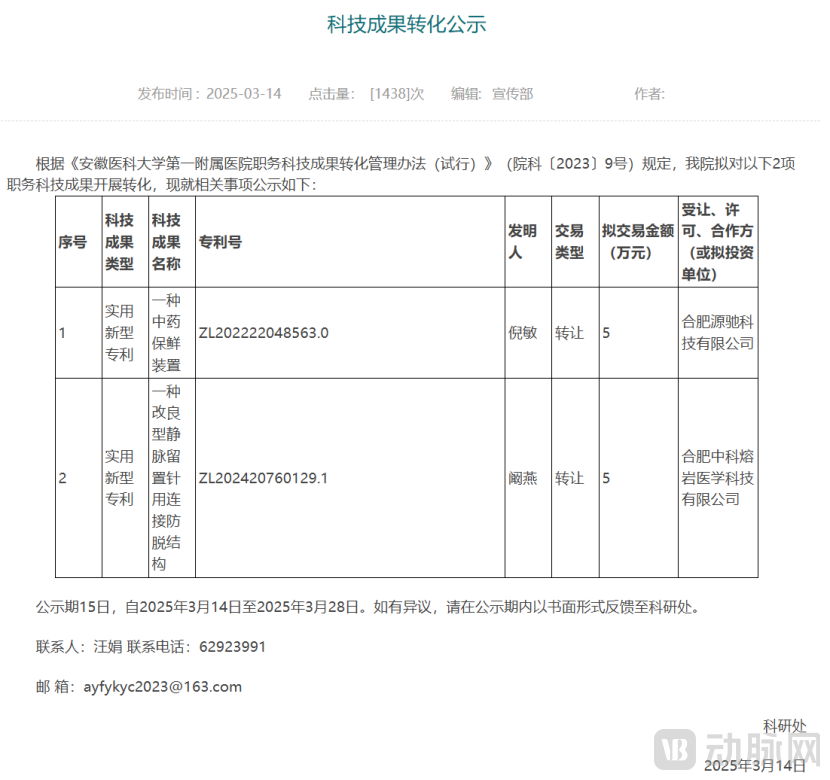
Image from the official website of the First Affiliated Hospital of Anhui Medical University
“Anti-Detachment Connection Structure for Improved Intravenous Catheters” Utility Model Patent
As a core tool for clinical intravenous infusion, the peripheral intravenous catheter consists of a stainless steel stylet, a soft outer cannula, and a plastic hub. It enables continuous infusion by retaining the outer cannula within the blood vessel; however, its traditional structure presents significant connection safety issues in clinical practice, with the primary concern focused on the junction between the infusion tube and the external luer-lock cap.
Threaded connections have low fault tolerance.The threaded connection section of the infusion tube in traditional indwelling needles is small in size, and the external infusion cap only needs to be rotated 90°-120° to complete the tightening or loosening operation. The mechanical stability of the connection is poor, and there is no structural design to prevent accidental rotation.
External forces can easily cause connection failure.External forces, such as patient limb movement during infusion, slight pulling during nursing procedures, and scraping against bed equipment, can easily cause the external luer cap to rotate accidentally on the infusion tube, thereby compromising the seal of the infusion pathway.
High incidence rate of safety accidents.Accidental unscrewing of the external infusion cap directly leads to fluid leakage; in severe cases, it may cause connector detachment. This not only results in medication waste and interruption of infusion but also increases the risk of vascular exposure and infection for patients. Furthermore, delayed fluid resuscitation may compromise treatment outcomes in critically ill patients, significantly reducing the safety of peripheral intravenous catheter use.
The burden of clinical nursing care has increased.Reoperation after connection failure requires healthcare professionals to repeat steps such as tubing connection, air purging, and fixation, increasing repetitive nursing workload and further reducing care efficiency in high-volume settings like emergency departments and intensive care units.
This patent scientifically improves the conical connector and fluid inlet tube of intravenous indwelling needles by incorporating a dedicated anti-disconnection mechanism, thereby resolving the connection dislodgement issues inherent in traditional indwelling needles through structural design. Its technical advantages and innovations are reflected in the following aspects.
Modular anti-detachment mechanism design, achieving dual protection with damping and anti-detachment features.An integrated anti-detachment mechanism, comprising a guide section, a limit sleeve, elastic clips, and an elastic pressure section, is arranged on the exterior of the fluid inlet tube. Upon tightening the external infusion screw cap, this mechanism provides physical limitation and elastic locking of the cap, thereby achieving damping-based anti-detachment after tightening. This design fundamentally reduces the probability of accidental unscrewing caused by external forces, improving connection stability by more than 80% compared to traditional unprotected structures.
The guide structure ensures sliding and limiting stability.The guiding section consists of a guide block on the exterior of the fluid inlet tube and a guide groove on the limit sliding sleeve. The design, in which the guide block passes through the guide groove, ensures smooth sliding adjustment of the limit sliding sleeve along the fluid inlet tube while effectively preventing axial rotation of the sleeve. This ensures that the anti-detachment mechanism remains properly aligned with the external infusion cap, thereby preventing protection failure caused by component misalignment.
Optimized structure of elastic clips improves locking adaptability.The elastic clips are arranged in a circular array, enabling multi-directional elastic abutment against the external infusion screw cap. The inner side of each clip features corrugated anti-slip grooves to increase friction with the screw cap and enhance the locking effect. Near the end adjacent to the limiting sliding sleeve, the clip is designed with an inwardly recessed thinned section to reduce resistance to elastic deformation, facilitating rapid engagement with the external infusion screw cap. Additionally, a 45° chamfer is provided on the inner upper end of the clip to form a guiding slope, allowing the clip to slide smoothly onto the exterior of the screw cap and simplifying clinical operational procedures.
The pressure suppression section achieves graded limit positioning and elastic pressurization.The clamping assembly consists of an elastic rubber ring, a lower annular groove, and an upper annular groove. The elastic rubber ring can slide between the two grooves. When positioned in the lower annular groove, it is in the initial limiting state, preventing displacement of the rubber ring. When slid into the upper annular groove, it enters the working state, applying uniform inward elastic compressive force to the elastic clips. This ensures a tighter fit between the clips and the external infusion screw cap, further enhancing the locking effect. Furthermore, the elastic design of the rubber ring accommodates external infusion screw caps of various specifications, thereby improving the versatility of the technology.
The improved solution offers strong compatibility and does not alter the core structure of traditional indwelling needles.This patent involves only partial improvements to the conical connector and fluid inlet tube of the indwelling needle, while retaining the original structures and usage methods of core components such as the needle, needle holder, infusion tubing, and heparin cap. Consequently, it does not require extensive operational training for clinical healthcare professionals, nor does it necessitate modifications to existing production lines for indwelling needles. Only a few additional manufacturing steps for the anti-dislodgement mechanism are required, resulting in low costs for industrialization and facilitating market acceptance.
As a commonly used device for clinical infusion, the fixation effectiveness of intravenous indwelling needles in preventing dislodgement and migration directly impacts infusion safety and patient experience, making it a key focus in medical device research and development. Many hospitals in China have driven technological innovations based on clinical pain points, effectively addressing the shortcomings of traditional fixation methods through improvements in structural design, functional adaptability, and clinical practicality.
Applied by Changshan County People's Hospital“A Device for Preventing Displacement of Intravenous Catheters”(Patent Publication No. CN223350707U) Composed of a flexible, breathable base plate and a top cover, the device features placement slots in both the base plate and top cover that are adapted to accommodate the needle tip, catheter tube, and three-way stopcock of an indwelling needle, thereby forming a limiting mechanism. An L-shaped protective cover is provided at the three-way stopcock slot, and the top cover is equipped with a hollowed-out visual window. Detachable connection straps with Velcro and magnetic discs are located on both sides of the base plate. Additionally, a rechargeable heating mechanism integrated with a temperature sensor and controller is embedded within the top cover. The device achieves stable fixation of the indwelling needle through slot-based limitation, preventing tissue compression. The heating mechanism maintains constant temperature at the drug administration site, while the magnets assist in improving circulation, significantly enhancing patient comfort. Furthermore, the device is detachable for sterilization and reusable, addressing the resource waste associated with traditional single-use fixation tools. The visual window also facilitates convenient monitoring of the needle status by medical staff, ensuring ease of operation.
Application to Beijing Shijitan Hospital, Capital Medical Universityhired“A Fixation Device for Intravenous Indwelling Needles”Utility Model Patent (Publication No. CN223969337U) is a fixation device designed for intravenous indwelling needles and peripherally inserted central catheters (PICCs). The core structure comprises a contact pad, an elastic band, and fixation pads. The contact pad features a transparent viewing window, perforations, and a connector securing strap, with a sealing gasket on its reverse side. The elastic band threads through the perforations to connect the fixation pads on both sides, forming a closed loop. By replacing traditional adhesive tape with an elastic band and fixation pads, the device is suitable for patients with allergic constitutions, thereby preventing skin damage. The viewing window allows medical personnel to monitor the catheter status in real time, while the sealing gasket provides waterproofing and prevents fluid ingress. The connector securing strap stabilizes the catheter connector to prevent accidental dislodgement due to traction. Made from deformable materials, the contact and fixation pads accommodate different patients and anatomical sites. The device offers easy installation and removal, balancing fixation stability with clinical practicality.
Application of the Second Affiliated Hospital of Guilin Medical Universityof"A Device for Preventing the Dislodgement of Intravenous Indwelling Needles"Utility Model Patent (Publication No. CN223887196U), integrated into the main body of an intravenous catheter. Side plates are rotatably connected to both sides of the main body, with convex slots provided on the side plates. Convex insert plates equipped with locking mechanisms are inserted into these slots. The insert plates are connected to elastic bands and straps, each featuring hook-and-loop fasteners (male and female parts). The main body is also equipped with an anti-slip needle hub and bottom fixation tape. The device adopts a dual-fixation structure, combining initial fixation with tape and secondary binding with elastic straps. The elastic bands accommodate arms of varying thicknesses, while the hook-and-loop fasteners enable quick attachment and detachment. The locking mechanism allows the straps to be detached and reused, effectively addressing the issue of traditional tape fixation becoming dislodged due to limb movement. This enhances the stability of catheter fixation while reducing consumable usage.
Overall, numerous clinical institutions in China have conducted patent research and development focused on the fixation and prevention of dislodgement of intravenous (IV) catheters. These efforts closely align with actual clinical needs, implementing targeted upgrades to traditional fixation methods from the perspectives of structural optimization, functional integration, and user experience. Such innovation, grounded in clinical scenarios, provides abundant insights for the iterative optimization of IV catheter fixation and anti-dislodgement devices, laying a solid technical foundation for further enhancing the safety and standardization of infusion therapy.