

Capital Medical University to Transfer Urine Testing Device Patent for RMB 40,000
Recently, Beijing Luhe Hospital, affiliated with Capital Medical University, released a public notice on the transformation of scientific and technological achievements, proposing to transfer its utility model patent"Urine Testing Device Based on Medical Laboratory Analysis"Patent assignment to Beijing Kangnuo Zhuoshang Technology Achievement Transformation Co., Ltd., with a proposed transfer amount of40,000 yuan。
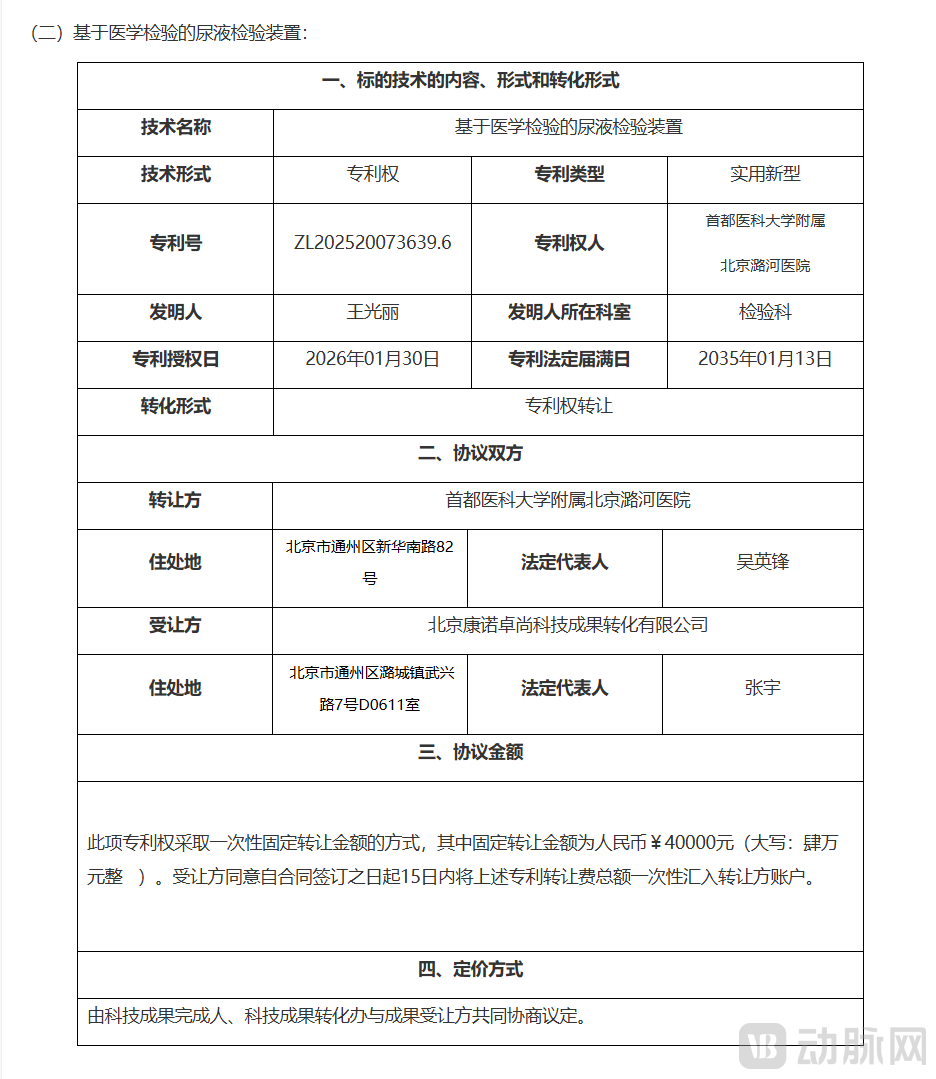
Image from Capital Medical UniversityOfficial Website of Beijing Luhe Hospital Affiliated to Capital Medical University
This patent was invented by the inventor from the Department of Laboratory Medicine.Wang GuangliR&D, with the core innovation lying inDeveloped an integrated structure for urine testing and disinfection/cleaning, the drive assembly actuates the cleaning plate and the liquid reservoir opening plate to achieve automatic alcohol disinfection and reciprocating cleaning of the testing area, allowing cleaning operations to be completed without disassembling the test strip carrier, thereby significantly improving testing efficiency; meanwhile, an elastic cable management assembly is integrated to effectively organize device cables and prevent tangling, extending equipment service life. This design addresses industry pain points associated with traditional urine testing devices, such as cumbersome disinfection procedures and workflow bottlenecks during high-volume sample processing.
Urine TestAs a core routine test in clinical laboratory medicine, urinalysis serves as a critical basis for diagnosing urinary system diseases and metabolic disorders. By precisely detecting chemical and formed elements in urine, it measures key physiological indicators such as pH and specific gravity. Furthermore, it enables urine culture and pathogen identification to determine the presence of microbial infections, identify specific pathogenic species, and assess antibiotic susceptibility. This provides indispensable clinical data support for early diagnosis, targeted treatment, and dynamic monitoring of disease progression, playing a vital role in the clinical diagnosis and treatment system.
In current clinical practice,Various Urine Testing DevicesIt is the primary tool for performing the aforementioned urine tests and a common piece of equipment in the laboratory departments of medical institutions. However, existing traditional urine testing devices exhibit significant technical deficiencies and operational pain points in practical applications. After completing a single urine test, laboratory personnel must manually disassemble the internal components holding the test strips, perform separate alcohol disinfection, and then reassemble the components back into the device before the next test can be conducted.
This cumbersome disassembly, reassembly, and sterilization process not only significantly increases the daily workload of laboratory staff, forcing them to expend considerable time and energy on equipment handling in addition to sample testing, but also directly prolongs the total turnaround time for each test, resulting in low operational efficiency.
In the routine laboratory operations of medical institutions at all levels, urine testing volumes are often substantial. This is particularly evident in settings with concentrated sample testing demands, such as general hospitals and primary healthcare facilities. In these scenarios, the aforementioned limitations of traditional devices are further exacerbated. The repeated disassembly, assembly, and sterilization procedures significantly slow down the overall workflow, failing to meet the clinical laboratory’s practical needs for streamlined processes and user-friendly operation, nor can they accommodate the high-throughput, continuous sample testing pace required by medical institutions.
Therefore, R&DA Urine Testing Device Capable of In-Situ Sterilization Without Disassembly, Simplifying Post-Test Cleaning Procedures, thereby enhancing the overall efficiency of urine testing and alleviating the workload of laboratory personnel, which has become an urgent and practical need in the field of clinical laboratory medicine.
This urine testing device, based on medical laboratory testing, features targeted innovative designs addressing the clinical pain points of traditional equipment, combiningEase of Operation, Functional Integration, Practical UsabilityThree Core Advantages, with Key Innovations Reflected inAutomated Disassembly-Free Sterilization and Cleaning with Integrated Cable Management and ProtectionTwo Major Dimensions: Achieving Technological Upgrades in Both Laboratory Workflow Efficiency and Equipment Durability
During the disinfection and cleaning process, the device abandons the traditional detachable cleaning mode. Through a linked design of the drive assembly, sliding assembly, and cleaning structure within the test chamber, the motor drives the rotation of the shaft, rotating plate, and fixed column, thereby pushing the opening plate to slide back and forth along a fixed trajectory, which simultaneously drives the cleaning plate to reciprocally wipe the test strip area.
Meanwhile, as the opening plate slides into the designated position, the fixing block pushes against the sliding plate to compress the spring, aligning the circular hole in the sliding plate with that in the opening plate. This allows alcohol within the opening plate to drip precisely through the aligned holes onto the test strip’s detection area, achieving seamless integration of automatic disinfectant release and wiping cleanup. The entire process requires no disassembly of any components, significantly simplifying post-test cleaning procedures, effectively saving operation time, and markedly improving the overall efficiency of urine testing, making it particularly suitable for clinical testing scenarios with high sample volumes.
In terms of structural design, the device also innovativelyAdded an elastic cable bundle assembly, through the coordination of the positioning plate, positioning rod, second spring, and arc-shaped plate, the elastic potential energy of the spring drives the arc-shaped plate to elastically clamp and neatly restrict the device’s cables. This allows the cables to be wound in an orderly manner around the arc-shaped plate, fundamentally preventing cable tangling and disarray during use. It reduces cable wear, breakage, and other damages caused by entanglement, effectively extending the overall service life of the equipment and lowering equipment maintenance costs in clinical applications.
In addition,The overall structural layout of the device is compact and rational.The test kit integrates multiple functional modules, including testing, actuation, cleaning, and disinfection. An electric rail drives the push plate to slide smoothly along the guide rail, facilitating the movement of test strips through a standardized testing procedure. Test results are displayed intuitively on a front-end monitor. The operation is simple and user-friendly, requiring no complex professional skills, thereby meeting the daily operational needs of clinical laboratory departments. This design achieves automation and standardization of the testing process, further enhancing the device’s clinical utility.
This device precisely meets the efficiency demands of laboratory departments across medical institutions at all levels, demonstrating broad prospects for promotion and application in scenarios such as general hospitals, community health service centers, and physical examination institutions, with considerable potential for market adoption.
The current urine testing equipment market is in a stage of dual-wheel development driven by policies and technological iterations, overall presentingAccelerated Domestic Substitution, Clear Market Segmentation, and Upgrading Demand Toward Greater Efficiencycore features. In terms of market landscape, foreign brands dominate the high-end market by virtue of their technological accumulation,Flagship Integrated Testing Equipment Featuring High Precision and High Throughput, catering to the precise diagnostic needs of large Grade 3A hospitals; domestic brands rely onCost-Effectiveness and Localized Service AdvantagesAchieving rapid breakthroughs, with market share in the mid-to-low-end segment and primary care settings continuing to rise, while gradually penetrating the high-end market through technological upgrades, leading to increasing industry consolidation.
Sysmex - UC-3500 Fully Automated Urine Analyzer, this fully automated urine analyzer is a high-end imported device for dry chemistry urinalysis. It employs advanced optical sensing and refractive index measurement technologies to accurately identify abnormal colorimetric changes in urine samples, while simultaneously enabling precise determination of indicators such as specific gravity and turbidity.
Equipment SupportMultiple specialized test strips are available to cover key urinary parameters, while also enabling simultaneous combined detection of microalbumin and creatinine., providing a critical basis for early screening of kidney disease. The entire testing process is fully automated, requiring minimal manual intervention from sample aspiration and reagent strip reaction to result output. Furthermore, the device features a modular design that allows it to integrate with other urine testing equipment in the same series to form an automated testing pipeline. It is also compatible with dedicated laboratory information management systems, further optimizing the overall efficiency of the testing workflow.
This device, leveragingHigh detection accuracy and high level of process automationcharacteristics, it is currently primarily deployed in the laboratory departments of large general hospitals and Grade 3A specialized hospitals in China. It serves as one of the core devices for medical institutions to conduct routine urinalysis, screen for urinary system diseases, and facilitate early diagnosis of kidney diseases. It is often used in conjunction with urine formed element analysis equipment to establish a multi-dimensional urinary testing system, thereby meeting the clinical demand for precise diagnosis.
Meanwhile, the device has also been deployed in select high-end health checkup centers and regional medical laboratory centers, catering to large-volume, high-standard urine testing scenarios. Owing to its stable analytical performance, it has become a mainstream choice in the premium urine analysis equipment market; however, due to its high-end positioning, its penetration rate remains relatively low among primary healthcare institutions.
Siemens Healthineers - CLINITEK Status+ Urinalysis Analyzer, this urine analyzer is a point-of-care testing device that employs advanced optical sensing and diffuse reflectance photometry technologies to accurately identify subtle color changes after reagent strip reactions, effectively reducing the rates of misdiagnosis and missed diagnosis. The device can detect multiple core parameters of routine urinalysis, as well as special indicators such as microalbumin and creatinine, along with their related ratios, providing a basis for early screening of kidney disease. It also supports urine pregnancy-related tests, offering comprehensive test coverage.
The device features a highly simplified operational workflow, allowing users to complete the entire process from test selection to result output in just a few easy steps. Equipped with functions such as automatic calibration and automatic test strip recognition, it also has built-in printing and data storage modules that enable direct output of test results and data retention. Furthermore, it supports integration with information management systems for seamless data synchronization. With its compact size and high portability, the device is well-suited to meet operational needs across various usage scenarios.
This device, by virtue ofRapid detection, easy operation, and high functional integrationIts characteristics have made it the mainstream device for point-of-care urine testing. It is currently widely used in point-of-care testing scenarios such as outpatient clinics, emergency departments, and hospital wards across medical institutions at all levels, meeting the clinical need for rapid test results to support diagnosis and treatment. It is also deployed in primary healthcare settings, including community health service centers and specialized outpatient clinics, to facilitate routine daily urine screening.
Meanwhile, owing to its portability and rapid detection capabilities, this device is also employed in high-end health examination centers and mobile medical testing scenarios, making it a key option for diverse urinalysis needs. However, as such devices primarily focus on rapid point-of-care testing, their application remains limited in settings involving centralized, high-volume sample analysis.
The urine testing device based on medical laboratory testing involved in this patent precisely aligns with current market development trends and actual clinical needs, offering broad market prospects. This device is based onAutomated Disinfection and Cleaning Without Disassembly, with Elastic Cable ProtectionAs a core differentiating advantage, it directly addresses the common industry pain points of cumbersome cleaning procedures and prone-to-wear cables in similar products. It effectively enhances inspection efficiency and reduces equipment maintenance costs. It not only meets the demand for high-efficiency sample testing in primary healthcare institutions but also satisfies the requirement for convenient daily operations in hospitals at all levels, thereby forming an effective functional complement to existing competing products.
Meanwhile,The device features a compact overall structure and simple operation, requiring no specialized or complex procedures.,while also ensuring cost controllability, aligning with the procurement characteristics of medical equipment at the primary care level, demonstrating strong feasibility for implementation in primary care settings such as community health service centers, township health centers, and private clinics; in scenarios with moderate sample volumes, such as small and medium-sized hospitals and health examination institutions, it can also enhance testing efficiency through streamlined processes, indicating broad application potential.
Benefiting from the market dividends of accelerated substitution with domestically produced medical equipment and rising procurement demand for primary care medical devices, as well as the innovation and practical value in its technical design, the device can establish unique competitive advantages in market promotion. It holds strong prospects for industrialization and commercialization in China’s urine testing equipment market, particularly in the primary care sector, while also providing new directions for the lightweight and convenient innovative development of urine testing equipment.