

Beijing Shijitan Hospital Affiliated to Capital Medical University to Transfer Integrated Injector-Style Allergen Skin Prick Test Device for RMB 60,000
Recently, Beijing Shijitan Hospital, Capital Medical University, released a public notice on the conversion of scientific and technological achievements, proposing to transfer its “An Integrated Syringe-Type Allergen Skin Prick Test Device“Utility model patent transferred to Beijing Aiboer Biotechnology Co., Ltd. The transfer fee isRMB 60,000. The inventors of this achievement areWang Xiaoyanand his team。
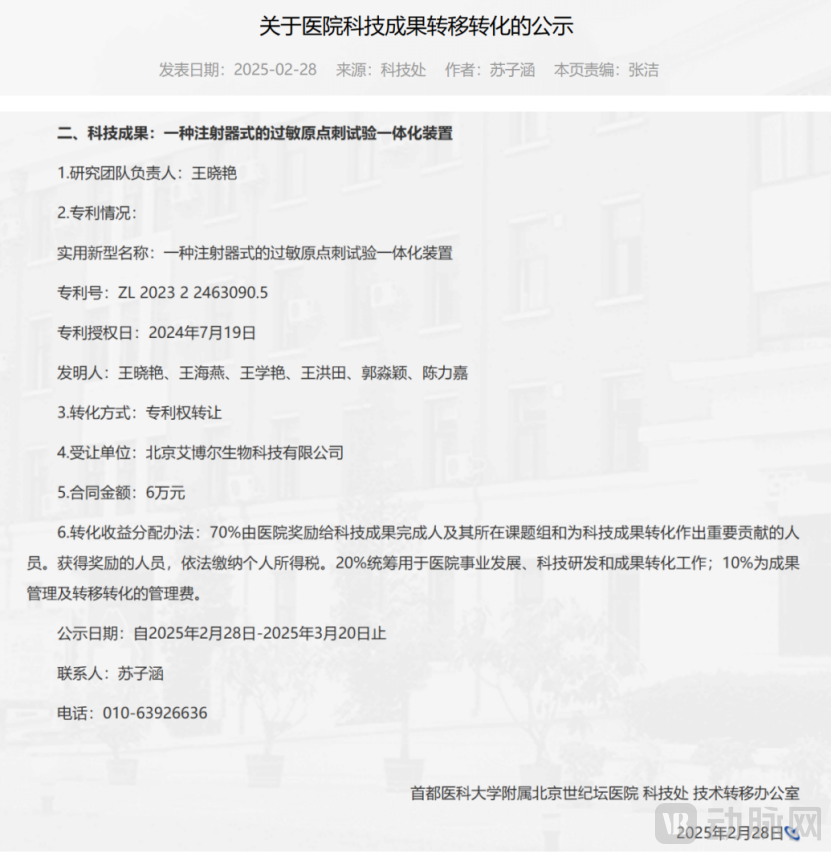
Image source: Official website of Beijing Shijitan Hospital, Capital Medical University
“An Integrated Syringe-Style Allergen Skin Prick Test Device“Integrating core components such as the barrel, lancet, gear-driven fluid delivery mechanism, and actuation switch, this device combines lancing and fluid delivery into a single unit. Pressing the switch engages the gears to drive the fluid delivery mechanism, enabling quantitative output of allergen suspensions. The barrel features volume markings, and the lancet can be conveniently detached via a needle release switch; the device also comes with a needle cap and a protective cover. Compared with traditional two-step procedures, this device offers simplified operation, precise dosing, and reduced risks of needlestick injuries and contamination, thereby revolutionizing the clinical workflow for skin prick testing in allergy diagnosis.”
Skin prick testing is the mainstream in vivo diagnostic method for allergic diseases, widely used for allergen detection in conditions such as allergic rhinitis, asthma, and dermatitis. However, traditional operational models have long suffered from various technical and practical challenges, hindering improvements in clinical diagnostic efficiency.
The operational workflow is cumbersome, and the two-step process is inefficient.Conventional testing requires manually squeezing the lancet fluid bottle to drop the allergen suspension onto the patient’s skin, then setting down the bottle and picking up the lancet needle to perform the skin prick. This two-step process necessitates switching instruments, which not only increases the operational steps for healthcare professionals but also prolongs the testing time per patient, easily causing procedural bottlenecks during peak outpatient hours.
Low Dose Control Accuracy Affects Test Results.Manual squeezing of the allergen extract bottle fails to precisely control the drop volume. Excessive dosage may lead to reagent waste and potentially interfere with the interpretation of skin reactions, while insufficient dosage may fail to meet test requirements, resulting in biased test outcomes and reduced diagnostic accuracy.
Poor device connectivity poses operational safety risks.The prick test solution vials and prick test needles are separate instruments that require frequent replacement during procedures, which can lead to issues such as instrument slippage and contamination. Additionally, the lack of a convenient disassembly mechanism for used prick test needles increases the risk of needlestick injuries among healthcare workers, posing a potential risk of cross-infection.
No standardized volume-control markings, making reagent management inconvenient.Traditional prick test fluid bottles lack precise volume markings, preventing healthcare professionals from monitoring the remaining reagent level in real time. This can lead to insufficient reagent supply and subsequent interruption of tests, while also hindering standardized management and use of reagents.
“An Integrated Syringe-Style Allergen Skin Prick Test Device“The utility model patent is based on a syringe prototype, integrating core components such as the barrel, lancet needle, fluid-dispensing mechanism, gears, actuation switch, and positioning device. Through mechanical transmission and optimized structural design, it achieves comprehensive innovation over traditional prick tests, with advantages demonstrated in four key dimensions: operational ease, precision, safety, and practicality.”
Operational Dimension: Integrated Design for One-Step Pricking and Fluid Delivery.The device features a detachable and internally connected design between the lancet and the cartridge containing the allergen suspension. Healthcare professionals can perform skin prick tests with one hand by simply holding the cartridge, and then execute fluid delivery by pressing the push-button switch. This eliminates the need to change instruments, simplifying the traditional two-step procedure into a single step and significantly improving clinical operational efficiency. Additionally, the press head of the push-button switch is designed with an arc-shaped contour that conforms to natural finger-pressing habits, further optimizing the tactile experience during operation.
Precision Dimensions: Gear-Driven Metering for Precise Reagent Dispensing.The device features an internal gear mechanism engaged with a fluid-dispensing component. Pressing the actuation switch rotates the gear by a fixed angle, thereby advancing the fluid-dispensing component within the barrel by a predetermined distance. This ensures precise delivery of a fixed dose of allergen suspension, eliminating dosage errors associated with manual compression through its mechanical design. This standardizes the test dose and enhances the accuracy of detection results. The barrel is constructed from transparent material with graduated markings on the outer wall, allowing healthcare professionals to monitor the remaining reagent volume in real time, thus facilitating reagent management and test planning.
Safety Dimension: Multi-layered Protection Structure to Reduce Operational and Usage Risks.On the one hand, the device is equipped with a needle release mechanism that enables rapid separation of the lancet from the barrel under external force through the coordinated action of a separation strip, recessed groove, and locking block, thereby preventing needlestick injuries to healthcare personnel during post-test disassembly. On the other hand, the device features a needle cap and a protective cover; the needle cap protects unused lancets from contamination, while the protective cover encases the fluid-dispensing component to maintain a sterile environment, effectively reducing the risk of reagent and instrument contamination and enhancing test safety.
Structural Dimension: Modular and detachable design to accommodate diverse clinical needs.The lancet and the barrel, as well as the positioning component and the barrel, are all detachably connected. This allows for the replacement of lancets with different specifications according to testing requirements, and facilitates cleaning, disinfection, and component replacement of the device. The piston of the fluid-dispensing component forms a sealed fit with the inner wall of the barrel, preventing leakage of the allergen suspension and ensuring effective utilization of the reagent. The positioning component is equipped with a dual-port design, which separately enables movable connections for the fluid-dispensing component and the actuation switch. The compact and rationally arranged structural design balances the stability and practicality of the device.
As the global prevalence of allergic diseases continues to rise, market demand for allergen testing is growing steadily. As a mainstream diagnostic method, skin prick testing has become a focal point for research and development in related devices. The industry is currently trending toward greater convenience, precision, integration, and safety, while patent commercialization and technology implementation are accelerating.
"Applied for by Beijing Tongzhou District Maternal and Child Health HospitalA Skin Allergen Prick Pen"Utility Model Patent (Publication No. CN219422859U) provides a skin allergy prick pen, which simplifies the operation steps by synchronizing the titration of allergen solution with the pricking process. The quantified titration liquid makes the operation of the allergy test more standardized. Additionally, it features a unique fixed-point design for the prick needle to define the pricking area, facilitating easier handling by operators and reducing experimental errors caused by varying levels of operator experience, thereby improving the precision and accuracy of the test."
Tongji Hospital Affiliated to Tongji Medical College of Huazhong University of Science and Technology applied for “A Multi-Point Quantitative Titration Device Based on Allergen Skin Prick Test Solutions"Utility Model Patent (Publication No. CN223664591U), comprising a transparent syringe barrel, handle, piston, and piston rod. The surface of the transparent syringe barrel is marked with graduation lines. The top end connects the piston rod to an adjustment screw via a press plate, working in conjunction with an adjustment nut to achieve quantitative sampling. The bottom end is threaded to a hollow plate, on the underside of which five liquid aspiration tubes are arranged at equal intervals. A brown allergen loading box is magnetically attached to the side. This device enables the simultaneous quantitative aspiration and dispensing of five types of allergens, thereby avoiding cross-contamination, improving detection efficiency and accuracy, and facilitating storage, cleaning, and disinfection."
of ALKAccuTest Series Allergy Skin Testing Device, including AccuTest-1, AccuTest-8, and AccuTest-10, as well as AccuTest 48-well and 60-well allergen trays, designed to optimize allergy testing and diagnosis. AccuTest-1 is a single skin prick test device, while AccuTest-8 and AccuTest-10 are multi-head applicators with eight and ten heads, respectively. These devices feature reduced tip length and diameter to enhance precision and minimize patient discomfort. Additionally, the devices incorporate improved ergonomic features, such as a larger top surface and ribbed grip, to ensure uniform pressure and consistent results.