

Fujian Medical University to Transfer Patent for Retractable Surgical Retractor at RMB 160,000
Recently, the First Affiliated Hospital of Fujian Medical University plans to patent“A Retractable Surgical Retractor”to be transferred, this transaction adopts the patent right transfer model, with a proposed transfer amount of160,000 yuan, with the transferor being the First Affiliated Hospital of Fujian Medical University and the transferee being Hangzhou Qinglang Technology Co., Ltd. The inventor of this patent isLin Jianbo and his team。
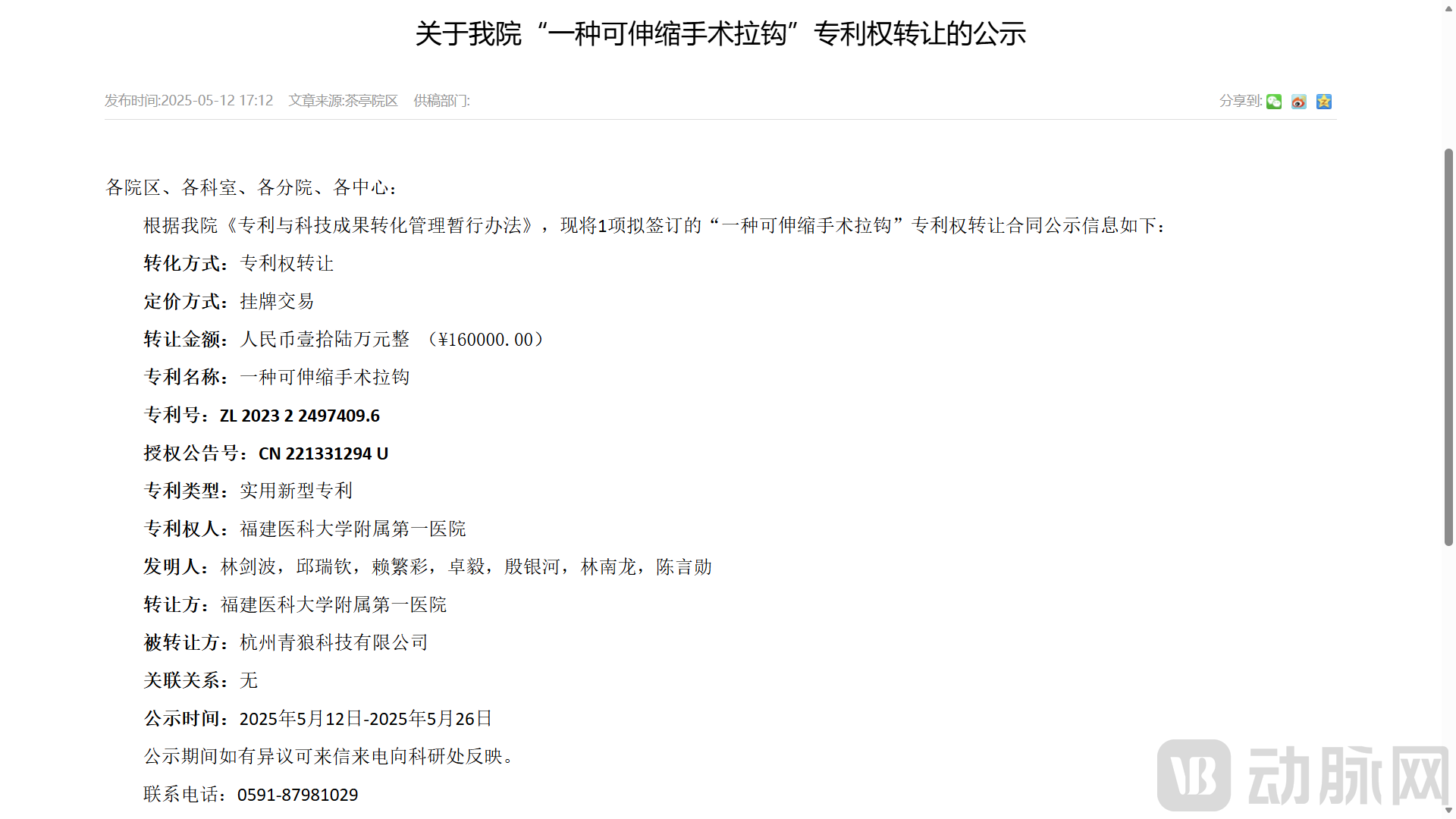
Image from the official website of The First Affiliated Hospital of Fujian Medical University
This patent innovatively addresses the need for surgical wound exposure in thoracic surgery, achievingSingle-Hand Remote Control, Synchronous Retraction and Extension of Dual Retractors, Multi-Level Limit Fixation, addressing the pain points of traditional retractors, such as large space occupation, labor-intensive operation, and susceptibility to wound retraction. It offers clinical advantages of high efficiency, convenience, and stability, representing a practical medical device innovation well-suited to real-world operating room scenarios.
Thoracic SurgeryAs a core clinical specialty dedicated to the diagnosis and treatment of diseases affecting intrathoracic organs, it primarily focuses on the diagnostic evaluation and surgical management of benign and malignant conditions involving key structures such as the esophagus, lungs, and mediastinum. High-volume procedures routinely performed in thoracic surgery include cervical anastomosis for esophageal cancer and single-port laparoscopic surgery.
During the performance of such procedures,Apply stable and moderate traction to the surgical incision to achieve an adequate and clear operative field., is a key prerequisite for ensuring precise surgical manipulation, minimizing collateral tissue damage, and enhancing surgical safety and efficiency, an operation that relies heavily on basic medical devices such as surgical retractors.
In current clinical practice in China, the widely adopted approach remainsTraditional Stainless Steel Integrated Handheld Surgical Retractor,Such retractors feature a simple structure, fixed length, and an overall short design, leading to a series of unavoidable limitations and clinical pain points in practical use:
First,Limited Working Distance of Traditional Retractors, the assistant must operate manually in close proximity, with their arms and hands inevitably occupying the already constrained surgical field, which can easily cause spatial interference with the lead surgeon and the scrub nurse, thereby affecting the pace and fluidity of the procedure;
Secondly,Traditional retractors feature a unilateral retraction structure., to achieve symmetrical traction and expansion on both sides of the wound, two retractors must be used simultaneously with coordinated two-handed operation by an assistant; this approach is not only physically demanding and requires high operational coordination, but also makes it difficult to ensure uniform traction force and distance on both sides;
Third,Traditional retractors do not have a position-locking function., once retracted into position, the retraction state can only be maintained manually. Prolonged manipulation easily leads to fatigue-induced tremors, and the surrounding soft tissues tend to recoil due to elasticity, resulting in inadequate exposure of the surgical field and increasing the difficulty and risk of the procedure.
With the rapid development of surgery towards minimally invasive, refined, and efficient approaches, existing retractors are no longer able to meet the supporting requirements for high-quality thoracic surgeries, creating an urgent clinical need forA Novel Surgical Retractor Enabling Remote Operation, Bilateral Synchronous Retraction with Single-Hand Use by One Operator, Adjustable Retraction Range, and Stable Locking in the Expanded State, to address the design flaws of existing instruments and effectively enhance the quality of surgical coordination and clinical user experience.
Addressing the prominent issues associated with traditional surgical retractors in thoracic surgery clinical practice, such as excessive space occupation, labor-intensive operation, and unstable retraction, this patent leverages a novel structural layout and transmission mechanism to achieve functional upgrades and experiential innovation in surgical retraction instruments. It possesses multiple technological innovations and comprehensive advantages that significantly distinguish it from existing products.
In terms of operational mode, this device breaks the limitations of traditional close-range handheld use,Adopting a remote control structure that combines an "extended-length long shaft with an independent handle,"The operator can perform all retraction maneuvers from a position remote from the surgical incision, effectively preventing the hands and forearms from entering the core operative field and encroaching on the working space. This approach minimizes interference with the surgeon’s operational pathway and visual field at the source, making it particularly suitable for high-precision procedures in confined spaces, such as single-port laparoscopy and cervical anastomosis.
In terms of functional implementation,Innovatively adopts an integrated linkage system comprising a "handle sliding component, pull-cable transmission, internal slider within the long shaft, and return spring", a simple push-pull action at the handle drives the pull cord to move the hook at the front end of the long rod in a directed manner, forming bidirectional counter-traction with the fixedly set hook one, truly enabling single-person, single-hand synchronous retraction on both sides of the wound, significantly reducing operational complexity and physical exertion for medical staff, and enhancing the fluency and coordination of surgical assistance;
In terms of positioning stability,The device forms a multi-stage locking mechanism through the "multiple sets of evenly spaced limit blocks and secondary engageable limit block" at the slot of the handle., once retracted to the ideal wound width, it can be quickly locked and positioned, reliably maintaining the spacing between retractors and the wound retraction state. This prevents narrowing of the surgical field and inadequate exposure due to manual fatigue or tissue elastic recoil, significantly enhancing the safety and continuity of the surgical procedure;
On Structural Reliability, this patent employs a differentiated optimization design for the internal sliding components: the guide rail and slider within the handle adopt a circular structure to ensure smooth movement, while the guide rail and slider within the long rod adopt a square structure to restrict deflection and wobbling; meanwhile, Hook 1 and Hook 2 employ“Uniform specifications, symmetrical morphology”The standardized design ensures uniform force distribution and stable traction, while facilitating manufacturing, cleaning, and sterilization, thereby fully complying with clinical usage standards and safety requirements for medical devices.
Compared with traditional stainless steel handheld retractors, this patented technology inOperating Distance, Usage Efficiency, Locking Effect, Spatial Adaptabilityachieving comprehensive improvements in these areas, effectively meeting the development trends of minimally invasive, precise, and efficient practices in thoracic surgery, possessing outstanding clinical practical value and potential for large-scale promotion, and boasting broad prospects for practical application and market expansion in China’s surgical instrument market.
The current market for surgical retraction instruments is maintaining steady growth, with product offerings spanning traditional handheld retractors, self-retaining retractors, and minimally invasive-specific retractors, thereby meeting the clinical needs of various departments and surgical procedures. International brands hold a significant position in high-end and complex surgical scenarios, leveraging their technological expertise and brand strength. Meanwhile, domestic brands have achieved widespread adoption across medical institutions at all levels by relying on mature manufacturing processes, high cost-effectiveness, and comprehensive supply and service systems. Overall, the market exhibits a diversified and stratified competitive landscape.
As the penetration rate of minimally invasive surgery continues to rise, and clinical procedures evolve toward greater precision and efficiency,Remote control, easy adjustment, status lock, and compatibility with small incisionsInnovative traction devices featuring such characteristics are becoming a key direction for technological iteration and market demand in the industry.
Xinhua Medical Thoracic Surgery RetractorThese are basic surgical instruments widely used in clinical practice in China. Made primarily of medical-grade stainless steel, the products offer excellent structural strength, corrosion resistance, and suitability for repeated sterilization. The product line covers multiple series, including ventricular retractors, deep retractors, and soft tissue retractors, meeting the needs for tissue retraction and surgical field exposure in various procedures such as open thoracotomy and video-assisted thoracoscopic surgery (VATS) through small incisions. Following the classic design of traditional hand-held retractors, this series features comprehensive models and specifications, stable handle grip, and hook heads shaped to conform to anatomical characteristics. It is capable of performing basic retraction of muscles, pleura, mediastinum, and other structures in routine thoracic surgeries. With mature manufacturing processes and consistent quality, the series complies with standard equipment configuration requirements for healthcare institutions.
As a leading enterprise in the field of surgical instruments in China, Xinhua Medical’s thoracic surgery retractors have achieved stable application across hospitals at all levels, owing to their mature manufacturing system, robust supply chain, and high cost-effectiveness. They are a common choice for public hospital procurement and routine departmental configuration. The products are primarily targeted atConventional Thoracic Surgery Scenarios, by virtue ofStandardized and highly versatileIts characteristics have enabled it to maintain a stable frequency of use in routine surgeries at primary healthcare institutions, as well as secondary and tertiary hospitals. It meets the basic retraction needs of both traditional open surgeries and conventional minimally invasive procedures, holding a steady share in the domestic market for surgical retraction instruments and providing clinicians with a reliable and cost-effective basic instrumental solution.
The Shanghai Yuntong Yunyin Brand Single-Port Laparoscopic Retractor is a Class II Medical Device., the product consists of a fixator and silicone strip retractors. The fixator is available in multiple models to accommodate different surgical incisions and operative scenarios, while the silicone strip retractors come in various specifications for flexible combination use. The main body of the product is made from ABS plastic, medical-grade silicone, and stainless steel. Its design meets the requirements of single-port laparoscopic surgery, enabling exposure of the surgical field through multi-angle tissue retraction. The overall structure is simple and easy to use. As a single-use sterile device, it helps reduce the risk of cross-infection within healthcare facilities and complies with clinical usage standards for minimally invasive surgical instruments.
This product is primarily intended forSingle-Port Laparoscopy and Various Minimally Invasive Surgical Scenarios, it is widely applied across multiple departments, including general surgery, gynecology, and urology. Owing to its compatibility with minimally invasive surgical techniques, diverse specification options, and ease of clinical operation, it has gained recognition and adoption by numerous medical institutions. With the continuous popularization of minimally invasive surgical technologies, the demand for single-port laparoscopic surgery continues to rise. As a highly specialized retraction device for minimally invasive procedures, this retractor maintains stable application in operating rooms at hospitals of all levels. It meets the routine clinical needs for small incisions and refined exposure of the surgical field, standing as one of the representative products among domestic single-port laparoscopic retraction devices.
This patentable retractable surgical retractor precisely meets the clinical upgrade needs of thoracic surgery and minimally invasive surgery, withIntegrated Structure, One-Handed Remote Control, Bilateral Synchronous Traction, and Multi-Level Limit LockingSuch innovative designs bridge the functional gap between traditional products and complex self-retaining systems, offering practicality, convenience, and stability. The product is widely compatible with mainstream surgical procedures, including cervical anastomosis for esophageal cancer and single-port laparoscopy, meeting the shared clinical needs of both primary care hospitals and tertiary Grade A hospitals. Against the backdrop of accelerated domestic substitution and sustained growth in demand for minimally invasive devices, it demonstrates clear clinical value and readiness for industrialization. With broad market promotion potential, it is poised to become a high-quality, innovative solution in the niche field of surgical retraction instruments, combining competitiveness with strong growth prospects.