

Tongji Hospital to Transfer Pediatric Surgical Wound Protector Patent for RMB 210,000
Recently, Tongji Hospital Affiliated to Tongji Medical College of Huazhong University of Science and Technology released a public notice on the transformation of scientific and technological achievements, proposing to transfer its “A Wound Protector for Pediatric Surgery”The patent has been assigned to Hubei Yapnuodi Technology Development Co., Ltd. The assignment fee isRMB 210,000. The inventor of this patent isWang Pei。
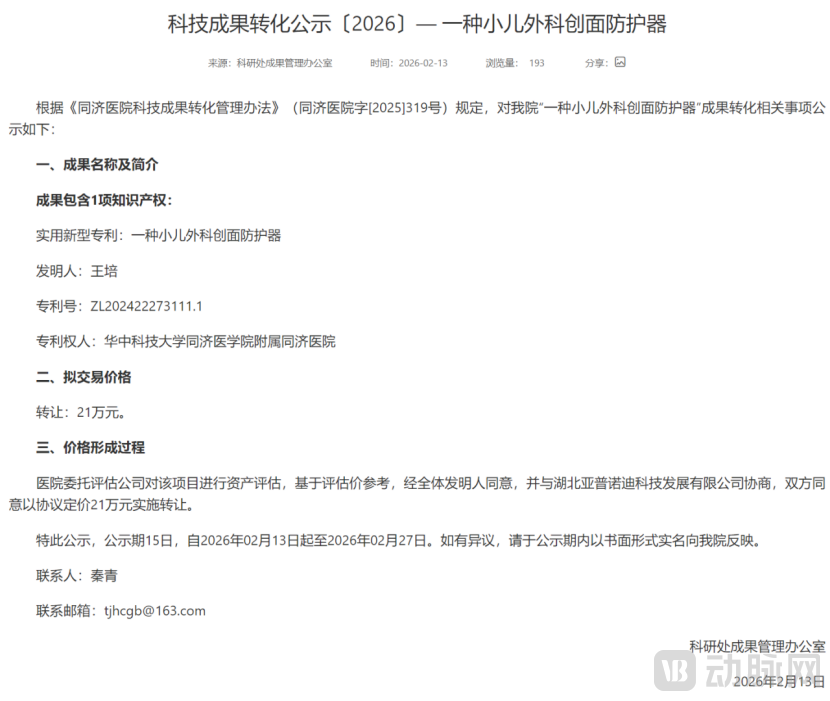
Image source: Official website of Tongji Hospital, Tongji Medical College, Huazhong University of Science and Technology
“A Pediatric Surgical Wound Protector” is a utility model patent designed for postoperative wounds in children, serving to isolate, protect, and care for the wound site to reduce risks such as infection, scratching, collision, and water exposure, thereby promoting healing. Its typical design includes a protective body, fixation straps, and a breathable, waterproof structure; some variants also integrate antibacterial properties, adjustability, or multi-position adaptability to accommodate pediatric patients of different body sites and sizes, ensuring both safety and convenience for clinical and home care.
Pediatric surgery is a clinical discipline primarily focused on pediatric conditions requiring surgical intervention. It is generally subdivided into specialized departments, including neonatal surgery, pediatric general surgery, pediatric cardiothoracic surgery, pediatric urology, pediatric neurosurgery, pediatric otolaryngology–head and neck surgery, and pediatric orthopedics. In clinical practice, wound dressing and protection are routinely performed for injured sites. Currently, the traditional techniques employed for wound protection in pediatric surgery suffer from significant limitations and application defects due to constraints in material properties and design concepts, failing to meet the clinical demands for specialized and refined protective care.
The mainstream clinical approach to wound protection involves dressing wounds with gauze bandages combined with topical medications. However, gauze itself is a flexible textile material that is relatively soft and lacks rigid structural support, thereby failing to provide basic physical protection against impact or friction.Inability to form an effective external barrier for the wound, making it difficult to resist damage from external contact.
Meanwhile, children are naturally more active and have a weak sense of self-protection,The dressed wound is highly susceptible to bumps and contact during daily activities, and continuous friction between the dressing and clothing is also difficult to avoid., which can lead to secondary injury of the wound, not only exacerbating the child's suffering but also directly disrupting the wound healing environment, significantly reducing the efficiency of wound recovery, and affecting clinical treatment outcomes.
Furthermore, traditional dressing methods can only secure topically applied medications and provide basic dust protection for the wound.Lack of specialized protective structural designs tailored to children’s physiological characteristics and activity patterns,It cannot be adaptively adjusted according to the child's body parts and wound size, making it difficult to provide specialized and tailored protective coverage for pediatric surgical wounds.
The utility model patent for the pediatric surgical wound protector, currently undergoing commercialization, offers multiple advantages and innovations in both technical design and clinical application, precisely addressing the core pain points of traditional products.
First,Innovative Structural Design, this protective device is based on gauze and features a double-layer protective structure formed by four sponge filler blocks and two acrylic protective plates. The protective plates are slidably connected to the filler blocks, allowing flexible adjustment of the protective spacing through screws and an adjustment tube with reverse threads. It can be adapted for wound protection on various parts such as the lower leg, upper arm, and forearm in children, demonstrating strong adaptability.
Secondly,Upgraded Protective Performance, the protective plate is made of acrylic material, forming a rigid protective layer over the wound. During physical activity, any impact force on children will first act on the protective plate, preventing direct contact between the wound and the impact. Meanwhile, sponge filler blocks provide cushioning between the protective plate and the skin, reducing discomfort caused by hard contact. Additionally, the protective structure creates an open space between the gauze and the external environment, minimizing direct friction between clothing and the gauze.
Third,Practical Design Detail OptimizationThe protective plate is equipped with ventilation holes to ensure air circulation at the wound site, thereby enhancing breathability; the filler block is connected via a magnetic attachment structure involving an iron box and magnets, enabling rapid replacement and reducing the risk of cross-infection; a telescopic cover is installed at the screw rod to prevent gauze from adhering to or snagging on the threads; the adjustment tube is paired with a silicone block featuring internal grooves, facilitating more convenient spacing adjustments during clinical procedures.
Fourth,Convenient for Clinical Use, the protector can be directly assembled after gauze dressing of the wound, and its assembly does not affect the child's clothing, aligning with actual clinical usage scenarios.
As key adjunct devices for postoperative nursing in pediatric clinical practice, wound and limb protection devices for pediatric surgery have seen sustained growth in market demand and R&D attention alongside the refined upgrading of pediatric medical services. Industry enterprises and research institutions are actively carrying out technological development and patent layout focusing on children’s physiological developmental characteristics, limb mobility features, and the practical needs of wound protection. Currently, granted patents for similar technologies in this field mainly revolve aroundAdaptability of limb joint movement, protective fixation effect on wound sites, and skin-conforming comfort for childrenDesign innovation centered on three core directions has resulted inJoint-Linked Limb Protection and Site-Specific Localized Immobilization ProtectionCompetitive Landscape of Two Mainstream Technical Approaches. No composite wound protection design featuring a gauze base, combined with rigid protective plates and an adjustable filling cushioning structure, consistent with this patent, has yet emerged.
“Utility Model Patent for a Postoperative Wound Protector in Pediatric Surgery”, with the announcement number CN215503609U, consists of components such as an upper arm sleeve, a rotating rod, a central rod, a connecting rod, a sliding rod, and a frustum-shaped forearm sleeve. Silicone rings are provided on the inner walls at both ends of the upper arm sleeve and the forearm sleeve to fit against the skin and enhance wearing comfort. Meanwhile, a snap-fit structure composed of a clip frame, springs, latch tongues, and locking strips enables convenient fixation of the device. The various rods of the device are hinged together via hinge seats, and the sliding rod slides within the chute of the forearm sleeve. When a child’s arm rotates, the upper arm sleeve and forearm sleeve can move flexibly along with the joints; this design neither restricts the child’s limb movements nor fails to prevent the upper arm sleeve from slipping down, thanks to the limiting action of the elbow. Furthermore, the frustum-shaped forearm sleeve can gently clamp onto the injured area of the forearm, avoiding excessive clamping pressure that could impair blood circulation and lead to wound infection.
Utility Model Patent for “A 3D-Printed Orthosis for Pediatric Rehabilitation” Applied by Lanhe Technology Group Co., Ltd., with the announcement number CN223696121U, is a limb rehabilitation and protective device specifically designed for children, primarily addressing the needs for rehabilitation fixation and protection of the ankle and lower leg. The core components of this brace are manufactured using an integrated 3D printing process, which conforms to the physiological characteristics of children’s limbs. It ensures comfortable wear without compromising blood circulation due to excessive tightness, making it friendly to children in their developmental stages. It is mainly used for post-injury rehabilitation fixation and basic protection of the ankle and lower leg in children.