

Tiangong University to Transfer Innovative MIT-Based Intracerebral Hemorrhage Detection Patent for RMB 600,000
Recently, Tiangong University released a public notice on the commercialization of scientific and technological achievements, proposing to transfer its independently developed invention patents.“Method, Apparatus, Device, Medium, and Product for Detecting MIT Regions in Cerebral Hemorrhage”Transfer to Beijing Ruiguang Tongda Technology Co., Ltd., proposed transaction priceRMB 600,000。
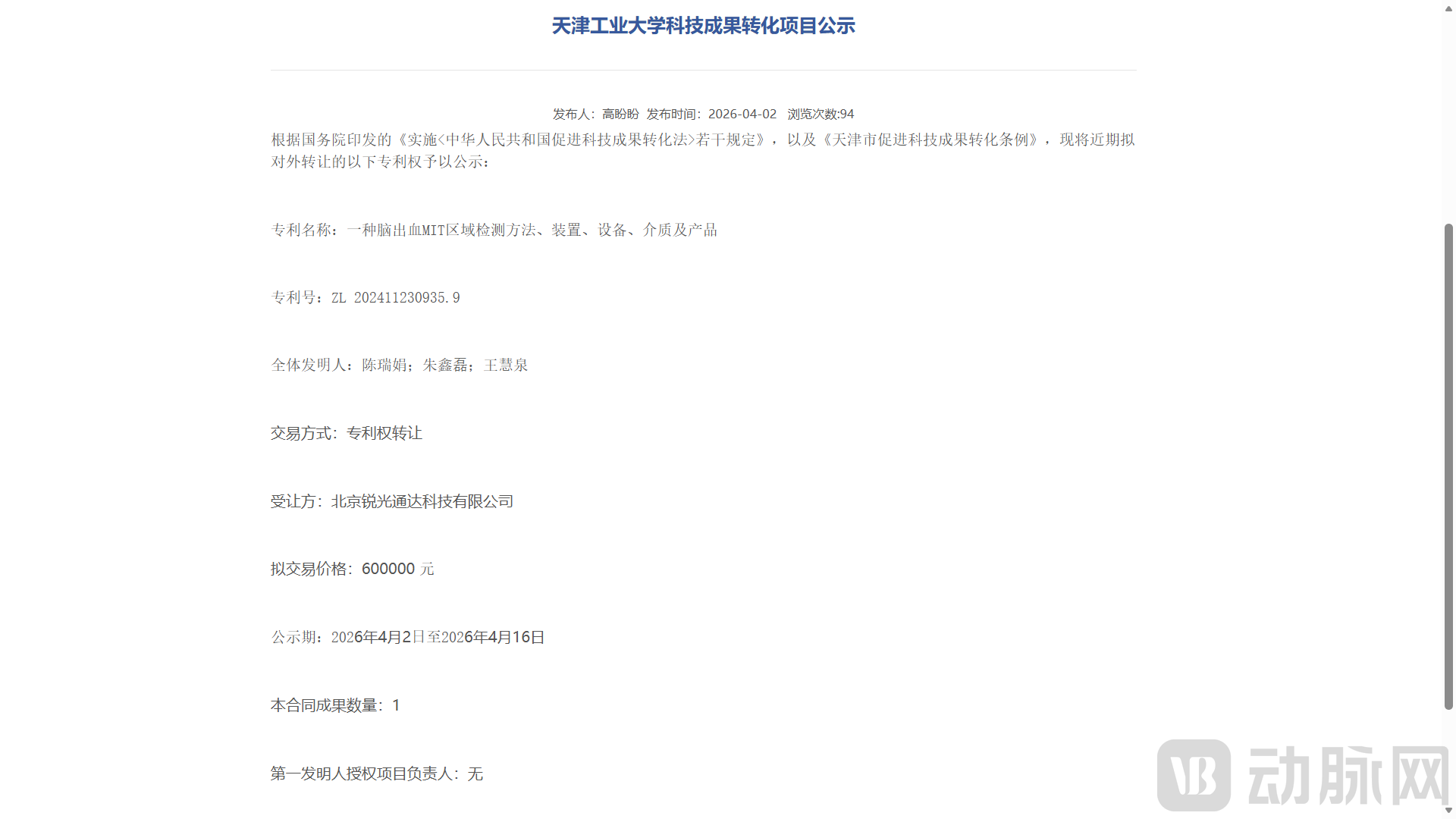
Image from the official website of Tiangong University
This patent focuses onField of Magnetic Induction Tomography (MIT) Detection for Intracerebral Hemorrhage, InnovativenessA Technical Solution Combining Brain Region-Specific Coil Array Adaptation, Stacked Autoencoder Model Training, and Lesion Localization for Optimal Detection Region Selection, overcoming the bottlenecks of traditional Magnetic Induction Tomography (MIT) imaging, such as limited information content, weak noise immunity, and insufficient reconstruction accuracy. It enables precise conductivity imaging and image reconstruction of cerebral hemorrhage regions under low-coil configurations and noisy environments. Combining clinical advantages including being radiation-free, low-cost, and suitable for real-time bedside monitoring, it represents a novel medical imaging technology achievement aimed at rapid diagnosis and postoperative monitoring of cerebral hemorrhage.
Intracerebral Hemorrhageis a category of critical central nervous system diseases characterized by abrupt onset, rapid progression, and persistently high rates of mortality and disability, imposing extremely stringent requirements on the therapeutic window for patient treatment.Can precise lesion localization, extent assessment, and continuous status monitoring be achieved within a short period of time?, directly determining the success rate of clinical treatment and the quality of subsequent rehabilitation.
In the current clinical diagnosis and treatment system, the detection and diagnosis of intracerebral hemorrhage mainly rely onTraditional imaging technologies such as computed tomography (CT) and magnetic resonance imaging (MRI), such methods provide clear imaging and high diagnostic accuracy, serving as the core approach for confirming cerebral hemorrhage; however, they have significant limitations in practical application.
Computed tomography (CT) involves ionizing radiation, making it unsuitable for repeated examinations within short time intervals. Both CT and magnetic resonance imaging (MRI) systems are bulky, fixed-installation devices that cannot be moved, thereby hindering bedside testing. Furthermore, their high acquisition and operational costs fail to meet the needs for continuous, dynamic, and long-term patient monitoring in pre-hospital settings, emergency departments, and intensive care units (ICUs). Magnetic Induction Tomography (MIT), also known as electromagnetic tomography, is a novel biomedical imaging technique that is non-contact, radiation-free, and capable of real-time imaging. By using an external excitation magnetic field to induce eddy currents within biological tissues, measuring the resulting induced electromagnetic signals, and reconstructing conductivity distribution, MIT offers unique advantages including low cost, portability, and the ability to provide real-time bedside monitoring. It is therefore highly suitable as a complementary tool for preliminary screening of intracerebral hemorrhage before surgery, intraoperative localization assistance, and long-term dynamic postoperative monitoring.
However,Existing MIT technology faces significant bottlenecks in brain imaging applications:Constrained by limited clinical deployment space and the demand for device portability, the system supports only a limited number of configurable coils, resulting in insufficient effective imaging information acquisition. Meanwhile, signals in practical detection scenarios are susceptible to environmental electromagnetic noise interference, which exacerbates the difficulty of solving the inverse problem. This leads to poor reconstruction quality of brain conductivity distribution images, characterized by blurred edges, significant deviation in lesion localization, and weak noise immunity. Consequently, it is challenging to consistently produce clear imaging results that meet clinical diagnostic requirements, hindering the practical implementation of the system for precise detection and continuous monitoring of cerebral hemorrhage lesions.
In the face of clinical demands for rapid screening, bedside monitoring, long-term tracking, and low-consumption, safe full-process monitoring of intracerebral hemorrhage, existing technological systems exhibit significant gaps.There is an urgent need for innovative MIT detection solutions that can overcome the limitations of limited imaging information, weak anti-interference capability, and insufficient reconstruction accuracy., providing safer, more efficient, and sustainable imaging support for the clinical diagnosis and treatment of intracerebral hemorrhage.
“A Method, Apparatus, Device, Medium, and Product for MIT Regional Detection of Cerebral Hemorrhage”“Focusing on detection mechanisms, algorithmic models, and system architectureBreakthrough innovations in three core areas have resulted in a solution that combinesHigh Precision, High Noise Immunity, and High Practicalitydedicated MIT detection protocol for cerebral hemorrhage, comprehensively addressing the shortcomings of existing technologies.
This technologyFirst-time division of brain imaging regions into multiple standardized detection zones by angle, design dedicated coil arrays tailored to different regions. First, rapidly localize the lesion using CT, MRI, or other modalities; then intelligently select the optimal coil configuration that ensures the lesion remains stably within the “-45° to 45° high-sensitivity detection zone” on the detection side. This approach enhances lesion characteristics and suppresses background interference at the signal acquisition source, thereby maximizing the detection efficacy of a limited number of coils.
At the algorithmic level, patentsAdopting Stacked Autoencoder (SAE) Deep Learning Network, dedicated MIT prediction models are trained separately using magnetic field and conductivity sample sets corresponding to different partitions, enabling end-to-end precise prediction from phase information to conductivity distribution. This approach significantly simplifies the difficulty of solving the inverse problem, while enhancing image reconstruction speed and fidelity. In terms of hardware, the system integrates a signal generator, excitation coil, detection coil array, lock-in amplifier, and host computer into a unified unit. The excitation and detection coils are arranged symmetrically at 180° and support angular rotation, featuring a compact structure and convenient deployment, allowing rapid adaptation to bedside detection scenarios.
Compared with traditional MIT technology, this solution can still achieveHigh-quality imaging with clear lesion margins, precise localization, and intact morphology, significantly enhancing anti-interference capability and reconstruction accuracy; meanwhile, it fully preserves the core advantages of MIT—radiation-free, low-cost, and capable of continuous real-time monitoring. It does not rely on fixed imaging suites, is portable, and allows for repeated examinations, perfectly filling the gap left by CT and MRI in long-term bedside monitoring.
Overall, this patent establishes comprehensive protection spanning methods, devices, equipment, storage media, and program products. With a mature technological closed loop, it directly supports product development and can be employed for rapid pre-hospital preliminary screening, preoperative localization in emergency settings, and dynamic postoperative monitoring in critical care. This significantly enhances the safety, convenience, and cost-effectiveness throughout the entire diagnosis and treatment process of cerebral hemorrhage, representing a key innovative achievement in translating magnetic induction tomography technology from the laboratory to clinical application in the field of cerebral hemorrhage.
The current domestic market for intracerebral hemorrhage detection and monitoring presentsGold Standard Leads, Non-Invasive Monitoring Rises Rapidlylandscape.Large-scale imaging equipment such as CT and MRIIt remains the core basis for clinical diagnosis, but its application is limited by immobility, radiation exposure, and the inability to provide continuous monitoring, making it difficult to cover key scenarios such as emergency bedside care, postoperative monitoring, and pre-hospital emergency rescue.Non-invasive functional imaging technologies represented by Magnetic Induction Tomography (MIT) and Electrical Impedance Tomography (EIT)Rapidly emerging, related products are gradually entering hospital departments such as emergency care, neurocritical care, and stroke centers, with market demand continuing to expand. Currently, the number of MIT-based intracerebral hemorrhage detection products worldwide is limited, and the industry is overall in a transitional phase from technical validation to large-scale clinical adoption. No absolute monopoly has yet formed, creating significant breakthrough opportunities for technological solutions with core algorithmic and imaging advantages.
The United Imaging uCT 520 is a 40-slice spiral CT product designed for mainstream clinical scenarios., leveraging United Imaging’s self-developed image reconstruction and low-dose imaging technologies, it optimizes scanning workflows and equipment usability while ensuring image clarity and diagnostic reliability. It supports practical features such as intelligent patient positioning, intelligent scan planning, and multi-planar reconstruction, enabling efficient completion of routine and emergency examinations of the head, chest, abdomen, and skeleton. The overall design aligns with the daily diagnostic needs of healthcare institutions, offering stable operation, convenient maintenance, and strong clinical adaptability.
In terms of market applications,The uCT 520 has been widely deployed in medical institutions at all levels across China., particularly achieving large-scale adoption in secondary hospitals, primary care facilities, specialty outpatient clinics, and health examination centers. With its balanced performance configuration, reasonable deployment costs, and comprehensive after-sales service system, it has become the mainstream choice for upgrading medical imaging equipment and conducting emergency examinations at the primary care level. It plays a critical role in initial screening and definitive diagnosis in scenarios such as stroke, cerebral hemorrhage, and traumatic emergencies, maintaining consistently high levels of market recognition and penetration.
GE Signa Explorer 1.5T MRIIt is a mainstream 1.5T magnetic resonance imaging (MRI) system launched by GE HealthCare., leveraging a mature magnetic resonance platform and intelligent imaging technology, it achieves an optimal balance among image quality, scanning efficiency, and patient comfort. With stable imaging performance and a comprehensive suite of clinical application sequences, it fully supports routine diagnosis and precise examination of multiple anatomical regions, including the central nervous system, abdomen, bones and joints, and soft tissues, thereby meeting diverse clinical needs such as daily hospital diagnostics and differential diagnosis of complex cases.
This MRI model is widely used in medical institutions at all levels, both domestically and internationally. Owing to its reliable performance, mature technological framework, and comprehensive after-sales support, it has become a standard magnetic resonance imaging (MRI) configuration for secondary-and-above hospitals, general hospitals, and specialized medical facilities. It plays a pivotal role in the precise diagnosis of conditions such as cerebral hemorrhage, cerebral infarction, tumors, and inflammatory diseases. With extensive long-term clinical validation, it demonstrates a high level of application maturity and broad market coverage, earning strong industry reputation and clinical recognition.
This patentA Method, Apparatus, Device, Medium, and Product for Detecting MIT Regions in Cerebral HemorrhagePrecisely aligned with critical clinical needs and the direction of technological advancement, this technology boasts broad prospects for market translation and implementation. By optimizing brain region-specific coils, localizing lesion-sensitive areas, and employing stacked autoencoder models for image reconstruction, it effectively addresses key pain points of traditional Magnetic Induction Tomography (MIT), such as insufficient imaging accuracy, weak noise immunity, and limited coil configuration flexibility. While maintaining the advantages of being radiation-free, low-cost, and suitable for real-time bedside monitoring, it significantly enhances image reconstruction quality and stability. This enables seamless integration with CT and MRI to provide comprehensive support across the entire clinical workflow: preoperative initial screening, intraoperative localization, and long-term continuous postoperative monitoring.
Leveraging the implementation of this patent transfer, the technology can be rapidly integrated into product development to deliver standardized equipment solutions for tertiary and secondary hospitals, stroke centers, primary healthcare institutions, and emergency medical systems. This innovation fills the domestic market gap for high-precision microwave imaging tomography (MIT) bedside monitoring of intracerebral hemorrhage, demonstrating significant potential to become a mainstream technology in the field of non-invasive ICH monitoring, with outstanding commercial and clinical value.