

Jilin University to Transfer Real-Time Angiographic FFR Calculation Technology for RMB 100,000
Recently, Jilin University released a public notice on the conversion of scientific and technological achievements, proposing to transfer them through negotiated pricing.“Method and System for Calculating Fractional Flow Reserve Based on Real-Time Vascular Imaging”Relevant patents have been assigned to Alpha Medical Technology (Jilin) Co., Ltd., with the assignment amount being100,000 yuan. The inventors of this patent areLiu Bin and His Team。
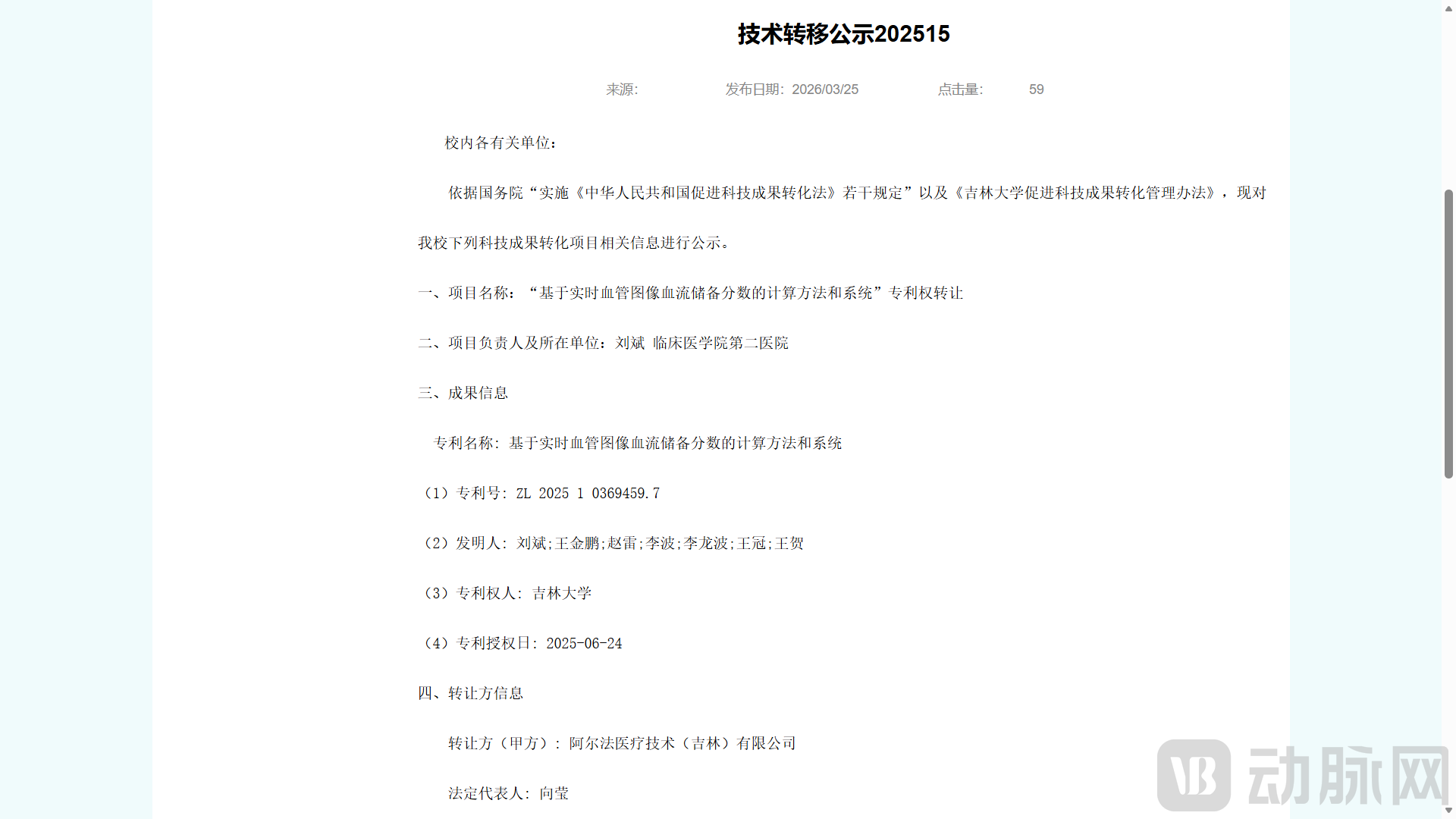
Image from the official website of Jilin University
This invention, developed by Jilin University, eliminates the need for traditional invasive guidewires during coronary stent implantation. By leveraging preoperative and intraoperative vascular imaging, it calculates fractional flow reserve (FFR) in real time to guide physicians in stent selection, positioning, and efficacy assessment. Its core function is to assist physicians in making real-time predictions and conducting precise evaluations of procedural outcomes during stent implantation.
Fractional Flow Reserve (FFR)It is a core functional indicator for assessing myocardial ischemia, guiding stent implantation, and evaluating therapeutic efficacy during percutaneous coronary intervention (PCI). With the growing demand for precision and minimally invasive approaches in the interventional diagnosis and treatment of coronary artery disease, there is an increasingly urgent clinical need for real-time, non-invasive, and accurate fractional flow reserve (FFR) assessment during procedures. However, current FFR calculation and application technologies suffer from significant limitations that severely constrain surgical decision-making efficiency, procedural safety, and patient prognosis, failing to meet the critical clinical demand for efficient and intelligent interventional solutions.
Inherent Clinical Limitations of Traditional FFR Assessment Techniques:On one hand, pressure wire measurement is an invasive procedure that requires the additional insertion of a guidewire, thereby increasing procedural complexity, patient radiation exposure, and the risk of vascular injury. It is time-consuming with a cumbersome workflow, and may not be applicable to certain complex lesions. On the other hand, existing image-based FFR calculation solutions lack real-time capability; they can only perform offline calculations based on preoperative static images and cannot dynamically update according to intraoperative stent position and expansion status. This results in significant lag in assessment outcomes, failing to support immediate intraoperative decision-making.
From the perspective of surgical practice scenarios, existing technologies suffer from critical decision-making shortcomings.Prior to stent implantation, physicians cannot predict in advance, based on real-time positioning, whether the selected stent model and implantation site will effectively improve ischemia. Stent selection and landing zone determination rely on empirical judgment, which can lead to issues such as inappropriate stent sizing and incomplete coverage. During and after stent expansion, there is no real-time monitoring of vascular lumen area and actual fractional flow reserve (FFR) changes, making it difficult to immediately evaluate procedural efficacy and respond promptly to adverse events such as under-expansion or malapposition. Furthermore, for complex lesions such as vascular plaques, existing solutions do not incorporate precise modeling based on parameters including plaque dimensions, elasticity, and balloon pressure, resulting in significant deviations in lumen area and FFR calculations, which further reduces the reliability of clinical decision-making.
Furthermore, current technologies fail to achieve efficient fusion of preoperative and intraoperative imaging. Preoperative angiography/intravascular imaging cannot be precisely registered with intraoperative real-time angiography, and stent contours cannot be intuitively synchronized on preoperative images. Consequently, the assessment of lesion coverage relies on the physician’s visual inspection. Moreover, the lack of an integrated visualization interface results in the separate presentation of FFR values, trend curves, and imaging data. Physicians are forced to switch between multiple interfaces for decision-making, which further reduces procedural efficiency. These issues collectively trap coronary intervention FFR assessment in a dilemma characterized by “invasive procedures carrying risks, non-invasive methods lacking real-time capability, decision-making without sufficient basis, and low operational efficiency,” creating an urgent clinical need forAn Integrated FFR Calculation Solution for Real-Time Intraoperative Computation, Dual-Image Fusion, Precise Prediction, and True Assessment, addressing pain points in decision-making throughout the entire stent implantation procedure.
FFR Assessment in Coronary Intervention Procedures"High invasive risk, insufficient real-time capability, and experience-dependent decision-making"Addressing critical industry pain points, Jilin University has innovatively developed a method and system for calculating fractional flow reserve (FFR) based on real-time vascular imaging. Centered on the core breakthrough of “preoperative-intraoperative image registration + dual-mode virtual/real FFR calculation,” this technology creates an intelligent, end-to-end solution spanning stent prediction, intraoperative localization, and efficacy verification, thereby comprehensively revolutionizing the assessment logic and operational efficiency of coronary intervention diagnosis and treatment.
This technologyPioneering Fully Non-Invasive FFR Assessment, eliminating reliance on invasive measurements with traditional pressure wires and enabling precise calculations solely through vascular imaging. This approach fundamentally mitigates safety risks associated with wire manipulation, such as vascular injury, dissection, and thrombosis, while simultaneously reducing patient radiation exposure and contrast agent usage. It requires no additional interventional procedures intraoperatively and does not prolong the surgical workflow. While enhancing procedural safety, it significantly alleviates patients’ physiological burden and discomfort. The technology is adaptable to various percutaneous coronary intervention (PCI) scenarios, including complex lesions, elderly patients, and high-risk cases, thereby further expanding the clinical applicability of fractional flow reserve (FFR).
This technologyBreaks through the bottleneck of traditional imaging-based FFR, which is limited to preoperative offline calculation and delayed results, enabling real-time dynamic intraoperative FFR updates.Before stent deployment, virtual FFR can be rapidly calculated based on the ideal stent expansion area and intraoperative real-time positioning to pre-validate the appropriateness of stent sizing and implantation location. During balloon inflation, the system automatically identifies stent expansion dimensions, updates luminal area in real time, and calculates actual FFR, thereby providing immediate feedback on procedural efficacy. This enables operators to promptly detect and address issues such as underexpansion and malapposition, effectively avoiding post-procedural reinterventions.
In terms of accuracy assessment, technical support covers two types of preoperative imaging: angiographic images and intravascular imaging sequences.It achieves precise coordinate registration with intraoperative real-time angiography, automatically overlaying the stent contour onto preoperative images to clearly assess whether the stent fully covers the lesion area. For complex vessels with plaque, this technology innovatively employs a lumen area correction formula that integrates plaque curvature, thickness, elastic modulus, and balloon inflation pressure. This approach significantly reduces deviations caused by idealized estimations, making FFR calculation results more consistent with actual human physiological conditions. Additionally, it can generate longitudinal cross-sectional images from intravascular imaging, intuitively displaying the vessel wall and lesion distribution, thereby further enhancing the accuracy of stent positioning and lesion coverage assessment.
The system is equipped with an integrated four-component graphical user interface., enabling simultaneous switching between virtual FFR and real FFR modes, preoperative image display, intraoperative real-time image display, and FFR trend curve visualization. This allows operators to synchronously monitor image localization, numerical results, and functional changes without switching between multiple screens, significantly reducing the learning curve for clinical procedures.
This system requires no modification to existing hospital angiography or intravascular imaging equipment, enabling direct compatibility and integration with a low deployment threshold. By leveraging standardized FFR calculation formulas and parametric assessment of lumen area, it eliminates reliance on manual experience, ensuring stable and reproducible detection results. It facilitates precise stent selection and positioning via virtual FFR, reducing intraoperative trial-and-error and adjustments. Post-dilation, actual FFR measurements provide rapid validation of procedural outcomes. This approach not only comprehensively optimizes procedural efficiency while safeguarding safety and treatment quality but also simplifies operational workflows and reduces healthcare costs. As a key upgrade technology for precision interventional diagnosis and treatment of coronary artery disease, it holds significant clinical translation value and broad prospects for promotion and application.
The field of image-based fractional flow reserve (FFR) calculation has currently formedPreoperative CT-FFR Screening + Intraoperative Angiography/Intravascular Imaging-Based FFR AssessmentDual-track competitive landscape, with global leading enterprises and domestic innovative companies having achieved product approvals and clinical implementation, while technological routes revolve aroundCT, Coronary Angiography, OCT/IVUSDivergence of the Three Major Imaging Sources, inReal-time Performance, Intraoperative Adaptability, Stent Planning Capabilitysignificant differences are evident above, with the industry as a whole entering the stage of clinical validation and commercial scale-up.
MicroVision Medical OCT-FFR: Calculating FFR Based on High-Resolution Intravascular OCT Imaging, prospective multicenter studies presented at the 2025 ESC Annual Congress demonstrated a diagnostic accuracy of 98.0%. By leveraging high-resolution structural information from optical coherence tomography (OCT), it enhances the precision of complex lesion assessment, focuses on the integration of intravascular imaging and functional diagnostics, and is primarily used for precise intraoperative evaluation.
Pulse Medical’s QFR (Quantitative Flow Ratio) is a representative product for intraoperative FFR calculation based on coronary angiography., has obtained NMPA and CE certifications and is included in international guidelines. It enables rapid intraoperative FFR calculation without the need for a guidewire, guiding stent implantation and post-procedural assessment. It supports rapid analysis of angiography from multiple projections, is backed by robust clinical validation, and leads in commercialization progress, primarily focusing on FFR calculation for entire vascular segments.
Medtronic CathWorks FFRangio System Calculates FFR Based on Routine Coronary Angiography Images, without the need for pressure wires or hyperemic agents, it enables rapid intraoperative offline FFR analysis to assist operators in assessing the degree of lesion ischemia. Officially launched in China in 2025 and introduced into catheterization laboratories, it supports intraoperative angiographic image analysis, primarily based on static offline computation.