

Yidu Tech Achieves First-Ever Profit with Over RMB 55 Million Net Income: AI Healthcare Crosses Commercialization Threshold
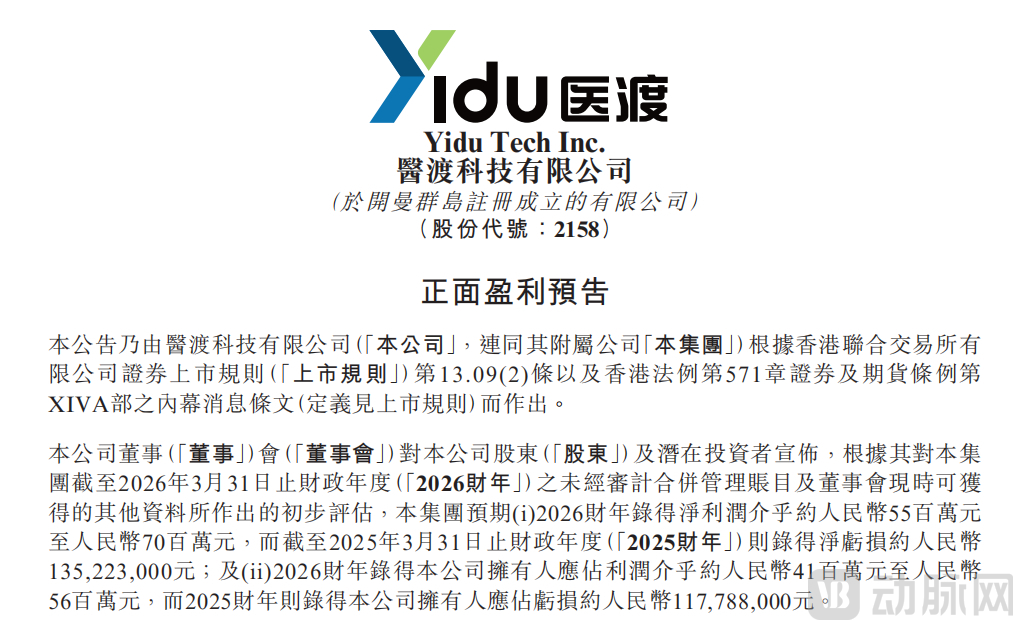
April 20,Yidu Tech (02158.HK) Issues Positive Profit Alert, Forecasting Net Profit of Approximately RMB 55 Million to RMB 70 Million for Fiscal Year 2026 (Ended March 31, 2026).This marks the company’s first full-year profit since its establishment 11 years ago, representing a pivotal transition from persistent losses to stable profitability, compared with a net loss of RMB 135 million in the previous fiscal year.
This is not merely a financial turnaround for a single enterprise; it signifies that China’s AI healthcare sector is crossing the critical threshold from technological validation to commercial realization. Vertical medical AI is beginning to emerge from the prolonged cycle of “high investment and slow returns,” entering a new phase capable of self-sustaining growth.
1Why Yidu? The Data Moat of YiduCore
Before breaking down the profitability, we need to answer one question: Why was Yidu Tech the first to successfully establish a closed-loop business model?
The answer lies in its strategic path selection. Over the past 11 years, Yidu Tech has not focused on developing a single software product, model, or isolated project. Instead, it has consistently invested in a more fundamental endeavor: transforming dormant real-world medical data into credible evidence capable of informing clinical practice, scientific research, management, and insurance decision-making. Only when evidence begins to drive decision-making does the healthcare system truly establish the foundation for intelligent upgrading.
Specifically, Yidu Tech has independently developed YiduCore, an intelligent healthcare infrastructure. As of the end of September 2025, YiduCore had cumulatively processed nearly 7 billion medical records, covering over 1.3 billion patient visits, with its disease knowledge graph encompassing virtually all known diseases. The company’s service network extends to more than 10,000 medical institutions, and 17 of the top 20 multinational pharmaceutical companies are its clients.
Behind these figures lies a “data–algorithm–scenario” flywheel honed over more than a decade. The governance and compliance of medical data constitute the most time-consuming and costly link in the entire AI healthcare value chain. For competitors starting from scratch, catching up to this level of depth would entail financial and time costs that are difficult to imagine.
However, the true barrier of YiduCore lies not only in its data scale, but also in its“Evidence-Based and Traceable” Data Governance Standards. While general-purpose large language models can easily access publicly available medical literature, they cannot tap into hospitals’ internal longitudinal data covering the entire patient journey—diagnosis, treatment, follow-up, and outcomes—which constitute the gold standard for clinical decision-making. Through years of in-depth collaboration with top-tier hospitals, Yidu Tech has built a data moat that competitors cannot quickly replicate simply by “burning cash.”
It is precisely this moat that has given Yidu Tech the confidence to convert its model capabilities into hospitals’ willingness to pay as the wave of AI commercialization arrives.
2Where Profits Come From: The Triple Resonance of Orders, Products, and Efficiency
Yidu Tech’s profitability this time is not the result of a single breakthrough, but rather the outcome of three concurrent factors: order growth, product upgrades, and improved operational efficiency.
In March 2026, Yidu Tech released the clinical evidence-based intelligent agent “Yidu Zhixun”. This platform integrates real-world data with AI reasoning capabilities, connecting to top global journals such as NEJM, The Lancet, and JAMA, to build an evidence-based medicine system covering more than 30,000 authoritative guidelines and 5 million high-quality publications. Its core value lies in ensuring that “every statement is evidence-based, every conclusion is traceable, and every diagnosis and treatment is explainable,” thereby suppressing large language model hallucinations at the source.
Productization and implementation mark the key starting point for realizing profitability in this cycle.If the past 11 years saw Yidu Tech primarily building intelligent infrastructure in the back end of the healthcare system, then the launch of “Yidu Zhixun” signifies that these capabilities are now moving to the front line of physicians’ daily decision-making.
During the internal beta phase, it attracted over 6,000 healthcare professionals. The evidence-based engine has been deployed in more than 40 Grade A tertiary hospitals, deeply participating in over 500,000 clinical decision-making processes. At the Sun Yat-sen University Cancer Center, the Clinical Copilot is invoked nearly 1,000 times per day, covering approximately 70% of medical staff.
Furthermore, product iteration has not ceased: following the launch of the physician version, Yidu Tech will unveil new offerings, including the “Yidu Zhixun” Hospital Version and “Yidu Zhiguan,” at the CHIMA conference on April 24. The continuous enrichment of its product portfolio will further expand the boundaries of commercialization.
Once a product’s value is clinically validated, order growth follows naturally.The Company’s Big Data Platform and Solutions (BDPS) business saw its order backlog exceed RMB 400 million, with new orders in the first half of fiscal year 2026 increasing by 19% year-on-year, a growth rate far surpassing historical levels.
On the Eve of a Profit Warning, Yidu Cloud Successively Wins Bids for Beijing Cancer Hospital’s AI Project (Approximately RMB 4.88 Million) and Hainan Province’s Public Health Emergency Platform Project (Nearly RMB 12.89 Million), Corresponding to To-B and To-G Scenarios Respectively. Hospitals and government departments now regard AI capabilities as infrastructure-level necessities—clear evidence that such products are shifting from “optional” to “essential.” In terms of business model, Yidu Zhixun adopts a hybrid “B-end + C-end/B2B2C” approach, with hospital procurement, pharmaceutical companies’ academic promotion, and future token-based billing unlocking high-margin incremental growth opportunities.
Following the surge in order volume, a qualitative leap in operational efficiency became the “final push” toward profitability.For a long time, medical AI companies have been trapped by high levels of project customization and the difficulty of spreading out delivery costs. Yidu Tech has achieved a continuous increase in the proportion of high-gross-margin products by enhancing standardization capabilities and improving the reuse rate of AI modules.
In the first half of fiscal year 2026, the company’s total revenue reached RMB 358 million, representing an 8.7% year-on-year increase; adjusted EBITDA amounted to RMB 54 million, doubling year-on-year; and the net loss narrowed by 72% year-on-year, bringing the company nearly to break-even—a milestone achieved one year ahead of management’s expectations. As of the end of September 2025, the company’s cash reserves stood at nearly RMB 3.7 billion. Products, orders, and operational efficiency are closely interlinked, collectively forming the complete picture of profitability.
3Policy Dividends and Capital Revaluation: The “Pricing Anchor” for AI Healthcare Is Taking Shape
Understanding the business prospects of Yidu Tech cannot be divorced from the broader context of China’s healthcare payment reforms.
2025 marks the final year of the three-year action plan for DRG/DIP payment method reform, with nearly all pooling regions across China having achieved full coverage of payment reform. The principle of “same disease, same price” is compelling hospitals to control costs and improve efficiency, creating an urgent demand for AI tools that can assist in clinical decision-making and optimize treatment pathways.
Against this backdrop, Yidu Tech’s Clinical Copilot and Yidu Zhixun can provide evidence-based treatment recommendations and cost estimates, helping physicians make optimal decisions under DRG/DIP constraints. These solutions are not merely efficiency tools; they are becoming critical infrastructure for hospitals to achieve quality improvement, cost control, and refined management in the era of payment reform.
Policy support continues to strengthen: The 2026 Government Work Report explicitly promotes the large-scale commercial application of “AI+,” while the National Healthcare Security Administration emphasizes innovative exploration of AI application scenarios, encouraging local pilot programs and their nationwide rollout across China.
Profitability has fundamentally reshaped the capital market’s valuation logic for Yidu Tech.
Previously, due to sustained losses, the company primarily relied on PS (Price-to-Sales) ratio for pricing, resulting in significant valuation volatility. With the inflection point to profitability now established, the market is expected to gradually shift toward PE (Price-to-Earnings) valuation. Referencing profitable AI healthcare companies listed in Hong Kong, such as Health 160, Ali Health, and Ping An Good Doctor, the current median PE ratio for profitable entities in this sector ranges from approximately 30x to 45x.
Citibank recently released a research report, reaffirming its “Buy” rating on Yidu Tech with a target price of HK$11. Using the sum-of-the-parts valuation method, the big data platform, life sciences, health management, and net cash contribute HK$2.8, HK$2.0, HK$2.7, and HK$3.4 per share, respectively, providing a sufficient margin of safety. Citibank expects that starting from fiscal year 2027, the company’s revenue growth will accelerate further, and its earnings per share (EPS) will enter a phase of rapid growth.
More noteworthy is the signal of confidence from the company itself. Since 2026, Yidu Tech has conducted 34 share buybacks, totaling nearly HK$240 million, ranking first in buyback intensity among AI healthcare companies listed on the Hong Kong Stock Exchange. This substantial financial commitment clearly signals that the company enjoys robust cash flow and that its current stock price is significantly below its intrinsic value.
Policy Opens Up Demand Space, Profitability Reshapes Valuation Framework, Buybacks Signal Bottom Confidence—The Convergence of These Three Forces Places Yidu Tech at the Starting Point of Value Reassessment.
4Profitability Is the Starting Point; The Realization Phase Has Just Begun
Yidu Tech’s First Profit: A Landmark Milestone in the AI Healthcare Sector. Yet more noteworthy than the profit figures themselves is the critical validation achieved behind the scenes—the commercial closed loop of medical AI is no longer confined to theoretical deduction but has begun to demonstrate real-world feasibility.
Since 2026, the focal point of industry competition has been shifting: from “model capabilities” to “scenario integration,” and from “answering questions” to “participating in decision-making and execution.” Isolated technological advantages no longer constitute long-term barriers; what truly determines the competitive landscape is whether a company can establish a stable closed loop among usage frequency, scenario depth, and payment conversion. In this regard, Yidu Tech has taken the lead in delivering a “zero-to-one” solution.
A review of the past decade’s development trajectory in AI-driven healthcare reveals clearly defined phases: The period around 2018 marked the starting point, driven by technology and capital; around 2020, the industry entered a stage of scenario exploration and pilot implementation; after 2023, large language models sparked a new wave of enthusiasm. In 2026, with Yidu Tech achieving profitability for the first time, a new phase is emerging—shifting from “technology narratives” to “commercial realization.”
For AI healthcare companies still in the exploratory phase, this profit warning holds more reference value than any financing news. It declares that China’s AI healthcare industry has bid farewell to the pure stage of “technological romanticism” and entered a new cycle where “technological ideals” and “commercial realities” advance in parallel.
Yidu Tech has taken the lead in delivering results, but this is far from the endgame. The ensuing competition will no longer be about “whether it can be done,” but rather “who can move faster, dig deeper, and go further.” Other companies that similarly hold data assets and are deeply embedded in clinical scenarios may well follow suit. The commercialization payoff period for the AI healthcare industry has only just begun.