

Anhui Medical University First Affiliated Hospital Team Invents Integrated Anesthetic Gas Purification Device to Address Contamination Challenges
Inhalation AnesthesiaInhalational anesthesia is a general anesthesia technique that delivers anesthetic gases or volatile anesthetics into the patient’s body via the respiratory tract (through the mouth, nose, or endotracheal tube), producing central nervous system depression to achieve reversible loss of consciousness, analgesia, muscle relaxation, and suppression of adverse reflexes during surgery or medical procedures. Due to its superior controllability, inhalational anesthesia has become a cornerstone technology in modern anesthesiology.
However, in specific clinical applications, anesthetic gases are prone to contamination with impurities such as airborne dust and bacteria; if not effectively purified, this can directly compromise patient safety during diagnosis and treatment. Nevertheless, traditional anesthetic gas purification technologies have long suffered from multiple shortcomings.
On the one hand, equipmentLow efficiency in disassembly, assembly, and maintenance.Traditional devices typically secure multiple filter screens with bolts. Prolonged use often leads to bolt corrosion, making filter removal time-consuming and labor-intensive. Furthermore, delayed maintenance can significantly reduce purification efficiency, thereby failing to consistently ensure the cleanliness of anesthetic gases.
On the other hand,, the filter component is prone to installation errors.Traditional filters feature a discrete, multi-component design that requires piece-by-piece assembly during replacement, making them prone to errors in installation sequence and inadequate sealing. Furthermore, some conventional devices offer only basic filtration capabilities, failing to address requirements such as temperature regulation and moisture management for anesthetic gases. Inhalation of excessively cold gases can cause patient discomfort, while moisture accumulation within the device promotes bacterial growth and compromises equipment longevity.
Not only that,Traditional equipment either lacks a convenient mobile structure, making it difficult to adjust its position within the operating room; or features an poorly designed mobile structure that is prone to displacement during operation, thereby compromising the stability of gas purification.
Based on this, the First Affiliated Hospital of Anhui Medical UniversityLi Fei's Team,Comprehensive innovative design addressing the pain points of traditional technologies, achieving breakthroughs from multiple perspectives including structural design, operational convenience, purification efficacy, and clinical adaptability.
its "Anesthetic Gas Scavenging System“The device adopts a split threaded connection structure comprising a lower chamber body, a middle chamber body, and an upper chamber cover, paired with a T-slot locking mechanism to secure an integrated filter cartridge. The filter cartridge integrates four layers of fiber media made from different materials to achieve multi-stage purification. The equipment is also equipped with ultraviolet (UV) sterilization lamps, S-shaped heating elements, and an annular water reservoir, thereby combining sterilization, temperature control, and water treatment functions. The base is fitted with universal casters for convenient disassembly/assembly and efficient maintenance. This design addresses common pain points of traditional devices, such as cumbersome filter replacement, susceptibility to installation errors, and limited functionality, thus meeting the clinical requirements of operating rooms.”
The design highlights of the device are its “detachable modular structure” and “quick-release latch.”
The entire unit consists of three detachable sections—upper, middle, and lower—that can be unscrewed, much like opening a thermos, allowing for easy access during maintenance. Its core filtration module integrates four filter cartridges with distinct functions into a single “filter cassette.” Replacement is as simple as changing a printer toner cartridge: just insert the cassette and twist to lock it in place, completely eliminating the common hassles of traditional filters, such as incorrect installation and time-consuming assembly.
Functionally, it is not just a filter, but an “air processing station.”
After entering the device, the gas first undergoes preliminary sterilization via ultraviolet (UV) light, followed by fine filtration of dust and bacteria through a four-layer composite filter. The purified gas is then moderately heated to prevent patients from experiencing cold discomfort upon inhalation. Meanwhile, the equipment efficiently collects and discharges condensate from the air, maintaining internal dryness to inhibit bacterial growth.
Its base is equipped with universal wheels, allowing it to be easily maneuvered into position within the operating room; once secured, it remains highly stable, without shaking or shifting during operation, perfectly adapting to the dynamic environmental requirements of the operating room.
Currently, this utility model patent has entered the stage of achievement transformation. The First Affiliated Hospital of Anhui Medical University recently published a public notice on the transfer of patent rights, proposing to transfer its “Anesthetic Gas Scavenging System“The utility model patent has been transferred to Hefei Houbo Medical Technology Co., Ltd. The transfer fee is”50,000 yuan。
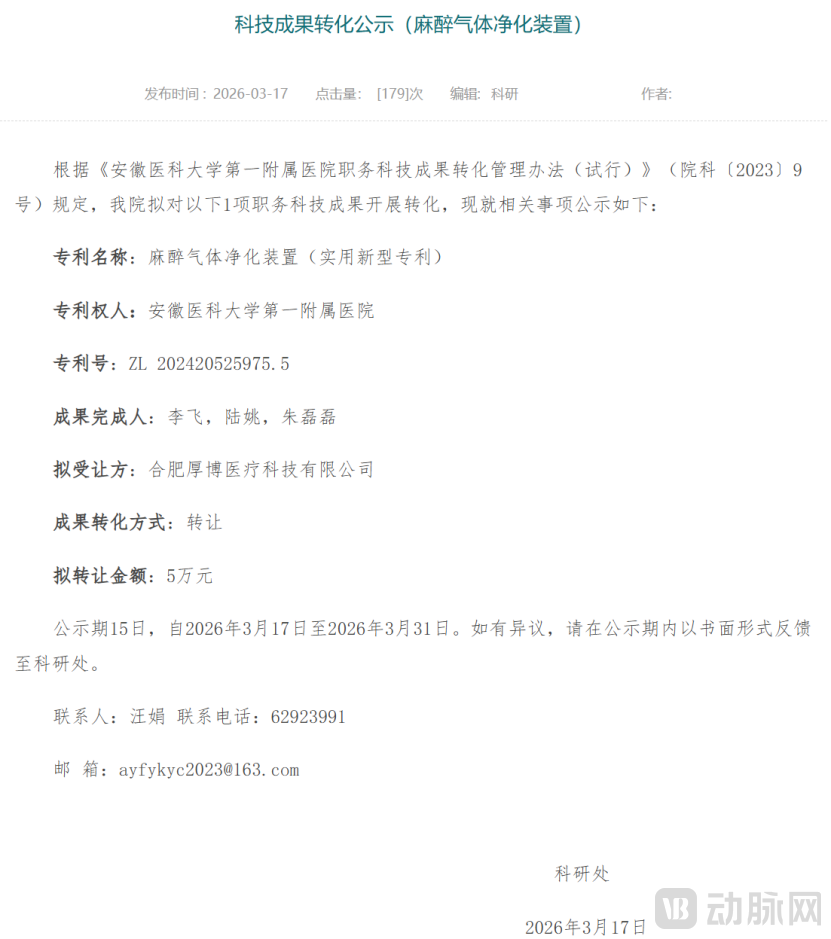
Image from the official website of The First Affiliated Hospital of Anhui Medical University