

Chuzhou University Transfers Patented Technology for High-Value Essential Oil Derived from Local Chrysanthemum Stems and Leaves
Recently, Chuzhou University released a public notice on the transformation of scientific and technological achievements, proposing to transfer its patented invention technology“Essential Oil from Chuzhou Chrysanthemum Stems and Leaves and Its Application”Conducting a transfer transaction, with Chuzhou University as the transferor and Xi'an Huaqi Zhongxin Technology Development Co., Ltd. as the transferee, at an agreed price between both parties.RMB 12,000, the inventor of this patent isYu Shijun and His Team。
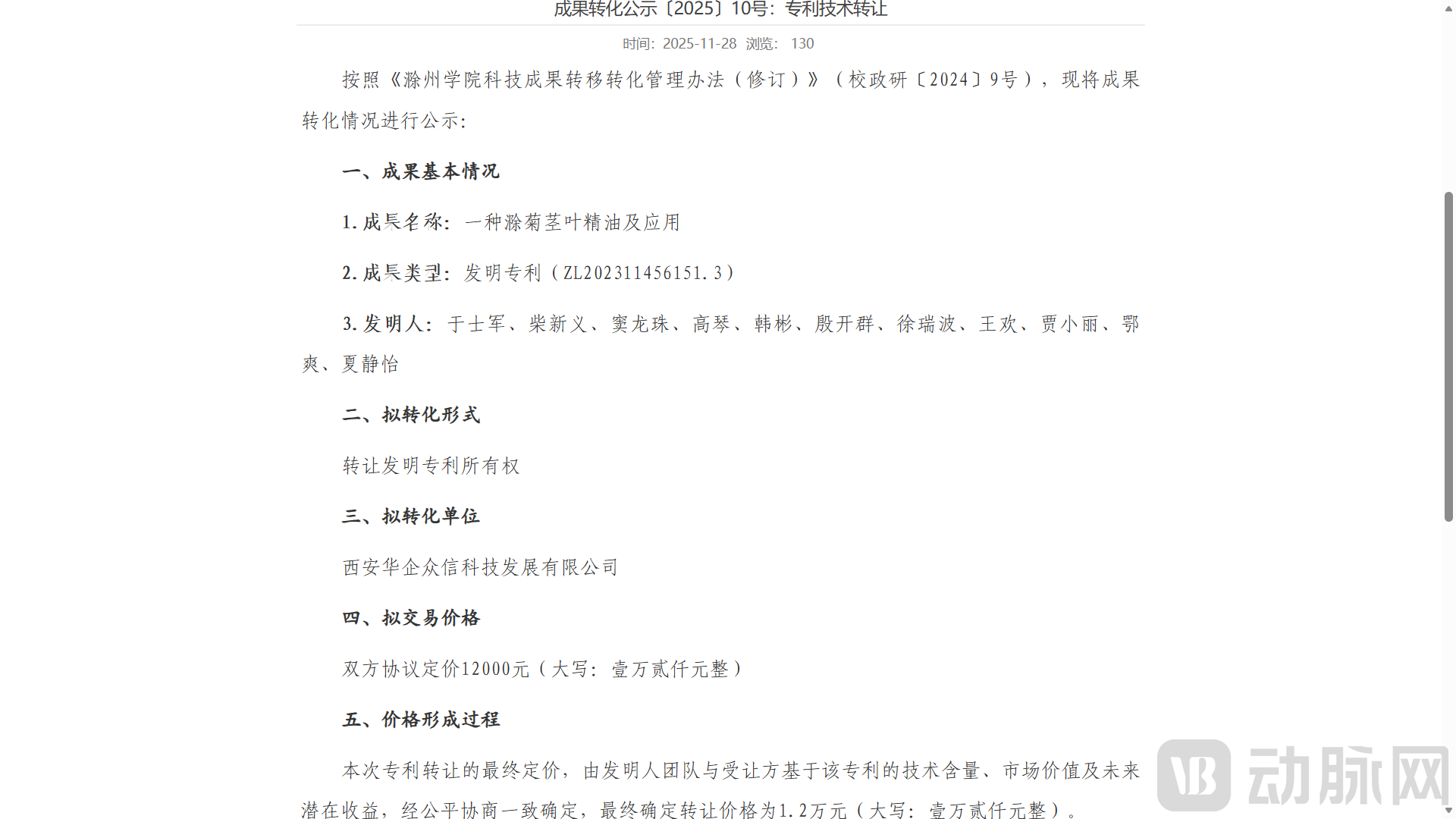
Image from the official website of Chuzhou University
This patent is based onWaste stems and leaves of Chuzhou Chrysanthemum, a local specialty geographic indication product from ChuzhouUsing Chuzhou chrysanthemum as the raw material, high-activity essential oil was prepared by optimizing the steam distillation process. This approach breaks through the traditional industrial limitation of utilizing only Chuzhou chrysanthemum flowers, clarifies the core chemical constituents of the essential oil and its antibacterial and antioxidant efficacy, and for the first time confirms its potent inhibitory effects against fruit and vegetable pathogens such as Fusarium sulawesiense and Aspergillus niger. This achievement realizes the high-value utilization of agricultural by-products and provides innovative technical support for extending the entire Chuzhou chrysanthemum industry chain and developing natural antibacterial and antioxidant products.
Chuzhou Chrysanthemum ranks first among China’s Four Famous Chrysanthemums. It is a product protected under the National Geographical Indication system and serves as a classic medicinal substance in traditional Chinese medicine (TCM) that is both food and drug, holding a significant position within the TCM framework. Both ancient texts and modern clinical practice affirm its core medicinal value: In TCM theory, Chuzhou Chrysanthemum is believed to dispel wind, clear heat, improve vision, and detoxify, and is primarily indicated for conditions such as headache and dizziness, red and swollen eyes, irritability and chest heat, and furuncles and toxic swellings.
Modern medical research has confirmed that Chuzhou chrysanthemum is rich in active compounds such as volatile oils, organic acids, polyphenols, flavonoids, and polysaccharides. It exhibits pharmacological effects including anti-inflammatory and antibacterial activities, antioxidant properties, and immunomodulation, thereby addressing intervention needs for a range of health and application issues, such as skin inflammation, pathogenic microbial infections, oxidative stress-induced damage to the body, and spoilage of fruits and vegetables.
In current clinical and industrial application scenarios, mainstream approaches for addressing issues related to infection, inflammation, and oxidative damage still rely onChemically Synthesized PreparationsPrimarily: In the field of antibacterial and anti-inflammatory therapy, clinically used antibiotics and synthetic antimicrobial agents are employed to control bacterial and fungal infections. Although they act rapidly, they easily induce the emergence of drug-resistant strains, and long-term use may disrupt the skin barrier and the body’s microbial homeostasis, leading to adverse reactions such as irritation and allergies.
In the Field of Fruit and Vegetable Preservation, widespread reliance on chemical preservatives to inhibit spoilage fungi such as Fusarium sulawesiense and Aspergillus niger, while extending shelf life, poses risks of chemical residues and fails to align with the trends toward green food and healthy consumption;In the Field of Antioxidants and Skincare, most commercially available products are formulated with artificial antioxidants and synthetic active ingredients, raising concerns about their long-term safety and failing to meet consumer demand for natural, gentle, and low-irritancy products.
At the same time,The Chuzhou chrysanthemum industry itself suffers from structural application deficiencies:Existing research and product development have been heavily concentrated on the flowers of Chuzhou chrysanthemum, while the stems and leaves from the same plant—which exhibit greater biomass and whose comprehensive utilization value has long been underestimated—lack systematic study and industrial-scale development.
Studies have confirmed that the total phenol and total flavonoid contents in the stems and leaves of Chuzhou chrysanthemum are significantly higher than those in the flowers, and they possess a richer aromatic profile, making them high-quality raw materials for extracting natural essential oils. However, they have long been discarded as agricultural by-products, resulting in substantial resource waste and loss of economic value.
More critically, the current market lacksStandardized Preparation Technology for Functional Ingredients Derived from Chuzhou Chrysanthemum Stems and Leaves, Featuring Potent Antibacterial Activity, High Antioxidant Capacity, and Natural Safety, making it impossible to provide stable, efficient, and low-cost natural raw materials for sectors such as antimicrobial drugs, cosmetics, skincare products, and fruit and vegetable preservatives, thereby failing to meet the multifaceted demands of clinical practice for gentle and safe anti-inflammatory and antimicrobial solutions, the food industry for green preservation technologies, and the beauty industry for natural skincare ingredients.
In this context, the development of Chuzhou chrysanthemum stems and leaves that can achieveResource Utilization and High-Value Valorization, and possess clearAntibacterial, Antioxidant, and Anti-inflammatory Effectsinnovative technologies have become an urgent necessity for perfecting the Chuzhou chrysanthemum industry chain and filling the gap in the market for natural functional ingredients.
This patent revolves aroundEssential Oil from the Stems and Leaves of Chuzhou Chrysanthemum and Its ApplicationsUndertake systematic innovation to overcome multiple technical bottlenecks in the traditional development of Chuzhou chrysanthemum and the preparation of plant essential oils, thereby establishing a comprehensive technological system that integrates raw material innovation, process innovation, efficacy innovation, and application innovation.
In terms of raw material innovation, essential oil was extracted for the first time using the stems and leaves of Chuzhou chrysanthemum as the core ingredient., transforming waste into valuable resources by fully utilizing by-products with greater biomass and significantly higher total phenol and total flavonoid content than the floral parts, thereby addressing long-standing industry pain points such as low utilization efficiency of Chuzhou chrysanthemum resources, short industrial chains, and low added value, and achieving efficient whole-plant utilization of this geographical indication product.
In terms of process innovation, an optimized steam distillation process is adopted., with a material-to-liquid ratio of 1:4–1:6 and a distillation extraction time of 1.5–2.5 hours as core parameters, complemented by standardized steps such as crushing, layering, and dehydration using anhydrous sodium sulfate. The process is mild, easy to operate, and highly adaptable to general-purpose equipment, maximizing the retention of active essential oil components while ensuring stable yield and purity, making it suitable for large-scale production.
In Terms of Ingredient and Efficacy Innovation, 86 chemical constituents were precisely identified by GC-MS, with six core active components—including β-selinene, 2-thujone, and camphor—accounting for over 58% of the total composition. For the first time, it was demonstrated that this essential oil exhibited an inhibition rate of 88.98% against Fusarium sulawesii and 65.25% against Aspergillus niger at a concentration of 100 μg/mL. It also showed significant inhibitory effects against Escherichia coli and Staphylococcus aureus, along with potent scavenging activity against hydroxyl radicals, DPPH radicals, and ABTS radicals. The antimicrobial and antioxidant activities displayed a favorable dose–response relationship, indicating well-defined efficacy and stable performance.
In terms of application innovation, break through the traditional single-scenario limitations of Chuzhou chrysanthemum tea and medicinal use., expanding essential oils into multiple fields such as fruit and vegetable preservatives, cosmetics and skincare products, detergents, and antibacterial pharmaceuticals, thereby providing novel raw material solutions for natural antimicrobial action, green preservation, and gentle skincare. This effectively extends the Chuzhou Chrysanthemum industry chain, diversifies product offerings, and enhances industrial value, offering ecological benefits, economic returns, and promising application prospects.
The natural plant essential oil market is currently experiencing rapid growth, with the global and domestic market sizes continuing to expand. Consumer demand is rapidly extending from traditional aromatherapy to functional applications such as skincare and cosmetics, antibacterial and anti-inflammatory treatments, food preservation, and health care. Mainstream products on the market are primarily lavender, tea tree, chamomile, and chrysanthemum essential oils. These products generally suffer from issues such as reliance on petal-based raw materials, high costs, unclear antibacterial and antioxidant data, and limited application scenarios. Meanwhile, there is a significant shortage of specialty Asteraceae essential oils that offer strong bacteriostatic properties, high antioxidant capacity, suitability for fruit and vegetable preservation, and stable, low-cost sourcing. With the widespread adoption of green consumption and safety concepts, the market's...Additive-Free, Medicinal and Edible Homologous, Traceable Origin Functional Natural Essential OilsRising demand continues to create ample opportunities for new products with proven efficacy and differentiated ingredient advantages.
Microwave Solvent-Free Extraction Using Endogenous Water in the Material as the Medium, enabling efficient extraction without organic solvents by leveraging microwave technology. It is currently mainly applied in the fields of essential oils from aromatic plants, active ingredients of traditional Chinese medicine (TCM), and natural functional factors in food. It is particularly suitable for the preparation of heat-sensitive volatile oils and high-value-added natural products. This technology can be used for Asteraceae and aromatic plants such as chrysanthemum, mint, and agastache, and also widely supports the green production of raw materials for fruit and vegetable preservation, cosmetics and skincare, and antibacterial natural extracts. Meanwhile, it facilitates the resource utilization of agricultural by-products, ensuring an environmentally friendly process with no solvent residues throughout.
This technology has now transitioned from laboratory research to industrial-scale commercialization, rapidly penetrating industries such as traditional Chinese medicine (TCM) extraction, high-end essential oils, and natural health products. It has become a mainstream green process replacing traditional water distillation and solvent extraction. Currently, its applications in the pharmaceutical, daily chemical, and food processing sectors are becoming increasingly mature, with continuous improvements in equipment intelligence and scalability. Driven by both policy support and market demand, its market penetration rate is steadily increasing due to advantages such as high efficiency, low energy consumption, safety, and environmental friendliness, making it a key direction for the green extraction of natural products.
Supercritical CO₂ extraction uses CO₂ as the extraction medium, enabling high-efficiency separation under near-critical conditions, with no residual organic solvents throughout the process and mild operating temperatures. It is widely used in the preparation of plant essential oils, heat-sensitive active ingredients, natural flavors, and medicinal extracts, particularly suitable for extracting aromatic raw materials such as chrysanthemum, rose, and mint, as well as bioactive components from traditional Chinese medicine. With mature applications in the food, cosmetics, and pharmaceutical industries, it maximizes the retention of aroma and active structures.
This technology has currently entered the stage of large-scale industrial application, becoming a mainstream process in fields such as high-end essential oils, natural health supplements, and traditional Chinese medicine extraction. With its market penetration rate continuously rising, it is rapidly replacing traditional solvent-based methods under the dual drive of policy and market forces, leveraging advantages such as environmental friendliness, safety, high purity, and high selectivity. It represents a key technological pathway for the high-value extraction of natural products.
This patent utilizes the essential oil from the stems and leaves of Chuzhou chrysanthemum, an agricultural waste by-product, as raw material, achieving waste-to-wealth conversion and high-value utilization of the entire plant of this geographical indication product, while also possessingBroad-Spectrum Antibacterial, Highly Effective Antioxidant, Natural and SafeTriple Core Advantages, Ready for Direct EntryFresh produce preservation, cosmetics and skincare products, antibacterial pharmaceuticalsThree High-Growth Sectors, Precisely Filling Market Gaps. Leveraging the mature cultivation base and stable supply of Chuzhou Chrysanthemum, raw material costs are controllable, and there is significant room for value chain extension. Compared with similar essential oils, it possesses distinct advantages in resources, efficacy, cost, and differentiated competitiveness. As the trend toward replacing synthetic formulations with natural functional ingredients accelerates, this technology can be rapidly translated into a series of products. This not only enhances the added value of the Chuzhou Chrysanthemum industry but also meets diverse market demands, demonstrating strong commercialization potential and broad market prospects.