

Zhejiang University Team Develops Novel Endoscope Drying Station to Eliminate Aerosol Infection Risks, Licenses Patent for RMB 100,000
Recently, Zhejiang University has proposed to“A Drying Station for Flexible Endoscopes”Utility Model Patents Are Priced by AgreementRMB 100,000RMB for the commercialization of patent achievements. This patent is byQian Lei, Chen Zhuyi, Han XiaoJointly developed; this patent belongs toKey Practical Technologies in the Medical Device Field。
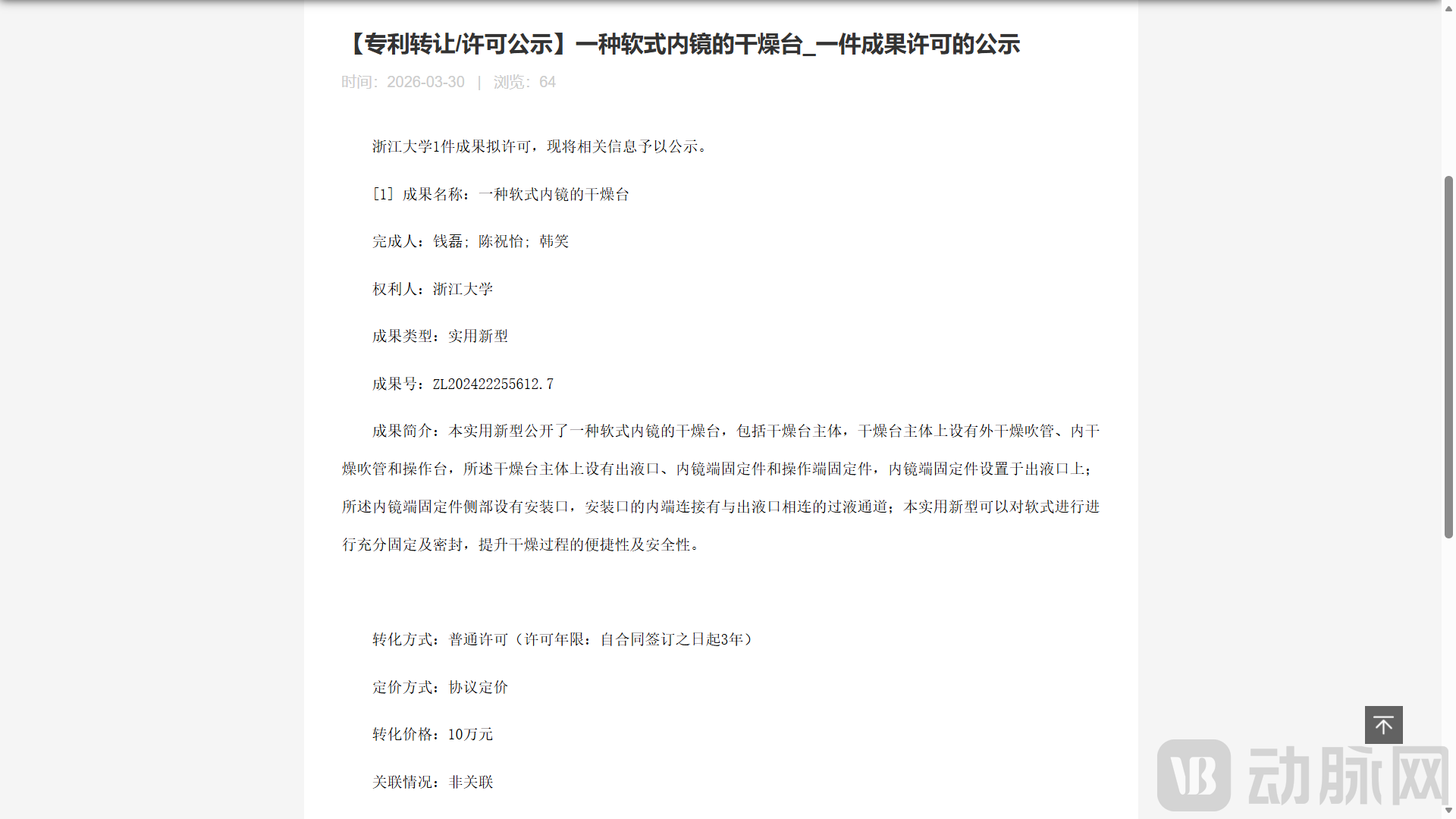
Image from the official website of Zhejiang University
Its core technological innovation lies inAddressing the Pain Points of Traditional Flexible Endoscope Drying Devices: Instability, Inadequate Sealing, and Aerosol Generation, through the elastic clamping and sealing structure at the distal end of the endoscope, the integrated positioning and limiting mechanism at the operating end, the L-shaped arc-transition fluid channel, and the sealed fluid outlet system, it achieves secure fixation, efficient drainage, and full-process sealing during the drying of flexible endoscopes. This design structurally eliminates the risks of endoscope oscillation, splashing of residual fluids, and dissemination of pathogenic aerosols during drying, significantly enhancing the operational convenience of the cleaning and drying process for flexible endoscopes and the safety of nosocomial infection control.
Flexible EndoscopeIt is a core invasive diagnostic and therapeutic device used clinically for the clear visualization of lesions in the gastrointestinal tract, respiratory tract, and other areas, as well as for definitive disease diagnosis. It mainly includesFiber-Optic Flexible Endoscopes and Electronic Flexible EndoscopesTwo categories,Among them, flexible fiberoptic endoscopes are widely used due to their cost advantage.。
Such devices, which come into prolonged direct contact with patients’ mucous membranes and body fluids during examination and treatment procedures, are classified as high-risk from an infection prevention and control perspective. After use, they must undergo thorough internal and external cleaning and adequate drying. If residual fluids inside the devices are not promptly removed and dried, bacteria can readily proliferate and biofilms may form, thereby leading to nosocomial cross-infections and posing serious threats to patient safety and healthcare workers’ health.
Currently, clinical practice commonly employs traditional drying stations equipped with air jets for endoscope drying. This method involves connecting a drying tube to the air inlet connector at the operating end, relying on internal airflow to dry the lumen of the outer flexible hose. However, this conventional approach has significant drawbacks:
On the one hand,The device fails to provide stable fixation and effective sealing for flexible endoscopes., during the airflow purging process, the outer hose is prone to uncontrolled, violent oscillation, which not only reduces operational convenience but also easily causes damage to the tubing;
On the other hand,Residual Fluid Inside Endoscopes Mixed with High-Speed Airflow Can Easily Form Aerosols Carrying Pathogenic Bacteria, directly dispersing into the surrounding environment and posing a clear risk of healthcare-associated infection;
Meanwhile,Conventional drying stations lack dedicated flow-guiding and sealed drainage structures., waste liquid lacks a directed discharge path, making it prone to stagnation and splashing, thereby further exacerbating environmental and equipment contamination.
In the face of increasingly stringent standards for hospital-acquired infection prevention and control, as well as the demands for clinical safety operations, healthcare institutions urgently needA specialized drying device capable of securely clamping flexible endoscopes, providing full-process sealing, directional flow guidance, and preventing aerosol dispersion., addressing the shortcomings of existing technologies at their structural root to ensure the safety, standardization, and efficiency of the entire endoscope cleaning and drying process.
A drying station for flexible endoscopes provided by this patent,Guided by the Clinical Needs for Hospital Infection Prevention and Control, achieving systematic innovation in structural design, functional implementation, and safety assurance, thereby effectively filling the technological gap in existing flexible endoscope drying equipment. Compared with traditional drying devices, the innovations of this technology are primarily reflected in four key dimensions:
First, to construct an integrated structure for endoscopic elastic clamping and compression sealing., through the synergistic action of a threaded mounting component, an annular elastic clip, and a frustoconical compression chamber, to achieve adaptive clamping and hermetic sealing at the distal end of the flexible endoscope, thereby mechanically eliminating pipeline oscillation, displacement, and air leakage during airflow purging;
Second, Design a Multi-Dimensional Positioning and Limiting Mechanism for the Operating End, leveraging upper and lower grooves, stoppers, slotted notches, and the air supply connector’s limit slot to form a composite positioning cavity, achieving omnidirectional constraint of the operating end and significantly enhancing installation stability and operational convenience;
Third, an L-shaped arc-transition fluid channel and a sealed fluid outlet system are employed., enabling residual fluids within the endoscope to be directed and discharged along smooth curved surfaces, thereby preventing fluid accumulation, backflow, and splashing, and reducing equipment contamination and cleaning difficulty;
Fourth, integrated enclosure protection and air pressure monitoring functions, blocking aerosol diffusion through a sealed enclosure and enabling real-time monitoring of airway pressure via a pressure-measuring hose, thereby further enhancing the controllability and safety of the drying process.
In summary, this technology comprehensively enhances the stability and safety of endoscope drying, aligns with the trend of upgrading hospital infection prevention and control, boasts broad market demand and prominent industrialization value, and holds significant application importance for standardizing post-procedure endoscope reprocessing workflows.
Endoscope drying and storage devices have become standard equipment in the endoscopic diagnosis and treatment workflows of healthcare institutions. They are widely used in endoscopy centers, outpatient surgical units, and specialized sterile supply departments across hospitals at all levels, covering multiple clinical specialties such as gastroenterology, pulmonology, and emergency medicine. With the growing adoption of minimally invasive endoscopic procedures and continuously improving standards for healthcare-associated infection prevention and control, the industry is gradually forming a landscape centered onCentralized Drying and Storage, Rapid Purge DryingIn the market landscape dominated by this primary application model, device functionalities are trending toward air purification, standardized storage, process standardization, and safety controllability. The overall market is in a phase of stable adoption with continuously expanding demand.
Olympus ScopeLocker Air is an integrated drying and storage cabinet designed for the reprocessing and storage of flexible endoscopes., launched by Olympus and manufactured by Capsa Healthcare, is positioned as standardized infection control equipment for the endoscope reprocessing workflow. It is primarily used for channel purging, internal cavity drying, and hygienic storage of endoscopes after cleaning and disinfection. The device supports continuous circulation of HEPA-filtered airflow, enabling simultaneous air drying of both the internal channels and external surfaces of endoscopes. Equipped with autoclavable connectors, a quick-connect air circuit module, and a rotating endoscope stand, it facilitates parallel processing of multiple endoscopes while protecting the distal tips. The system is adaptable to the spatial and installation requirements of healthcare institutions of varying scales.
In terms of market application, ScopeLocker Air, as a mainstream cabinet-type product in the international field of endoscopic infection control, is primarily targeted at endoscopy centers in tertiary hospitals, gastroenterology departments, outpatient surgery centers, and large-scale endoscope disinfection institutions. It is mainly used for centralized drying and long-term sterile storage of batches of endoscopes. Leveraging its brand influence and compliance advantages, it is widely adopted in endoscope reprocessing rooms and standardized endoscopy centers within high-end medical institutions, representing a typical solution for in-hospital batch endoscope drying and storage.
Steris RELIANCE 6500 is an integrated drying and storage system designed for the flexible endoscope reprocessing workflow., representing a mainstream international centralized solution for endoscope drying and storage. The equipment utilizes continuous HEPA-filtered air circulation to simultaneously dry the internal channels and external surfaces of endoscopes. It supports vertical, independent hanging storage, and the cabinet is equipped with retractable panels to facilitate endoscope retrieval and placement as well as standardized management. The overall design complies with international standards for endoscope infection control, such as ANSI/AAMI ST91, providing a stable and clean environment for the drying and storage of endoscopes after cleaning and disinfection.
In terms of market applications, the RELIANCE 6500, as a standardized endoscope drying and storage product under Steris, is primarily targeted at endoscopy centers in large and medium-sized medical institutions, gastrointestinal endoscopy departments, outpatient surgery centers, and professional endoscope disinfection facilities. It is widely used for the centralized drying and clean storage of batch endoscopes. Leveraging its brand compliance advantages and mature system solutions, it has been extensively applied in the standardized reprocessing workflows of endoscopes in high-end medical institutions both domestically and internationally, making it one of the representative products in the field of centralized endoscope drying and storage.
The soft endoscope drying console provided by the patent transferred by Zhejiang University precisely meets the clinical requirements for the endoscope drying process.Reliable fixation, tight sealing, easy operation, and controllable hospital-acquired infection riskThe core requirements and technical design philosophy are highly consistent with the current industry trend toward miniaturization, specialization, enhanced safety, and integrated workflows in post-endoscopic processing equipment.
This technology features a compact design and strong practicality. It not only meets the daily operational needs for rapid bedside drying and efficient single-unit processing in endoscopy centers, but also adapts to the usage conditions of various settings, including primary healthcare institutions, outpatient operating rooms, and third-party sterilization centers. It can be industrialized as a standalone specialized device or integrated with existing endoscope reprocessing systems, thereby further enriching comprehensive solutions for the entire endoscope reprocessing workflow.
With its outstanding clinical adaptability, clear engineering pathway, and high level of safety protection, this technology demonstrates strong feasibility for industrialization and significant market potential. It is poised to develop differentiated and specialized application solutions in the niche field of endoscope drying, thereby providing robust support for enhancing infection prevention and control management as well as operational efficiency in healthcare institutions.